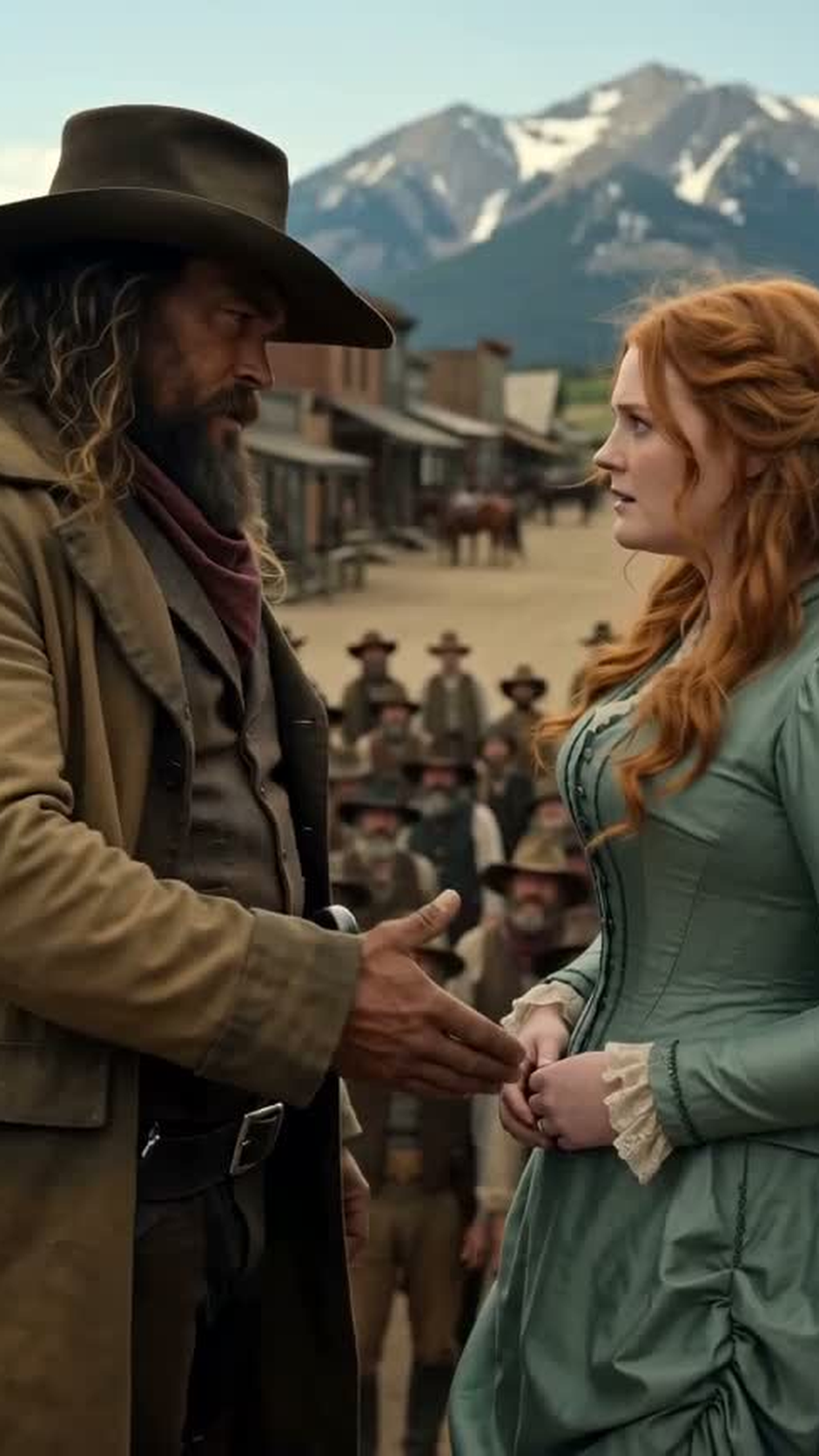
Jessup's pencil did what Dominic's rifle could not have done: it ended the fight before the fight arrived.
He had been a coward all his life and a hired gun for two years, and the combination had finally produced in him the one useful act of his existence — because lying bound in a barn with a hole in his leg, listening to a woman read Dickens aloud through a wall to the man he'd been paid to frighten, Jessup had undergone something like a conversion. Or perhaps it was simpler. Perhaps it was the broth. Natalie fed him the same broth she fed Dominic, and changed his dressing with the same hands, and a man who has been fed and tended by the person he came to steal is a man whose errand gets harder to remember by the hour.
When Dominic could sit up — gaunt, gray-whiskered, furious at his own weakness in a way that made Natalie hide smiles in her sleeve — Jessup asked for paper, and wrote it all: the payment, the plan, the clerk Deeds and his forty dollars, the annulment drawn before the crime it was meant to bless. He signed it with a hand that shook. Then Harlan Pruitt rode into the mouth of the defile at the head of four men and a sheaf of courthouse paper, and rode straight into the one reception in Idaho Territory he had not rehearsed: Dominic Brennan standing — standing — on his own cabin porch with a rifle cradled loose in the crook of his healing arm, Natalie beside him tall as a flagpole in her green dress, and the Territory's own marshal, summoned by the fastest ride of Natalie's life down the north gully at dawn, drinking coffee on the porch rail behind them with Jessup's statement in his coat pocket.
It was, in the end, an anticlimax of the most satisfying kind. Pruitt's paper was read. Jessup, limping out of the barn on a crutch Dominic had carved him, was read louder. Deeds the clerk confessed before he was even asked, in the manner of small men everywhere, and Harlan Pruitt — who had wanted, in the end, nothing more exotic than to unmake the afternoon the whole territory laughed at him — was arrested for conspiracy and attempted robbery on the porch of the cabin he had tried to steal, while the woman he had priced at thirty dollars poured the marshal a second cup of coffee and did not say a word she would have had to be ashamed of later.
"You're a hard woman, Miss Zimmerman," the marshal said, mounting up.
"No, Marshal," Natalie said. "I'm a married one, come Thursday. Or near enough that you may congratulate me early."
Thursday week, Dominic could ride. He rode slowly, and she rode beside him with her hand never far from his arm for two days down the mountain, and if any man wishes to know what courtship looks like when it is conducted by two people who have already nursed and defended and chosen each other, he may picture that ride: the long silences, easier now than any speech; the short ones, full of everything.
Willow Ford had turned out. Word travels down a mountain faster than a horse does, and the town that had mocked Natalie Zimmerman eleven days before now lined its main street in the particular silence of people who have read Jessup's statement in the newspaper at Fort Hall and come to witness the rest of the story. The circuit preacher — a gaunt Scotsman named McAllister who had married half the territory and buried the other half — performed the ceremony on the only stage the town had to offer.
They were married on the platform.
It had been Natalie's idea, stated once, at breakfast, in a tone that ended discussion: "I was sold on that platform, Dominic, in front of the whole town, and nobody in Willow Ford is going to remember it as the end of the story if I can help it." So the bunting came out again, and the podium was pushed aside for a preacher's Bible, and Natalie Zimmerman — who wore the sage-green dress, remade by her own hands with fresh lace, because she declined on principle to be married in anything she had not already been defiant in — climbed the wooden steps on the arm of a man who had to duck his head under the bunting, and stood up straight in the September sunlight in the exact place where she had been humiliated, and was married there, with the whole town watching, to the mountain.
Tobias Crane attended. Tobias Crane wept, a little, into a large handkerchief, and afterward pressed her hand and said the Society was proud — proud — and Natalie, who understood ledgers in all their forms, let him have his sentence and kept her own counsel. Liddy sent a letter from the merchant's house, all exclamation points. Rose sent another from a mining camp, enclosing a newspaper clipping and the words: I TOLD YOU TO MARRY RICH.
"Well," said Dominic that evening, as they rode out of Willow Ford in the long light with the marriage lines folded in his coat over his healing wound, "that's the town told."
"That's the town told," she agreed.
The autumn that followed was, she would say for the rest of her life, the season she had been built for. The valley took her the way good ground takes seed. She learned the place entire — the creek and its colors, which he now panned openly in her company, teaching her hands the swirl of it, a wedding gift of trust worth more than the gold itself; the garden's last harvest; the cattle brought down to the winter meadows; the roof re-shingled before the first snow, the two of them up the ladder together, the giant man and the giant woman, hammering side by side in the thin bright air while the valley rang like her father's forge. She set his house in order with the ferocious competence of a woman who has kept books for merchants: preserves rowed by date, stores inventoried, the lean-to he'd exiled himself to converted to a proper second room with a window she'd insisted on, because a person should be able to see weather coming.
He, in his turn, built her a chair. It took him a month of evenings and he never mentioned it until it stood by the fire — a chair built to her measure, at last, in a world that had never once built her a chair: tall-backed, broad-seated, strong enough for a plow horse, with her initials cut small into the top rail. She sat down in it the first night and cried, briefly and furiously, at being measured kindly by furniture, and Dominic pretended not to notice in the manner of a man who has finally understood that this, too, is a form of attention.
In October she wrote to Karl. It took her four evenings and most of a candle, because there is a kind of letter that has to be built the way her father built a gate — every board true, or the whole thing hangs wrong. She told him about the platform, all of it; about the hand in the dust; about the valley and the graves and the chair. She did not write a single word of reproach, because she had at last understood that the crowded house in Missouri was not Karl's failure but simply the size of the world she'd been born into, and a person cannot be blamed for the dimensions of a house. Karl's answer came down with the last supply rider before the snow, three pages in his schoolboy hand, the last of which she read twice and kept in her sewing basket for the rest of her life: I have put your name back over the forge door, Nat. It was always yours. Clara reads your letters aloud on Sundays. There is room, she says to tell you, whenever you want it — and Natalie had laughed and cried at once, at her table for four, in the valley at the end of the world, at the discovery that the room had been made by her leaving.
They were careful with each other in the ways that matter and careless in the ways that don't, and by the time the first snow came down the defile like a curtain being drawn, Natalie Brennan knew the truth of her life had inverted itself completely. She had been sold to the silence, and the silence had turned out to have a library, a sense of humor so dry it needed water, and a pair of hands that had built her a chair.
The snow closed the valley in November, as Dominic had promised it would, sealing the defile until spring. And it was in December, in the deep white quiet, with the stores laid in and the cattle breathing frost in the barn and the whole world narrowed to one lamplit cabin, that Natalie counted the days a second time, and a third, and then sat down in her chair by the fire with her hands folded over a body she had known all her life and did not know at all anymore.
"Dominic," she said.
He looked up from the harness he was mending, and eight years of mountain solitude had not dulled him to the tone a woman uses exactly once for exactly one sentence. He set the harness down with great care.
"You're certain," he said. It was not a question, but she answered it.
"As certain as a woman can be, at two months gone. Dominic—" She had rehearsed this. She had rehearsed all of it, through three nights of lying awake doing arithmetic no ledger would hold. "I am not Mary. I am strong as an ox — you've seen me work, you know it's true. Women bigger than the room have babies every day of the world. I will not have you look at me for seven months as if I were made of glass, do you hear me? I will not have this child begin its life in a house of dread."
"No," he said quietly. "You won't." And he crossed the room and knelt — actually knelt, the mountain going down on one knee on the cabin floorboards, which creaked in protest — and put his great scarred hands, with a gentleness that undid her entirely, on either side of her waist. "We'll do it right," he said. "Everything I didn't know then, I know now, and what I don't know I'll fetch. Come April, when you're at seven months, we go down — snow or no snow, I'll sledge you down myself over the pass — and you have the Widow Abernathy and the doctor at Fort Hall and a room in town with a stove. The child's to be born with help around it, Natalie. That's my whole plan and the whole of my asking. The rest—" His voice went rough at the edges. "The rest I leave to you and God, who've done the better work so far."
She put her hands over his, and her father's ring — she wore Heinrich's wedding band on a cord, too small for any finger she owned — knocked softly against his knuckle.
"April," she agreed. "We go down in April."
It was a good plan. It was a careful, loving, well-built plan, constructed by two capable people out of everything their lives had taught them.
And it might even have survived, if the winter of 1878 had been an ordinary winter, and if their daughter had been an ordinary child, and if the storm that came down out of the Sawtooths in the last week of March — three weeks before the child was due, with the defile still sealed white and the north gully running with meltwater ice — had not arrived in the same hour as the first pain that bent Natalie Zimmerman Brennan double over her own kitchen table, four weeks early, with her husband twelve miles of white wilderness away up the north ridge, checking the cattle fences before the blow came in.