The tissue held their mother's veil.
Giselle had carried it out of the cedar chest in the attic, where it had slept for a decade in the dark with the good christening gown and the family's whole vanished softness, and she stood on the porch at midnight and unfolded it with hands that shook, and held it up, and said to the doorway where her father now stood behind Melanie in his borrowed robe:
"I was going to wear a new one. Julian's mother picked it out. It's beautiful and it cost more than my first car and it isn't—" She swallowed. "It isn't hers. I want hers, Dad. And I want—" The sentence broke and she built it again from the pieces. "I asked Julian to walk me down the aisle because I was too much of a coward to have nobody. He said he'd only do it if I was too much of a coward to ask you. So I'm asking. Walk me down the aisle, Dad. Please. In front of absolutely everybody."
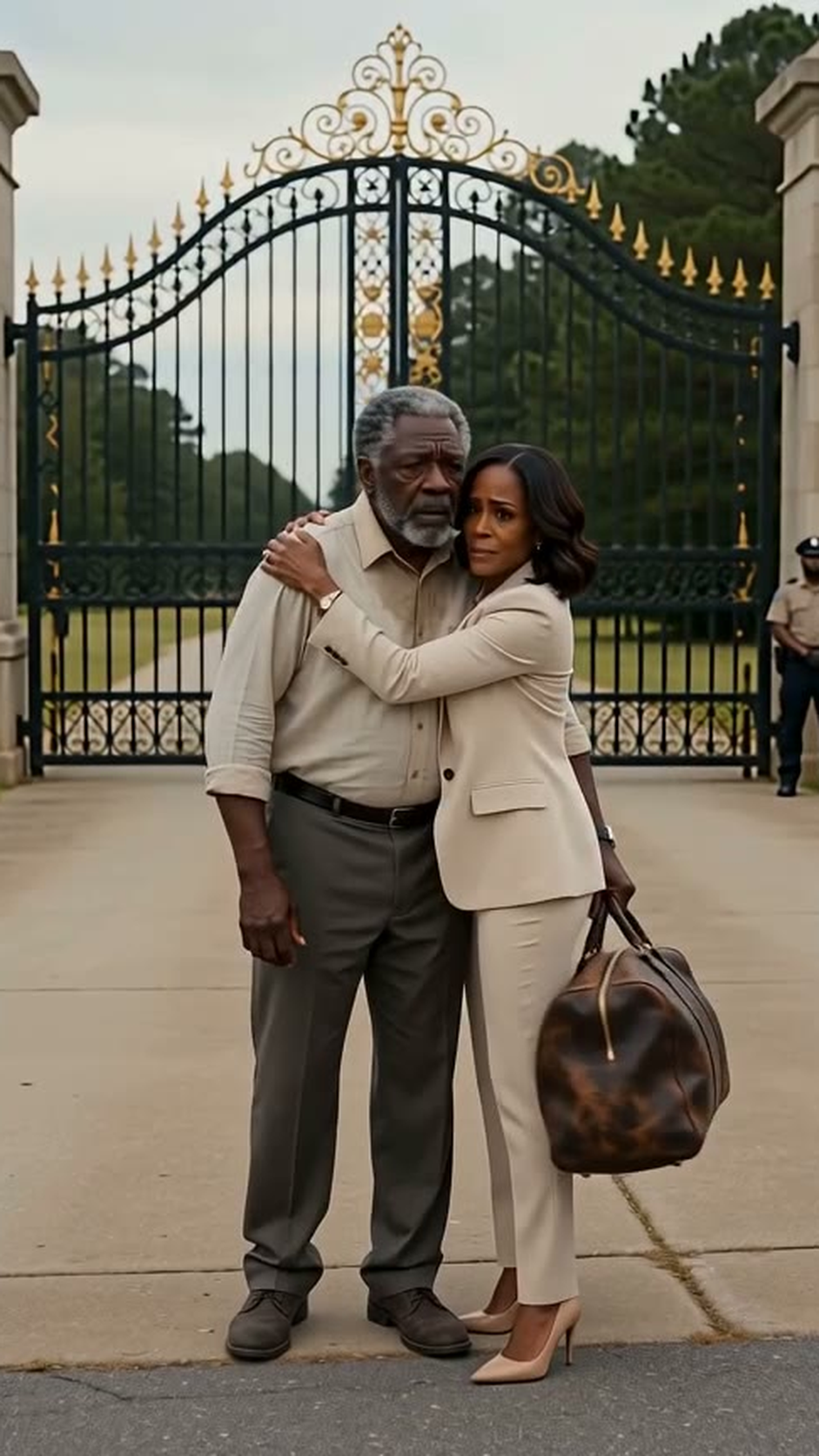
Gerald Crawford had held himself together through a prison gate, a bus station, and his own trial by family. He did not hold himself together through that.
"You didn't have to bring a bribe, baby," he said into her hair, holding his daughter on the front porch at midnight like the last nine years had been an illness the family was finally sweating out. "I'd have walked you through fire in these slippers."
—
On the morning of the wedding, Kenneth came to the guest room to tie his father's tie.
He did it without announcing himself — knocked once, came in with the charcoal tie in his hand and the air of a man reporting for a duty he'd volunteered for and rehearsed — and stood behind his father at the mirror and worked the knot with the clumsy care of someone whose hands were built for contracts. Gerald watched him in the glass. Neither of them spoke for most of it.
"I practiced what I'd say to you for five years," Kenneth said at last, to the knot. "In the car. In the shower. Whole speeches. Every one of them prosecuting." He tightened, adjusted, frowned at his own work. "I don't seem to have the other speech, Dad. I keep opening my mouth and there's just — arrears."
"Then we'll write it as we go, son," Gerald said. "We've got the material." And he caught Kenneth's wrist as it passed, briefly, the way you steady a man on a ladder, and let go before it could become a moment either of them had to survive.
Upstairs, Melanie was doing the bride's hair when she took the little cedar wren out of its tissue — four years in a dresser drawer, smelling faintly of scarves — and set it on Giselle's vanity among the brushes and the good jewelry.
"From your father," she said. "He carved it the year you turned thirty-four, in the prison workshop, out of a nail and four months of evenings. He said to give it to you when it could land soft." Giselle picked it up with two fingers, the way you handle something alive. "I think it's landed," Melanie said. "Don't you?"
Giselle carried it down the aisle inside her bouquet, hidden in the stems, where only she could feel its weight — a thumb-sized bird, flying at last exactly where it was always going.
The wedding of Giselle Margaret Crawford and Julian Harlan Pierce took place on Saturday, November thirtieth, in the garden of the Pierce estate, under a sky the color of a held breath that mercifully never broke.
Three hundred guests. Two families' worth of Jackson society, the whole gleaming machinery of reputation that had so terrified the bride — and at the top of the aisle, on the arm of a radiant woman in her dead mother's veil, walked a sixty-eight-year-old man in a charcoal suit Melanie had bought with him that Friday, slowly, because his knees were not what they had been, and not one person in three hundred rose to their feet for the bride.
They rose for both of them. It started with Harlan Pierce, of all men — the judge stood first, deliberately, like a ruling — and then the garden came up around them in a wave, and Gerald, who had expected to endure the walk like a dose of medicine, walked it instead through a wall of applause that Julian would later call the loudest sound he had ever heard outdoors.
Aaron sat in the second row, in a suit of Kenneth's that almost fit, between his brother and Melanie, and did not hide. If anyone asked, he was the youngest Crawford boy, back from up north. The whole truth had an appointment on Monday morning, and everybody in the family knew it, and it had lost most of its power to frighten them — because a secret told by its owner, on his own feet, in daylight, is just a story. It was the hiding that had always been the wound.
Kenneth made the toast.
He stood with his glass in his hand and looked at three hundred faces, and then, deliberately, at one. "My father built the company I run out of a pickup truck and a handshake," he said. "He taught me that a man's name is the only property he really owns. I spent five years believing he'd thrown his away." His voice held. It held because Melanie was looking at him, and because some things you simply finish. "He hadn't thrown it away. He'd spent it. There's a difference, and it took me far too long to learn to read it. To my father — who came home." He raised the glass. "Dad. Welcome home."
"Welcome home," said three hundred people, and the old man at the head table covered his face with one hand and laughed and cried at the same time, and did not apologize for either.
—
Aaron surrendered himself on Monday morning, with counsel, as arranged.
What the law did with him took eleven months, and it would make its own story — the confession, the restitution ledger that the prosecutor called, in open court, "the most complete act of contrition this office has ever been handed," the plea, the sentence that was not prison: five years of probation, two thousand hours of community service, and a judge — not Harlan, who had recused himself with a wave like a man swatting a fly — saying that the court could not give Gerald Crawford back his five years, but it could decline to waste five more of his son's on top of them.
The court's other work was quicker, because paper, unlike families, does not need to forgive before it can move. In October, on the strength of Aaron's confession and the documentary record, a judge of the circuit court vacated the conviction of Gerald Crawford in full, and the Jackson paper that had printed DISGRACE under his photograph in another decade printed CORRECTION under it now, in type nearly as large.
Nearly. Gerald cut it out anyway. He kept it in the leather bag, which Melanie had tried three times to retire and had finally understood was not luggage anymore.
He converted the shed himself.
It took him the whole following spring, weekends, with Aaron doing the heavy lifting under supervision and Kenneth appearing with lumber and opinions — the joke, which Gerald made exactly once and then retired, was that the roof was the best in the county and the landlord was lenient. It became a workshop: his father's tools, Margaret's garden bench restored along one wall, a kettle, a radio, a window cut where no window had been. People who came to the house that year learned that if you wanted Gerald Crawford, you went around the garden to the little building with light in its window and the smell of cedar coming out of it, and you knocked, and he was always — always — in the middle of making something for somebody.
In November, a year to the week from the release, Kenneth drove his father down to the Crawford Properties office park on a pretext so thin it embarrassed them both, and walked him past the front of the building, where the sign had been down for refinishing all month.
The letters had gone back up that morning, brass on black granite, in the same typeface Gerald had chosen in 1987: CRAWFORD PROPERTIES — and beneath, smaller, restored to the place it had occupied until the year of the disgrace, when a board Kenneth chaired had voted it off in an afternoon: FOUNDED BY GERALD CRAWFORD.
Gerald read it twice. He reached out and ran his thumb along the word FOUNDED the way a man checks a scar he has decided to keep.
"You put me back on the building, son."
"I took you off it," Kenneth said. "On the record. In the minutes. I un-took you the same way. It seemed important that it be the same way."
By the following June he had a commission he would let no one else touch: a crib, white oak, for Giselle's first child, due in September — the announcement of which, made at Easter with Giselle standing behind her father's chair with her hands on his shoulders, had reduced Gerald Crawford, in front of witnesses, to a man holding on to the back of a chair and saying Well now, well now, like a struck bell. He built it in the workshop on Thursdays, because Thursdays were the day everything in his life had turned, and on Thursdays Aaron worked beside him under the terms of a community-service schedule and a father's entirely unofficial supervision, learning to plane a rail true.
"She'll stand up in that," Gerald said, running his palm along the finished rail, testing it for splinters the way he'd tested every promise he'd ever made — by hand, in person, himself. "They all stand up in it. That's the whole job of the thing. You build it strong enough to be pulled on, and then you let them pull."
At Christmas, the family sat down to dinner in the room where it had all been decided, around the table where a letter had once slid under a slammed palm. Gerald sat at the head of it — nobody discussed it; the chair was simply his, the way a lighthouse is simply the lighthouse's — and carved, and argued about football, and told the oak-tree story twice. At dessert, Melanie stood — unplanned, glass in hand, a little unsteady in the way of a woman who has been carrying a sentence around for over a year waiting for a room worthy of it — and said: "To the ones who come back." She looked at Aaron. "And to the ones who go and get them." She looked at her father-in-law. "And to Margaret Crawford, who never missed a Saturday, and who I believe has been supervising this entire operation."
"To Margaret," said the whole table, and drank, and Aaron — who had been quiet most of the meal in the way of a man still learning the acoustics of belonging — said, to his plate, with great care: "The pantry's putting a bench in the hall garden in the spring. June's idea. It's got her name on it." He looked up, wrecked and smiling. "St. Mark's. If anybody wants to come and be bored at the dedication. It's mostly sandwiches."
"We'll bring the sandwiches," Giselle said instantly, and then everybody was talking at once about dates and potato salad, and it was, Melanie thought, the most ordinary and miraculous sound in the world: a family planning something.
On the wall, Margaret's portrait had company now: a photograph from the wedding, three hundred blurred faces and one clear one in the middle of the aisle, an old man walking his daughter home through a standing crowd.
Melanie, carrying in the last of the dishes, paused in the doorway where she had once stood with a dish towel in her hands and a rising fury, and looked at the whole noisy length of them — Kenneth laughing with his head back, Giselle glowing, Aaron reaching past his father for the rolls with the ease of a man who belongs to the room — and Gerald looked up and caught her eye over all of it.
He lifted his glass an inch, just for her. The first one who came. The only one who'd never had to be forgiven for staying away.
"Errands all done?" he asked.
"All done, Dad," Melanie said, and took her seat at the table.
THE END