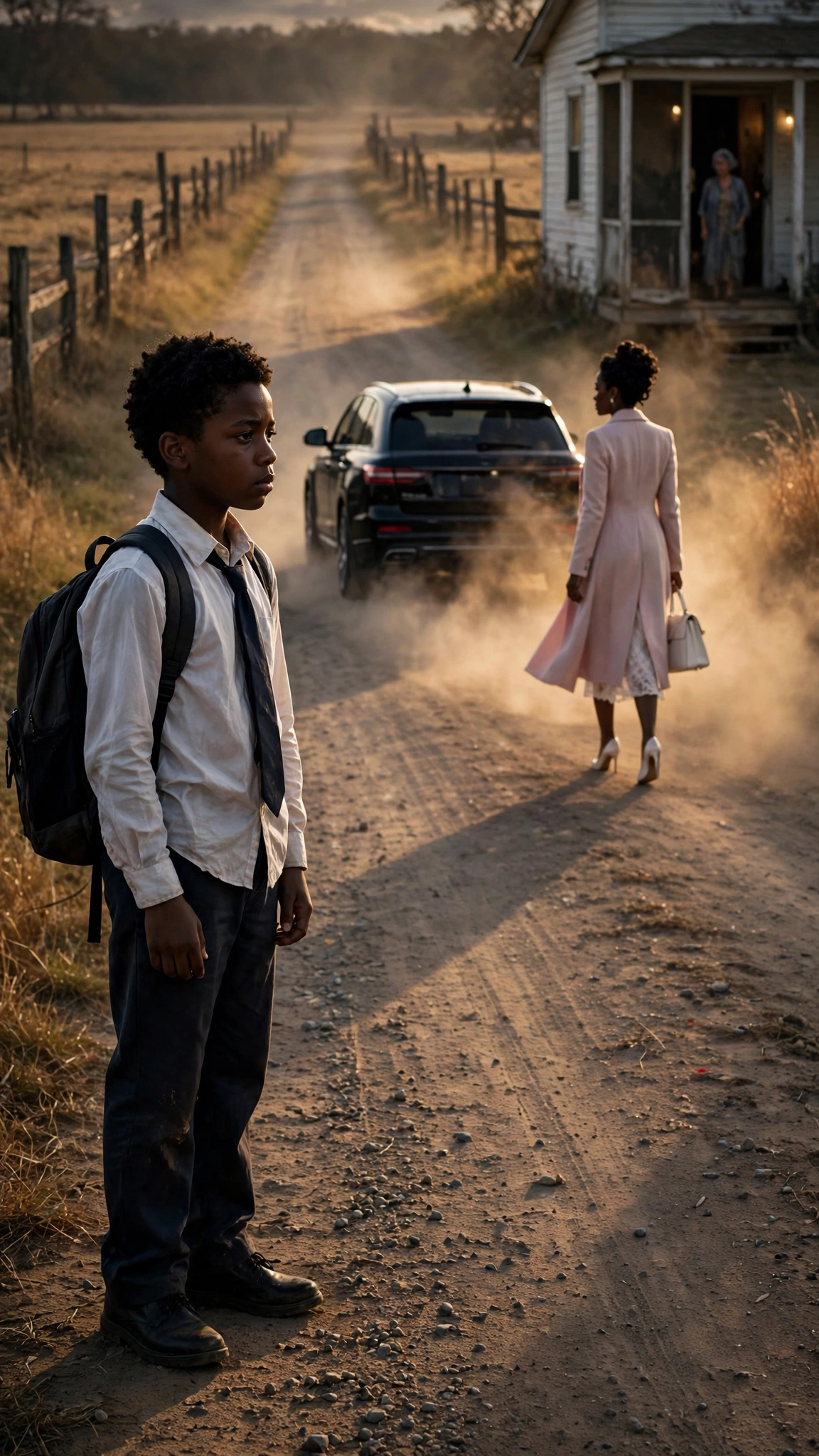
The first thing Matthew noticed was how quiet the road was.
It was a Georgia country road, the kind that ran straight between fields of dry yellow grass and wooden fences until it met the sky, and in the late afternoon the sun sat low and hard over the trees, throwing long shadows across the gravel. There was no traffic. There was no wind. There was only the black SUV, its engine running low and steady, and Veronica standing beside the open door in her pale-pink coat, looking at him the way she looked at a bill she did not want to pay.
Matthew was ten years old. He was wearing his funeral clothes — a white shirt that had gone wrinkled and damp under the arms during the long morning at the church, a dark navy tie his father had knotted for him once, years ago, and shown him how to knot again, navy trousers, black leather shoes that were already dusty from the gravel. His school backpack hung from one shoulder, the strap cutting into him because he had been holding it so tight. His lips trembled. He could feel them trembling and he could not make them stop.
Veronica's hair was piled high in a voluminous updo, black curls catching the sun. Her coat was long and tailored, pale pink, the color of the inside of a shell. Under it she wore a white dress. Her heels were white and pointed. Her handbag was white and structured and hung from her arm like a small, perfect box. She was beautiful in the way expensive things are beautiful, and she was looking at him without any sympathy at all.
"You're not coming home."
She said it the way she said everything — coldly, clearly, as if she were reading an instruction out loud and the instruction had nothing to do with her. Matthew's breath caught. For a second he did not understand the words at all. They were English words, words he knew, but they would not fit together in his head. Not coming home. Home was the house with the blue shutters. Home was the kitchen where his father made pancakes on Saturdays. Home was his room with the window that looked out over the backyard. Home was the only place he had.
"Please, Veronica."
His voice came out smaller than he meant it to. It shook. He took one frightened half-step toward the vehicle, his fingers tightening around the strap of his backpack, and he raised one hand toward her without touching her. He did not know what he was asking for. He only knew that if she left him here, on this empty road, there would be nobody. His father was gone. His mother had been gone for years. Veronica was the only adult left in the whole world who knew his name, and she was standing beside a car with the engine running.
She did not answer him. She did not even look at him. Her fingers were already on the door handle.
She pulled the door shut with force.
The slam was enormous. It was a heavy, metallic sound, the kind of sound that seemed to hit Matthew in the chest, and he flinched and lost his balance for half a step on the loose gravel, his shoes scraping and shifting unevenly beneath him. For a moment after the slam, everything went quiet — the engine, the wind, the birds, all of it seemed to stop — and then the window began to rise, slow and smooth, the tinted glass climbing up between his face and hers until there was nothing left of her but a pale shape behind dark glass.
"Wait!"
He said it louder this time, desperate, and he took two quick steps after the car as the tires turned sharply over the loose gravel and dust sprayed outward in a pale cloud. His backpack slid off one shoulder. He shielded his face with his arm. The SUV accelerated, and the dust rose around him, and the sound of the engine grew smaller and smaller until it was gone, and the road was empty again, and the only sound left in the whole world was his own breathing, loud and ragged in his ears.
He stood there for a long time. He did not know how long. The sun was still high and hard. The dust settled slowly back onto the gravel. His shoes were covered in it. His trousers were covered in it. His shirt stuck to his back with sweat. His eyes were wet, and he could feel the tears running down his face, but he did not cry out loud. He had learned, in the last year, how to cry quietly, because crying loudly in that house had never helped anyone.
And then, with trembling fingers, he reached into his trouser pocket.
The paper was still there.
It was a small, crumpled, folded piece of white paper, and he pulled it out carefully, the way you would pull a wounded bird out of a bush, and unfolded it with both hands. There was a telephone number written on it in his father's handwriting. The numbers were big and careful, the way his father wrote when his hands were shaking. There was nothing else on the paper. No name. No explanation. Just the number.
He stared at it, and for a moment the road and the dust and the empty sky all went away, and he heard his father's voice again — not loud, not close, but there, the way a voice stays in a room after the person has left it.
"He'll help you, son."
Matthew folded the paper again, slowly, and put it back in his pocket, and pressed his hand flat against it through the cloth of his trousers, as if he could hold the voice inside it.
That was how it began. Not on the road. Not with the door slam. It began that morning, in a church full of flowers, with his father lying in a box and everybody crying except the one person who should have been crying the most.
—
The morning had started before the sun was properly up.
Matthew had woken in his own bed, in his own room, and for the first few seconds he had forgotten. He had forgotten the hospital. He had forgotten the machines and the quiet way the nurses talked. He had forgotten the night his father had called him close and pressed something into his hand and told him to keep it safe. He had forgotten all of it, and then he remembered, all at once, and the remembering was like falling down a flight of stairs in the dark.
His father was dead. Alexander Carter was dead. He had died the day before, in the late afternoon, in a hospital bed with the blinds half drawn, and Matthew had been there, and he had held his father's hand, and his father's hand had gone cold in his, and that was the last thing. That was the whole of it.
Veronica had not come to his room that morning. Nobody had. He had dressed himself — the white shirt, the navy tie, the trousers, the shoes — and he had knotted the tie the way his father had shown him, standing in front of the bathroom mirror, his fingers clumsy, the knot coming out crooked twice before it finally held. He had put the folded paper in his trouser pocket. He had not known why. His father had only said to keep it safe, and to keep it secret, and to use it only if he had no one else. Matthew had not understood. He had only nodded, because his father was dying and nodding was the only thing he could do.
The church was full. Matthew had never seen so many people in one place who all knew his father's name. Men in dark suits stood in clusters near the door, talking in low voices. Women in dark dresses held tissues. The flowers were everywhere — white lilies, mostly, their smell thick and sweet in the warm air. Somebody had put a photograph of his father on a stand near the coffin, and Matthew could not look at it for more than a second at a time, because the man in the photograph was smiling, and the man in the coffin was not.
Veronica sat in the front row, in a black dress, her back straight, her face dry. She did not cry. Matthew watched her out of the corner of his eye through the whole service, waiting for her to cry, because that was what people did at funerals, and she never did. She sat still, her hands folded in her lap, her eyes on the coffin, and once, when the preacher said the words about ashes and dust, she glanced at her watch.
Matthew sat beside her. Nobody held his hand. The preacher talked about Alexander Carter — a good man, a hard worker, a man who had built something out of nothing, a man who loved his family. Matthew listened to every word, because he wanted to keep them. He wanted to remember exactly what was said about his father, so that later, when the house was quiet and everybody had gone home, he could say the words to himself and they would still be true.
After the service, people came up to him. They shook his hand. They patted his shoulder. They said they were sorry. They said his father had been a fine man. They said if he ever needed anything, he should call. Nobody asked him where he would live now. Nobody asked him what would happen to him. They all seemed to think that Veronica would take care of it, because Veronica was his stepmother, and stepmothers took care of children. That was what everybody believed.
But Matthew knew something they did not know. He had known it for a year, in the quiet way a child knows things without ever being told. He knew that Veronica did not love him. He knew that she had never once asked him about school, or about his friends, or about anything that mattered to him. He knew that she had married his father for the house and the money and the name, and that she had waited, patiently, for the day when the house and the money and the name would be hers alone. He knew all of this the way you know that the stove is hot — not because someone explained it to you, but because you touched it once and never forgot.
He had not told his father. He had wanted to, a hundred times, but his father had been sick, and then sicker, and there had never been a right moment, and Matthew had told himself that it did not matter, that his father knew, that fathers always knew. And now his father was dead, and Matthew was standing in a church full of people who believed a lie, and the only thing he had in the whole world was a folded piece of paper in his pocket with a telephone number on it and no name.
After the burial, after the dirt had been thrown and the flowers laid down and the cars had driven away in a slow, black line, Veronica had said they were going home. She had said it the way she said everything — as if it were a fact, not a choice. Matthew had climbed into the back seat of the black SUV, his backpack on his lap, and he had watched the cemetery gates slide past the window, and the town, and the fields, and he had thought, for one foolish, hopeful moment, that maybe he had been wrong about her. Maybe she would take him home. Maybe she would make him dinner. Maybe she would sit with him while he cried, the way his father used to sit with him when he was small and afraid of the dark.
And then she had turned off the main road onto a gravel road he did not know, and driven for ten minutes without speaking, and stopped, and looked at him, and said the words.
"You're not coming home."
Matthew stood on the empty road with the dust settling around his ankles and the sun burning the back of his neck, and he understood, finally, what his father had been trying to tell him in the hospital. His father had known. His father had known all along that Veronica would do this. That was why there was a paper in his pocket. That was why there was a number. That was why his father had looked at him with those tired, frightened eyes and said, "He'll help you, son."
Matthew did not know who "he" was. He did not know what the number would bring him. He only knew that the paper was real, and that his father had given it to him, and that his father had never lied to him, not once, in ten years.
He pressed his hand against his pocket one more time, feeling the small, hard square of folded paper through the cloth, and he started walking.
He did not know where he was going. He only knew that he could not stay on that road, and that the sun was going down, and that somewhere ahead of him there had to be a house, and a door, and a person who would open it.