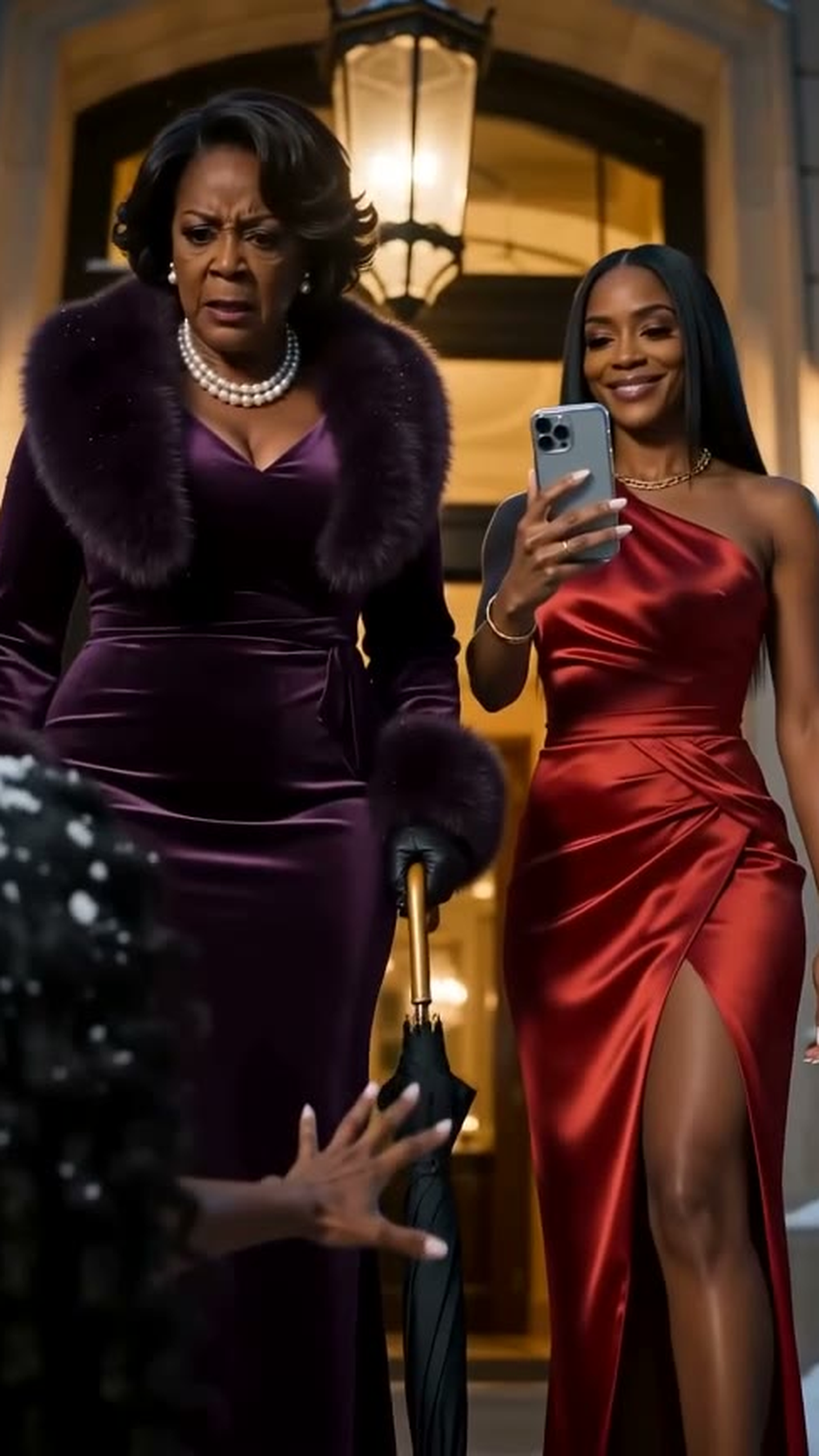
The first thing Tessa felt was the cold.
Not the ordinary cold of a winter night in the city, but a deep, stealing cold that had already climbed through the soaked silk of her gown and settled into her bones. She lay on the icy pavement outside the Ashford Sterling Hotel, her silver-white dress spread around her like spilled moonlight, darkened now with meltwater and scattered snow. Her curls clung wet to her face. Her breath came in small, broken pulls that hurt all the way down.
Somewhere above her, heels clicked on wet stone. A door sighed shut. The golden lanterns of the hotel entrance burned warm and far away, and the whole grand facade — the columns, the stone, the wreaths of winter greenery — looked down at her the way the rich look down at a beggar: without seeing her at all.
Her hand moved. She did not decide to move it. It crept across the ice on its own, fingers numb and trembling, reaching toward the one figure standing close enough to matter.
"Emma…" Her voice came out as a thread. "Emma… please help me."
Emma Ashford stood three feet away in a gown the color of fresh blood, her phone raised and steady, its small light burning. She was smiling — not wildly, not madly, but with the soft, pleased expression of a girl watching something she had waited a long time to see. She did not lower the phone. She lifted it a fraction higher, to get a better angle.
"Keep begging," Emma said.
Tessa's fingers curled against the ice, and something inside her chest simply gave way — not her ribs, though those ached, but the last small room where a sister was supposed to live. She let her forehead sink toward the pavement. A snowflake landed on her lashes and did not melt.
Then a shadow fell across her, and with it came the voice she had feared and obeyed for thirty years.
"Get up." Her mother stood over her in purple velvet and fur, pearls at her throat, a silver brooch catching the lantern light, and in her gloved hand the family's black umbrella with its gold fittings — the umbrella Vivian Ashford carried the way other women carried a signature. "Get up, Tessa. You are embarrassing this family in the street."
Tessa tried. God, she tried. She got one palm flat on the ice and pushed, and her arm shook so violently she thought it would fold. "I can't—" she whispered. "Mama, I can't feel my—"
The umbrella came down.
It did not strike her. It struck the pavement a breath from her reaching hand with a sharp metallic crack that rang off the stone columns, and her whole body recoiled as if it had — fingers snapping back, shoulder jerking, breath tearing out of her in a sob. Snow and grit stung her cheek.
"I said get up."
Her mother caught her by the forearm and hauled. The grip was shocking in its strength, nails through velvet gloves, and it pulled Tessa halfway up before her wet shoes found nothing on the ice — she went down again, hard, onto one knee, catching herself with her palm, a bright stripe of pain racing up her wrist. Her mother's hand let go as if it had touched something unclean.
Through the blur of tears and snow, Tessa turned her face toward the golden doorway, where a tall figure in a charcoal overcoat stood motionless in the light.
"Dad…" It was barely a sound. "Dad."
Richard Ashford looked at his daughter on the ground. For one second — one — his face changed, and Tessa saw the man who had once carried her on his shoulders through this very lobby, his hand steadying her small ankle. His mouth tightened. His eyes dropped.
He turned away and walked back into the warmth of his hotel.
What happened after that came to her in pieces, the way drowning people remember the shore. Hands under her arms, rough and impatient. Her bare feet dragging across the snowy ground, leaving two thin lines. The rear door of the black SUV opening. Her own voice, small and far away: "Don't leave me…" Emma's pause. Emma's smile. The door closing with a heavy, finished sound.
And then the alley.
They did not even drive far. A service alley behind a closed strip mall, where the wind found every seam of her wet gown and the asphalt was a black mirror of ice. The SUV's taillights shrank to two red points, then nothing. Tessa curled around herself on the freezing ground and shook until the shaking stopped, which frightened the night custodian who found her more than the shaking would have.
His name was Marcus. His flashlight beam stopped on her like a held breath.
What she remembered last, before the dark took her, was the beam dropping as he ran, and his voice — a stranger's voice, the kindest she had heard in weeks — saying, "Ma'am? Ma'am, stay with me. Stay with me now."
She woke to white.
Not snow. A ceiling. A hospital's cold white light, a monitor's soft green pulse, a pain that lived everywhere and nowhere she could point to. Her throat was raw. Her head throbbed in time with the monitor. And standing beside her bed, in a dark jacket over a collared shirt, holding a thin report folder, was a man with the tired, careful face of someone who delivers bad news professionally.
"Miss Ashford. I'm Detective Cole Voss." He set the folder on the bedside table, and she saw the heading on the top sheet, stark in black type: EMERGENCY PSYCHIATRIC EVALUATION REQUEST. "Your family says you attacked them."
The words did not land at first. They floated, meaningless, above the beeping monitor. Then they landed all at once, and her breath went quick and shallow, and the green line leapt.
"They—" Her voice broke. She shook her head slowly, and even that small movement sent pain lancing behind her eyes. "No. No, I didn't— I would never—"
The door opened.
Bridget Colton came in carrying a worn banker's box, and the sight of her — navy suit, dark waves, that composed, sharply observant face, the face of the only person in Tessa's life who had never once looked away — made something in Tessa's chest unclench so suddenly she nearly wept. Bridget set the box on the table with the precision of a woman setting down a loaded thing. She opened it. And she took out a small sealed evidence sleeve, and in her gloved fingers, catching the cold light, a single USB drive.
Tessa's expression changed. The fear did not vanish, but it stepped aside, and underneath it stood something her family had never once seen on her face: quiet, controlled, absolute determination.
"I found it," Bridget said softly.
Detective Voss looked from the drive to Tessa and back, and she watched professional skepticism turn, degree by degree, into alarm. Bridget plugged the drive into the laptop on the tray table. The screen lit. Rows of folders bloomed across it, neat as a ledger of sins: FINANCIAL RECORDS. HIDDEN ACCOUNTS. VIDEO EVIDENCE. CONFIDENTIAL TRANSFERS.
Voss leaned closer. His eyes widened.
"Tessa…" he said. "What is this?"
She looked at him from the hospital bed, bruised and bandaged and done being afraid, and she whispered the word she had carried like a coal in her chest for ten long days.
"Everything."
* * *
TEN DAYS EARLIER
The night of the Winter Gala began, as all Ashford tragedies began, with everything looking perfect.
Tessa stood in the marble lobby of the Ashford Sterling beneath a chandelier the size of a small car, wearing the silver-white gown her mother had chosen — chosen, not offered, laid across her bed that morning like a dress uniform — and smiled at arriving donors until her face ached. Outside the tall windows, snow was falling over the city in thick, silent curtains. Inside, it was all gold light and string quartets and the perfume of white lilies, and every guest who took her hand said some version of the same thing: Your mother has built something remarkable. You must be so proud.
It was an empire, everyone agreed. Forty years of Ashford Sterling: eleven luxury hotels, a foundation whose name was on hospital wings and scholarship funds, a family whose portrait hung in the flagship lobby — Vivian in purple at the center, Richard's hand on her shoulder, Emma laughing, and Tessa at the edge of the frame, smiling the smallest smile, in the position she had occupied all her life: inside the picture, but never in its middle.
She was thirty years old, the eldest daughter of the Ashford family, and she had a title at the company — Director of Compliance — that her mother had invented the way one invents a harmless pet. A ribbon-cutting job. A signature on routine filings. Vivian Ashford did not believe in letting anyone real near the real machinery of her empire, not even blood. Especially not blood.
But ten days before the gala, the machinery had made a mistake. A routine reconciliation — a sleepy Tuesday task Tessa had done a hundred times — had turned up a wire transfer that did not belong to anything. And Tessa, who had been raised to smooth surfaces and never to pull threads, had done the one thing her upbringing had forbidden.
She pulled.
On the night of the gala, standing in that golden lobby with snow falling beyond the glass, Tessa Ashford was smiling at donors with a secret folded inside her like a second spine: she knew what her mother had done. She knew about the accounts. She knew about the transfers. She knew why the foundation's money bled out in the night like a cut artery.
And in less than four hours, her mother was going to find out that she knew.
There were details she would assemble later, from statements and reports, the way you assemble a photograph from negatives. The desk clerk who saw the family come down in the service elevator and thought nothing of it, because the Ashfords were the building. The doorman who held the side door against the wind and afterward could not forgive himself for the ordinariness of his own courtesy. The valet who heard a sound like a branch snapping — the umbrella on stone — and looked up, and looked away, because looking away was the first skill the hotel taught. The city itself, indifferent, gorgeous, plowing its snow into grey ridges along the avenues while a woman lay down to die in an alley behind a pharmacy, in a gown that cost more than the ambulance that came for her.
Tessa knew none of this in the lobby that night. In the lobby that night she knew only the small, bright, manageable things: that the mayor's wife preferred to be greeted by her first name; that the hospital board chair, Dr. Osei, had a laugh like a struck bell and a checkbook like a sacrament; that the ice in the champagne buckets was carved into swans because her mother believed God was in the details and intended to outdo Him. She knew that her father was expected at nine and had not yet appeared, and that his absence at the door was a message she had learned to read in childhood: Richard Ashford arrived late to everything that might require him to take a position.
Mostly, standing in the gold light with her practiced smile, she knew this: that she was the only person in the building carrying a loaded secret, and that secrets, like guns, change the posture of everyone around them whether or not they're ever fired. She caught herself watching her mother's hands — the famous hands, ringed and manicured, that had signed forty years of other people's destinies — accepting a glass, touching a donor's sleeve, blessing the evening. In ten days those hands had signed three more transfers. Tessa knew because she had checked, the night before the gala, one last time, unable to help herself, the way you press a bruise. The Corvus Trust. $340,000. Approved in her mother's own looping script, out of the scholarship endowment, while downstairs the staff were polishing the silver for the celebration of the foundation's generosity.
She had stood in the dark office with that number on the screen and done the arithmetic of her mother's soul, and the arithmetic had failed her, because there was no sum in which a woman steals from scholarships and remains a mother. There were only two columns: what Vivian Ashford was in the portrait, and what she was in the ledger. Tessa had spent thirty years living in the portrait. She had ten days' experience of the ledger, and it had already nearly cost her everything she had — which, she understood now, smiling at the mayor's wife, was the point of the exercise her mother was about to run. Not punishment. Demonstration. A lesson, delivered in front of the whole family, in what happened to Ashfords who read the ledger.
The string quartet began to play. Emma swept past in red, already radiant, already cruel with boredom. "Try to look less like staff, Tessa," she murmured, and glided on.
Tessa smoothed her gown, lifted her chin, and went to greet the next guests, while the snow came down and down, erasing the street, preparing the ice.