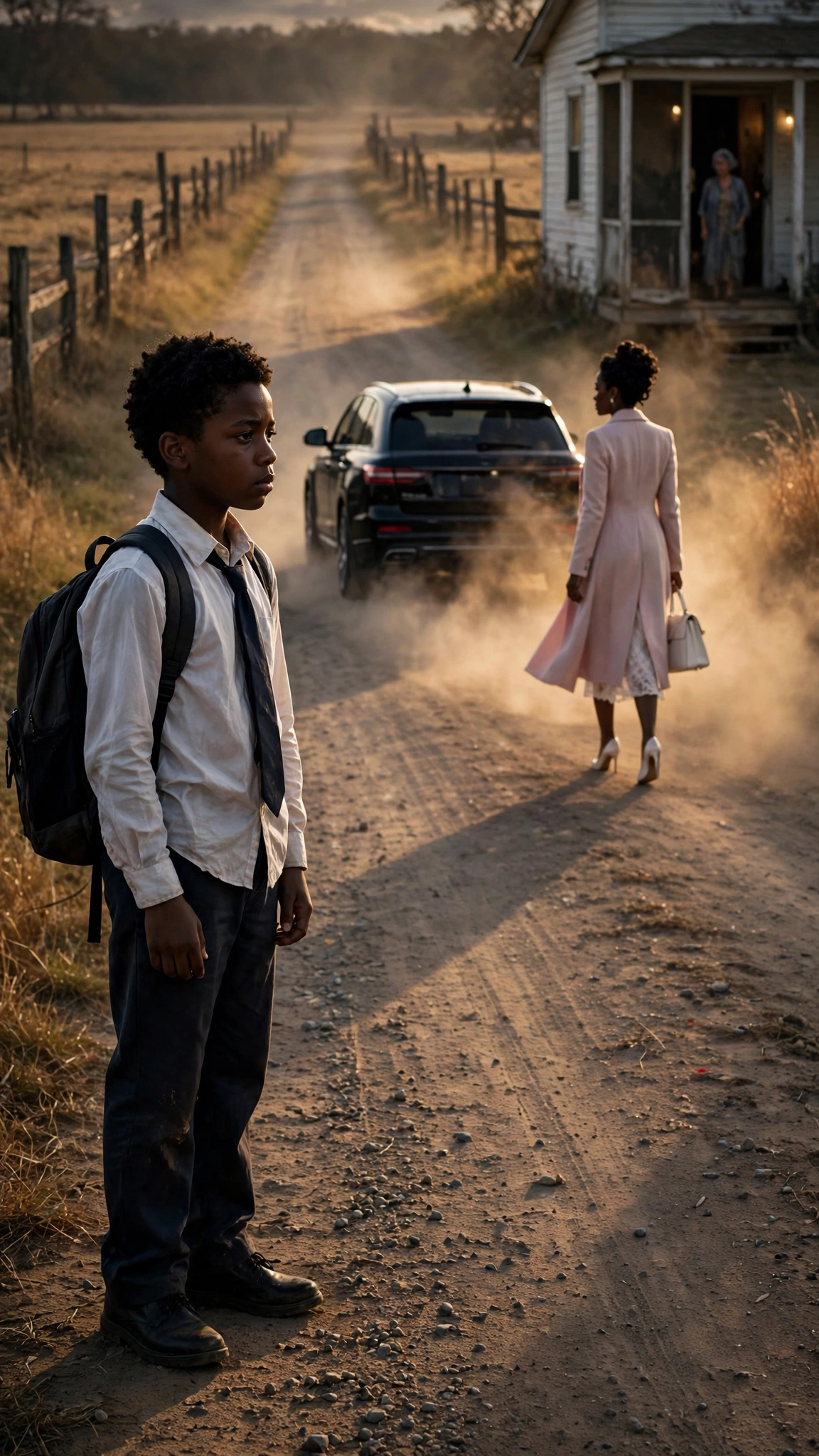
Rosa woke before the sun.
She had not slept well. She had lain awake most of the night, listening for sounds from the spare room — a cry, a footstep, anything — and thinking about the boy asleep down the hall. She had been a teacher for thirty-four years, and she had seen children who were hungry, and children who were frightened, and children who had lost someone they loved, but she had never seen a child who had been left on the side of a road on the day of his father's funeral. The more she thought about it, the angrier she became, and the anger was clean and steady, the kind of anger that makes a person get up and do something instead of just sitting with it.
She got up quietly, put on her robe, and went into the kitchen. She made coffee. She stood at the window and watched the sky turn from black to gray to pale pink over the fields, and she thought about the paper. She had seen it only for a second — a folded white square, numbers written on it in a man's careful handwriting — but she had seen the way Matthew held it, the way his fingers tightened around it when he thought no one was watching, and she knew what it was. It was a lifeline. Somebody's father had given his son a way to call for help, and the son had not used it yet, because he was ten years old and frightened and did not know what to do.
She would use it for him. Or rather, she would ask him to use it, and if he would not, she would do it herself. That was the decision she had made in the night, and she had not changed her mind.
Matthew woke just after seven. He came into the kitchen slowly, in the clean clothes she had left for him — a shirt that was a little too big, trousers that were a little too long, rolled up at the cuffs — and his hair was still damp from the bath, and his eyes were puffy from crying, but he looked better. He looked like a boy who had slept in a bed and eaten a meal and been safe for one night, and that was something.
"Good morning," Rosa said, and she put a plate of toast and eggs in front of him, and a glass of orange juice. "Eat. You need your strength today."
He ate. He ate slowly this time, like a person who knows there will be more food tomorrow, and Rosa watched him, and her heart ached, because a ten-year-old boy should never have had to learn what it felt like to eat fast because he did not know when the next meal would come.
"Matthew," she said, when he had finished, "I saw the paper. Last night, in the bath. I saw you holding it. I didn't mean to look, but I saw it, and I saw the number on it."
Matthew froze. His hand went to his pocket, to the shirt pocket where he had put the paper, and his fingers closed around it through the cloth. His face went pale.
"It's all right," Rosa said quickly. "I'm not going to take it. It's yours. Your father gave it to you. But I want to ask you something, and I want you to think about it before you answer. Did your father tell you to use that number if you needed help?"
Matthew nodded, slowly.
"And do you need help, Matthew?"
He nodded again, and his eyes filled with tears, and he looked down at the table.
"Then I think we should call it," Rosa said gently. "Together. Right now. I'll do the talking, if you want. You can just sit beside me. Is that all right?"
Matthew thought about it for a long time. He thought about his father, and the hospital, and the tired eyes, and the words — "He'll help you, son" — and he thought about the road, and the dust, and the long walk, and he thought about Rosa, who had opened her door and given him food and a bed and asked for nothing in return, and he nodded.
"All right," he whispered.
Rosa went to the telephone on the wall in the hallway — an old telephone, the kind with a cord, the kind she had had for twenty years — and she picked up the receiver, and Matthew stood beside her, clutching the folded note in his hand, and she dialed the number. The phone rang once. Twice. Three times. Matthew's heart was beating so hard he could hear it in his ears.
And then a man's voice answered. It was a deep voice, calm, a little rough, the voice of a man who had been woken up and was trying not to show it.
"Hello?"
Rosa took a breath. "Hello. My name is Rosa Bennett. I'm a teacher, in Georgia, and I'm calling about a boy. His name is Matthew Carter. He's ten years old. His father was Alexander Carter, and —"
She did not get any further, because the voice on the other end of the line changed. It went from calm to sharp in a single second, the way a person's voice changes when they hear something they did not expect and cannot quite believe.
"Alexander's son?"
It was not a question, exactly. It was more like a prayer, or a gasp, or a word a man says when the ground shifts under his feet.
"Yes," Rosa said. "Alexander's son. Matthew. He's here with me. His father died yesterday, and his stepmother left him on the side of a country road, and he walked to my house, and he has a piece of paper with this number on it, and I —"
"Where are you?" the man said. His voice was low now, and serious, and controlled, and there was something underneath it — anger, or grief, or both — held back by a tremendous effort. "Tell me exactly where you are."
Rosa told him. She gave him the address, and the name of the road, and the name of the town, and the man repeated it back to her, slowly, as if he were writing it down.
"Listen to me carefully," he said. "My name is Gabriel Carter. Alexander was my brother. I am Matthew's uncle. I did not know — I did not know he had a son. I did not know Alexander was sick. I did not know any of it, and that is my fault, and I will carry that for the rest of my life. But I am telling you this now, Mrs. Bennett, and I need you to hear me. Your stepmother made a terrible mistake."
He was not talking to Rosa. He was talking about Veronica, and his voice, when he said the words, was cold and certain, the voice of a man who knew something nobody else knew.
"She made a terrible mistake," Gabriel said again, "and she is going to find out what it was. But first, I need you to do something for me. I need you to keep Matthew safe. I need you to keep him in your house, and I need you to tell no one that he is there. Not the neighbors. Not the school. No one. Do you understand?"
"I understand," Rosa said.
"I am coming," Gabriel said. "I am leaving Atlanta now. I will be there in two days — I have things I must do first, papers I must gather, and I will not come empty-handed. When I arrive, I will bring everything with me. Until then, keep him safe. And Mrs. Bennett — thank you. Thank you for opening your door."
The line went dead. Rosa stood in the hallway with the receiver in her hand, listening to the dial tone, and Matthew stood beside her, looking up at her with wide eyes, his fingers tight around the note.
"What did he say?" Matthew whispered.
Rosa put the receiver down, slowly, and she knelt down so that she was at his eye level, and she put her hands on his shoulders.
"He said his name is Gabriel," she said. "He said your father was his brother. He said he is your uncle, Matthew. And he said he is coming."
Matthew stared at her. An uncle. He had an uncle. He had never known. His father had never once mentioned a brother, not in ten years, not in all the stories he had told, not in all the photographs on the walls of their house. And yet there was an uncle, and the uncle had a voice like a man who had just been given back something he thought he had lost forever, and the uncle was coming.
"Is he angry?" Matthew asked, in a very small voice. "At me?"
"No, baby," Rosa said, and she pulled him into a hug, and he let her, and he buried his face in her shoulder, and for the first time since the hospital, he cried properly — not quietly, not carefully, but the way a child cries when somebody finally tells him it is safe to cry. "He is not angry at you. He is angry at the woman who left you on that road. And Matthew — I think your father knew. I think your father knew all along that she would do this, and that is why he gave you that number. He was protecting you, even at the very end. He was making sure that someone would come."
—
Across the state, in Atlanta, Veronica Carter was sitting in a lawyer's office, and she was learning that something was wrong.
The office was on the twentieth floor of a glass building downtown, and the lawyer — a thin man named Preston Hale, with gray hair and a gray suit and a voice like dry paper — was sitting across the desk from her, his hands folded, his face carefully blank, and Veronica was watching him the way a cat watches a mouse that has just done something unexpected.
"I don't understand," she said. Her voice was cool and controlled, the way it always was, but there was a tightness underneath it. "The will reading was scheduled for today. My husband is dead. I am his widow. I would like to know what he left me."
"Mrs. Carter," Hale said, and he chose his words with great care, "there has been a complication. A second document has been filed with the court. A revised will, executed six months ago, with a different executor and different terms. Until the court determines which document is valid, I cannot release anything. I cannot tell you what you have inherited, because at this moment, I do not know."
Veronica went very still. She did not move. She did not blink. She sat in the leather chair with her pale-pink coat folded over her arm — she had worn it to the funeral, and to the lawyer's office, because it was her armor — and she thought, very fast, about the last six months. About the nights her husband had gone out, saying he had business, and come home late, smelling of hospital disinfectant. About the mornings he had spent on the telephone, his voice low, the door closed. About the way he had looked at her, in the last weeks, with something in his eyes that she had chosen not to see.
"A revised will," she said, and her voice was very quiet. "Executed six months ago. And you did not tell me."
"I did not know," Hale said. "The revised will was executed by a different firm. It was filed with the court yesterday morning, by a lawyer in Savannah. I received a copy an hour ago."
"Who is the executor?" Veronica asked.
Hale hesitated. He looked down at the papers on his desk. He did not want to say the name. He said it anyway.
"Gabriel Carter. The deceased's brother."
Veronica's hand tightened around the strap of her white handbag until her knuckles went white. Gabriel Carter. She had never heard the name. In seven years of marriage, Alexander had never once mentioned a brother. She had believed — she had been certain — that she knew everything about her husband's family, that there was no one else, that when he died, everything would come to her, clean and simple and uncontested.
She had been wrong. And the worst part was that she did not know how wrong she had been, or what else Alexander had hidden from her, or what this Gabriel Carter knew, or what he had in his hands.
"I see," she said, and she stood up, and she smoothed her coat, and she picked up her handbag, and she walked out of the office with her head high, because Veronica Carter did not run, and Veronica Carter did not panic, and Veronica Carter never, ever let anyone see her afraid.
But in the elevator, going down, her hands were shaking. And in the car, driving home, she thought about the boy. Matthew. The ten-year-old boy she had left on the side of a country road that morning, because she had believed he did not matter, because she had believed he was nothing, because she had believed that once his father was dead, he would simply disappear.
She had believed he did not matter. And now, sitting in traffic on Peachtree Street, with the sun going down over the city, she understood, for the first time, that the boy mattered very much. That the boy had a piece of paper in his pocket. That the boy had a number. That the boy had called someone.
And that someone was coming.