The rain was still hammering the windshield when Lily's fingers closed around my arm.
We were parked at the departures curb of George Bush Intercontinental, Terminal C, and through the streaming glass I could see my husband walking away from us — Mark, in his charcoal suit and pale-blue shirt, his black leather bag in one hand, moving toward the automatic doors like a man with a plane to catch. Denver. Three days. A site walk for the new Bennett Builders contract, the one that was supposed to save us.
"Mom."
Lily's grip tightened. Both of her small hands were wrapped around my forearm, her fingers digging into the pale-yellow silk of my sleeve, and she was pulling — actually pulling me toward her, away from the window, with a strength I didn't know an eight-year-old had.
"Lily, baby, what—"
"Mom, don't go home." Her voice came out in a whisper so fast and ragged it barely sounded like her. "Don't go home. Daddy said it's a gas leak."
The world narrowed to the sound of her breathing — quick, uneven, terrified.
Eight years of motherhood had taught me her fears. Thunder. The dark hallway. The neighbor's dog. This was none of those. And before motherhood there had been seven years of something else: seven years answering 911 calls for Harris County, seven years of listening to strangers' worst moments through a headset, learning to hear the difference between a child who was scared of a shadow and a child who was scared of something real.
This was real.
"Sweetheart." I turned in my seat and gathered her hands into mine. Her whole body was trembling inside her yellow floral dress. "What did Daddy say? Tell me exactly."
"There's a gas leak at home. He said—" Her eyes kept flicking to the terminal doors, to her father's back disappearing into the crowd. "He said don't tell you. He said you'd be scared. But Mom—" Her lower lip shook. "I don't want to go home. Please don't make me go home."
"Okay," I said, and my dispatcher's voice came back to me like it had never left — calm, low, certain. "Okay, Lily. We're not going home. I promise you. We're not going home."
I held her until her breathing slowed a fraction, and then I did the thing I will be grateful for every day for the rest of my life: instead of merging into the airport traffic toward Katy, toward home, I circled once around the departures loop and pulled into the short-term parking garage where I could see the terminal doors.
Understand what it cost me to do that. I had a plan for Tuesday — a careful, frightened woman's plan, built over six days: follow him, yes, but from a distance; gather proof; be a witness, not a casualty. The plan had not included my daughter's hands around my arm. The plan had not included the words gas leak arriving in a whisper from the back of my own car, turning every suspicion I'd been treating like a theory into a fact with my child's name on it. There is a moment on a bad 911 call — every dispatcher knows it — when the call stops being information and becomes weather: it is happening, it is happening now, and the only question left is what your voice is going to do about it. I had that moment at the departures curb of Terminal C, with the rain coming down and my husband's back getting smaller in the glass, and what my voice did was simple. It promised my daughter we were not going home, and it did not break that promise.
"Are we waiting for Daddy?" Lily whispered.
"We're watching," I said. "Just watching. Like a game."
It took eleven minutes.
The automatic doors slid open and Mark walked out of Terminal C — without his bag. Without his suitcase. He stood under the overhang in the rain-light and looked left, then right, then left again, the way you look when you're checking whether anyone is watching you. His jaw was tight. He raised one hand, and a taxi rolled up out of the wet gray, and my husband — who was supposed to be boarding a flight to Denver — opened the door and got in.
"He never boarded," I heard myself say.
My hand was clamped around the steering wheel so hard my knuckles had gone white.
The taxi pulled away, and I followed it.
I don't remember deciding to. I remember Lily's small voice from the back — no, beside me, I'd moved her up front, I remember the rain and the wipers and the red smear of the taxi's taillights through the wet windshield, and I remember my own voice in my head, very quiet, counting facts the way I used to log calls. Subject left terminal at 08:04. Subject did not board. Subject is heading west. Subject is heading home.
Halfway down the freeway my phone buzzed in the cup holder. It nearly slipped out of my trembling hand when I picked it up.
A text. From Mark.
Did you get home? Turn on the heat.
I read it three times. The phone slid in my grip and I caught it against the wheel. Beside me Lily made a small sound, and I put my arm across her the way you do when you brake too fast, and I understood — all at once, in my bones, the way you understand a caller's silence on a 911 line — that my husband had just asked me to light the match.
The taxi turned into our subdivision in Katy at 08:41. I parked two houses down, behind the Abernathys' oak, engine off, rain drumming the roof.
And then Mark came around the side of our house, and the breath went out of my body.
The suit was gone. He was wearing his old dark work jacket, dark trousers, heavy work gloves. In his right hand was a red gasoline can, its weight dragging his arm down with every step. In his left hand was a crowbar.
"Oh my God," I whispered. "Mark…"
Lily made a sound I will hear in my sleep for years and pressed herself down against the seat, and I pulled her lower, gently, below the line of the window. "Eyes on me, baby. Eyes on Mommy. You're safe. You're safe."
My hands were shaking so badly I misdialed twice. Not 911. Not yet — some cold, trained part of me wanted one more fact, wanted to know how deep the water was before I screamed. I called Evelyn.
My mother-in-law answered on the first ring.
"Mark?" she said.
My blood stopped. Not hello. Not Laura? She had been expecting her son's call — at 08:43 on the morning he was supposed to be over Oklahoma.
"It's Laura," I said.
A silence. Then Evelyn's voice came back low and controlled and stripped of every pleasantry she'd ever performed for me in eleven years of Sunday dinners: "Take Lily. Don't complicate things."
The line went dead.
I sat in the rain-noise with the phone against my ear and felt the last of my old life come apart. Evelyn knew. Evelyn had always, somehow, known.
A crack split the wet air — wood and metal, loud enough that Lily flinched against me. Through the windshield I saw our back patio washed in the white glare of the motion-activated security light, and Mark frozen in it, caught, one arm raised — and then he swung the crowbar into our back door a second time and the whole door shuddered in its frame.
My phone was already at my ear. Nine-one-one. And this time my hands were steady, because this was the one thing in the world I knew how to do.
"911, what's your emergency?"
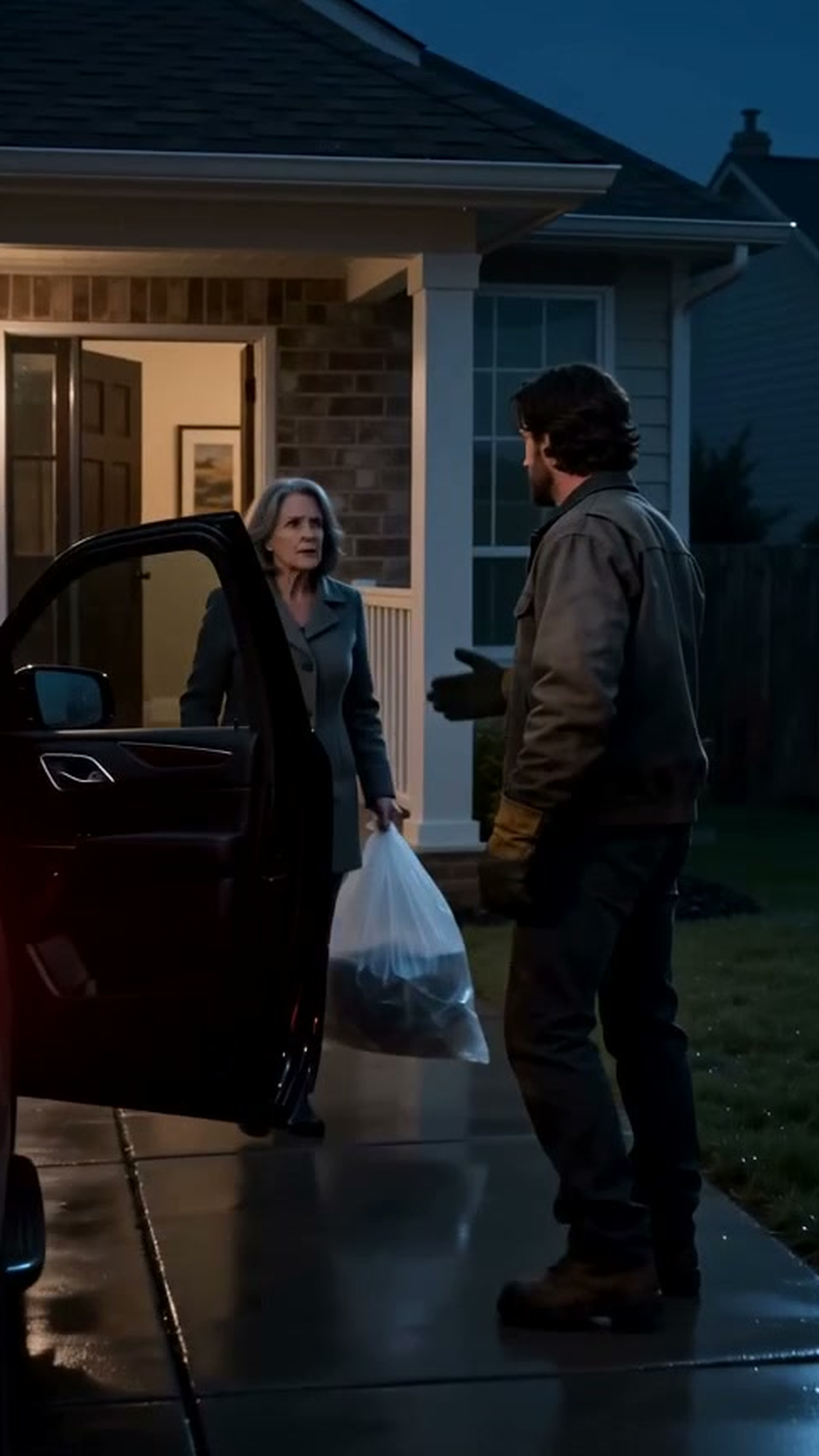
And from the end of the street, headlights swept across the wet pavement — a car pulling up in front of my house, a car I knew — and Evelyn stepped out of it into the rain carrying a heavy plastic bag that swung against her leg with a weight that bent her wrist, and Mark, my husband, the man with the crowbar, turned toward his mother and raised his gloved hand in greeting, like she'd arrived right on time.
"Lily," I whispered, "close your eyes."
—
SIX DAYS EARLIER
The letter from the insurance company came on a Wednesday, mixed in with the coupons and the water bill.
I almost threw it away. It was addressed to Mark Bennett, and it said, in the bland blue language of insurers, that it was confirming "recent changes to your policy." I stood at the kitchen counter with Lily's lunchbox half-packed and read it twice, and something in the phrasing snagged at me — the dispatcher instinct again, the wrong note in a familiar song. We had one life insurance policy, taken out when Lily was born, modest and mutual and chosen together at our own kitchen table. I had never heard of this company.
I put the letter back in the envelope. I put the envelope back in Mark's pile. I finished Lily's lunchbox — apple slices, the sandwich with the crusts cut off — and I said nothing that morning, because that night was the night Mark came home smiling for the first time in months.
It hadn't always been a house with secrets under the floor. When I met Mark Bennett I was twenty-three and answering phones at the county, and he was the contractor who'd come to rewire the dispatch center's break room and stayed an extra hour rewiring nothing, just to keep making me laugh through the worst shift of my month. He built our house with his own crew. He carried Lily through every room of it the day we brought her home, narrating: kitchen, where Mommy burns toast; hallway, where you're going to lose your first tooth; your room, Lilypad, where nothing bad is ever allowed to happen. For years I believed the narration. Then the developments started failing — a subdivision in Conroe that ate two years and came up mud, a partner who vanished with a draw account, loans stacked on loans like shingles on a bad roof — and Mark started doing what drowning men do: he stopped telling the truth in smaller and smaller rooms of the house, until the only room left where he told it was the garage, late, to a phone that wasn't his.
I'd felt it coming the way you feel weather in a scar. The new silences. The laptop that closed when I entered. The way he'd begun, that spring, to ask after my shifts, my routes, my habits — what time did I usually get home, did I still take the tollway, did Lily's school still let out at three. I'd answered all of it like a wife. I answered all of it like the audience he'd rehearsed on for eleven years.
Which is why the letter mattered the way it did. Not because it proved anything by itself — an envelope proves nothing; I'd logged enough calls to know paper lies as fluently as people — but because it arrived in the same week my husband started smiling again, in the same month my daughter started flinching at bedtime, and everything in my training said the same thing about coincidences: there is no such thing, there is only the pattern you haven't finished reading yet.
"Denver," he said, turning me around the kitchen by my waist like we were twenty-five again. "Tuesday. The Harper Group wants a walk-through before they sign. Laura — if this lands, we're out of the hole. All of it. The loans, the suppliers, everything."
I laughed, and I was happy, and the happiness is the part I have had to forgive myself for. Because six weeks before that letter, something had already begun moving under the floor of my life, quiet as gas through a wall — and my daughter, who had been awake on Sunday night when she should have been asleep, had already heard its first whisper.
But on that Wednesday, I only knew about the letter. And that night, after Mark fell asleep with one arm flung over his eyes, I got up, went down to his truck in the garage, and opened the glovebox — looking for nothing, telling myself nothing, the way you check a smoke alarm battery in the dark for no reason you can name.
There was a second phone in there. Cheap. Prepaid. The kind dispatchers learn to recognize in the first thirty seconds of the worst calls of people's lives.
It lit up in my hand.
One message. No name saved. Just six words:
Tuesday. After that, we're free. — M