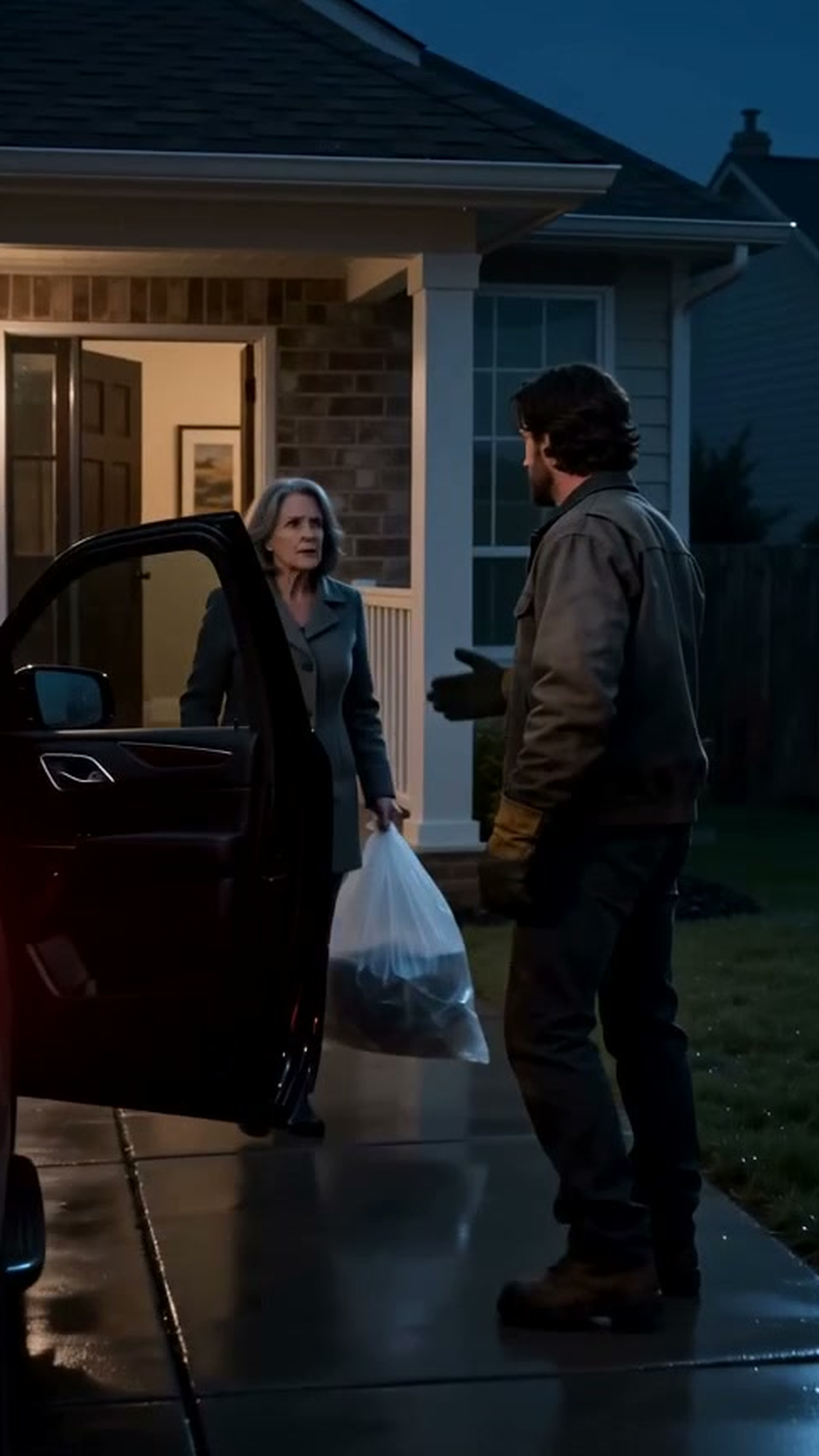
They opened the bag that night at the substation, with gloves on, in front of a camera, while I watched through glass with a paper cup of coffee going cold in my hands.
It had burst on the concrete, but Evelyn — methodical, terrified Evelyn — had packed it in layers, and the layers told the story in order, like a confession read backward.
On top: the fireproof lockbox from our hall closet. Inside it, inventoried one by one by a detective with a voice like a man reading a will: the deed to the house. Our wills. Three passports — mine, Mark's, Lily's. Eighteen thousand dollars in banded hundreds from the floor safe. My mother's jewelry, in its blue velvet box, every piece accounted for. Lily's silver christening cup. Her baby book, the one with the lock of hair taped to the first page and her first word written in my handwriting — banana — in green pen.
Earlier that evening they had taken my full statement, two hours of it, in a room with a humming light, and I had given them the week whole — the letter, the phone, the policy, the scratched fitting, the battery-less detectors, the drawing with the black windows. Ruiz sat beside me with a legal pad and touched my elbow exactly twice, both times when a detective used the phrase the deceased-about my daughter and me in the grammar of people who discuss cases; I corrected the grammar both times, politely, and continued. Lily, meanwhile, was interviewed in a soft room at the children's advocacy center by a woman named Pruitt who had puppets and juice boxes and no uniform anywhere on her, and who told me afterward, in the corridor, the sentence I have tried since to live up to: "She's remarkably clear, Mrs. Bennett. Children usually are, when somebody finally asks them the question straight. She said her job was to tell a safe grown-up, and she was still deciding who was safe, and then on Tuesday morning she decided it was you." I stood in that corridor with my back against the wall and cried for the first time since the airport — not from grief, or not only grief: from the plain, devastating pride of it. My daughter had run her own investigation at eight years old and brought the results to exactly the right desk.
Underneath the lockbox: a manila envelope of insurance papers. The two-million-dollar policy. The doubled homeowners' rider. The accidental-death clause, highlighted — highlighted — in yellow marker.
And underneath everything, folded in thirds, a single sheet of notebook paper in my husband's handwriting. The detective flattened it under the glass for me, and I stood up without deciding to.
TUE — 0600 L departs IAH run. 0640–0715 E. strips house (key). 0800 M lands "Denver" — cab — patio by 0845. L home by 0830 per instructions. Heat on = ignition. Fire reads furnace/gas leak. Alibi: flight manifest + E. confirms call. Accelerant staged as stored fuel (garage can). Door forced AFTER = break-in theory if needed.
And at the bottom, in the same hand, the same pen, the afterthought of a man who trusted paperwork more than people:
Lily policy — confirm active before Tue.
Before the bag, they had shown me the signatures. A document examiner from the county — a soft-spoken woman with reading glasses on a beaded chain, the least dramatic person in Texas — laid three pages side by side under the interview room's light: my true signature, from our marriage license, eleven years old and girlish; my true signature from Lily's school forms, last September; and the signature on the insurance applications. "Yours loop the L upward," she said, tapping with one unpolished nail. "It's an optimistic hand, if you'll forgive the expression. His doesn't." On the third page my name stood in a stranger's careful forgery, the L dragged downward like a hook, the letters leaning away from each other as if even the ink had known. "He practiced," she said. "We found a sheet in his desk — forty-one attempts. He kept the best three. In my experience, Mrs. Bennett, they always practice the signature of the person they intend to survive." I asked to keep a copy of the practice sheet. It sounds morbid. It wasn't. Forty-one attempts at my name, worked at like a trade, in the desk where he also kept Lily's height chart taped inside the drawer — that sheet was the marriage, as far as I was concerned. Everything else was a story we'd both been telling the neighbors.
They had to say my daughter's name twice before I heard them. A second policy. A quarter of a million dollars on the life of an eight-year-old girl, with my signature forged at the bottom in a hand that had practiced my loops, and next to it in the checklist, in her father's handwriting, the instruction to confirm her coverage before the day he planned to turn her into a payout.
I was sick in a detective's trash can. Then I sat back down, because there was more, and because Evelyn, in the room next door, had begun to talk — and I had earned the right to hear every word of it.
Once, between rooms, they walked her past the glass of mine — escorted, cuffed, her coat still damp at the hem — and Evelyn stopped. Not long; the deputy at her elbow allowed it a single second, the way people allow weather. She looked through the glass at me and mouthed, with great care, the only sentence she has ever addressed to me that required no translation and no forgiveness to understand: Is she all right? I nodded once. Evelyn closed her eyes like a woman setting down a weight she'd carried up a long flight of stairs, and let herself be led on to say everything.
She talked for three hours. She talked about the loan first: Bennett Builders' 2023 development loan, the one that had failed, the one whose documents bore her signature as guarantor — a signature Mark had traced from her Christmas cards and promised was "just for the bank's file, Mom, just a formality." When the development collapsed, that signature became a leash. He'd come to her in the spring with the arithmetic of ruin: the fraud surfaces, she loses the house, the church, the good name she'd polished for sixty-two years — or she helps him with one clean insurance fire, an empty house, nobody hurt. That was the deal he'd sold her. Nobody hurt. A fire, a check, a fresh start.
She described the spring afternoon he'd come to her kitchen with the folder — how he'd laid it out like a contractor showing a client a renovation: bank notices, the fraud exposure, the clean solution. A fire, a claim, a fresh start. He had even brought her own forged signature and set it in front of her like a place card, and Evelyn, who had kept a house and a church reputation and a terrible secret for thirty years, had looked at her son across her own kitchen table and understood that she had not been raising a boy all those years. She had been storing a fire. "He said your name like a line item," she told the detectives, and one of them repeated it back to me in the corridor with the air of a man who has heard the sentence he'll remember at retirement. "He said, 'Laura's the policy, Mom. Laura's how we get clear.' Not his wife. The policy."
"When did you know it wasn't an empty house?" the detective asked her.
Evelyn wept then — the first time, the deputies told me, in three hours. "When he told me Laura had to be the one to turn on the heat," she said. "Innocent men don't need their wives to light it, detective. I knew that night. I knew, and I packed the bag anyway, because I was a coward for thirty years before I was ever his accomplice. Ask Laura about thirty years. Ask her what I carried for thirty years. He knows. He's been spending it our whole lives."
The detectives also showed me the second phone that night — the cheap prepaid from the glovebox, charged now and wearing a evidence tag — and the thread on it that had started my whole war. Tuesday. After that, we're free. — M. "The M is his mother," the lead detective said. "She confirmed it. She sent it the night she agreed to help him. Said she sat in her car outside her own house for an hour after she pressed send, trying to unsend it with her mind." I stared at the six words that had detonated my life, and what I felt was not triumph. It was a tired, cavernous pity — for the woman who had typed freedom and meant a leash, and for the wife who had read it in the dark and understood it instantly, correctly, in the worst of all its meanings.
That night Lily and I slept at Dana's — Lily in the guest room with the fox and three night-lights, me on a couch I didn't sleep on, listening to another woman's good house make its ordinary noises. At some point after midnight my daughter padded out in her socks and stood in the doorway holding her backpack by one strap.
"Mom," she said. "Do I still have to carry it?"
I knew what she meant. Not the bag. The secret, the job, the whole unbearable promotion to witness she'd been serving since Sunday. I opened my arms and she climbed into the couch's narrow geography and arranged herself against me the way she had at four, at two, and I said, "No, baby. Grown-ups carry it now. Your job is done. You did your job better than anybody."
"Even Dad?" she whispered.
"Your dad," I said, carefully, in the dark of my best friend's living room, "has a different job now. And a lot of grown-ups are going to make sure he does it far away from us." She was asleep in four minutes. I lay awake until dawn being sure of it enough for both of us.
I didn't understand that part. Not then. Not until the jail call, two days later, at Dana's kitchen table, with a detective's recorder running and my ex-partner's hand resting steady over mine.
The prosecutor assigned to the case was a woman named Halsey with a voice like a closing door, and on the second day she walked me through what was coming with a candor I will always be grateful for. Mark had been denied bail — the checklist, she said, had done that nearly by itself; judges read the words confirm active before Tue in a defendant's handwriting next to his child's name and tend to stop being generous. His lawyer was already signaling the only defense the facts left standing: that Evelyn was the architect, Evelyn the insurance mind, Evelyn the one with a thirty-year-old secret to protect — that Mark was a weak son bullied by a monstrous mother. "He'll sell her to save himself," Halsey said. "Count on it. And he'll call you, because you're the only person left whose belief he ever actually enjoyed. When he calls, you're going to let him talk, and you're going to remember that the man who forged your signature forty-one times does not get to choose the story anymore." I said I understood. I had, after all, spent seven years coaching strangers through exactly this: the call where the person who harmed you asks to be remembered kindly, and your only job is to stay on the line and let the record keep its own counsel.
Mark called collect. I accepted, because Ruiz and the detective both said the same thing: let him talk.
"Laura." His voice was the kitchen voice, the turning-me-around-the-kitchen voice, worn thin. "You need to get me out of this. Whatever they're telling you — Mom is confused, Mom is old, Mom will say anything. You know me. You know me, Laura."
"I know your handwriting," I said.
A silence. Then, when he spoke again, the warmth was gone, and I heard for the first time the thing my daughter had heard in a dark kitchen — the voice under the voice.
"Then ask my mother what was really in that bag," Mark said. "Ask her what I had her carrying. Thirty years she's been carrying it, Laura. Ask her what my father died of. It wasn't the ladder. IT WASN'T THE LADDER—"