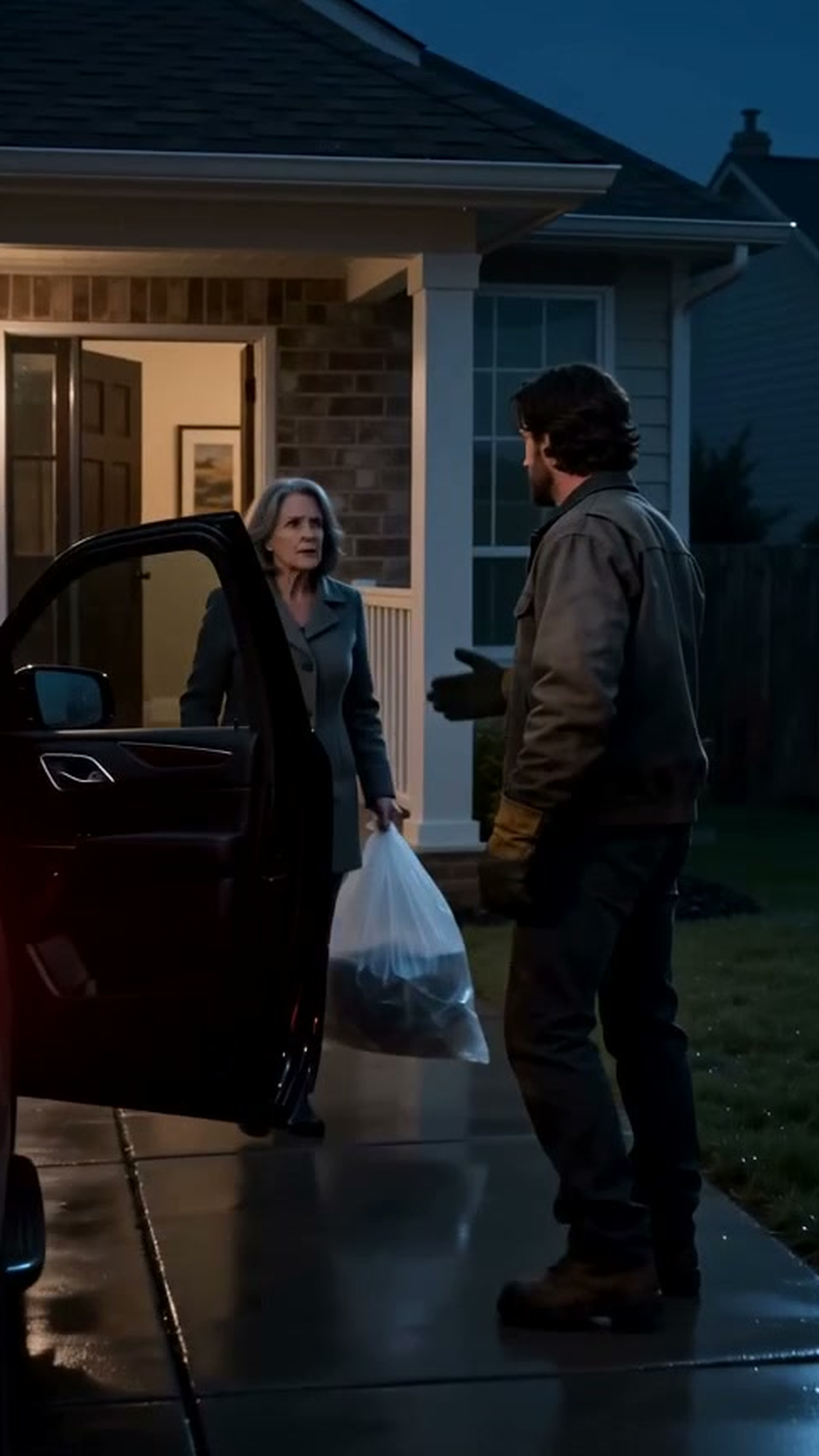
Evelyn told it to the detectives the following morning, with her lawyer present and her hands folded so tightly her knuckles shone.
Her husband Robert had not fallen from a ladder in 1996. He had come home early and found his son — seventeen years old, a boy with forged checks spread on the garage workbench and a duffel of his father's tools already sold — and the two of them had gone up the garage stairs shouting, the way fathers and sons do at the exact age when a boy is big enough to be dangerous and young enough to think he already is. There was a shove. There was a railing that Mark had loosened the week before, practicing — even then, a boy who rehearsed accidents. Robert Bennett went down fourteen stairs and did not get up, and Evelyn came home at dusk to her son sitting on the concrete floor holding his father's head in his lap, weeping, begging.
She called it a ladder. She called it an accident. She told a deputy and a pastor and a whole church the same clean story, and she buried her husband, and she raised his killer at her own table — and the boy grew up knowing that the truth lived in his mother's chest like a second heart, and that he owned it, and her.
"Thirty years," she told the detective, "I carried that boy's sin like it was mine. And then he asked me to help him carry a worse one, and God forgive me, my hands were already trained." She looked up at the camera, and I like to believe she knew I'd watch it someday. "The bag was the first thing I ever refused him. Whatever that makes me. It has to count for the first one."
It counted. Not for everything — the prosecutors were clear about that, and so was I — but it counted. Evelyn pleaded guilty to conspiracy and fraud, took probation and restitution, and signed her house on Maple Creek over, in full, into a trust for her granddaughter. Mark's "confused mother" defense died with his father's true story on the record. Facing the checklist, the forged signatures, the tampered furnace, the jail call — facing Lily's recorded statement, taken gently by a woman with puppets and all the time in the world — Mark Bennett pleaded guilty in February to two counts of attempted capital murder, arson, and insurance fraud, and was sentenced to thirty years.
At the sentencing I read my statement standing, because I had decided Lily would one day read it too, and I wanted no crouch in it. I told the court about the braids. I told them about a teacher asking what the black in the drawing was, and an eight-year-old explaining that you can't see a leak, that's why she'd drawn it black. I told them about the words turn on the heat, and what it is to be given your own murder as a household instruction, in the syntax of care. I did not look at Mark while I spoke; the prosecutor had said I didn't have to, and Dana, in the second row, in her dress uniform, held my gaze like a console light the entire time — the voice in somebody's worst four minutes, returning the favor. The judge, sentencing him, used the phrase "a level of premeditation this court rarely encounters," and mentioned the checklist by exhibit number, and I watched my husband's square hands — the hands that built our house, that braided nothing, that held a crowbar in the rain — where they rested on the defense table, and I felt nothing at all, which was its own kind of verdict, and a mercy I hadn't expected.
He wrote me one letter. It said he was sorry about the deck. I burned it in Dana's fire pit, on a cold night, with the heat in the house running high and every window in it open by my own choice.
Before the sale closed, I took Lily back to the Katy house one time, at her request — children set their own ceremonies, and hers was specific: she wanted to stand in her old room and say goodbye to it out loud. The remediation crews had done their work. New furnace, sealed and inspected and certified by men with meters and clipboards; new detectors in every hall, blinking their small green reassurance; the attic aired and certified clean; the back door replaced, its frame rebuilt, its lock bright. It smelled of paint and new wood, a stranger's house wearing our address. Lily walked it room by room with her hands clasped behind her back like a building inspector — she noted the new door, the new thermostat, the garden Mark never got to ruin entirely, blooming recklessly by the fence — and in the doorway of her old room she stopped at the height chart penciled on the frame, the marks running from a toddler's totter to a mark beside the words LILY 8, TUES in my own handwriting, which I did not remember making and could not stop looking at. "Can we take the numbers with us?" she asked. We could not take the doorframe. I photographed every mark with my phone, close and straight, the way I'd once photographed a scratched brass fitting for a file — and later Dana, who contains multitudes, had them printed and framed as a narrow white strip, and it hangs in the Maple Creek house in Lily's new room, running upward beside her bed like a vine. The house kept its wall. We kept the growing. It seemed to both of us a fair division of the past.
The Katy house was repaired and sold to a young couple who know none of it, and I hope the walls are kind to them. Lily and I spent the spring in Dana's spare room, and in May we moved into Evelyn's house — our house now, Lily's house, held in trust with her name on the deed and her christening cup on the mantel where it belongs. We painted the kitchen yellow. Lily chose it. Yellow, like her dress. Like my dress. Like the morning we survived.
In my first training class that fall, a twenty-two-year-old with new-console nerves asked the question they always ask, the one the instructors usually deflect with a joke about coffee. "Did you ever take a call," she said, "that was about you?" The room went quiet in the particular way of people who already know the answer. I told them the truth — that I had spent seven years learning to be a voice in other people's worst four minutes, and then one Tuesday morning I had needed one, and my partner had been there, because I had asked her to be, in advance, out loud, on the record. "That's the lesson under all the lessons," I told them. "Nobody survives the worst four minutes on instinct. They survive them on arrangements. Be somebody's arrangement. And if you're ever the one in the car — make the call. Make it early. Make it ugly and half-finished and shaking. A logged call at the start of a crime is worth a hundred perfect statements after it." She wrote it down. They all wrote it down. I like to think of that sentence traveling now through Harris County in a dozen headsets, doing quiet work I'll never hear about.
She sees a kind counselor with a dollhouse in her office, and she is relearning the world in the order children should: that houses are for sleeping in, that promises should be kept or spoken aloud, that secrets which hurt are not hers to carry. Some nights she still packs her backpack by the door. It gets lighter, month by month. In September she went back to school and told her teacher her summer project was "helping my mom answer phones" — because I'd gone back too, part-time, training new dispatchers at the county, teaching twenty-two-year-olds the thing Dana taught me: how to hear the difference between a shadow and a real fear, and how to stay calm enough to be somebody's voice in the worst four minutes of their life.
Evelyn's own sentencing was a quieter room. Probation, restitution, a suspended sentence hanging over her like a held breath — and afterward, in a lawyer's office with rain on the windows that no one in the room remarked on, she signed the deed. Her hand shook on the first letter of her name, that tall slanted E with the flourish she'd learned in 1973, and then steadied, and she signed the house on Maple Creek into her granddaughter's trust with the same hand her son had once traced for a loan. "It was never really mine," she said to the notary, who wisely pretended not to hear. "I was just the one carrying it." She did not ask me for anything. She did not ask to see Lily. She asked the lawyer, as she stood to leave, whether the porch light at the Maple Creek house still worked, because Lily used to be afraid of the step down in the dark — and I drove home with that sentence riding beside me the whole way, because it was so ordinary, and so grandmotherly, and so thirty years too late to be simple.
Evelyn writes to Lily on the first of every month. The letters come to me first — that's the rule, and Evelyn has never once broken it — and Lily reads them at the kitchen table and decides, each month, what to do with them. She keeps them in a shoebox. In October, she asked to send one back. It was a drawing: a yellow house, a red can crossed out with an X so firm it tore the paper, and three stick figures on the porch — two tall, one small — holding hands. The small one was in the middle.
Progress, with children, does not announce itself; it accumulates in doorways. In June, Lily left the backpack in her room for the first time — forgot it, actually forgot it, and came back from the kitchen asking for a second helping of spaghetti with both hands free. In July she asked Ms. Okafor — who'd transferred to summer school, who'd been briefed, who'd volunteered — whether bad secrets are the kind you tell. When the teacher said yes, that's the rule, Lily considered this gravely and said, "I know. I already did. My mom says it was the bravest thing." Her counselor used the dollhouse. For months Lily placed the smallest figure outside the little house, on the lawn, facing the street, and no conversation could move her indoors. In August, the figure moved to the porch. In September, to the front room, by the window, where the dollhouse's tiny lamp stood. "She likes to see outside," Lily explained. "But she's inside now. Inside is warm." I reported this to Dana in the tone of a woman announcing a lottery win, and Dana, who had heard everything I know about survival through a headset before she ever heard it from me, said, "Log it, partner. That's a clear channel," and I laughed until I cried, one of the good cries, the kind with no sirens in it.
On the first truly cold night of the year, I found Lily standing in the hallway in her nightgown, looking at the thermostat.
"Mom," she said. "It's cold."
"I know, baby."
"Can I?" She looked at me seriously, the way she looks at me now before big things — checking my face for fear the way she used to check it for permission. There was none to find. "Can I turn on the heat?"
I crouched down beside her, in the hallway of the yellow-kitchen house, in the warm dark with my daughter's hair falling out of its braids, and I said the truest thing I know.
"It's your house, Lily. Turn it all the way up."
She did. The furnace sighed awake below us — a good sound, an honest machine doing its one kind job — and Lily leaned her whole weight against my side, and together we listened to our home grow warm, and I understood that we were going to be all right.
Not because the world had become safe. Because she had asked, and I had said yes, and neither of us was afraid of the answer anymore.
"We're home now, right?" Lily said.
"We're home," I said. "We're home."
THE END