The risk management office had a bowl of mints on the table that nobody ever touched, and Marcus had come to understand, over six weeks of Thursday meetings, that the mints were the truest thing in the room. Everything else — the soft voices, the printed timelines, the phrase *adverse outcome* used in place of the word *death* the way a sheet is used in place of a body — was a way of not touching the thing in the middle of the table.
"Let's walk it once more," Whitaker said. "The board will have the imaging by then. I want to be sure we're all hearing the same thing from the radiology review."
The radiology review was the rock Marcus had been clinging to for six weeks, and he recited it now the way other men recited scripture. The aneurysm — the congenital flaw in Jaylen Brooks's aortic wall — had been invisible on every scan taken that night, because the scans taken that night were of a bleeding boy and nobody images the aorta of a trauma patient who is exsanguinating from three other places. It had been invisible on every scan of the boy's entire life, because no scan of the boy's entire life had ever had cause to look. Two outside experts had reviewed the file. Both used the same word, independently, in writing: *undetectable*. A third used a phrase Marcus had not been able to read without leaving the room: *no surgeon, however skilled, could have anticipated or repaired this defect under the conditions present.*
The board was expected to clear him. Everyone said so. Whitaker said so, in the tone of a woman who charges four hundred dollars an hour to be right. The chief of surgery said so, with a hand on his shoulder.
"It doesn't matter," Marcus said, quietly, to the mints, "what they decide. I want it in my file that I asked for this review. If they don't put it in, I'll write it myself. I asked to be judged. I want that somewhere permanent."
Whitaker studied him. "It's already in the file, Marcus. It's the first page of the file. Do you know how many surgeons request their own review? In twenty years, I've had two. The other one was guilty of something."
"I'm guilty of—" He stopped. The sentence had been trying to get out of him for six weeks, in kitchens and parking garages and scrub rooms, and it was not a legal sentence, so it had no business in this office, and he swallowed it the way he had swallowed it every time. "I'm guilty of being the one whose hands he died in. That's not a crime. I know it's not a crime. I've said it to the mirror. It doesn't — " He looked up, and his eyes were bright, and he hated it. "It doesn't *take*, is the problem. It doesn't take."
He had been a teacher once, before he was a defendant — back when the corridor still belonged to him. The residency program put the third-years with him because he was patient with their questions and ruthless with their sloppy knots, and he had loved it, the watching-a-young-surgeon-happen part of the job. That Thursday at noon, two hours before the end of the world, a third-year named Okafor caught him outside the scrub room with a tablet and the specific bright terror of a young doctor who has just seen a scan she doesn't understand.
"Dr. Bennett. Sorry — I know today's — sorry. It's the boy in four, the MVC from this morning, his pressure's soft and I can't— if you have two minutes, I just want to know what I'm missing."
*A boy in four. A motor vehicle collision.* She watched his face change and didn't know what she'd done. The scrub room door was three steps away. The corridor chair was forty steps the other way. For a moment — a moment he would count among the six weeks' worst — Marcus Bennett stood in front of a frightened young resident with a dying boy's numbers on a screen and could not make a single word come out of his mouth, because all he could hear was a heart monitor from six weeks ago slowing down under his hands like a clock running out of spring.
"Show me," he said at last, and his voice worked, and his hands worked — he took the tablet and walked her through the numbers standing up, and the boy in four was not Jaylen, and the problem was a spleen, and spleens could be fixed, and he told her exactly how and in what order, and by the end of it her shoulders had come down out of her ears. "You weren't missing anything," he told her. "You were two minutes from seeing it yourself. That's what two minutes is *for*. Go."
She went, at a run, the way young doctors go toward their whole lives, and Marcus watched her disappear around the corner and understood that he had just done — fluently, usefully, well — the thing the board was about to decide whether he should ever do again, and that a boy upstairs would live tonight partly because a man who couldn't forgive himself had stopped in a corridor to teach.
It was the first steady thing that had happened to him in six weeks, and it frightened him almost as much as the hearing did. Because if he was still that man, then the man was still in there, underneath — and he would have to decide, after three o'clock, what to do with him.
He left the office at one-forty with his instructions — home, rest, arrive at two-thirty composed, say nothing to anyone — and instead of going home he did what he had done every day that week. He went to the waiting corridor outside the surgical wing, the one with the steel chairs and the glass doors, and he sat down in the chair at the end of the row, and he took off his mask and put his hand over his face and he rehearsed, for perhaps the four hundredth time, the conversation he was going to have with his wife at seven o'clock that evening, when it was over, when there was an ending.
It began: *Naomi, sit down. Six weeks ago a boy died in my OR.*
It had never once gotten further than that in rehearsal. Four hundred times he had sat his imaginary wife down in an imaginary chair and four hundred times he had watched her face from inside his own head and the words had simply stopped, the way a heart stops, without drama, just — stopped.
On his way down the corridor he had stopped — out of a habit older than the crisis, a habit from residency — at his locker, to splash water on his face at the locker-room sink and look at the man he was about to present to a board. The inside of the locker door had been accumulating his real life for a decade, taped up in layers like sediment: a photo-booth strip from his own wedding after-party, four frames of Naomi in a borrowed veil making progressively worse faces while he laughed himself out of the frame; a photograph of the two of them on the porch of the house the year they bought it, paint on her nose, his arm around her waist, both of them squinting into a future they had every reason to trust; a child's drawing, crayon, from a grateful patient's daughter — a stick surgeon with an enormous heart drawn outside his body, labeled DR. B in wavering capitals.
He stood there a long time, looking at the man in the photographs.
That man had a tell-everything face. That man had once driven home at dawn, still in scrubs, to confess — before coffee, before she'd even asked — that he had scratched her car in the hospital garage and had been rehearsing the sentence for eleven miles. That man had called her from a conference in Denver to describe, in detail, a dream he'd had about her, because keeping even a dream felt like a filing error. The man in the photographs and the man in the mirror had the same face and the same wedding ring and six weeks of scorched earth between them, and Marcus did not know how to introduce them to each other, and in three hours a board was going to ask him, in effect, which one of them was the surgeon.
He closed the locker door gently, like a man closing a door on a sleeping child, and went to sit in the corridor chair to wait for his verdict — all of his verdicts, as it turned out, though he only knew about one of them.
He was on rehearsal four hundred and one, in the real chair, with his hand over his face and his shoulders doing the thing they did now when he was alone, when David's voice came from somewhere near the elevators, low and wrecked and unmistakable, saying words Marcus could not quite make out — and then a sound he would have known in a burning building.
His name. In his wife's voice. Frightened.
*Where is Marcus?*
★ ★ ★
Paula did not let go of Naomi's hand all the way to the elevator alcove, which was absurd — they were already on the fourth floor; the surgical wing was forty yards away — but Paula held on as if the hand were a rail on a ship, and she talked the whole way in the hushed, rapid undertone of a woman delivering a eulogy and a weather report at the same time.
"I wanted to call you a hundred times. A hundred times, honey, I had my phone in my hand. Doug said, 'Paula, it's not your place, it's sealed, it's legal' — *sealed*, like a tomb, and all of us walking around up here knowing and you down there not knowing, and I'd see him, Naomi. You have to understand what we've been watching. That man has been sleeping in the on-call room. He cries in the scrub room where he thinks the water covers it. He sits in that corridor—"
"Paula." Naomi stopped walking. Her voice surprised her with its steadiness. "Is my husband *dying*?"
Paula's face crumpled with relief so pure it was almost violent. "Oh, no. No, honey. No."
"Is he sick? Is he — is there someone else? Another family, a child, is he—"
"No." Paula took both her hands now. "No to all of it. He's not sick and he's not straying and there's no baby and no other woman, and I will have that on my conscience scrubbed clean, at least. It's *work*. It's a case. A bad case, a terrible case, and it's been sealed up by lawyers and he has been carrying it like a — " She searched for the word and found one that made Naomi's eyes fill instantly. "Like a *coffin*, sweetheart. Alone. Because they told him to, and because he's Marcus, and Marcus would carry a coffin alone into the sea before he asked his wife to pick up the other handle."
"Where is he?" Naomi said. "Right now. Paula. Where is he sitting?"
Paula pointed down the corridor, toward the surgical wing, past the nurses' station where two women in blue scrubs were watching them with the charged stillness of people who have waited six weeks for a door to open.
"In the waiting corridor," Paula said. "End of the row. He's there every day at this time. Sitting."
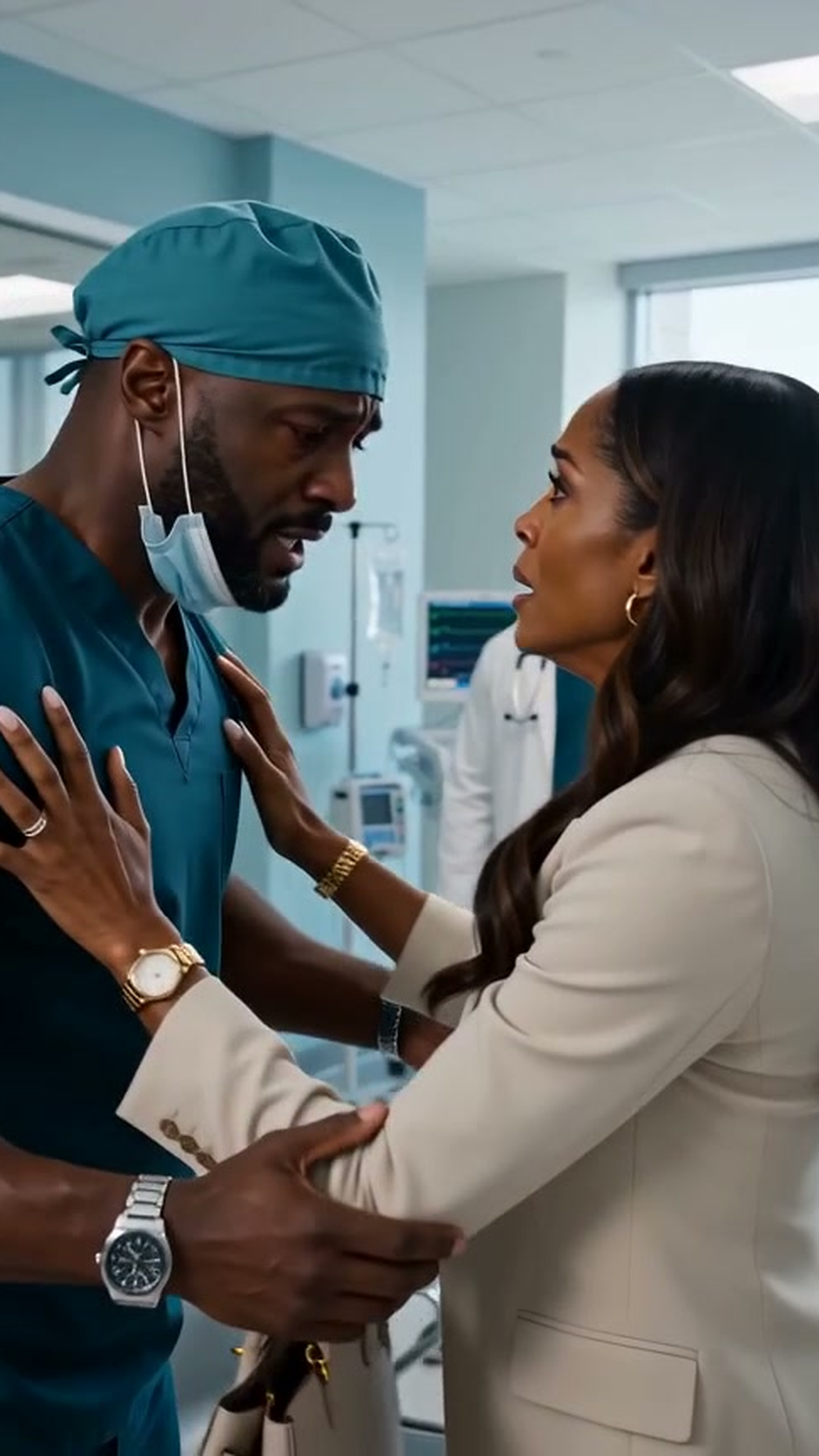
Naomi walked. She remembers very little of the forty yards — the brightness of the floor, the smell of antiseptic and coffee, her own heels announcing her like a drum line — until she rounded the station and David Carter stepped into her path with tears in his eyes and said the words that she had, in some chamber of herself, been hearing for six weeks without knowing it.
*He hasn't told you anything, has he?*
And down the corridor, in the end chair of the waiting row, her husband lifted his head at the sound of her voice asking where he was — and Marcus Bennett, who had rehearsed this moment four hundred times and never once gotten past the first sentence, stood up from that chair with his heart slamming and walked toward the end of the worst six weeks of his life, knowing there was no seven o'clock conversation anymore.
There was only now.