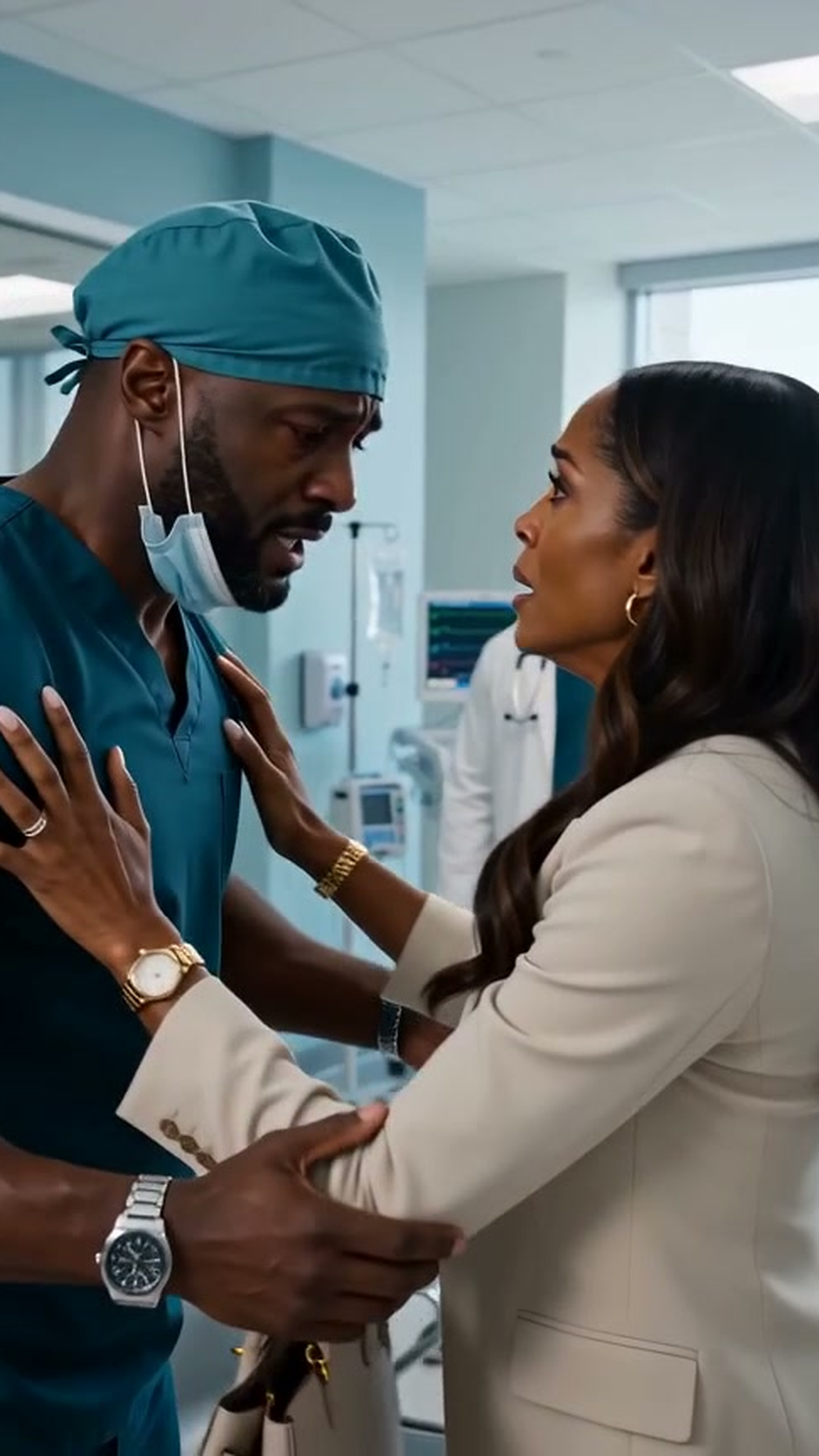
David said it again, gently, the way you lower something heavy to the ground: "Marcus. She deserves to know."
For a moment nobody moved. The corridor held its bright, antiseptic breath. Naomi stood with her hand pressed to her mouth and her husband's unfinished sentence hanging in the air where it had broken — *Honey… there's something I—* — and the rest of it, the whole six weeks of it, stood behind that broken sentence like a wave behind a seawall, and she did the thing she had driven across town to do.
She lowered her hand. She looked at him — his red eyes, the mask hanging beneath his chin, the shoulders of a man carrying something alone into the sea — and she asked the question like his wife, not like a prosecutor.
"Marcus Bennett. What is Jaylen Brooks's middle name doing on a funeral receipt in your coat?"
He made a sound then that she had never heard from him in eleven years. Not a word. The sound a structure makes.
"Marcus—" she said, and stepped toward him.
"Jaylen Marcus Brooks," he said. His voice came out raw and fast, a confession outrunning its own keeper. "It isn't his birth name. His mother put it on the stone because — she said I was the last person who held his heart and she'd be damned if—" He stopped. Swallowed. Started again, and this time he would not stop, and she could see him decide it, could see the seawall give. "Six weeks ago. A Tuesday. Car accident, a drunk ran a light. He was seventeen. He was bleeding in three places and I got two of them, Naomi. I got two of them and the third one was a flaw in his aorta he'd been born with, hidden, no scan ever caught it because nobody ever had a reason to look, and it tore while he was open on my table and he died with my hands in his chest. He died at one-fifty-two and I sat beside his mother in a plastic chair and told her and she thanked me. She *thanked* me, and I've been — "
He ran out of air. David had moved, somewhere in there, had quietly gathered the fallen lunch bag and the pie container and the little folded note off the floor, and now he stood holding all of it against his white coat like an offering he didn't know where to set down.
"The hospital sealed it," Marcus said. "Peer review. Lawyers. They told me anything I said could be discovered if the family sued, that you'd become a witness to my — state of mind. Whitaker did the math. Tell her after the ruling, she said. After. So I paid for the funeral out of my old residency account because he needed burying and his mama works two jobs and it was my table, Naomi, it was my *table*. And Thursdays I go to her house. The porch rail. Her boy was going to fix it in the spring. And the review board meets at three o'clock today — in less than an hour they decide whether I keep operating — and I was going to tell you tonight. At seven. With an ending. I've rehearsed it four hundred times in that chair and I never got past the first sentence, and I'm sorry, I am so — " His face finally, fully broke. "I'm sorry. I lied to you by silence for six weeks. You're the only person on earth I have never lied to, and I lied to you, and everybody in this building knew before you did, and I will spend the rest of my life being sorry for exactly that."
The corridor was silent except for a monitor beeping somewhere, far away and ordinary.
Naomi was aware of several things at once, in layers, like sediment. That her hands were shaking. That she was furious — a clean, bright fury, at Whitaker and the math and the hospital and him, at six weeks of cold beds and warm scrubs and her own voice saying *it's nothing* to an empty kitchen. That underneath the fury, vast and immovable, was grief — for a boy she had never met, whose middle name was her husband's — and that underneath the grief was something she had not expected to feel and would not have believed an hour ago: relief. The floor of her marriage had not rotted. It had been *loaded*. There was a difference, and the difference was everything.
"You should have handed me the other handle," she said.
His face crumpled. "Naomi—"
"No. You listen to me now." She closed the distance between them and took his face in both hands, the way she had a thousand times, the way she had the morning of their wedding when his hands wouldn't stop shaking over his cufflinks. "I am not angry that a boy died, Marcus. I am not angry that you grieve him. I am angry that you decided what I could carry. Me. The woman who held your mother's hand in the ground. You don't get to decide that, beloved. That is not protection. That is you being the wall again, and I did not marry a wall. I married a *man*, and a man comes home, and a man sits at his own kitchen table, and a man says *a boy died in my hands today and I cannot stop seeing it*, and his wife — " Her voice broke at last, clean through. "His wife holds the other handle. That is the whole arrangement. That has always been the whole arrangement."
He put his forehead against hers, right there in the corridor, in his scrubs, in front of God and the nurses' station, and wept without any attempt to hide it, and she held the back of his neck and let him, and neither of them cared, for the first time in six weeks, about a single other person in the world.
"A reporter called me," Naomi said into his shoulder, because some confessions are easier made without faces. "Tuesday. At our house. She knew his name before I did, Marcus. She said *the Brooks case* like it was weather. A stranger stood in our kitchen through a telephone and told me, by accident, in the middle of apologizing, that my husband had a whole life I wasn't in."
He went rigid against her. Of all the blows the day had stored up, she felt this one land the hardest — felt it go through him like a current — because it was the precise nightmare he had been trying, with all his ruinous discipline, to prevent, arriving anyway, by the back stairs, in a stranger's voice.
"She knew before you," he said, hoarsely. "A *reporter*—"
"She knew before me. The nurses knew before me. Paula knew. *D* knew—" She pulled back, and her hands were fists in the front of his scrubs, and the fury and the love were so braided by then that she couldn't have separated them with instruments. "Who is D, Marcus? Because I found the text. *Thursday still? The porch can wait if you're tired.* I stood in our bedroom and I read that and I did not call her, do you understand me? I did not call a grieving mother and interrogate her about my own marriage, because I wanted to hear it from *you*."
"Denise," he said at once — too fast, the way innocent things are said when they've waited too long. "D is Denise Brooks. The porch is her porch. Thursdays I—" and then the enormity of it reached him, standing there, that his wife had spent two days imagining a lover where there was a grave, that his silence had furnished even *that* room for her, and he closed his eyes. "God. Naomi. There's no one. There's never been anyone. There's a porch rail and a grieving woman and a dead boy and a coward, and the coward is the only one of those that's mine."
"I know," she said, and was startled, both of them were startled, by how true it sounded. "I knew it Tuesday. Renata knew it before I did. The only person who thought I needed protecting from the truth was the one who was drowning in it."
He laughed then — a wrecked, astonished, single note — and then he was crying again, quietly, with her hands still fisted in his scrubs holding him up, and she thought: *here is the whole six weeks, right here. He has been standing in water up to his neck, waving me back from the shore, because he thought the shore was the safe place. He never understood the shore was the lonely one.*
"The first night," Naomi said. "Tell me about the first night. You came in at two-forty-seven. I know because I was awake, Marcus. I heard the door. I heard the tap run. I lay there and I listened to my husband sit in our kitchen in the dark for twenty minutes and I told myself it was nothing, and then you came — you didn't come up. And in the morning your ring was by the glass."
He stared at her. "You were awake."
"I was awake the whole six weeks. That's the part nobody tells you about being the one who doesn't know — you're not asleep. You're just lying very still, in the dark, listening to somebody you love decide not to turn on the light." Her voice did not rise. It did something worse; it went very quiet and very exact. "You left your wedding ring by a glass of water you never drank, and I held it in my fist until it got warm, and I want you to know that a stranger's wife would have left. I want you to know what it cost to be the woman who picked it up and put it back on the dresser and waited to be told."
"I found it in the morning," he said. "Back on the dresser, warm. I thought—" He had to stop. "I told myself you'd just tidied it. I told myself even that. I have been lying to myself in bulk, Naomi. You're not even the main account. You're just the one I couldn't afford."
"Then hear me, so the account closes." She took his hand — the right one, the famous one, the one that had held a boy's heart and a thousand others — and put her own hand over it and held it still, like something she was setting down in its place at last. "The waiting is over. Whatever it is from now on, I hear it at the kitchen table, in order, from you. And you—" her grip tightened, "—you never, ever sit in our kitchen in the dark again. You come up the stairs. You wake me. That is what I am *for*. Do you understand what a wife is for, Marcus Bennett? It is not for being protected from the war. It is for being told."
"Yes," he said. "Yes. I understand it now."
It was David who finally spoke, softly, looking at his watch with the expression of a man reading a tide table. "It's two-fifteen," he said. "Marcus. The board room is being set up. And — " He hesitated, and glanced toward the elevators, and his voice changed. "And there's something else. She said she'd wait until after. She promised me she'd wait until after, but she's been downstairs since noon and I don't think she's going to—"
The elevator chimed.
The doors opened, and a woman stepped out into the bright corridor — small, graying, in her Sunday coat, with a folder held against her chest in both arms the way people carry babies and subpoenas. She looked at the knot of them — the surgeon, the wife, the doctor holding a lunch bag — and she stopped, and her chin rose, and Naomi knew before anyone spoke, knew by the shape of the woman's grief and the shape of her courage, knew the way you know weather in a scar.
"Dr. Bennett," said Denise Brooks. "I know I'm not supposed to be up here."
She looked at Naomi then — really looked, for the first time, wife to mother across forty feet of polished floor.
"And you must be the one he does it for," she said. "He talks about you when he fixes my porch. Mrs. Bennett — I need to talk to that board before three o'clock, and I need you both to help me get in."