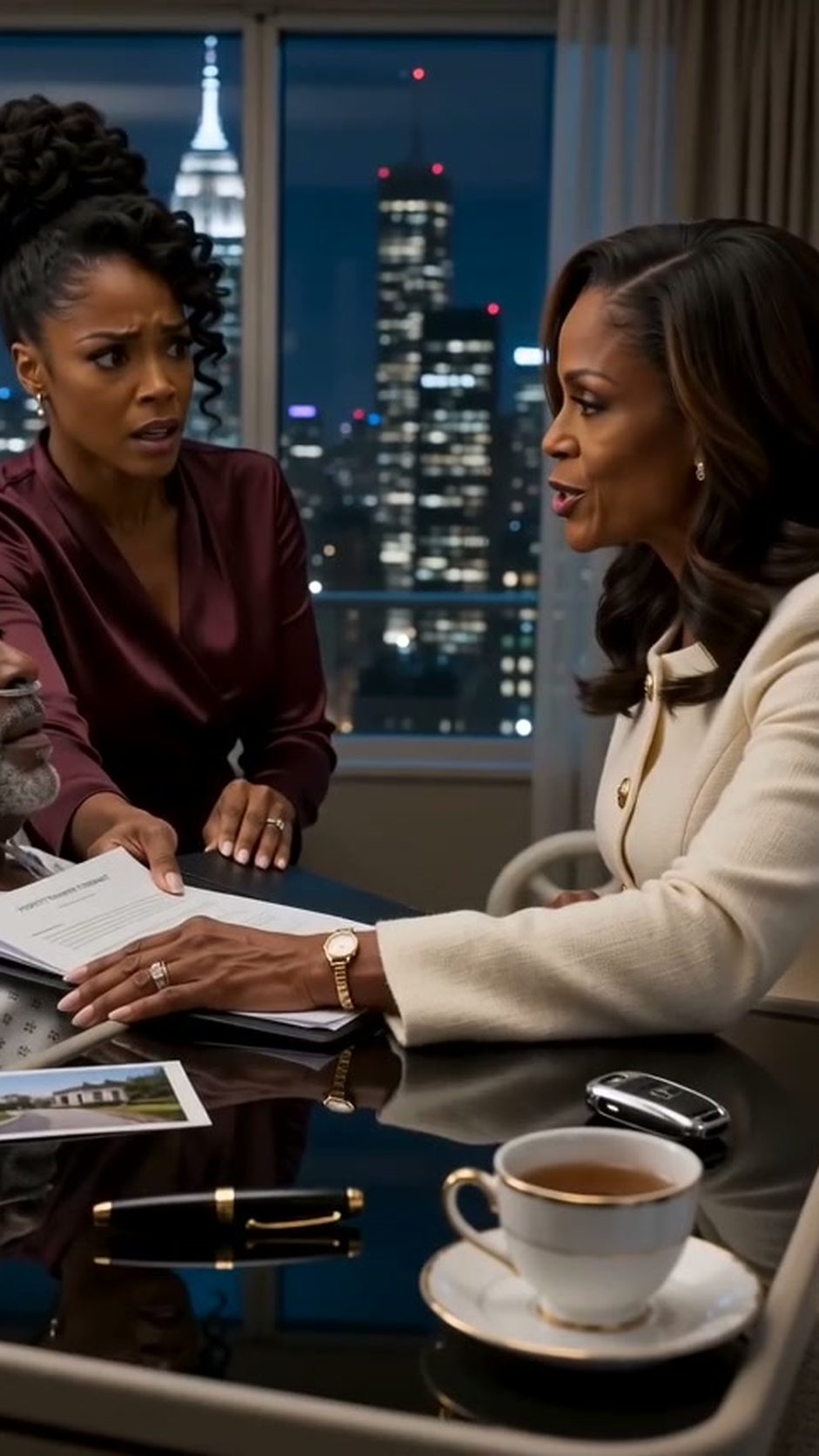
Raymond lived. She had commanded it in the tone she used for caterers and kings, and his heart — that vain, overworked, treacherous organ — had obeyed her, which Pierce said was the most married thing he had ever heard.
The reckoning proceeded on two tracks, the way reckonings do: at the speed of lawyers, and at the speed of women talking in kitchens.
The lawyers were faster. The attempted transfer was withdrawn within the week, unwound in a blizzard of corrective filings, with Hale — who had developed a sudden, sincere passion for his client's wife's position — cooperating at a speed that suggested a man helping to bury something he had nearly been buried in. The thirteen-year archive changed the temperature of every room it entered. Adultery, documented to the hour. Asset diversion, documented to the dollar: the brownstone, the cars, the school fees, the "consulting" invoices Sabrina had signed and Ruth had paperclipped, the escape account two states away, which the divorce filing froze to the last cent before Raymond's new attorneys had finished reading about it. The cold-weather clause of the Hart Family Trust woke up, exactly as Charles Hart had designed it to, all its protections firing at once like lights coming on down a long corridor.
The board of Calloway Properties — informed by Pierce, in a closed session, of the majority shareholder's identity and the chairman's attempted conveyance of trust assets — removed Raymond as chief executive by a vote of seven to two, with the tenderness of men voting a captain off a ship they intended to keep. The two dissenting votes were men whose resignations were accepted the following morning.
Vanessa declined the chairmanship. She took, instead, the title her father had held and the one the staff had been using about her for years anyway: she walked into the Alder Lane headquarters in the second week as Acting Chair of the trust and Chair of the board, and Ruth Delgado, who had typed Charles Hart's first payroll and waited thirty years for the building to come back to a Hart, met her at the elevator with the ledgers under her arm and said, "Your father's chair is still in his office, Mrs. Calloway. We never let the company reupholster it."
"Then sit with me while I decide what to do with it, Ruth. And it's Vanessa. It was always Vanessa."
* * *
Margaret came on a Sunday, without the pastor, without the pearls — the first time Vanessa had ever seen her mother-in-law's bare throat — and stood in the doorway of the Alder Lane house like a woman visiting the scene of her own crime.
"I did it," Margaret said. No preamble. Seventy-one years of artillery, and she arrived unarmed. "Whatever you think of me, know that I know what I did. I found out about the girl in the second year. Raymond told me himself — crying, if you can picture it, at my kitchen table, like a boy confessing he'd broken a window. And I told him—" her voice, that fog-glass voice, cracked down the middle "—I told him to be discreet. I told him a discreet arrangement was better than a scandal, and that the boy should be provided for, and that you—" She stopped.
"Say it," Vanessa said, not unkindly. She had learned, thirteen years deep, that the unbearable thing must always be said or it rots. "You told him I was a house with no heir in it."
"I told him you couldn't give him what she could." Margaret's hands worked at each other like small animals. "I have been a widow since I was forty-nine. I raised that boy over a laundromat on tips and spite, and I swore his children would never smell detergent steam, and when you lost those babies — God forgive me, Vanessa, God forgive me, I have said it to the ceiling every night this week — I counted it as your failure instead of my son's grief. I chose the blood. And the blood—" She made a sound that in a younger woman would have been a sob. "The blood was a driver's, and my son sold his soul for a certificate with a blank space where the father's name goes. I have read that report nine times. Jonathan Pierce sent me a copy. He said you instructed it."
"I instructed it," Vanessa said, "because you built your whole faith on a fact, and you deserved to learn the fact from paper, not from gossip. Sit down, Mother. I'll make tea."
They drank it in the sunroom, these two women, in the wreckage of the family they had between them spent twenty-one years alternately building and besieging, and Margaret said the hardest sentence of her life in a voice that barely carried across the teacups.
"If you had told me — that first year — I would have called you a liar and destroyed you in every drawing room in this city."
"I know."
"That is why you didn't." Margaret looked at her with the first clear gaze of their acquaintance. "That is why you waited thirteen years and let us all hang ourselves with rope we brought from home. You are the most frightening woman I have ever met, and my son—" the old eyes filled, and did not spill, a Calloway discipline at last put to honest use "—my son had you. He had you, and he spent you on a lie about his own blood. I will not forgive him for that while I live. I want you to know that someone in his family said it where you could hear it."
Vanessa covered the working hands with her own, steady as ever.
"Drink your tea, Mother. It's the blend you like. I keep it for you. I have always kept it for you."
* * *
Sabrina's choice, when Pierce laid it out for her in his office — with her own attorney present, a young woman who looked progressively more ill as the archive's table of contents was read aloud — took eleven minutes to make, which was ten minutes longer than Vanessa had predicted.
Option one was a war: fraud referrals for the consulting invoices; a civil suit for thirteen years of diverted funds, down to the school fees and the SUV leases and the escape account's twin deposits; a public record, a public trial, and a paternity finding entered into evidence where any reporter, any parent at Owen's school, any search engine on earth could find it forever.
Option two was a door. Sabrina signed a full confession and a lifetime nondisclosure agreement. She surrendered every asset purchased with Calloway money. She left the city. And in exchange — Vanessa's condition, inserted over Pierce's visible astonishment, nonnegotiable — a sum was settled into an irrevocable trust with an independent trustee, untouchable by Sabrina, untouchable by creditors, untouchable by Vanessa herself: Owen Cole's education, housing, and care, through college, with the boy's name alone on it.
"He isn't my grandson," Margaret had said, when Vanessa told her. "He isn't anything to this family. He is the living receipt for my son's ruin, and you are endowing him."
"He is twelve years old," Vanessa said. "He was the receipt, Mother. Now he's just a boy. I've had thirteen years to aim at exactly the right people. I don't intend to miss at the end."
Sabrina signed. At the end, pen down, she looked up at Vanessa across Pierce's desk with a face washed clean of thirteen years of performance, and what was underneath it was not a monster. It was a twenty-three-year-old receptionist who had gotten pregnant by a driver and looked at the rich man who desired her and seen — correctly, God help them all — that he would pay any price to believe the child was his ticket out of death.
"You knew," Sabrina said. "All this time. At the galas. You'd smile at me. You sent Owen a birthday present through the foundation every year. A book, every year, with a card." Her voice broke open. "Why didn't you hate me enough to stop it?"
"Oh, Sabrina." Vanessa stood, and gathered her handbag, and paused at the door of the office where she had first said the sentence about ending things on her terms, thirteen years before. "Hating you was never the assignment. The assignment was the ending. And this is it — for you, a door instead of a war. Walk through it and be a mother. It's the only true thing you've got. I checked."
At the threshold Sabrina said, very low, "What do I tell Owen? When he's older. He'll ask who paid for his school, his house — he'll ask about the hospital. What do I tell him?"
Vanessa considered her — this woman who had lied to a dying man about the one thing he was dying of not having, and who was now, at the very end of her empire, asking how to tell the truth. It was the first honest question Sabrina had ever put to her. She honored it with an honest answer.
"Tell him his mother made a terrible bargain, and that a woman he barely remembers refused to let him pay for it. Tell him the rest when he's twenty-five and can carry it. And Sabrina—" the ghost of the gala smile, and then, unexpectedly, something kinder underneath it "—when you tell it, tell it once, tell it whole, and never make him carry your half. That's the whole curriculum. The boy has had enough adults handing him their weight."
She left her standing in the doorway of other people's offices, in the first minutes of the rest of her life.
* * *
Raymond signed the settlement in the hospital, in a private room a floor below the ICU, sitting up against the pillows with a tray across his knees like a schoolboy at a desk. The pens were ordinary ballpoints. Hale was gone from his retinue; the new attorneys were younger, quieter, and spoke to Vanessa first when they entered a room, which told its own story.
He did not contest anything. The archive had seen to that, and something else had too — something Pierce, reporting by phone, described as "a man who has finally read the documents, Vanessa. All of them. Including the ones in his own marriage." The terms were these, and they were hers, and she had made one of the lawyers read them aloud twice to be certain they were merciful in the right places and merciless only in the right one: the divorce uncontested; the trust and the company and the eight properties and the ground itself, Hart ground, forever beyond his reach; his pension preserved intact, because she would not have it said she left a sick man penniless; Margaret's house and care guaranteed for life, because a promise to an old woman was a promise. And Raymond Calloway would retain his name, his watch, and his clothes, and the dignity of never being prosecuted for the attempted transfer — provided the signature on the final page was his, and final.
He signed. The trembling was worse now; the doctors called it medication and the nurses called it grief, and Vanessa, watching the pen make its slow, wrecked way across the line, called it nothing at all.
"There's a question you asked me," she said, when the attorneys had taken the folders and gone, and the room was only the two of them and the quiet machinery. "In the ICU. You asked if I ever loved you."
Raymond's eyes were already full. "Vanessa—"
"Every day," she said. "That's the part no one will understand, so I'll say it once, to you. I loved you every day of it. The eight years before, and the thirteen years during. Love was never the question, Raymond. It's why it took thirteen years. A woman who didn't love you would have left in the first October, with half the furniture and my father's name, and she'd have been right to. I stayed because I loved you, and I documented because I loved what my father built, and I waited because I loved—" she stopped, and corrected herself with the archivist's precision "—because I needed the ending to be true. Not loud. True."
He wept then, openly, a dying empire's king in a hospital gown, and she sat with him until it passed, because she had held his hand in two small hospital rooms where their children had slipped away unfinished, and some things the body remembers past every verdict the heart delivers.
On her way out, at the elevator, the young attorney caught up with her, carrying an envelope that had not come through legal channels. It was from Sabrina's lawyer, forwarded with a note: The enclosed is from the boy. His mother says he insisted. Do with it what you think best.
Inside, on lined notebook paper, in the handwriting of a twelve-year-old — the letters still too big, still being learned — were four sentences.
Dear Mrs. Calloway,
Mom told me the truth, or most of it I think. I'm sorry she lied to you. You were the only person at the hospital who wasn't yelling or crying. Are you okay?
From Owen
Vanessa stood in the hospital corridor, between the amber light and the elevators, and read it three times, and then she put it in her handbag — in the envelope's place, where the sealed things lived — and went home to write back.