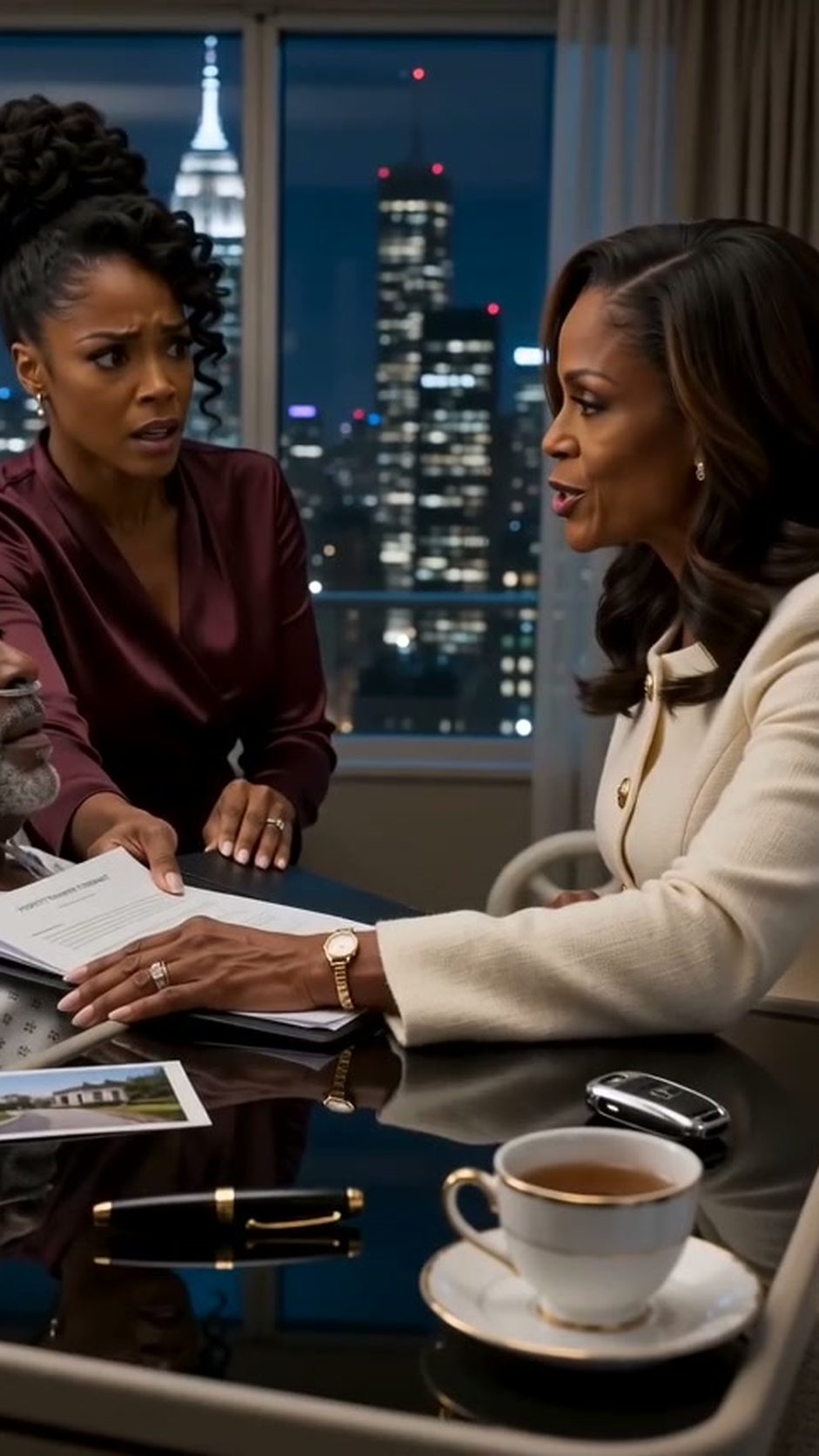
They arranged him like a king for it. That was the unbearable part — that even this, even his own dismantling, Raymond staged as a ceremony of state.
The pillows were plumped. The bed raised. A nurse smoothed the white patterned gown and checked the nasal cannula and withdrew with the tact of a woman who has set the scene for a hundred such theaters and knows better than to applaud any of them. On the black table: the folders, ranked like soldiers. The property photographs, eight of them, glossy — the waterfront houses, the hillside houses, the lake house with the dock her father had built plank by plank. The miniature mansion, brought by Margaret from the study at home, set down with ceremony at the table's corner. Three key fobs in a row, bright as medals. The black-and-gold fountain pen, Raymond's pen, the one from the magazine photograph.
Hale stood at the foot of the bed with the air of a man conducting an orchestra only he could hear. Margaret sat at her son's right hand, pearls luminous, spine like a flagpole. Sabrina stood at his left, in burgundy satin, one hand already resting — resting — on the back of his pillow, a claimant's hand, a hand practicing ownership of the very furniture of his death.
And Vanessa sat down in the chair nearest the bed, set her handbag in her lap, and accepted a cup of tea from a nurse she thanked by name.
She had read once that in the old days, executions were scheduled for dawn so the condemned could watch one last sunrise. She looked at the city going gold and blue beyond the glass, at the two towers squaring off across the river, and she thought: He built his whole life facing my father's tower. He never once turned around.
"Well," Raymond said. His voice was gravel and ceremony. "Since we're all — family." The pause before the word was the size of a grave. "Let's finish this. Hale."
The documents moved the way documents move at the end of empires: quietly, in order, with witnesses. Hale read the recitals in his facilitator's monotone. The trust for the boy. The eight properties, by their legal descriptions, each one a small geography of her father's life's work. The three vehicles, by their identification numbers — she remembered buying the first of them, remembered the salesman, remembered Raymond's hand at her waist that day, proprietary and warm.
Raymond signed. Page by page, slower each time, the trembling fought and mastered and fought again — the smug satisfaction of a man performing his own legend: the provider, providing, to the very door of death. Sabrina watched the pen the way altar servers watch the flame. Margaret watched Sabrina with the fulfilled serenity of a woman whose prayers had been answered by the management.
And then came the last document. The master agreement. The thick one.
His trembling finger pressed onto the final page to hold his place. Sabrina's hand closed on the folder and pulled—
—and Vanessa's hand came down, flat and gentle and absolute, and stopped thirteen years of momentum with no more effort than a woman setting down a cup.
"Thirteen years, Raymond."
You know this moment. You have already stood in this room, in this silence, and heard the monitor crack its single wrong note. What you have not seen — what the silence was holding, the way a held breath holds a scream — is what happened next.
What happened next was that Vanessa Calloway opened the envelope.
She did it without hurry. Hurry is for people who fear interruption, and she had arranged, with an attorney's precision and a wife's patience, to be uninterruptible. The seal broke with a small, clean sound. She drew out the contents — not the DNA report. Not yet. She was her father's daughter, and her father had taught her that you demolish a building from the foundation up, so that it falls inward, onto its own ground, and hurts no one standing outside the fence.
"Before Hale files these," she said, pleasantly, to the room at large, "there is a title matter. It won't take a moment. Hale — you ran a title search, of course."
Hale's smile performed a small, professional death. "The properties are Calloway Properties assets—"
"The properties," Vanessa said, "are Hart Family Trust assets. They have been since my father's lifetime." She laid the first document on the black table like a card player laying down a card she has held so long it has warmed to her hand. "The Harborview houses. The Alder Lane house. The lake house. All eight. Here is the Trust Consolidation and Trustee Confirmation — certified, recorded, and, I am afraid, fatal to this evening's ceremony." A second document joined the first. "Signed by you, Raymond. Nine years ago. In Pierce's boardroom. The management of the properties remains with the company — nothing about your work changes, nothing about the tenants, the taxes, the staff. But the title—" she touched the page, almost tenderly "—the title belongs to the trust. And the trustee of the Hart Family Trust is the person sitting in this chair."
The monitor had begun, very slightly, to hurry.
"You can't give away these houses, darling," Vanessa said, and the darling was the most devastating syllable spoken in that room all night. "They were never yours to give. You just attempted — in front of your attorney, your mother, and two nurses I intend to be very kind to in my statement — to transfer eight properties you do not own to a trust controlled by your mistress. There are legal words for that. Hale knows them. I can see that Hale knows them."
Hale had gone the color of his own stationery. "Raymond," he said quietly, "don't say anything. Not one word. I'm instructing you—"
"The cars," Sabrina said. Her voice came out wrong, too high, a string tuned past its pitch. "The cars are his. Tell her the cars are—"
"The cars are titled to Calloway Properties." Vanessa laid down the third document with the same dreadful gentleness. "And fifty-one percent of the voting shares of Calloway Properties are held by — I'm sorry, this must be tedious — the Hart Family Trust. The board serves at the pleasure of the majority shareholder. I had the registry certified this morning. I am the majority shareholder, Sabrina. I have been the majority shareholder since before you were old enough to sign the lease on your first apartment. The one the company paid for." She folded her hands. "Raymond owns a salary, a pension we will discuss, a watch I gave him for his fiftieth, and the clothes in his closet. That is the complete inventory of what Raymond Calloway can give away. He is welcome to all of it, with my blessing. It was never the money, you see. It was the ground. And the ground was never—"
"He's Raymond's blood!"
Margaret was on her feet — she had been building toward it since the first document, rising by inches of outrage — and the pearls swung, and the hand that had pressed the table that morning in another version of this day now pointed, trembling, at Vanessa like the finger of an Old Testament God. "Whatever papers you have dug up, whatever lawyers' tricks — the boy is his blood! His son! His heir! Everything he built should go to his blood, not to a barren woman with a filing cabinet!"
The room went absolutely still. Even the monitor seemed to listen.
Vanessa stood up.
She had not planned to stand. She had planned the documents, the order, the tone; she had planned to be, throughout, the calmest person in the room, because her calm was the message. But there are words that have been aimed at a woman for twenty-one years, and barren had been Margaret's favorite arrow since the Christmas of the second lost baby, and Vanessa found herself on her feet with the envelope's remaining contents in her hand, and her voice, when it came, was so quiet that Sabrina actually leaned forward to hear the end of her own world.
"His blood," Vanessa repeated. "Yes. Let's finish with the blood, Mother. Since you insist. Since you have always insisted."
She drew out the second report and laid it down on top of the transfer agreement — on top of Raymond's signature, on top of the smug, trembling triumph of ten minutes ago — the way one lays a stone on a grave.
"Laboratory of Maryland. Chain of custody available for your attorneys. Swab obtained from a bottle your grandson discarded at his Little League game two years ago, Margaret — the foundation sponsors his team; I thought you knew." Her eyes never left Raymond's face. "DNA paternity test. Tested man: Raymond Calloway. Child: Owen Cole."
A sound came out of Sabrina that was not a word in any language.
"Probability of paternity," Vanessa read, from memory, because she had read it a hundred times in nine years and it was carved on the inside of her, "zero point zero zero percent. Exclusion confirmed. Raymond — Owen is not your son. He never was your son. He is Marcus Webb's son. Your driver. You remember Marcus. You paid him a very generous severance twelve years ago, three months before the baby was born. Sabrina was already pregnant when you met her at the leasing office, darling. She simply—" she glanced, almost gently, at the woman in burgundy, who had taken one small, unsteady step backward and found no wall there "—she simply let you believe the version that made her a rich man's family instead of a driver's mistake. And you believed it. You believed it because it told you that you were not going to die uncontinued. She didn't sell you a son, Raymond. She sold you immortality. You're her best customer. You have been paying installments for thirteen years."
The monitor was racing now, and Raymond's hand had come off the blanket and was gripping the bed rail, and his face — God help her, his face — his face was doing something she had never seen it do in twenty-one years, something she would not have wished, in the end, on any living man: it was understanding everything at once.
Sabrina reached for the documents — a wild, drowning reach, both hands, to gather them, hide them, unhappen them — and Vanessa intercepted her wrist with one firm, restrained movement, woman to woman, skin to skin, no violence in it at all and no mercy either. "No," she said. "Those are mine. Everything on this table is mine. That was rather the point of the evening."
Sabrina recoiled. The property photograph on the table's edge — the lake house, the dock, her father's planks — slid as her hip brushed the table and stopped, trembling, half over the edge, like the whole past thirteen years deciding whether to fall.
"Vanessa." Raymond's voice. She would hear it in her sleep for months. Broken machinery of a voice, a king's voice in a collapsed mine. "Vanessa. Please. Please say—"
"Don't." The doctor was already in the doorway; the nurse had moved, fast and silent, to the monitor. "Breathe, Raymond. Slowly. You're not dying tonight." Vanessa leaned over him — close, the way she had leaned in the morning, with her hand flat now on his sternum, feeling the frantic drum of him through the hospital gown, holding him in his body by main force of will. "Dying would be easy. You don't get easy. You get to live, and know. Breathe."
Whether it was the command in her voice or the medication the nurse slid into the line, the numbers on the monitor began, grudgingly, to step down from the ledge. Raymond's eyes stayed on hers the entire time — wide, wet, stripped of every performance he had ever owned — and as the sedation took him down into the gray country, his hand found her wrist and held it with the last of his strength, and she heard him shape, more than say, the only honest sentence he had produced in thirteen years:
"Did you ever—"
The monitor beeped, steady and ordinary, like a heart deciding to continue.
"—love me?"
And then he was under, and the room was full of efficient strangers, and Vanessa stood in the corridor with the empty envelope in her hand, looking down at her own handwriting on the front of it — the label she had written in Pierce's office nine years before, in her neat, gala-program hand.
FOR THE DAY HE REACHES FOR THE GROUND.
She was still looking at it when Pierce came around the corner with a second folder under his arm and said, quietly, "Phase two, Vanessa. Whenever you're ready."