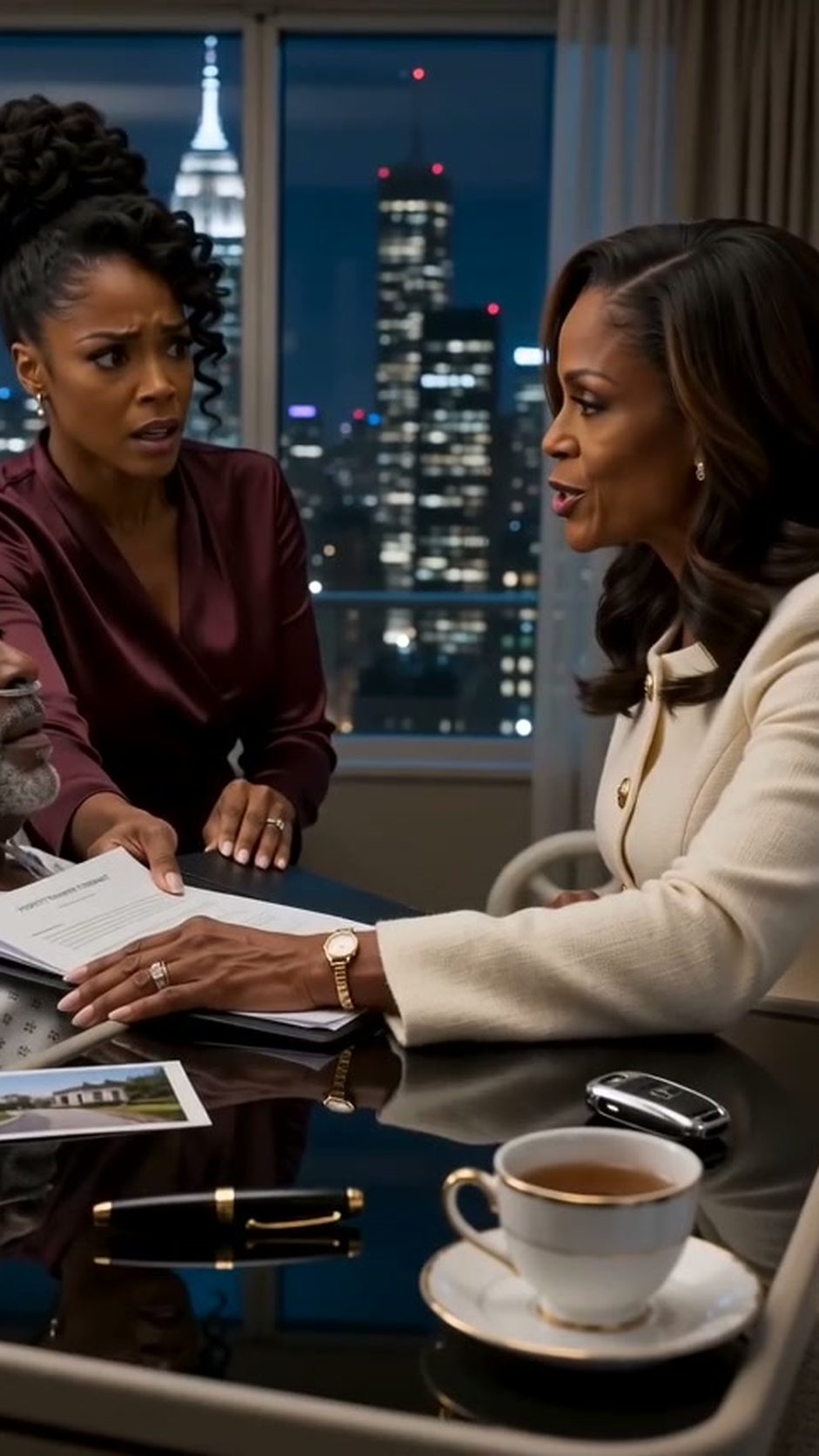
The divorce became final on a bright morning in April, in a courtroom with high windows, and it took eleven minutes.
The judge — who had read the file, and whose expression throughout suggested a woman reading a novel she intended to recommend to her book club — made one comment from the bench, addressed to no one in particular and therefore to history: "In twenty-six years, I have never seen a record this complete." Pierce, at Vanessa's left, allowed himself the smile of a man whose queen has not merely won the game but been awarded the board.
Outside, on the courthouse steps, there were no reporters. She had arranged that too — one call, one favor owed by an editor whose daughter the foundation had put through medical school. Thirteen years of her life were sealed in the court record and the storage facility, and she intended for the world to know exactly the version she chose to publish: a quiet divorce, an amicable settlement, a chairwoman taking up her father's work. The truth was not gossip. The truth was hers, and she kept what was hers.
At the bottom of the steps she stopped, and did the last piece of paperwork herself, in her head, the way she had done everything that mattered.
Vanessa Hart.
She had been Vanessa Calloway for twenty-one years — had been Mrs. Raymond Calloway for the last thirteen of them the way a lighthouse is a ship's: fixed, bright, and wrecked against in private. The name came off like a coat she had worn through a long winter she'd never agreed to. Underneath it was the name she'd been born with. Hart. Her father's name. The name on the ground.
"Well," said Pierce, beside her, squinting into the spring light like a man emerging from a very long, very satisfying cellar. "What does Vanessa Hart do now?"
"She has a list," Vanessa said, and they both laughed, because of course she did.
* * *
The list was not short, and it was not revenge-shaped. She had finished with revenge in the ICU, with her hand on a dying man's chest, commanding him to live; everything after that was construction, which is a slower and better use of a Hart.
The Calloway tower kept its name — changing it would have been vanity, and besides, she told Ruth, the letters were brushed gold and very expensive — but the company went home to its origins in every way that mattered: Hart Development Group, by the end of the year, with a professional CEO hired from outside the family, a board rebuilt like a seawall, and an endowment carved permanently out of the profits for the foundation. The eight properties she walked through one by one in the spring, with a notebook, deciding their fates the way her father had decided their beginnings: the lake house she kept — she'd earned the dock, plank by plank, in a currency no one else could count; two of the waterfront houses became the endowment's income; the brownstone across the river, the first evidence in box one, she sold without ever entering it again, and put the proceeds into the foundation's newest project and its most personal.
A residence and scholarship house for young mothers finishing their education. It opened in the fall with forty beds, a daycare on the ground floor, and a brass plaque by the door that named it for no one — she had forbidden her own name on it — but dedicated it, in letters small enough that you had to step close to read them, the way you step close to hear the important things:
For the children who were almost mine. For the women who wait, and the ones who shouldn't have to.
At the opening, a resident — twenty years old, a nursing student, with a daughter of eight months asleep against her shoulder in a wrap — stopped Vanessa on the stairs of the daycare and said, shyly, that she had read about the house in the paper and wanted to know whose idea it was, so she could tell her daughter someday whose door they had knocked on. Vanessa looked at the sleeping child, at the small, serious fist curled against her mother's collarbone, and felt none of the old arithmetic stir — no Christmas-table counting, no grief keeping its ledger. Only a plain, enormous gladness, the kind with no paperwork in it.
"Tell her it was built by a woman who waited a long time to be useful," she said. "And tell her the door is the kind that stays built. That's the whole story a house needs."
She went on up the stairs to cut a ribbon she had also tried to refuse, and the scissors were, she noted with private amusement, held for her by the mayor's wife — and not one person in the photograph was performing anything at all.
Sabrina sent a photograph at Christmas, through the trustee, as the agreement permitted: Owen, thirteen now and shooting up like a weed in sunshine, holding a report card and a Little League trophy, grinning the driver's grin into the camera without a shadow on him. On the back, in Sabrina's hand, three words: He knows nothing — no. She had written, and Vanessa believed every word of it because it cost the writer so much: He is happy. Thank you.
Vanessa wrote back, as she had written back to his first letter, because she had decided that the boy was not a file and would not be filed: Dear Owen. Yes, I am okay. Better than okay. Study hard, be kind to your mother, and when you're grown, if you ever want to know the whole of it, you may ask me and I will tell you the truth. It's the only thing I've ever been interested in giving people. She signed it, as she signed everything now: V. Hart.
Raymond she visited twice.
The first time was in June, at the rehabilitation residence — modest, clean, sunlit, the best his pension and her guarantees could reasonably arrange, which was to say considerably better than he deserved and exactly what she had promised. He was thinner. The arrogance had gone out of him like air from a tire, and what remained was an old man in a chair by a window, working a crossword in a hand that shook, who looked up at his ex-wife in her ivory suit and wept without preamble, the way the very old and the very young weep, at the simple sight of what they have lost.
"I dream about the garden," he said. "The wedding. You laughed at something Charles said, bringing you down the aisle. I dream it in order. I never dream the hotel."
"I know," Vanessa said. "I used to dream the hotel. I don't anymore."
The second visit was at Christmas. She brought the tea — Margaret's blend; Margaret, who now telephoned her daughter-in-law every Sunday with the determination of a woman defusing her own history, had insisted on the tin being from her kitchen, a state visit in miniature. They drank it by his window while the snow came down on a city that had gone on, as cities do, entirely unaware that it contained the whole story. He asked about the company. He asked about the foundation house, and about the boy — he called him "the boy" still, and then corrected himself, with visible effort, to "Owen," and she understood that the correction was the most expensive sentence he owned.
"He's well," she said. "He's provided for. None of it touches him, Raymond. That was the design."
"You designed mercy into it," he said wonderingly. "Thirteen years of — and you designed mercy into it."
"My father," Vanessa said, "built foundations before he built houses. It's the part of the structure nobody sees. It's the part that decides what survives the storm." She stood, and smoothed her blazer, and took his trembling hand one last time — the hand that had signed the end of everything, in a hospital room, with the whole city watching through the glass. "I forgive you, Raymond. I want that on the record between us, since records matter in this family. I forgive you. I just don't belong to you anymore. I never entirely did. That was your one great miscalculation — and you made it in the first year, when you read the marriage certificate and not the trust."
She walked out into the snow with her head up, into the rest of her life, which was considerable.
* * *
The foundation gala came around again that autumn, as it had every year of the story, indifferent and glittering — twelve hundred guests, the quartet, the towers finding their beat across the water. She opened it herself this time, from the podium, in ivory, under no one's name but her own: the Hart Foundation, the residence house's first forty graduates, the endowment's new wing at St. Aurelia for children whose hearts needed mending. Owen's Little League team — sponsored still, funded still — had sent a card the size of a door, signed in forty hands.
And when the dancing started, it was Margaret who crossed the floor to her — seventy-two, pearls restored, spine like a flagpole still — and said, in the carrying tone she had once used for proclamations of blood, pitching it this time for the whole front row of the city's memory: "Dance with an old woman, Vanessa. The whole room is watching, and for once in my life I should like them to see me standing next to the right person."
They danced — awkwardly, briefly, to enormous applause that the two of them pretended was for the quartet — and if the society photographers ran the photograph the next morning, the caption under it said nothing about gold, or couples, or years. It said: The Chairwoman and Mrs. Calloway. It was, Vanessa thought, the first fully accurate caption of her adult life.
In January, on the anniversary — not of the wedding; she had retired that date — of an October afternoon with a bag of pasta going cold, Vanessa Hart drove out to the storage facility for the last time.
Thirteen boxes. She had Pierce's archivist bring them to the house on Alder Lane — her house; that had been in the trust too — and she spent one evening with them in front of the fire, the way you sit with an album of a war you survived. Photographs. Ledgers. Ruth's desert-dry paperclips. A boy growing up at twelve feet a year in surveillance stills, oblivious, innocent, getting taller. A woman in burgundy entering and leaving a brownstone, aging beautifully, never once looking over her shoulder for the wife — why would she? The wife had been trained not to exist too loudly.
Near the bottom of box eleven she found the photograph Deke had taken on the worst day of all of them — the Rosewood, dusk, Raymond coming out of the private entrance with his head thrown back, laughing, his hand resting on the swell of a burgundy dress. She had looked at this photograph for thirteen years the way you look at a scar: to confirm the geography of the wound. She looked at it now for a long time, and what she found, underneath the geography, surprised her with its gentleness. He had been happy in it. That was the unforgivable thing and the human thing, all at once: for one photographed second, outside a hotel, holding a borrowed future, her husband had been purely, stupidly happy, and she had loved the man in that laugh before she had ever learned to survive him.
She let it burn last, and she did not look away, and when it had gone she found that the hand holding the empty space where it had been was steady. Steady as stone. Steady as the hand that had come down, one October night in another life, on a stack of documents, and stopped the whole world moving.
The legal copies remained with Pierce, sealed, permanent, hers. These — the originals, the working papers of the thirteen years — she fed to the fire one handful at a time, without hurry and without hatred, while the tea went cold in the cup beside her and the city performed its nightly forever beyond the glass.
She kept exactly one thing out of the flames. It wasn't the DNA report, and it wasn't the trust certificate, though both had saved her. It was a lined piece of notebook paper, the letters still too big, still being learned:
You were the only person at the hospital who wasn't yelling or crying. Are you okay?
She put it in the drawer of her father's desk — her desk — where the important instruments lived. Then she stood for a while at the window, in the quiet house, in the warm light, a woman of fifty with her own name on the door and her own ground under her feet and her whole unwitnessed, unwasted life still in front of her like a morning.
"Thirteen years," she said to the empty room, and smiled the smile that had once frightened a ballroom — except that now it was only, simply, happy. "And every one of them, in the end, was mine."
THE END