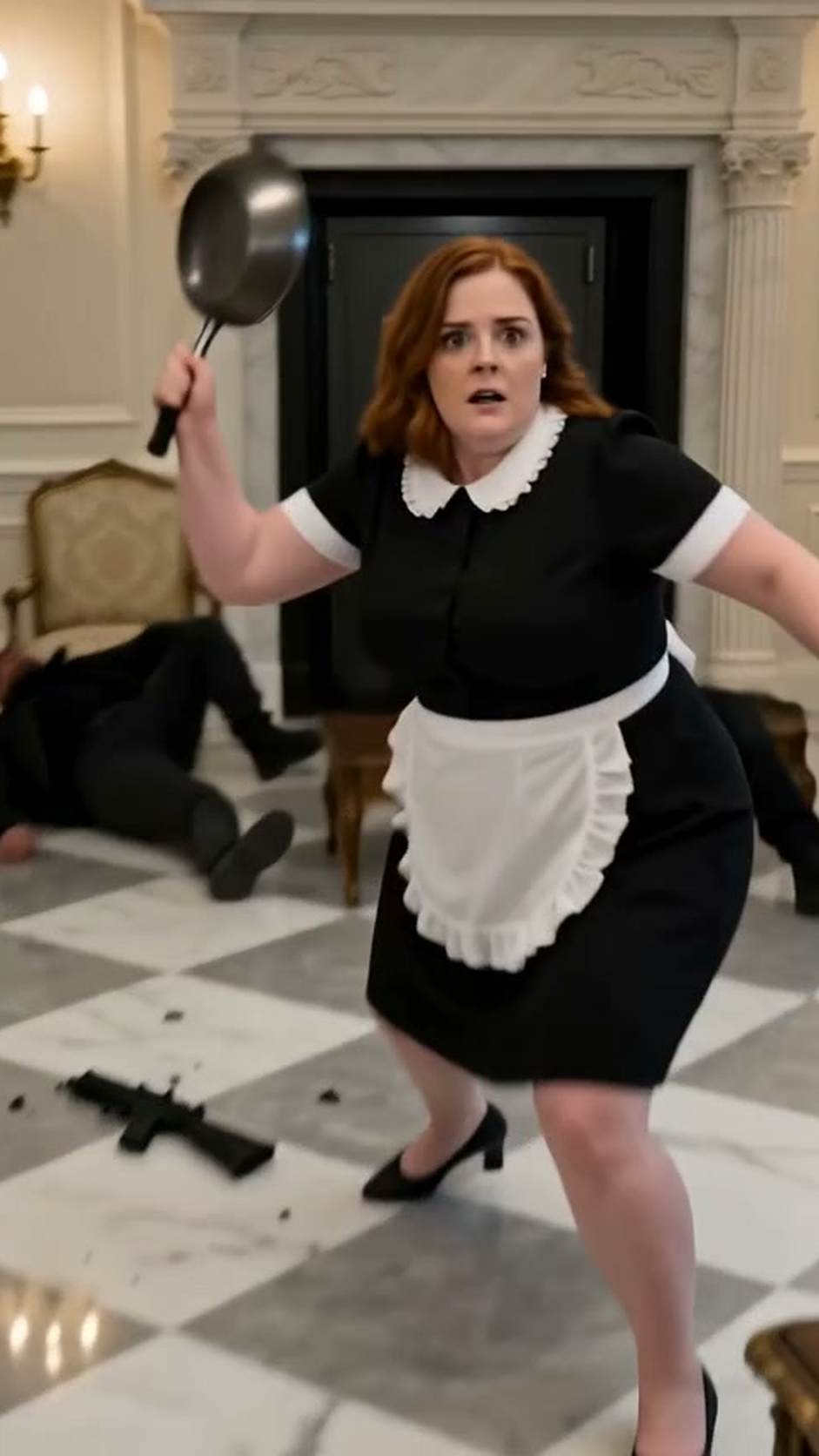
The night it happened, the rain over New Jersey was the kind that erases the world past the windows, and Ethan Caldwell was across the river at a sit-down in Bayonne that his uncle had arranged and insisted upon, with two of his captains and none of his misgivings, because Raymond had framed it as family business and Ethan had not yet learned to hear that phrase as a warning.
Maggie learned later — much later, from a man with every reason to finally tell the truth — exactly how it had been built. How the sit-down was set for the one night the house would be thinnest. How the alarm company received a service call that no one at the alarm company had made. How the three men came over the garden wall at the blind corner by the boathouse, where the camera had been dead for six days and the work order to fix it had been signed and quietly never sent.
She knew none of that at 11:40 on a Tuesday night. What she knew was the dishes.
She knew the kitchen was warm and lit and smelled of lemon. She knew Rosa had gone home at nine, and Danny's night man was doing rounds with an umbrella and a flashlight, and the house above her was dark and sleeping in the particular way of houses that believe they are safe. She knew she was drying the last of the pans. She knew the cast-iron skillet was on the counter by the door, where she had left it a week ago and every night since, the way you leave a word on the tip of your tongue.
And then the lights died.
Not flickered. Not browned out the way lights do in a storm, apologizing as they go. They died — kitchen, hall, the whole great house — all at once, in a single clean cut, the way a throat is cut, and the refrigerator stopped, and the little red eye of the alarm panel by the pantry door, which had blinked at Maggie four thousand times, did not blink.
In the dark, in the rain-silence, her father's voice stood up in her memory the way it had stood up ten thousand times at the kitchen table of her childhood.
Hands, Margaret. Feet. The room is about to change.
She did not turn on her phone light. She did not call out. She took the skillet off the counter by its handle, with the ease of long practice, and she moved along the wall in her stocking feet — she had kicked off her shoes an hour ago, her feet had ached, it was the luckiest accident of her life — toward the service door that led to the main hall, because from the main hall she could reach the study, and in the study there was a telephone that did not run on the house system, and a panic line to Danny's office, and the painting.
She heard them before she saw them: the particular hush of men who have rehearsed being quiet. Three sets of wet soles on marble. A whisper, cut off. The tick of a latch picked by someone who had been told exactly which latch.
They were not burglars and they were not lost. They crossed the hall the way men cross a room they've been shown on a map, and they went into the study, and Maggie Doyle went after them with a frying pan, because the study was where the telephone was — and because behind the painting on the study wall was the only proof in the world that her father had not been a coward, and she was not going to let three men in wet boots carry it out of the house in a bag.
The first man never saw her. He was covering the door with his rifle leveled, a professional, and professionalism had made him watch the hallway and the windows and not the shadow by the desk, and when he lunged — because she had made one sound, one, a breath — Maggie stepped in close, the way her father had drilled into her in a Columbus backyard with a wooden spoon and a clothesline, and she hit his gun arm with the skillet and the rifle went skidding across the marble and the man went through the coffee table with a crash that shook the paintings.
CLANG. She would hear that sound in her sleep for months. She hoped she would. It was the sound of the room becoming hers.
The second man came around the desk fast — they were good, she would give them that afterward, they were expensive men — and his fist took her in the ribs and folded the air out of her, and she went with the fold instead of against it, dropped under his second swing, and brought the skillet up edge-first into the underside of his ribs as she rose. She felt something give. He made a sound like a man sitting down hard on a secret and went to one knee among the ledgers, and she kicked his weapon away across the floor with her bare foot and nearly fell doing it.
The third man was at the painting. He had it off the wall already — the safe stood open-faced in the wall's recess, black and patient — and he turned with his gun coming up and Maggie threw the only thing her free hand found on the desk, which was Ethan Caldwell's whiskey glass, heavy crystal, and it took the man in the wrist and his shot went wide and high and then not wide enough, because the second part of it — no. It was one shot. It was one shot and it went through the sleeve of her uniform and the skin and meat beneath it in a line of white fire, and if she had been six inches to the left it would have gone through her heart, and she understood all of that later, in the hospital-adjacent quiet of her own room, with the bandage on.
At the time she understood only this: he was raising the gun again, correcting, and the desk was between them, and the skillet was in her hand, and she did the thing her father had taught her as the last lesson of all, the one he had made her promise never to use unless the room had already decided to kill her.
She came over the desk.
Not gracefully. Not like a film. Like a woman in a maid's uniform launching herself across a crime boss's desk with a cast-iron skillet, scattering two hundred years of accumulated paperwork, and the man — who was prepared for guards, for alarms, for dogs, for anything in the world except this — put his hands up by instinct, the fool's instinct, and the skillet took him across the side of the head with a sound like a dropped anvil, and he went down behind the desk and did not get up.
Silence. Rain. Her own breath going like a bellows.
Maggie stood in the wreckage with her arm burning and her hair in her face and looked at three men on the floor of Ethan Caldwell's study, and her first thought — she would be ashamed of it later, and then she would not be ashamed of it at all — was that not one of them had touched the safe.
The painting lay face-down on the marble. Behind it the safe door stood closed. Whatever else the night had cost, it had not cost that.
It was not quite over. The second man — the one she had folded over the bookshelves — came up off the floor while her back was turned, quiet as rising water, with a knife in his hand that he had had all along and had not thought he would need. She heard the ledger under his knee shift. It was enough. She turned into him rather than away — close, always close, where a blade is shortest — and the skillet met his wrist with a crack like a branch in January, and the knife went into the dark somewhere, and she put her shoulder into his chest and her hip under his weight and used his own stumbling momentum the way her father had taught her with sacks of flour in a Columbus driveway, and he went down the second time among the books and this time he stayed, with his eyes rolled white and his breathing going shallow and even.
Maggie's arm was on fire to the shoulder. The sleeve of her uniform was wet through and getting wetter, and some clear, cold part of her mind did the arithmetic — not the artery, or she'd be on the floor; a graze, a furrow, it would keep — and filed it, and moved on to the telephone.
The study phone was dead. Not unplugged — dead, the line silent as a held breath, and when she tried the hall extension at the door it was the same, and she understood that the telephones had been part of the plan, like the lights, like the alarm, like everything: the house had been carefully unwired from the world before a single boot touched the marble. Whoever had built this night had built it from inside, with a key, and a code, and a courteous knowledge of where every wire ran.
She went back into the study and shut the door and stood with her back to it, breathing, and then — because she was Patrick Doyle's daughter, and because a man unconscious can still die of a swallowed tongue while help is deciding whether to come — she went from one of them to the next in the wreckage and put two fingers against each throat and counted. Alive. Alive. Alive. She rolled the one by the desk onto his side, the way the first-aid instructor at the Princeton hotel had taught a roomful of housekeepers a decade ago, and she straightened his jacket where it had ridden up in the fall, without knowing why she bothered.
That was when she saw the wrist.
She sat down in Ethan's chair, because her knees had filed a formal resignation, and she put the skillet across her lap, because her hands needed a job, and she looked at the man by the desk, at the way his jacket had ridden up in the fall.
At his wrist.
He had a tattoo on his wrist, small and black and precise, that the struggle had bared: a compass, enclosed in a circle.
Maggie Doyle stopped breathing.
She knew that mark. She had known it since she was six years old, sitting at a kitchen table while her father drew it for her on the back of a racing form to teach her what the family her family served had once been. She had it on the last page of a black notebook upstairs, in her father's hand, with twelve words underneath it that she had crossed a state and fourteen months of other people's laundry to chase.
It points at the family. It always points at the family.
"Oh," she said, very quietly, to the ruined room. "Oh, no."
Because if the men who came for the Compass Ledger carried the compass on their skin — if the old mark had been raised again, after twenty-six years in the grave — then the thing she had suspected, in the deepest and most careful part of her heart, was true.
The ambush on Route 17 had never been about a driver who froze.
And somewhere out in the rain, headlights were sweeping up the drive, too fast, the way a man drives when his house has called him home with the worst news in the world — and Maggie sat in Ethan Caldwell's chair with her father's compass on an unconscious man's wrist six feet away, and waited for the ruthless crime boss of New Jersey to walk into his study and finally, finally see her.