By the end of her first week, Nora understood the house the way you understand weather: not by being told, but by being rained on.
There were thirty-one people on the staff of the Moretti estate, and every one of them lived in terror of a woman with a silver pencil. Mrs. Gable controlled the rotas, the keys, the pantry accounts, the staff meals, and — nobody said this aloud, but everybody's behavior said it — Mrs. Gable controlled access to Don Giovanni, and through Don Giovanni, the one lever that mattered over the master of the house.
Because Lorenzo Moretti was the master of the house. Nora learned that on the second day, from the cook, a vast Neapolitan named Bruno who had been with the family thirty years and spoke of the Morettis the way priests speak of weather in heaven — as a fact that governed everything and could not be appealed.
"Il capo," Bruno said, stuffing mushrooms with the concentration of a bomb disposal expert, "is a good son. A good son! He pays for everything. The chair — that chair cost more than my mother's house. The doctors — specialists from the city, they come in a car with a driver. The room — have you seen the room? Like a hotel for a king. Paintings! A television the size of a door!" He waved a mushroom at her. "Ask anyone. Il capo spares nothing for his father."
"Then why does nobody—" Nora stopped. Bruno's face had closed like the gallery door. He returned to his mushrooms.
"It is arranged," he said to the mushrooms. "Signora Gable arranges. There is a routine. Old people, they like routine."
The routine, as Nora pieced it together over the following days, was this.
Don Giovanni was woken at seven by an agency nurse who came for one hour in the morning and one in the evening, whose name nobody knew because Gable rotated them deliberately so that none of them ever learned the house. He was washed, dressed, given his medication and a bowl of something pale, and wheeled into the small day room off the east corridor, where the television played to an empty chair's companion — a blank wall with a painting of a harbor on it.
At midday, whichever maid was lowest in Gable's favor that week carried in a tray: soup gone cold on the journey, food cut for a man who could barely swallow and therefore needed time and patience and small bites — none of which the rota allowed. Ten minutes, Gable's rule. Ten minutes, and the tray came out, and whatever had not been eaten was recorded in the black book, in Gable's merciless hand, as refused.
Refused. Nora saw the book once, left open on the servants' hall table in the hour when Gable took her rest, and the word ran down the pages of entries like a verdict. Refused lunch. Refused dinner. Refused his medicine, spat it out. The old man is difficult, the book said, in thirty different ways. The old man will not eat.
But Nora had watched him, that first evening, sit with a smear of food drying at the corner of his mouth, facing a wall, and she understood then what she would spend the next six weeks proving to herself: Giovanni Moretti was starving in a palace, in full view of thirty-one people, because it was convenient for the one person who had made herself the wall between him and his son.
She started with the crusts.
Bruno, whatever his fears, could not abide waste, and the staff meal leavings went into a bin by the kitchen door. Nora began, carefully, to divert: a soft roll torn small. The heel of a custard. Mashed potato with butter, still warm, in a teacup, hidden under the cloths on her linen cart. She timed her east-wing duties so that her cart passed the day room at the dead hour after lunch, when Gable took her rest and the corridor cameras — there were cameras; of course there were cameras — were watched, if they were watched at all, by men paid to watch the gates and not the day room door.
"Hello," she said, the first time, from the doorway, with her heart hammering so hard she was sure the baby could hear it. "I'm Nora. I do the linen. I'm not supposed to be here, so we won't tell anybody."
Giovanni's eyes came to her — the only part of him, besides breath, that entirely obeyed him — and she watched the thing happen that no one in the house believed happened anymore: he attended. His gaze fixed on her face with a hunger that had nothing to do with the teacup.
"I brought this from the kitchen. It isn't much. It's warm, though." She came in — God forgive her, she came in, she crossed the threshold of the forbidden room with her illegal teacup — and knelt by the great chair, which cost more than a house and could not do the one thing it was for, which was to bring him to the height of a person who might be spoken to rather than down at.
"Small bites," she told him. "I'm in no hurry. Nobody knows I'm here, so I have all the time there is."
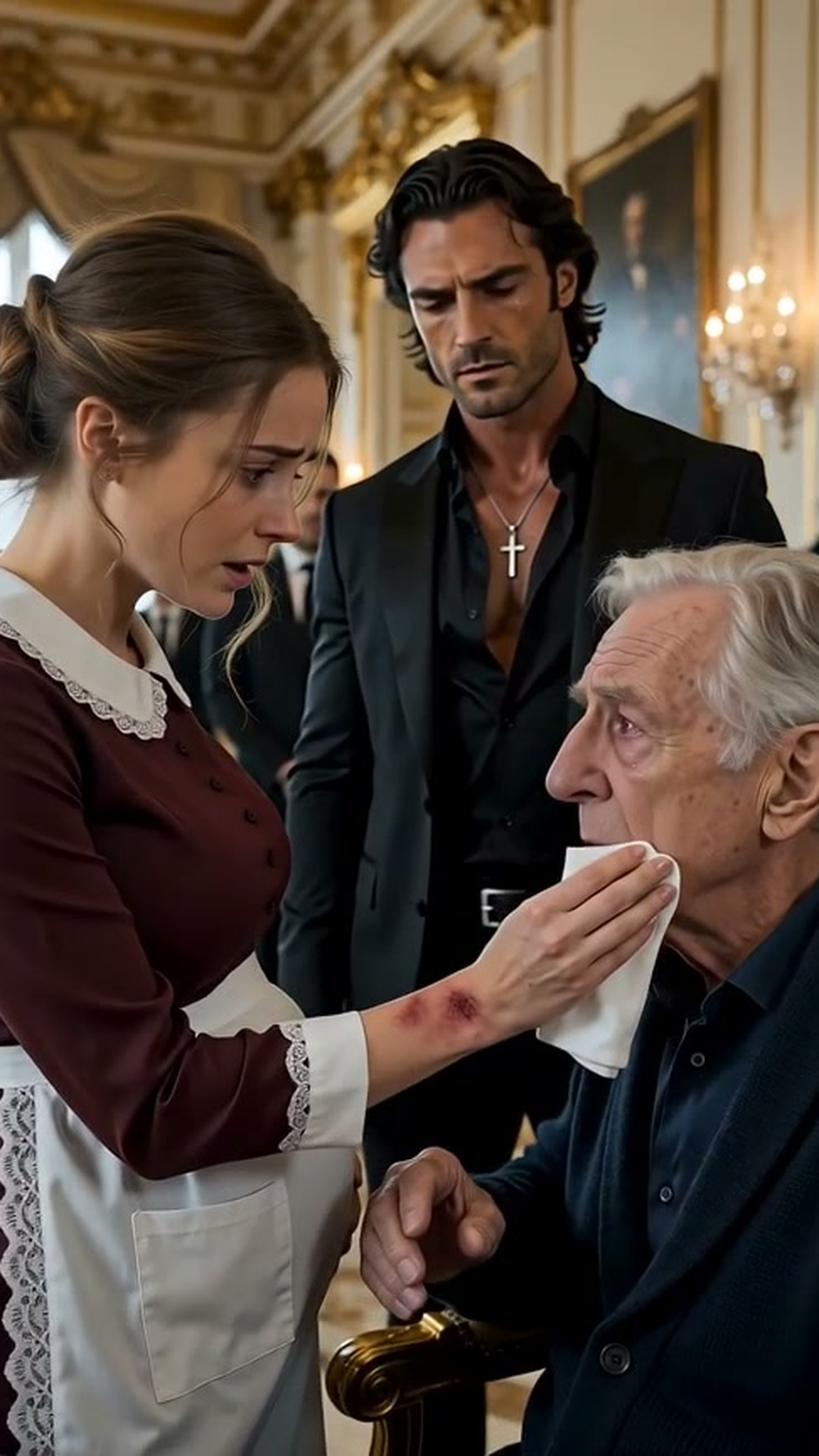
It took forty minutes to finish the teacup. Forty minutes, for half a cup of mashed potato, because his swallow was slow and treacherous and she would not risk him choking for anything on earth. His eyes never left her face. When she lifted the last spoonful away and dabbed his mouth clean with her handkerchief — carefully, the way you would for someone whose dignity was a country you were visiting — a tear slid down and lost itself in the lines of his cheek, exactly as it would six weeks later in the dining hall, in front of everyone.
"Oh," Nora said softly, stricken. "Oh, no. Was it too hot? Did I—"
His fingers moved. On the arm of the chair, his right hand made its tiny, heroic journey — a quarter of an inch, the effort of it visible in the tendons of his neck — until his fingertips rested against the back of her hand where it lay on the chair arm.
They stayed like that for a moment, the pregnant maid and the ruined king, in the forbidden room, in the stolen hour.
"You're welcome," Nora whispered, and covered his hand briefly with hers, warm over cold. "I'll come tomorrow."
She came the next day. And the next. And by the end of the second week she had built, out of nothing but patience and attention, the thing the specialists from the city with their car and driver had never bothered to build: a language.
One blink: yes. Two blinks: no. Eyes left: pain, or the nurse, or too cold. Eyes right: the window, open it, let him see the trees. One tap of the fingertip, when he could manage it, against her palm: again. Two taps: enough.
She learned that he hated the pureed carrots and loved anything with butter. That his swallowing was better in the morning and treacherous when he was tired. That he listened — rapt, starving for it in a way that broke her heart worse than the food — when she read aloud from the newspaper while she fed him, so she began to steal the newspaper too, out of the library recycling, and read him the racing results and the obituaries and, once, most of a very long article about a bridge being built in Ohio, which he attended to with the gravity of a man following the fate of nations.
She told him things, in those hours, that she had told no living soul. About Daniel. About the fall, and the phone call, and the landlord's patience ending. About the two hundred and eleven dollars and the card from her mother that she kept under her clothes in the suitcase like an exhibit in a trial no one else was attending.
"I know it's foolish," she said, "keeping a card. She wrote 'thinking of you' — the printed part says most of it. But when I have the baby, I want—" She stopped, and did her breathing, the way she had learned to do it when the grief came up her throat. "I want someone to know there's a baby. Even if it's just her. Even if she never comes. Isn't that silly? He's got no one at all in the world except me, and I've got—" She looked at the old man, and laughed a little, wetly, at the pair of them. "Well. I've got you, Don Giovanni. God help us both."
His eyes were wet. His fingertip, resting against her palm, tapped once. Again. Again. Again — a slow, deliberate rhythm, until she understood it wasn't a word in their language at all. It was just his hand, saying the only thing it could, over and over: I am here. I am here. I am here.
She never saw the black book again without thinking of the word refused. And she began, quietly and without any plan at all, to keep a record of her own — in a cheap spiral notebook hidden inside the cover of a detergent manual in the linen press, in her neat schoolgirl hand: dates, times, what he had eaten, how much, how long it took. The bowl at lunch: untouched, she wrote. Carried out at 12:10, still full. The book says refused. He ate the custard at 2:40 for me. All of it. Slowly. He was not refusing. He was waiting for someone to stay.
There were other educations, too, in those weeks, and not all of them were about Giovanni.
She learned that the staff of the Moretti house divided, like a country in a civil war, into those who had been there before Gable and those who had come after. The before-people — Bruno, Marta, old Ferro, the gardener Anselmo whose hands shook except among his roses — carried a quality Nora could only call mourning. They had served a house where Don Giovanni had walked the corridors like weather, where the staff ate at a long table with the family at Christmas and the old man carved, where a maid's daughter could be baptized in the estate chapel and Giovanni would stand godfather and cry openly and give the child a bond for her education. They spoke of those days in the past tense and then changed the subject, because the present tense had Mrs. Gable in it.
The after-people — hired by Gable, vetted by Gable, owing their places to Gable — were frightened and incurious and kept their eyes on the floor. They were not bad people, most of them. They were people who had learned what the house rewarded, which was blindness, and what it punished, which was everything else.
And she learned, by watching, what the house's blindness cost in small change. The flowers from the florist, billed weekly for Don Giovanni's room, that went instead to Gable's own sitting room. The good wine from the cellar book, signed out for the old man's table, that he never saw. The birthday — his eighty-first — that passed in November without a cake, a candle, a single card opened in his presence, because Gable had marked it in the book as a day he was "not to be disturbed," and the son in the study had sent, as instructed, an arrangement of white orchids the size of a sheepdog, which stood for a week in the front hall where guests could admire the family's devotion, and which Giovanni Moretti never saw at all.
Nora stood in the day room on the morning after that birthday with a stolen rose from the garden in a jam jar — Anselmo had cut it for her, silent, from the bush by the chapel wall, and put it in her hand with his eyes on the gravel — and set it on the tray table where his eyes could find it.
"Happy birthday," she whispered. "I know it's late. Late is my specialty. I'm late for everything except trouble."
His eyes went to the rose, and stayed, and the look in them was not grief, exactly. It was something older and more surprised than grief, the look of a man who had stopped expecting to be remembered and had just been caught out in it. His fingertip tapped twice against the chair arm — no — and then, after a moment, once.
No. Yes.
She laughed, quiet, through her nose, delighted despite everything. "Both? No and yes? That's cheating, Don Giovanni. That's not how our language works." But she understood him, because by then she understood him the way you understand a song you have heard every day for weeks: he was telling her it was too much and not enough, that he did not want the fuss and that the fuss was the first human thing that had happened to him in a year, and both of those were true at once, the way most true things about old men are.
She read him the racing results twice that day, because the first time she had rushed, and he deserved better than rushing.
She did not yet know what the notebook would become. She only knew that somewhere in that house was a son who paid for everything except the one thing that mattered, and that one day — she felt it the way you feel weather coming — the two halves of that sentence were going to collide.
She just didn't expect the collision to nearly kill her first.