The spoon hit the porcelain plate with a sound like a small bell, and Nora flinched.
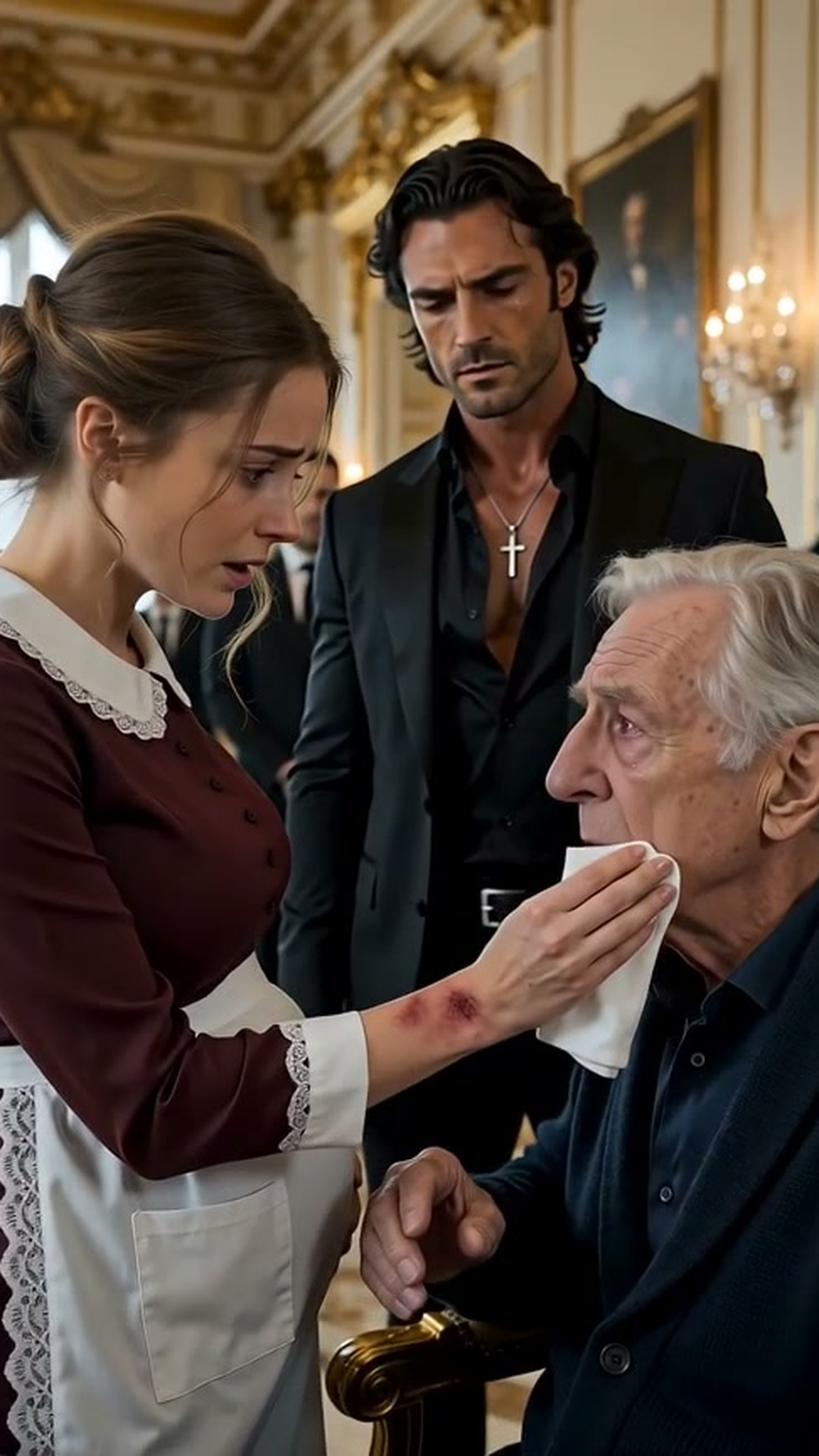
She had been leaning close to the old man, close enough to smell the faint lavender of the soap the night staff used on his skin, close enough to see the tear gather at the corner of his eye before it spilled. Her hand — trembling, because her hands always trembled a little now, in the sixth month, when she had been on her feet since five in the morning — held a white cloth to the corner of Giovanni Moretti's mouth, dabbing away a trace of the soft food he had managed to swallow.
He was hungry. That was the shameful, simple truth of it. He was always hungry, and nobody in this glittering house seemed to know, or to care.
The tear rolled down his lined cheek. Nora lifted the cloth toward it — and then fingers like iron closed around her wrist and wrenched her hand away.
Mrs. Gable did not raise her voice. She never raised her voice. That was what made the whole staff walk softly around her, the way you walk around a sleeping dog that bites.
"That is not your station," the head housekeeper said, very quietly, to Nora's wrist more than to Nora. "You are not paid to play nurse."
The pull had been sharp. Nora recoiled half a step, the silver spoon slipping from the saucer's edge and ringing against the plate, and her free hand went instinctively, before thought, to the round curve of her belly — protecting the only thing in the world that was truly hers.
Giovanni's eyes widened. On the arm of his great gold-framed chair, his fingers — thin as sticks, spotted, the nails carefully trimmed by no one — made a tiny, desperate, unsuccessful movement toward Nora's hand. As if he could catch her. As if he could stop this.
He could not. Everyone in the room knew he could not. That was rather the point of everything.
And then a shadow fell across Mrs. Gable's arm.
Nora did not hear him approach. Nobody ever heard Lorenzo Moretti approach; for a man built like a doorway, he moved through his own house with a silence that made the bodyguards along the wall straighten without knowing why. He was simply there, suddenly, towering behind his father's chair in his black suit, the silver cross at his open collar, his gray eyes fixed on the older woman's hand where it still gripped the maid's wrist.
"Let her go."
Two words. He said them the way other men might set down a glass. But Mrs. Gable's fingers opened as if the wrist had burned her.
Nora stumbled back the half-step she had lost, steadied herself against the arm of Giovanni's chair, and rubbed her wrist — where red marks were already rising on the pale skin — while her other hand stayed pressed to her belly. Her breathing was uneven. The other maids, frozen along the edges of the great dining hall with their trays and their linens, exchanged glances and said nothing at all.
"Mr. Moretti," Gable began, straightening her black jacket with a quick, practiced tug, recovering the way a cat recovers from a fall, pretending it had intended the whole thing. "I was only correcting—"
But Lorenzo was not looking at her anymore. He was looking at his father.
Giovanni Moretti, eighty-one years old, a man who had once made judges tremble and governors return his calls, sat sunken in his ornate chair in his navy cardigan, and his eyes were full of tears. One escaped and tracked down his cheek. And Nora — six months pregnant, exhausted, frightened half out of her wits, with the marks of the housekeeper's fingers blooming on her wrist — did the thing no one else in that room full of well-paid, well-trained people had done in months.
She turned back to him.
She lifted the white cloth, gently, and wiped the tear from the old man's cheek.
Giovanni's eyes rose to hers. His trembling fingers moved — a fraction, a breath, the smallest distance his ruined body allowed — and touched the edge of her hand, and she understood, the way she had learned to understand everything about him, and she adjusted her hand so that the contact cost him nothing, so that he could simply rest there, touching another human being who was not hurting him.
"He was hungry," Nora said.
Her voice trembled. She could not help that. But she did not look away from Lorenzo Moretti, and she did not let go of the old man's hand.
Something moved across the boss's face — something that started as confusion and ended, terribly, as the beginning of comprehension. He looked at the untouched plates further down the table, the congealed luncheon laid out for a staff of dozens. He looked at the one small bowl of soft food at his father's place, the one Nora had carried in herself. He looked at his father's hollow cheeks.
Then Mrs. Gable smiled her stiff smile and said, into the silence, the stupidest words of her life.
"We treat him like a king."
Another tear slid down Giovanni's face.
Lorenzo Moretti took one slow step toward the head housekeeper. She took, involuntarily, one small step back. And in a voice so quiet that the chandeliers themselves seemed to lean in to hear it, he asked the question that would end one world and begin another.
"Then why is my father crying?"
SIX WEEKS EARLIER
The agency driver let Nora out at the service gate of the Moretti estate in the rain, and she stood for a moment with her one suitcase in her hand, looking up through the iron bars at the house.
It was not a house. Houses were where people lived. This was a small nation of cream stone and black glass set in forty acres of upstate New York woodland, with a fountain in the turning circle and a roofline like a cathedral. Chimneys. A flag. Somewhere beyond the trees, she would learn, there was a helipad.
She was twenty-three years old, five months pregnant, and she had exactly two hundred and eleven dollars.
The baby's father, Daniel, had been a roofer with kind hands and a laugh like a screen door slamming, and he had fallen nineteen feet off a scaffold in March and not gotten up. There had been no insurance worth the name, no wedding, no family of his that wanted a pregnant girlfriend at the table. Her own mother, three states away and deep in a new marriage, had sent a card. Nora kept it in the suitcase, under the folded clothes, because it was the only proof she had that she had ever belonged to anyone at all.
So when the agency called about a live-in position — room, board, and a salary that made her dizzy, discretion required, uniform provided, immediate start — she had said yes before the woman finished the sentence.
What the agency had not said, what nobody would say for another six weeks, was whose house it was.
The housekeeper who admitted her at the service door was not Mrs. Gable but a pale girl named Tessa, maybe nineteen, who took Nora's suitcase with both hands and an expression of profound relief.
"Oh, thank God," Tessa whispered. "We've had three quit this month. Gable eats the new ones."
"What does that mean?"
"It means—" Tessa looked over her shoulder at the empty corridor, and lowered her voice further. "It means do what you're told, don't ask about the old man, and don't get attached to anything. Especially not the old man."
"Who's the old man?"
Tessa's face did something complicated. "You'll see him. Everybody sees him. That's the worst of it. You see him every day."
She led Nora up the back stairs — maids did not use the front stairs; maids, Tessa explained, did not use the front most things — to a small room under the eaves with a narrow bed and a window that overlooked the gardens. The uniform was laid out on the bed, folded to surgical precision: a dress the color of dark wine, a white apron, a lace-trimmed collar.
"She'll inspect you at six," Tessa said. "Mrs. Gable. Stand straight, hands where she can see them, don't speak first. And—" she hesitated at the door, and some genuine kindness in her overrode the fear, briefly— "eat something before. From the kitchen, when the cook's not looking. You're eating for two, and Gable counts the staff meals like she's paying for them herself. Which, between us—" Tessa shrugged, a tiny, hopeless gesture. "In this house, she might as well be."
Nora met Mrs. Gable at six, in the servants' hall, lined up with the rest of the day staff like a row of suspects.
Mrs. Gable was in her late sixties and looked carved rather than born: gray hair swept back without a single escapee, sharp bones, a black suit that had never in its life wrinkled. She walked the line slowly, with a silver pencil and a small black book, and when she reached Nora she stopped, and her pale eyes traveled — pointedly, unhurriedly — to Nora's belly.
"The agency," she said, "did not mention a condition."
"It doesn't affect my work, ma'am."
"We shall see what it affects." The pencil moved. "You will be assigned the east wing. Rooms, linen, dusting. You will not enter the master's study, the library, or the south terrace rooms. You will not speak to the family. If a member of the family speaks to you, you will answer in as few words as courtesy permits and inform me afterward of the exchange."
"Yes, ma'am."
"And you will have nothing—" the pale eyes lifted, and for the first time Nora felt the full arctic weight of the woman's attention— "nothing whatsoever to do with Don Giovanni. His care is arranged. It is not your concern, it is not your station, and curiosity about him will end your employment before your trial month does. Is that clear?"
"Don Giovanni," Nora repeated carefully. "The—the gentleman's father?"
Something closed in Mrs. Gable's face, like a door in a distant part of a house. "It," she said, "is clear or it is not."
"It is clear, ma'am."
"Good." The pencil scratched. "East wing. Six a.m. Tessa will show you the linen press."
Nora saw him that same evening, at seven, when the whole house seemed to exhale and the lights came on floor by floor like a ship waking.
She was carrying a stack of pressed sheets through the ground-floor gallery — she should not have been in the gallery at all, but the linen press had jammed its door and Tessa had begged her, quick, through the gallery, nobody's about — when the far doors opened and a man in a black suit wheeled an ornate, gold-framed chair out of the dining hall and parked it — there was no other word, parked it — beside a marble column, in the draft from the doors, facing the wall.
In the chair sat an old man in a navy cardigan, his silver head tipped to one side, his hands still in his lap. A napkin had been tucked at his collar and not removed. There was a smear of something at the corner of his mouth.
The bodyguard walked away, already looking at his phone.
Nora stood with the sheets in her arms and watched the old man sit facing the wall for one minute, then two. A maid passed him with a tray of glasses and did not slow. The cook's boy crossed the hall with a crate and looked at the floor as he passed, deliberately, the way you look at the floor when something on a chair has made you ashamed.
Giovanni Moretti's eyes moved. That was all that moved. They found Nora across the gallery — the only still thing in the hall, the only person looking at him as if he were a person — and held hers with an intensity that she would remember on her deathbed.
She could not go to him. She had been in this house four hours, and already she understood the architecture of the rule: it was not written anywhere, and it was load-bearing.
She did the only thing she dared. Very slightly, she inclined her head to him — the way you would to a gentleman you passed on a road, an acknowledgment, a courtesy — before she forced her feet to carry her and the sheets away through the gallery door.
Behind her, she heard nothing at all from the chair. He could not call out. That was the thing about Don Giovanni, the thing Tessa had meant.
He could not call out, and the whole house had learned to enjoy the quiet.