To understand what happened at the Moretti estate that winter, you have to understand Lorenzo — and to understand Lorenzo, you have to understand that he had been losing his father for two years, in installments, and paying a fortune for the privilege of not watching.
He had been there for the first stroke. That was the thing nobody in the family — no cousin in Palermo, no capo at the table, no priest at the cathedral — would ever say to his face: the mighty Lorenzo Moretti, who had taken his father's sprawling, dangerous empire at twenty-six and made it richer and quieter and more legitimate with every passing year, had held his father's hand in the ambulance while Giovanni, felled mid-sentence at a family dinner, eighty years old and still terrifying, had tried to say his son's name and produced only a broken, drowning sound.
He had been there for the second stroke too, eleven months later, which took the speech entirely.
After that, Lorenzo did what he did with every unbearable thing. He organized it. He purchased it into submission. The gold-framed chair, custom-built in Milan. The specialists. The day room converted at ruinous expense — the harbor painting chosen because Giovanni had been born in a port town and had crossed an ocean in steerage with nine dollars, and had told that story at every dinner for sixty years until the dinners stopped. The round-the-clock staff. The best housekeeper in three states, poached from a senator at double wages: Mrs. Gable, with her references like references like royal warrants, her black book, her reputation for running great houses like clockwork.
And then he had done the unforgivable thing, the cowardly thing, the thing he would spend the rest of his life paying for. He had let the clockwork run, and he had stopped going down the corridor.
It hurt too much. That was the whole of it and there is no dressing it up. To sit beside that chair and watch the most powerful man he had ever known reduced to a pair of eyes and one disobedient fingertip; to talk and talk into the silence and get no answer; to feel his own helplessness in the presence of the one person he had never once been helpless in front of — it unmanned him, and Lorenzo Moretti had built his entire life out of never being unmanned. So he visited on Sundays, at first, for an hour, with gifts that grew more expensive as his conversation grew more strained: a cashmere blanket. A music system. Photographs of the family, framed, arranged on the day room wall by Gable in a fan.
By the second year the Sunday visits had become monthly, and the reports — Gable's reports, delivered weekly, typed, immaculate — had become his father.
Father rested comfortably. Father refused his lunch but took a little broth. Father is very peaceful these days, Mr. Moretti. He sleeps a great deal. The doctors say this is to be expected.
The reports were beautiful. The reports were the reason Lorenzo could sit in his study forty yards and one whole universe from the day room, running an empire, and tell himself that the nine dollars in steerage had bought, at the end, peace.
The last monthly visit had been in October, and it had lasted nineteen minutes.
Lorenzo knew it had lasted nineteen minutes because he had checked his watch in the car afterward, the way a man checks the damage after a crash. He had brought his father a cashmere blanket in a box so handsome it could have held jewelry. He had sat in the visitor's chair — there was a visitor's chair in the day room, angled at Giovanni the way chairs are angled at exhibits — and he had talked. He had talked about the waterfront project, and the mayor, and the foundation's new wing at the hospital, filling the room with words the way you fill a grave with earth, steadily and without looking down. Giovanni's eyes had followed him the whole time. Once, the fingertip had tapped. Once. Again, again, tapping with a slow insistence that had, Lorenzo remembered afterward, in the car, raising its small terrible question at the back of his mind and been smothered by the schedule, the driver, the phone —
Gable had stood at the door when he left, with her hands folded. "He's tired now," she had said gently. "You see how he tires. But he does so look forward to your visits, Mr. Moretti. He took a little broth at lunch."
"He took a little broth," Lorenzo had repeated, with gratitude, to a woman charging him by the hour for the sentence.
In the car he had sat for a while without telling the driver to go. He had thought: He is dying, and I am watching it happen in installments so that it doesn't hurt all at once. He had thought: That isn't watching. Watching would hurt all at once. And then his phone had rung — the waterfront, the mayor, the endless important weather of the empire — and the moment had gone back under the surface of his life like a stone into a river, and the river had closed over it.
His mother had been dead nine years. Caterina Moretti, who had come over at nineteen with a cardboard suitcase and had run her husband's household and half his negotiations with a wooden spoon and perfect recall, had understood Lorenzo better than he understood himself, and on her deathbed — lucid, terrifyingly, to the end — she had taken his hand and said the thing that the family still quoted: "Your father looks like the storm, tesoro, but you are the sea. The sea holds everything. See that you hold him, at the end. Not the business. Him."
He had promised. Of course he had promised. A man promises anything at a deathbed; it is the cheapest currency there is, and Lorenzo, who was honest in business to a fault, had been paying out that promise ever since in blankets, specialists, televisions the size of doors — everything except the only denomination his mother had specified.
Him. Not the business. Him.
It was an old man who cracked it. Of course it was. The empire was held together by old men — men who had come over with Giovanni or just after, who had buried wives and rivals and in two cases sons, and who owed their considerable fortunes to the fact that Giovanni Moretti had once, in 1968, divided a waterfront between four families with a pencil stub and a napkin and made the division hold for fifty years by the simple force of being believed.
Salvatore Ricci, eighty-four, a consigliere of the old school, minus two fingers and plus a private income that would shame a bank, took to having his driver bring him to the estate on the first Sunday of the month. Ostensibly he came to pay respects to Lorenzo. Actually — everyone understood, and no one said — he came to sit with Giovanni, the way men of that generation sit with the wounded: without sentimentality and without leaving.
On the first Sunday of November he sat for one hour in the day room. The television played to the wall. The old man's tray sat untouched — the relief maid that day had been Tessa, and Tessa had been ordered to the linen press midday and had left it, and no one had come back. Salvatore, who had once personally negotiated a ceasefire in a basement full of armed men, fed his old friend four spoonfuls of cold soup with his own ruined hand, and then drove home, and that evening he did something he had not done in forty years of friendship with the Moretti family.
He telephoned Lorenzo, and he did not use the respectful formulas.
"You are being lied to," Salvatore said.
Lorenzo, in the study, with the weekly report open on the desk in front of him — Father took a little broth — went very still. "Salvatore."
"Your father is a skeleton in a gold chair, boy. He is dirty. His nails — Giovanni Moretti's nails, that he used to have done every Friday of his life like a sacrament, they are broken. He watched me the whole hour like a dog watches a door. I fed him. Me. With these—" a sound down the line, the old man gathering himself, furious and grieving— "you listen to me, Lorenzo. I knew him when he had nothing. I knew him when he could end a man's whole life with a look, and I have sat today and spooned cold soup into him, and he cried. Your father. Cried, because a friend fed him."
"That's not—" Lorenzo stood up. He did not remember standing. "Gable reports—"
"Gable reports!" The contempt down the telephone line was incandescent. "You run forty businesses and you cannot run down one corridor and look? My driver will say nothing, I will say nothing, the whole world that loves your father will sit in that room and rot politely rather than shame you — I am too old. I am done being polite. Go and look at your father, Lorenzo. Not the report. The man."
The line went dead.
Lorenzo stood in the study for a long time. The fire made its small noises. On the desk, the typed report said, in Gable's faultless prose, that his father was peaceful, and sleeping a great deal, and had taken a little broth.
He thought of nine dollars in steerage. He thought of a hand in an ambulance.
He did not announce himself. That was the first intelligent thing he had done about his father's care in two years, and he knew even as he did it — as he told no one, canceled the car, let the house believe him in the city until Friday — that some part of him, some gutter instinct bred in the bone, already believed Salvatore, and had perhaps believed worse for months, in the small hours, in the place where the reports could not reach.
He had telephoned the house that morning — one detail, one test, the kind he would have run on any business he suspected of cooking its books. He had asked, lightly, after his father. And Gable, perfect as ever, had given him the week's prose off the top of her head, smooth as a hand over silk.
"He's very settled this week, Mr. Moretti. He took a spoon or two of broth at lunch — of course we offered the full tray — and he's resting now. The nurse has just gone. I shouldn't disturb him before four; you know how the afternoons tire him."
A spoon or two of broth. Resting now. The nurse has just gone.
Three sentences, and every one of them, Lorenzo would discover within the week, false in the way that mattered — the broth refused by a mouth that needed an hour and got ten minutes, the rest that was a disconnected bell and an empty room, the nurse whose hour had been twenty minutes and whose signature said sixty. But that morning he had only Salvatore's voice in his ear, and his mother's words underneath it like a stone in a riverbed — Not the business. Him — and his own hand, rising to terminate the call, had stopped once, hovering, while something cold and ancient in his spine performed an arithmetic it had been avoiding for two years.
You know how the afternoons tire him.
He did not know. That was the thing. He did not know anything about his father's afternoons. He had purchased knowledge, in bulk, from a woman with a pencil, and the goods had never once been inspected.
He came up the drive on foot, in the early afternoon, through the winter trees, in a black coat, alone.
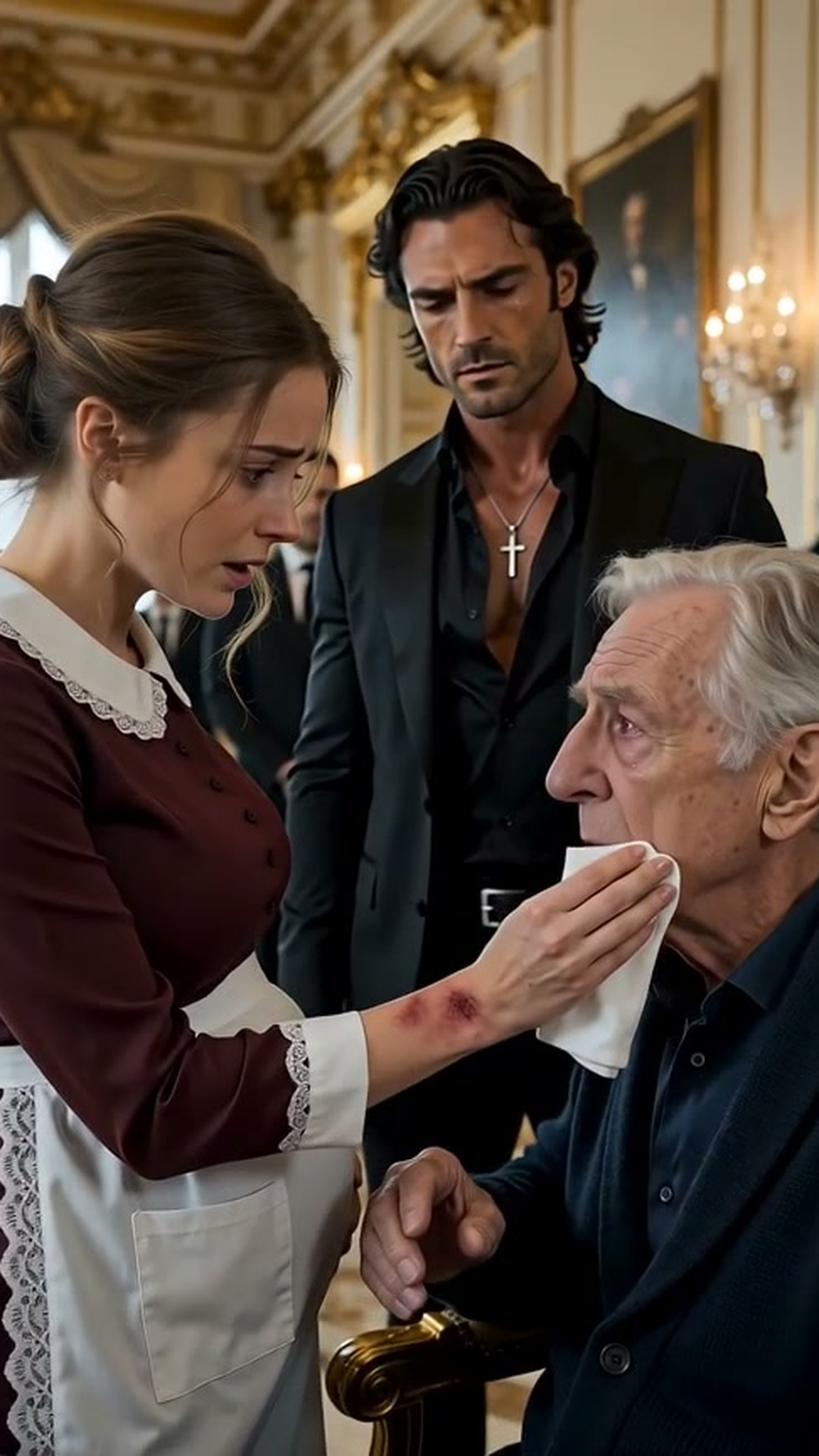
And at half past one, with the lunch trays long cleared and the house drowsing in its routines, Lorenzo Moretti walked quietly into the great dining hall — where the family, in the fiction maintained for him, sometimes took his father for a change of scene — and stopped in the doorway, and saw what there was to see.
A pregnant maid, holding a white cloth to his father's face.
An old woman's fingers, locked around her wrist like a trap.
And his father's eyes — his father's eyes, rising to him across the room, filling with tears, saying the thing they had been trying to say down forty yards of corridor for two years.
Help me. You came. Help me.