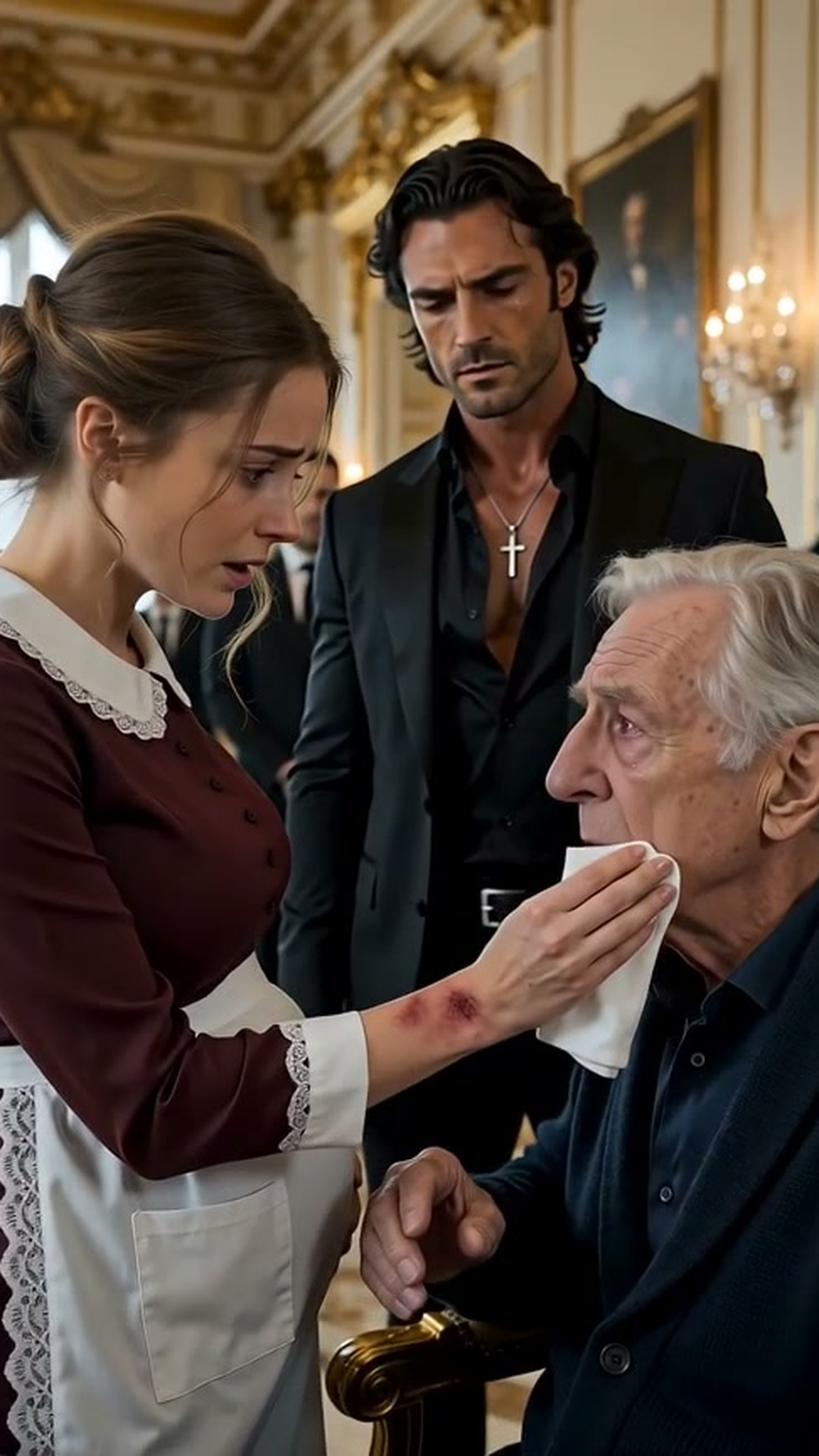
"Then why is my father crying?"
Mrs. Gable's mouth opened. No sound came out of it. For the first time in the memory of anyone in that room, the silver pencil had no page.
Lorenzo did not wait for her answer. He had already understood there would not be one — that the answer was the room itself, the cold plates, the marks rising on the girl's wrist, his father's face. He crossed the dining hall in four strides and did a thing no one had ever seen him do, before or since: he went down on one knee beside the gold chair, in his thousand-dollar suit, on the marble, so that his face was lower than his father's, and he took the old man's wasted hand between both of his with a gentleness that had no business existing in hands like his.
"Papà," he said. "Papà. I'm here."
Giovanni's eyes flooded. His whole ruined body trembled with the effort of something, and his fingertip, trapped between his son's palms, pressed — weakly, unmistakably — and pressed again, and Lorenzo, with tears starting in his own eyes in front of thirty-one employees and a row of bodyguards, understood that he was being held. That after two years of starving an arm's length from his son's empire, this was his father's embrace, and this was all of it he had left to give.
"Don't take your hand away," Lorenzo said to Nora, without looking up, in a voice that shook once and then steadied into something far more dangerous. "He's holding on to you. Keep holding his hand."
"Yes, sir," Nora whispered.
"And you." He rose, slowly, and turned to Mrs. Gable, and the temperature of the room seemed to drop out of it altogether. "You will not leave this house. You will sit in the servants' hall, with two of my men, until I am ready for you. If one item of paper, one record, one page of one book is destroyed or altered from this moment, I will consider it theft from my father, and I will respond accordingly." He looked at the bodyguard nearest the door. "Her office. Her book. Her desk. Everything, in boxes, to my study. Now."
Gable found her voice at last, thin and high. "Mr. Moretti, this girl has been— she has been feeding him against medical instruction, I have the records, the agency will confirm—"
"Yes," Lorenzo said. "I'm sure you have records." He looked, for the first time, directly and fully at Nora — at the burgundy uniform, the white apron stretched over her belly, the fading bruise of fingers on her wrist, the face of a girl who had been caught committing an act of mercy and expected to be destroyed for it — and something in his own face changed, with an almost audible finality, like a lock turning.
"You," he said. "What's your name?"
"Nora, sir."
"You've been feeding him."
It was not a question. She lifted her chin — she remembered later that her knees were knocking together under the apron, that she was more frightened in that moment than she had ever been in her life, and that it did not matter at all.
"Yes, sir," she said. "He was hungry."
"He was hungry," Lorenzo repeated, very softly, to the room, to the chandeliers, to the whole gleaming apparatus of care he had built and never once inspected. "In my house. My father was hungry in my house." He turned to the head of his security, a slab of a man named Ferro who had been with the family twenty years. "The doctor. His own cardiologist, not the agency — get him here. Today. And the agency nurses' company, their contract, every invoice, every signature. And find me the physiotherapist. The one we pay." His mouth twisted around the word. "Twice a week, Ferro. Find out where he's been going."
"Sir."
"And nobody—" his eyes swept the room, the maids, the guards, the frozen tableau of them all — "nobody is dismissed, nobody resigns, nobody leaves, until I have spoken to every person in this house. Anyone who tells me the truth about my father is safe from any consequence of it. Anyone who lies to me—" He did not finish. He didn't have to. He had his father's hand again, and was looking down at it, and what was left of the sentence stood in the room anyway, like furniture.
The cardiologist arrived within two hours — the real one, Dr. Anand, who had treated Giovanni for a decade and whose face, as he examined the old man in the day room with the curtains drawn, aged visibly by the minute.
"He's malnourished," Dr. Anand said, in the corridor, to Lorenzo, with a professional calm that sat on top of his anger like a lid on a pot. "Not catastrophically — someone, recently, has been getting food into him, and frankly, Mr. Moretti, it may be the only reason I'm not having a harder conversation with you. But his weight is well below where his chart says it should be. He has the beginning of a pressure sore at the sacrum, which means he is not being turned. And his medication—" He stopped.
"Say it."
"His cardiac medication adherence appears to have been— irregular. If doses have been missed at the rate his blister packs suggest, then we are fortunate, Mr. Moretti. We are not unfortunate only because we are fortunate. I want to be clear about that. There is a difference, and the difference is luck."
And then the house began, at last, to talk.
Lorenzo had said anyone who told the truth was safe, and for the first hour the staff did not believe him — they had been trained too well, and fear, once installed, does not uninstall at the first announcement. It was Bruno who broke it. Bruno, who had stuffed mushrooms and looked at the floor for two years, presented himself at the study door at a quarter past three with his chef's hat in his hands like a mourner, and stood, and said: "I cook for the old man myself, capu. Thirty years. The soft food, the good stock, I send it up with love, and I hear it comes back—" The big man's face worked. "The trays, they pass my kitchen coming back. Full. And I said to myself, Bruno, the old man is dying, he doesn't want— I lied to myself in my own kitchen, capu. Put it on me too. Put it on the list with her."
After Bruno, they came like water through a cracked dam. Marta the laundress, with the collars of a hundred shirts for her testimony. Anselmo the gardener, who had been ordered to cut the chapel roses away from the day room window because their scent "agitated" the patient, and who said, with his ruined hands twisting in his cap, that a man asking for roses with his eyes is not agitated, he is begging. The night watchman, who had twice found Don Giovanni, on his rounds at 3 a.m., wide awake in the dark with tears running into his ears, because the evening nurse had gone at twenty minutes and the call bell — the call bell, Lorenzo learned, with a stillness that made Ferro step half a pace nearer the desk — the call bell in the day room had been disconnected for over a year. Disconnected, and the disconnection logged in the maintenance book in Gable's own handwriting as a repair completed.
"She said he rings it for attention," the watchman said. "She said we're not to encourage it."
Lorenzo wrote nothing down during any of it. He simply listened, with his face like a man being read his own sentence, and thanked each of them by name, and by the time the light outside the study windows had gone the color of old brass, the boxes from the housekeeper's office had been joined, on the long table, by something much worse than invoices: the full, corroborated, multiply-witnessed anatomy of a two-year abandonment, conducted for profit, inside a palace, under his own name.
While the doctor spoke, Ferro's men were filling boxes in the housekeeper's office, and Tessa — white as her own aprons, summoned to the study at four o'clock along with the rest of the staff, one by one — had done the bravest thing of her life, braver, she would say later, than anything since: she had gone first to the linen press, before her interview, with her hands shaking too hard to hold the detergent manual steady, and had taken out a cheap spiral notebook in a schoolgirl's neat handwriting, and carried it into the study of the most dangerous man in New York, and laid it on his desk.
Nora's notebook.
"He's not refusing, sir," Tessa said, in a voice like a thread. "He never was. It's all in there. She wrote it all down. The lunches that came back full while the book said refused. The physio turned away at the gate. The nurse's hours. The pills in the cup, sir, she wrote the pills. If she'd been caught with it she'd have been—" Tessa's voice broke. "She's on nights now, sir, in the cellar, because of the weight he gained. Because he gained three pounds eating. Gable did that to her yesterday. She's six months gone, sir, and she's down in the cellar tonight on her feet till six, and if anything happens to her or the baby it'll be—"
"Stop," Lorenzo said.
The thread of Tessa's voice cut off. The study was silent except for the fire.
Lorenzo sat with the notebook open before him, and he read — the dates, the times, the full trays carried out, the custard eaten slowly at 2:40, all of it, page after page of evidence kept by a pregnant girl in a detergent manual for a man she was forbidden to speak to — and when he reached the last page, and the sentence written there in a hand that had not trembled at all, he put his face in his hands.
If I am dismissed I will take this book to Mr. Moretti himself, wherever he is.
Before that, he had sat with the boxes.
It was what he did with businesses that failed under him: he read the wreckage himself, all of it, in order, no summaries. The physiotherapist's diary, with its litany of turned-away visits — refused at gate, patient resting, refused at gate, patient agitated — in a neat, professional hand that grew, over two years, first puzzled, then careful, then resigned. The agency invoices with the nurse's hours rounded up like a grocer's thumb on a scale. The food budget ledgers, where the line items for his father's special diet marched in perfect order beside a second set of figures, smaller, in pencil, in the margins — the difference, month on month, between what a king's care cost on paper and what it cost in a teacup of stolen custard. And under the ledgers, at the bottom of the last box, Ferro's men had found the thing that Lorenzo Moretti would remember when all the rest of it had faded into case numbers: a birthday card. Cream-colored, expensive, unsigned by any hand but his own secretary's, bought the previous November for Giovanni's eighty-first and never delivered, never even taken upstairs. On the inside, in Gable's writing — she must have drafted the inscription for the family record, the performance of devotion — was the sentiment she had selected for a man she was starving: With gratitude for all you have given us.
He held it for a long moment, that card, between his finger and thumb, like something lifted out of a river.
Then he put it in his breast pocket, where it stayed through everything that followed, and it was thus — with his father's undelivered birthday in his pocket and a maid's notebook on his desk — that Lorenzo finally turned the last page of the record and read her final sentence.
If I am dismissed I will take this book to Mr. Moretti himself, wherever he is.
"Get her out of the cellar," he said, through his hands. "Now. Bring her to me. And Ferro—" He lifted his head, and his eyes were red and absolutely calm, the calm of a flooded river. "Cancel the cellar rota. All of it. And then go downstairs and inform Mrs. Gable that I am ready for her."