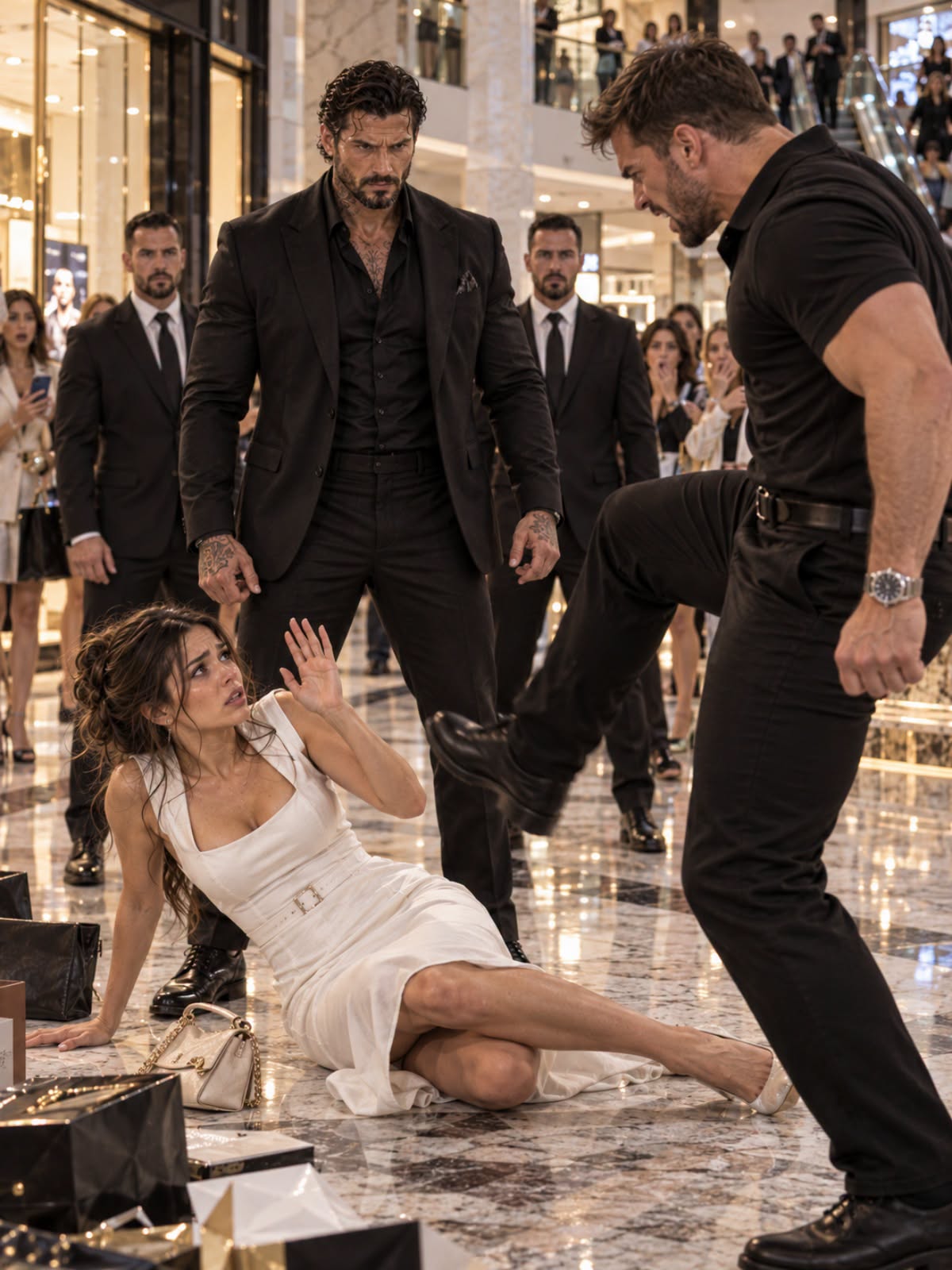
The thing about marrying a dangerous man is that you stop fearing the ordinary ones.
Sadi Vale discovered this the way she discovered everything worth knowing in her life: all at once, in public, on a cold marble floor, with a cracked knee and a man she used to love standing over her.
She had come to the Galleria for a pair of cufflinks.
It was their third wedding anniversary tomorrow, and Roman Vale — feared businessman, dark-eyed mystery, the man whose name made lawyers at Trevor's firm sit straighter — owned nothing decorative and accepted nothing decorative, and buying him a gift was an annual exercise in losing. He had given her a house on a cliff, a kitchen with a stove she didn't know how to use for two months, a life so plush it still felt like it was happening to somebody else. She wanted to give him something back. Something small. Something he would actually wear.
So: rhodium cufflinks. Simple. Silver, not flashy. The kind of thing a man like Roman could wear without feeling like a display case.
The boutique was quiet and warm and smelled of cedarwood and money, the kind of store where the lights were arranged like stage lighting and the saleswoman looked at you once, head to toe, and knew your credit limit before you opened your mouth. Sadi wore a simple white dress with no logos, no monogram, nothing that announced a price. Her hair was up. Her shoes were flat. She carried a small clutch and looked, to anyone watching, like a woman waiting for her husband to finish a phone call.
The saleswoman, who had learned this particular wife's habits three anniversaries in a row, smiled and turned the velvet tray. "The rhodium pair, Mrs. Vale?"
Sadi looked down at the cufflinks — plain, elegant, the weight of them exactly right — and then, because old habits are the last things to die, she checked the price tag before she allowed herself to breathe.
Four years of plenty. Four years of a husband who said take whatever you want, it's all yours, I mean all of it and meant it so completely it frightened her. And still, the girl who measured grocery money by the day, who knew which laundromat dryer gave you nine extra minutes on the timer if you kicked it just right, who had slept in her car twice — twice, and told no one — still lived somewhere inside her. She had loved that girl, once, for how hard she fought. Now she just checked the tags and let herself smile.
"These," she said. "I'll take these."
And then someone behind her said, in a voice like a door slamming in a house she used to live in:
"I said move."
She didn't move fast enough. Or he didn't want her to. A body — large, impatient, expensive-smelling — slammed into the back of her calf at full stride, and the world tilted, and the next thing she knew she was on the floor of the boutique, cheek an inch from cold marble, her knee cracked hard against the stone, the velvet tray gone, a dozen shoppers gasping in a ring around her like she was a scene in a movie they'd paid for.
"Seriously?" the man said. "People are walking here."
And Sadi looked up, and looked up, and thought: oh. Of course. It would be today.
Trevor.
Trevor in a suit that cost more than her old car. Trevor with an oversized watch on his wrist like a trophy bolted there. Trevor, who had just made partner at Bradford & Keller — she would learn that shortly, though she didn't know it yet — looking down at her with the same expression he'd worn the night he'd stolen six hundred dollars of their rent savings and left a note on the kitchen counter in handwriting she'd once found beautiful.
I need a different life.
She was twenty-three. She had worked double shifts — breakfast at a diner on the east side, evenings at a diner on the west side — so he could finish school. She had sold her father's necklace, the only thing she had left of him, to pay his tuition. And he'd taken the rent money and left her a sentence, and she'd spent three nights in her car, parking under the brightest streetlight she could find, folding her jacket into a pillow, telling herself that crying was a luxury she couldn't afford because she had to be awake at five.
Beside him now: a blonde woman in silk and diamonds, hand tucked possessively around his elbow. Chloe Mercer. His fiancée. Sadi knew her from the engagement announcement — the kind of announcement that travels.
He recognized her the same moment she recognized him. She watched the arrogance come back into his face like water filling a glass — first surprise, then the old satisfaction, then the particular smile he used to wear when he had an audience.
"You kicked me," he said.
"I nudged you," Sadi said, from the floor.
"You kicked me." He looked around at the gathering crowd, already performing. Phones were appearing. Of course they were. "Everybody saw it. She kicked me."
"Who is she?" the blonde said, silk whispering as she leaned in.
"Nobody," Trevor said.
And Sadi — Sadi sitting on the marble with a bleeding knee and her anniversary cufflinks scattered somewhere under a glass case — felt almost nothing. That was the strangest part. Not numbness. Something cleaner. His insults used to land like fists. Now they landed like rain on a roof she no longer lived under. They seemed small. He seemed small. The suit was big; the man inside it was the same size he'd always been.
She got slowly to her feet, testing the knee. It held, shakily. Blood welled through the torn skin — not much, a graze, but the marble was cold and unforgiving and the boutique lights were too bright and she could feel the whole store watching her decide what kind of woman she was going to be today.
"You look," Trevor said, looking at the white dress, at the absence of logos, at the plain clutch, "exactly the same."
She did not. But Trevor had never recognized quiet money. In his world, wealth announced itself or it wasn't real. The idea that a woman could own nothing with a name on it and still be richer than his entire partnership track was a geometry his brain couldn't do.
"I suppose you heard," he said, straightening the cuff of that expensive suit, "that I made partner."
"No," Sadi said honestly. She hadn't. She didn't read the Bradford & Keller newsletter. She had other reading material.
He smiled the smile of a man being generous to someone beneath him. "It's a big deal. Youngest in the firm's history." He let it sit. "I assume you've been — following things. After the announcement."
"The announcement," Sadi said.
"Our engagement." He slid an arm around the blonde's waist, pulling her in for the audience. "You must have seen it."
She had. She had seen it the way you see a weather report for a city you don't live in anymore: noted, filed, forgotten. "Congratulations," she said, and meant it the way you'd congratulate a stranger — warmly, impersonally, and entirely without wanting to be them.
His face changed. It was the one thing she could still do to him: be genuinely kind and watch it register as an attack.
"Don't," he said.
"Don't what?"
"Don't pretend you're happy for me."
"I don't have to pretend," Sadi said. "I am."
"You stalked me here. Admit it. You saw the announcement and you — what, hoped I'd see you? Hoped I'd remember?"
Sadi laughed. She couldn't help it. It came out light and short and it made two shoppers lower their phones, uncertain what kind of scene this was now. "Trevor. You're at the Galleria. People shop here. It isn't a shrine."
His jaw worked. The old expression was coming back now — the one that used to precede slammed doors, broken mugs, the punishing silences that lasted three days and always ended with her apologizing for something she hadn't done. "You always did have no ambition," he said, quieter now, for her and the front row only. "No drive. You were comfortable being poor. Remember? I used to tell you that. You could have been anything and you were — comfortable."
She remembered. Oh, she remembered. She remembered being comfortable the way a person is comfortable in a burning building — by never stopping moving. Breakfast at one diner, evenings at another. She remembered handing him tuition money she'd gotten from a necklace her father had given her on her sixteenth birthday. She remembered being comfortable.
"Trevor," she said. "Don't."
But he was tapping the glass case now with one knuckle, tap tap tap, the rhythm of a man who believed every surface in the world was his to touch, and she said, without thinking, "Don't touch the case."
Silence. A small one. The kind with teeth.
He turned slowly. "Excuse me?"
"The case," Sadi said. "Don't touch it. It smudges."
And there it was — the full return of the old Trevor, the one she'd lived with at twenty-three: the pointing finger, the dropped voice, the fury that never raised itself because it never had to. Stay away from my office, he said, loud enough for the ring of shoppers to hear it now, loud enough for it to be on half a dozen recordings. Stay away from Chloe. Stay away from me. And then, pointing the finger an inch from her face: "I could destroy whatever little life you have left. Do you understand me?"
Across the boutique, thirty feet away, near the entrance: Arthur and Malik. Roman's men. They'd been there the whole time, of course — they were always there, quiet and enormous and easy to mistake for furniture if you didn't know what to look for. Arthur's head tilted, a fraction of an inch. The smallest question in the world: Intervene?
Sadi gave the smallest shake of her head. Not yet.
She wanted — God help her, she wanted to see how far he'd go. Not because she enjoyed it. Because she needed to know, once and for all, whether the man in front of her was the whole of her past or just a ghost of it.
He reached for her shoulder. The shove was already beginning — she could see it in the set of his arm, the old choreography.
"Trevor," she said quietly. "You're making a mistake."
"The only mistake I made," he said, "was wasting years on you."
His hand came down.
And a tattooed hand closed around his wrist in midair.
The boutique went silent in a way that had weight, like a held breath. The hand on Trevor's wrist belonged to an arm in a black suit sleeve, and the arm belonged to shoulders broader than the doorway, and the shoulders belonged to a man with dark hair and a face that wasn't angry at all — which, Sadi had learned over four years of marriage, was precisely what made Roman Vale terrifying.
He didn't look angry. He looked interested. Like a man reading the last page of a contract he'd already decided to burn.
"Do not touch her," Roman said. Barely above conversation level. The words landed harder than a shout would have. "Let go."
Trevor tried to pull free. Couldn't. The tattooed fingers — ink winding across every knuckle, the platinum band catching the boutique light — did not move.
"Step away," Roman said.
He released Trevor's wrist. Trevor stumbled back a half step, cradling the wrist like it had been burned, and Roman had already turned, the danger draining out of him the instant his eyes found Sadi, the way a storm drains out of the sky when it moves past you.
"Are you hurt?" he said.
"My knee."
"Did he do that?"
She nodded.
Thirty feet away, Arthur and Malik were already moving — not running, just arriving, the way security arrives when it was always going to arrive. More men in dark suits materialized at the boutique entrance. The manager appeared, frozen, hands fluttering. The shoppers with their phones had gone very still. Chloe Mercer had taken two steps backward and then stopped, her silk dress catching the light, her diamonds suddenly looking like costume jewelry.
"Who the hell are you?" Trevor said.
Roman bent and helped Sadi to her feet — one arm around her waist, careful of the knee, his other hand steadying her elbow like she was the only thing in the room. And Trevor, staring, saw what he should have seen from the beginning: the platinum band on Roman's finger. And then its twin, on Sadi's.
"No," Trevor said.
"You want to leave?" Roman asked Sadi, quietly.
"In a minute," she said.
"You know her?" Trevor said. He was rebuilding the world in real time and it kept collapsing. "Who —"
"She is my wife," Roman said.
Chloe inhaled sharply enough to be audible.
And Sadi watched it happen — the most delicious and the most terrible thing she'd seen all year: Trevor reassembling reality around a single impossible fact. The abandoned waitress. The girl who'd slept in her car. Married to Roman Vale. The developer. The investor. The whispered name. His own firm — Bradford & Keller — had been chasing Vale International contracts for two years, and Trevor had once bragged at a dinner party, loudly, about shaking Roman Vale's hand at a charity gala, about being this close to the inner circle.
"Mr. Vale," Trevor said. The arrogance drained out of his voice like water from a sink. "Mr. Vale, it was — it was a misunderstanding."
"A misunderstanding," Roman said.
"You tripped," Trevor said to Sadi, desperate now, performing for a different audience. "Tell him. You tripped."
"I saw you kick her," Chloe said.
Trevor turned on her. "Don't."
"No," Chloe said, and Sadi almost liked her in that moment, almost, because there was steel under the silk. "I saw what you did."
"I didn't know who she was," Trevor said to Roman. Fast. The words of a drowning man grabbing at rope. "Mr. Vale, I swear, I didn't know —"
And that — that — was worse than the kick. Worse than the finger in her face. Worse than every slammed door of her twenty-third year. Sadi felt it land in her chest like a stone dropping into deep water.
Roman went very still. When he spoke, his voice was the quietest it had been all day.
"So hurting her would have been acceptable," he said, "if she belonged to no one powerful." He took a step forward. Trevor took a step back. "You thought she was poor. You thought nobody would defend her." A pause, heavy as marble. "That's what I wanted to know."
The boutique was so quiet Sadi could hear the hum of the display lights.
"What happens now?" Trevor said. His voice had gone thin.
Roman didn't look at his lawyers — didn't look at Arthur, didn't look at Malik, didn't look at the manager who was now visibly sweating. He looked at Sadi.
"What do you want?" he said.
He asked. He didn't choose for her. Four years of marriage and he still did this — still stopped at the edge of her and waited. Choice. Her anchor word, the one she'd carried out of poverty like a passport. He knew it. He'd built their whole life around it.
She thought about the girl in the car. She thought about the necklace. She thought about three nights under a streetlight and the note on the counter and I need a different life.
"I want the security footage preserved," Sadi said.
"Done," Arthur said from somewhere behind her.
"I want the police called."
"Don't," Trevor said. "Sadi. Don't."
"No threats?" Roman said quietly.
"No."
"No private punishment?"
"No."
"Don't," Trevor said again, and this time he was talking to Roman, to the men, to the universe. "Fine. Fine."
"You're seriously going to report me?" Trevor said to Sadi. "After everything — you're going to — you're enjoying this."
"No," Sadi said. And for the first time all day, her voice shook — not with fear, not with anger, but with the weight of finally saying the truest thing she owned. "I don't need you to suffer for me to know I survived you."
The police came in eleven minutes. By then the videos were already spreading — she could see it happening in real time, phones lifting, thumbs moving, the particular electricity of a crowd that knows it's holding something valuable. Every word recorded. You don't belong here. I can ruin whatever pathetic life you have left. I didn't know who she was.
She sat on the boutique's velvet bench while the manager fussed over her knee with a first-aid kit, and Roman stood beside her with one hand resting lightly on her shoulder, and Arthur murmured into his cuff that the footage was secured, and Malik stood at the door like a wall with opinions, and Chloe Mercer — blonde, silk, diamonds — came over before the police arrived and said, very quietly, "I'm sorry. I didn't know he was like that," and Sadi said, "Most people don't, until they do," and Chloe nodded and walked away and did not look back at Trevor, not once.
Trevor sat on the other bench, alone, holding an ice pack the manager had given him out of pure reflex, staring at nothing. Every few seconds his eyes flicked to Roman. Roman didn't look at him. Roman looked at Sadi's knee, at the saleswoman wrapping her purchase — the rhodium cufflinks, simple, silver, the weight of them exactly right — and when the box was handed over he took it himself and slipped it into his inner pocket like it was something precious.
Which, Sadi thought, it was.
The first officer took her statement. She gave it clearly: the shove, the fall, the threats, the finger an inch from her face, the hand raised to push her. She did not exaggerate. She did not need to. The videos would do the rest.
And as the officer wrote, Sadi looked past him — past the lights, past the crowd, past Trevor with his ruined suit and his ruined afternoon — and met Roman's eyes, and he gave her the smallest nod, the one that meant I'm here, I've got you, take your time, and she thought about tomorrow, their anniversary, and the cufflinks in his pocket, and the strange arithmetic of her life: that she had measured grocery money by the day and now she was measuring something else entirely.
By sunset, millions of people would know her name.
By morning, Trevor's firm would know his.
And Roman — Roman, who had stepped between her and the world without raising his voice, without lifting a hand in anger — would learn, in the days to come, that protecting her was going to take something harder than violence.
It was going to take letting her fight.