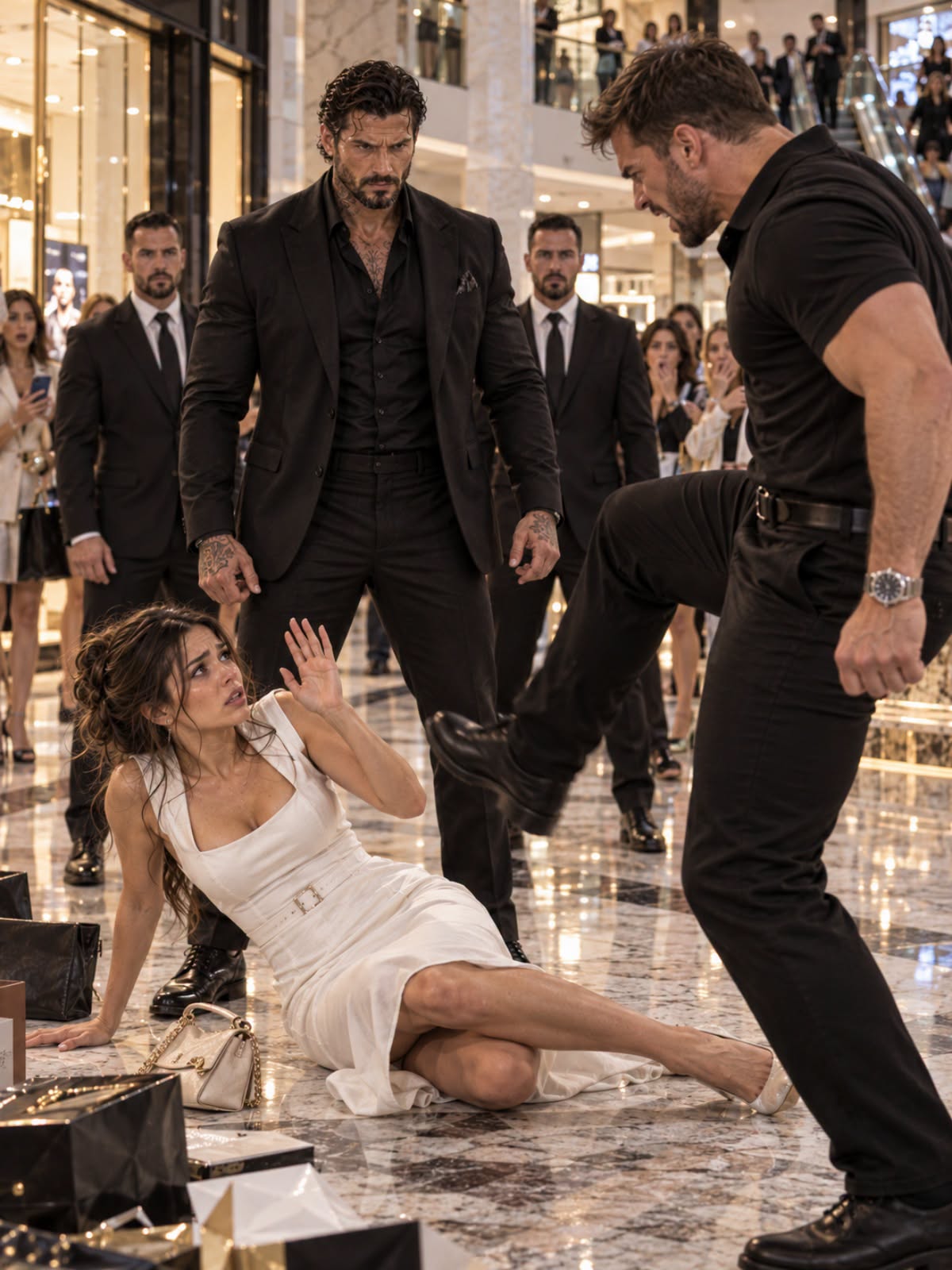
A year after the Galleria, Roman learned the thing his father had never taught him: the past doesn't disappear just because you want a different future. It doesn't fade politely. It waits — patiently, quietly — in paperwork, across a conference table, in the mouths of men who smile like they already know your answer.
The three men arrived on a Tuesday afternoon. They had names, but Sadi would never bother remembering them, because men like these were never really themselves — they were the weather of his old life blowing in through a door he thought he'd sealed. They had worked with his father. They had known Roman when he was something else. They made an offer the way men like them always make offers: as if it were already decided, as if they were merely informing him of his own future.
Access to the eastern warehouses. Just access. Just a signature, a nod, a door left conveniently unlocked.
Roman came home late. He took off his jacket and hung it with the particular care of a man trying to make one thing in his evening feel normal. He poured whiskey. He didn't drink it.
Sadi watched all of this from the doorway of the kitchen, her arms folded, her heart doing the slow, cold thing it did when it recognized danger before her eyes had caught up.
"Who?" she said.
"Who what?" Roman didn't turn around.
"You only pour whiskey you don't drink when somebody from your old world visits."
"That's annoyingly specific."
"Marriage."
Finally he looked at her. In the low light of the kitchen, the amber of the untouched whiskey caught something in his face that had nothing to do with light at all.
"They want access to the eastern warehouses."
"No."
"I haven't answered."
"You don't need to."
"It's complicated."
"How complicated?" She walked to the table and sat down. "Money complicated?"
"Enough to stabilize two construction projects."
"How much?"
He told her the number. She nearly whistled.
"That much?"
"And what's moving through the warehouses?"
"They didn't specify."
"Which means?"
"Nothing legal enough to specify."
"Then no."
"You make morality sound financially inconvenient."
"It usually is."
But then the part she hated — the part that lived in the air between them like smoke — surfaced. Refusing men like these was never just a no. It was a decision with a price tag that no accountant could itemize. Retaliation. Financially? Possibly. Physically? He didn't answer, and the absence of an answer was an answer, and she hated it with a clean, bright hatred.
"What do you want?" she asked.
"To refuse."
"Then refuse."
"You say that like consequence doesn't matter."
"It matters." She put her hand across the table, palm up. An offering, not a command. "But you're asking the wrong question."
"What question should I ask?"
"Who do you want to be if refusing costs you something?"
He stared at her hand like it was a foreign object he couldn't quite identify. Then he took it.
His father had built an empire asking one question, over and over, until it became the architecture of everything: what can I take? Sadi had rebuilt herself asking a different one: what can I live with? Those two questions had shaped two people who should never have found each other — and now they sat in a kitchen at midnight, and Roman Vale, son of the man who took everything, had to choose which question was going to be his.
He refused the offer the next morning. The men didn't argue. They just left, with the calm of people who know that a refusal is merely the opening move of a longer game.
The consequences arrived on schedule, like guests who'd been invited but never named.
Within weeks, two lenders withdrew. Not dramatically — no press releases, no accusations, just the sudden, surgical withdrawal of credit lines that had taken years to build, accompanied by language so polite it was almost an insult. A union contractor canceled, citing "scheduling conflicts" that nobody believed, least of all the man who'd shaken Roman's hand three days earlier with tears in his eyes about how the project would feed four hundred families.
Then came the warehouse on Harbor Street — the suspicious electrical fire at two in the morning. Nobody was injured. Nobody was even there. The message was clear enough that it didn't need a signature: we can reach what you own.
The board panicked. Panic, in a room full of wealthy men in tailored suits, looks remarkably like philosophy. Words like "temporary cooperation" were floated — said delicately, as if they were suggesting a new kind of organic tea rather than a return to the empire's original sin.
One meeting, at Roman's request, Sadi attended. She sat at the far end of the long conference table in a room with floor-to-ceiling windows overlooking the harbor, and she listened as six wealthy men explained, with enormous patience, why questionable partnerships were a necessary part of doing business at their level. They used the word "practical" eleven times. She counted. It helped keep her hands still.
One of the directors — silver-haired, with a smile he clearly believed was charming — leaned toward her and said, "Mrs. Vale, perhaps you could help Roman understand the practical reality."
Roman's face darkened in the particular way it did when violence was being considered and discarded. His hand found hers under the table, squeezed once — not a warning, an anchor.
"What reality?" Sadi asked.
"That ideals are expensive."
"They are," she agreed pleasantly. The director looked pleased with himself, the way a man does when he believes a woman has just surrendered to his logic. "So is prison."
Silence. Roman hid a smile so successfully that only Sadi — who knew the exact corner of his mouth where his restraint lived — saw it.
"And funerals," she added.
Nobody smiled after that.
The board approved selling the vulnerable assets instead. It cost hundreds of millions — a number so large it made the financial press lose its composure. The coverage called the move "baffling." Competitors called him weak, said it behind their hands at dinners, then louder, in print. His old associates — the ones who'd been waiting — called him finished.
Six months later, Vale International was smaller, cleaner, and more profitable than anyone had predicted. The numbers came in quietly, without fanfare, the way truth usually arrives: unglamorous and undeniable. Roman stared at the quarterly report for a long time in his office, late at night, and Sadi — who had come to take him home — watched him from the doorway and thought about how happiness, for a man like him, would never arrive as celebration. It would arrive as proof, and he still wouldn't quite trust it.
It was a Friday evening in early autumn when Roman came home carrying two grocery bags.
"What happened?" Sadi said.
"Nothing."
"You bought groceries."
"Yes."
"You don't buy groceries."
"I am capable of buying groceries."
She looked in the bags. Three bottles of wine. Pasta. Tomatoes. Bread. Six lemons, for no apparent reason whatsoever.
"What is this?"
"Dinner."
"Are we dying?"
"I thought we could cook."
"You threatened an international smuggling network more convincingly than you just said that."
Roman Vale, a man who could silence a boardroom with a single look, stood in his own kitchen holding a lemon like it might detonate, and Sadi laughed — she laughed so hard she had to lean against the counter — and something in his face did the thing it did now, the thing she'd spent three years earning: it softened without permission.
Two hours followed that neither of them would ever describe accurately to anyone else. The sauce burned — genuinely burned, black at the bottom of the pan, setting off the smoke detector twice. The pasta was dropped on the floor and salvaged with the kind of moral flexibility only private kitchens allow. He opened the wrong wine. She ate some of the burned sauce to spare his feelings and made a face that betrayed her immediately, and he looked so crestfallen that she laughed until her ribs hurt.
Midway through the disaster, his phone rang.
The old reflex arrived in both of them at once — the tightening in the chest, the shared understanding that a ringing phone at this hour meant emergency, meant power, meant responsibility, meant the world reaching in to take him back. She watched it happen: his hand started toward the phone on pure instinct, the body remembering a life the mind had left.
Then he silenced it.
She stared at him. "What?"
"You didn't answer."
"Arthur can handle it."
"Who are you?"
He smiled — a real one, small and unguarded — and went back to destroying the pasta.
The dinner was terrible. Sadi ate every bite. They took what remained of the wine to the balcony, where the city spread out below them in its autumn glitter, and she leaned against the railing and watched the man beside her — this man who had chosen quiet over empire — and asked, "Happy?"
"I don't know."
"Useful answer."
"I spent my entire life expecting happiness to feel like victory." He looked out at the city, and for a moment she saw the boy he'd been, raised in a house where love was a transaction and joy was weakness. "And?"
"This doesn't."
"What does it feel like?"
He looked back through the glass at their disastrous kitchen — the burned pan still smoking faintly in the sink, the lemon rolling lonely on the counter.
"Quiet."
"Maybe that's happiness," she said, and he put his arm around her, and they stood there in the cool air, and the city roared beneath them, and it was quiet.
A week later, the news came through Chloe, because news like this always comes through a friend first, softened, before it arrives as paperwork.
Trevor was eligible for early release. Extensive cooperation with authorities. Restitution paid. Evidence provided against what remained of Victor's network. The system, in its slow and bureaucratic mercy, had decided he had served enough of who he'd been to be allowed to try being someone else.
Roman's response, delivered without heat, without drama, was: "He should finish the sentence."
"Probably," Sadi said.
"He hurt you."
"Yes."
"He stole from people."
"Yes."
"He nearly got you killed indirectly."
"Also yes."
"Why aren't you angry?"
"I was."
"Past tense?"
"Mostly."
He studied her face the way he studied contracts — looking for the clause that changed everything. "You know what happens if Trevor leaves prison?"
"What?"
"My life continues." She said it simply, the way you'd state the weather. "I don't need his punishment to organize my future."
He was quiet for a long time. Then he nodded — not agreement, exactly, but recognition. He had, after all, spent a year learning that the past doesn't disappear because you want it to. It had to be outlasted, outgrown, outlived. And nobody understood that better than the woman in front of him.
Trevor was released four months later. He didn't call — which was, Sadi thought, the first wise decision he'd made in years.
One letter arrived. It was short. There was no request in it, no manipulation, no performance of remorse designed to open a door. Just facts, stated plainly: he was working at a nonprofit, helping former inmates understand financial paperwork — budgets, debt, the small print of starting over. The irony was enormous. Roman called it suspicious. Sadi called it appropriate.
The last lines were the ones she read three times:
You were right. Forgiveness isn't another chance. Thank you for giving me neither hatred nor access. Both helped.
She put the letter in a drawer. Not framed — he didn't get to be a monument. Not burned — she didn't need the ceremony. Just placed in a drawer, among ordinary things, where finished things go.
Finished.
Their third wedding anniversary arrived on a night that smelled of rain and expensive perfume.
Roman wore the cufflinks. He complained about fastening them — muttered darkly at the tiny mechanisms as if they were a board of directors being deliberately difficult — and Sadi pretended not to hear him, because some things between them had become rituals, and rituals don't need acknowledgment.
The fundraiser for the Second Chance Legal Project filled the ballroom of the Grand Meridian. Twelve hundred people had been helped now — twelve hundred lives rerouted, twelve hundred futures rewritten. Maria Velasquez gave the keynote, and her voice shook only once, at the end, when she talked about the first client who'd ever trusted her. Chloe announced a new housing program, and the applause went on so long that the event coordinator started checking her watch.
Backstage, before Sadi's speech, Roman handed her an envelope.
"Open it later."
"Why?"
"Because if you open it now, you'll cry before your speech."
"I don't cry."
He raised one eyebrow.
She gave the speech she'd been writing in her head for a year. Eight minutes. She talked about poverty as context, not tragedy — the thing that had shaped her without defining her. She talked about abuse as survivable, not as identity — the thing that had happened to her without becoming her. And she closed with the lesson she'd learned on the floor of the Galleria, with glass under her feet and a choice in her hands:
"Power isn't valuable because it can punish the person who hurt you. Punishment is the smallest thing power can do. Power matters when it gives someone the freedom to choose what happens next."
The room stood. The ovation rolled through the ballroom like weather. And Roman Vale — feared, formidable, terrifyingly calm Roman Vale — stayed seated.
Not from indifference. From pride so large it had nowhere to go. From fear, still, that happiness this complete was something the world might notice and take. From love — the kind that had learned to sit still and let the woman it adored have the whole room.
Back in the car, she opened the envelope.
It was a deed. The deed to the community building the Second Chance Legal Project had been renting for two years — the brick building on Carpenter Street with the good light and the reception desk where Maria kept the good pens.
"You bought the building." Her voice did something she didn't authorize.
He looked nervous, which was possibly the rarest thing she'd ever seen. "You said donations were acceptable."
"This is not a donation."
"It is legally."
"Roman."
"You needed permanent space."
The tears came anyway, exactly as predicted. "I predicted this."
"I hate you."
"No, you don't."
"Why put it in the organization's name?" She was crying harder now, laughing through it, furious at both. "Why not — "
"Whose name should it be in?"
She looked at him. Really looked. Not his. Not hers. The organization's.
The man who had been raised to own everything — every room he entered, every person who owed him, every piece of ground he stood on — had learned to give without possessing. Had learned that some things are more yours when you refuse to put your name on them.
She cried until she laughed, and then she laughed until she cried, and he held her in the back of the car on their third anniversary, and outside the window the city kept turning, indifferent and beautiful.
His past had tried, one more time, to make him choose between who he'd been and who he wanted to be. It had offered him money. It had threatened him with fire. It had sent its lawyers and its lenders and its quiet men with quiet warnings.
And Roman Vale had chosen — not once, in a dramatic moment, but every day since: in the refusal, in the burned sauce, in the silenced phone, in the deed with someone else's name on it.
Whatever his past had made him no longer controlled his future. It couldn't. Because he wasn't building that future alone anymore — and the woman beside him had never once asked him to be anything but the man he was choosing to become.
Tomorrow, there would be new paperwork. New threats, maybe. New choices. That was the nature of the world they'd survived.
But tonight, there was this: a building that belonged to everyone, a letter in a drawer that belonged to no one, and a marriage that belonged — finally, entirely — to the two people inside it.
The future was theirs to build. Together.