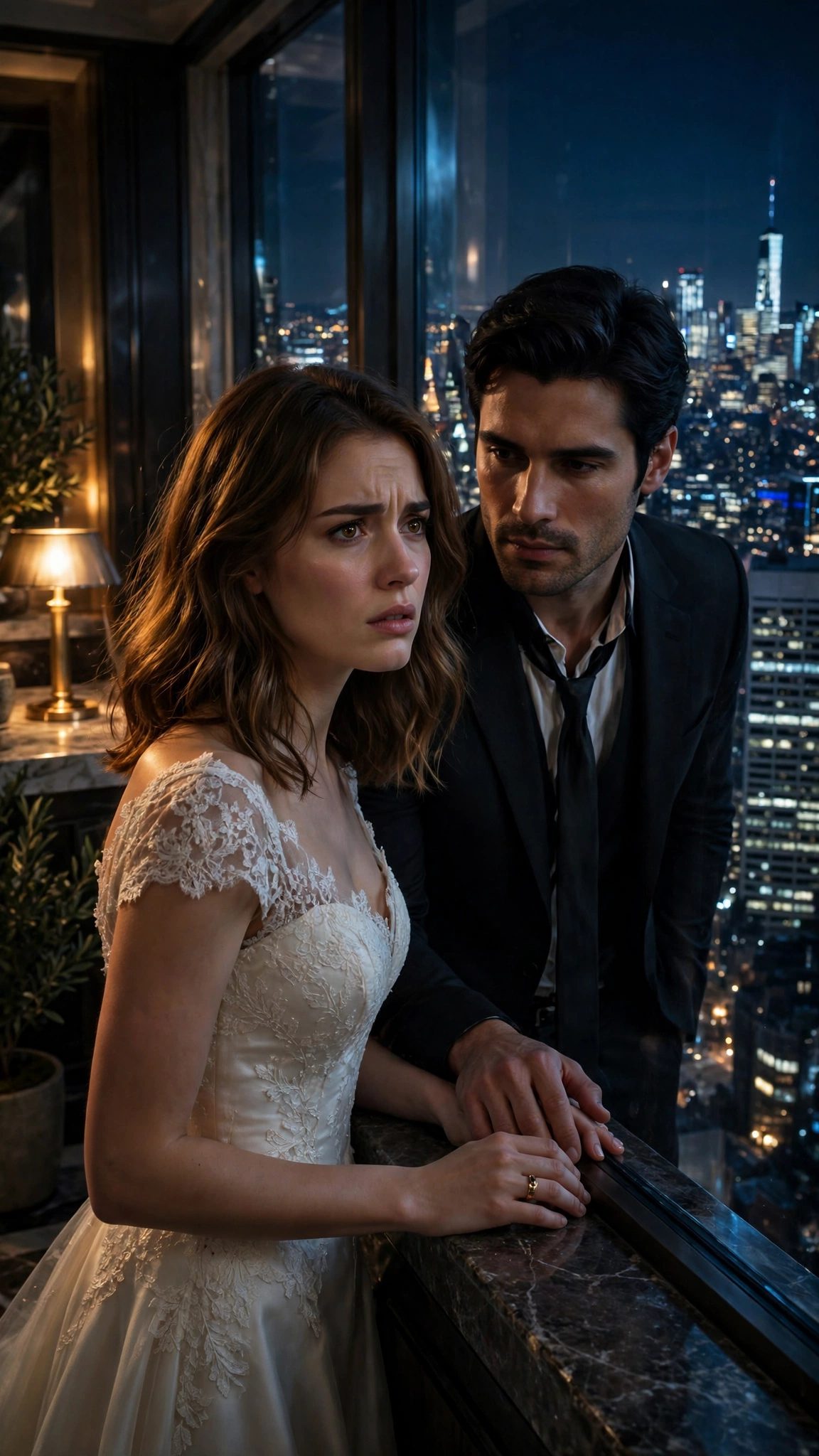
The man who had married me to keep me alive looked straight into my eyes on our wedding night and said, "This marriage means nothing."
I was standing in the bedroom of his Manhattan penthouse wearing an ivory wedding dress I had never dreamed of buying, staring at a husband I barely knew, and my ring felt like it was strangling me.
Dominic Moretti loosened his black tie with one slow pull, the way a man does when he is finished with a long day and not when he has just married a stranger. He did not look at the dress. He did not look at the flowers dying in their vase on the dresser. He looked at me the way he had looked at me in the parking lot four days earlier, like I was a problem he had already decided how to solve.
"Emily, I'm sorry," he said.
"Stop apologizing," I told him. My voice sounded steady, which surprised me, because nothing else about me was steady. My hands were shaking. My knees were shaking. The whole shining city outside the floor-to-ceiling windows seemed to be shaking, or maybe that was just me.
"I should have protected you," he said.
I stood up from the edge of the bed. The ivory silk whispered against my legs, too fine and too expensive for a woman who bought her clothes on a teacher's salary and mended them herself when they tore. "Just tell me the truth," I said. "All of it. Tonight. No more half answers."
Dominic inhaled deeply and began to speak, and what he told me was worse than anything I had imagined in the four days since I had met him.
Four days earlier, I had been Emily Carter, twenty-seven years old, high school art teacher, professional worrier, and owner of an apartment whose radiator made terrifying noises every winter. My life was small and ordinary and entirely mine. I taught teenagers how to mix color and how to see. I graded still lifes at my kitchen table. I called my best friend on Sundays. I had a sketchbook, a chipped blue mug, and a mother who had been gone for eleven years and still spoke to me in my head whenever I was about to do something stupid.
That Thursday, I stayed late after school. The hallways had gone quiet in that particular way school hallways do after the last bell, when the building belongs to the radiators and the janitor's radio. I had forgotten my sketchbook in the art room, and I was crossing the faculty parking lot with my coat half on and my keys already in my hand when I heard voices behind the maintenance building.
Men. Three of them, maybe four. They were discussing truck routes, delivery schedules, warehouse codes, and addresses, in the low, bored voices of men who do this every day. The same kinds of details I might find in a puzzle or a crime story, except these were not in a story. They were standing twenty feet from where I taught children to paint fruit.
I should have kept walking. My mother's voice said so, very clearly, in the back of my head: keep walking, Emily, this is not your business, keep walking. But my feet had already stopped, because one of the men said a name I recognized from the news, and another one laughed, and then one of them said, "Thursday. The Moretti trucks. Same as always."
It had happened back then, whatever it was. And I could not explain why I already knew the answer. He was Mafia, and they were discussing truck routes and delivery schedules around the docks, and I was a high school art teacher standing in a parking lot holding a sketchbook, listening to men plan something that would get someone killed.
I heard something then. Something safe, and familiar, and completely impossible.
"Emily."
My name, from everywhere and nowhere. Nobody called my name that way back then, low and certain, like the person saying it had been waiting for me.
Then I saw Dominic standing there, wearing his charcoal suit and the same black car I had seen twice that week parked behind him at the curb, and he looked down at me with dark eyes that did not blink.
"You've heard too much," he said.
I told him I hadn't been paying attention. It was a lie, and we both knew it was a lie, and it did not matter, because he said, "That doesn't matter. They saw you."
My throat went dry. I stared at him, at the suit that cost more than my car, at the calm in his face that was somehow more frightening than any anger would have been.
"What does that mean?" I asked.
"It means you are in danger now," he said. "And I am the only reason you are still standing here."
I did not believe him. I wanted very badly not to believe him. But then his black car sped down the road toward us, too fast, and the door swung open as it stopped and slammed into my side as I stepped back, and I stumbled and would have fallen if his hand had not caught my arm. I should have died, I thought, wildly, stupidly. I should have died right there in the parking lot, and then none of this would be happening.
I remember asking Dominic what happened. He didn't answer. I remember asking him why.
"Get in the car, Emily," he said.
"What if I refuse?" I asked.
"Then you won't ever know why," he said. "And they will find you anyway."
I heard myself answer no, quickly, but I also noticed that the words were still on my tongue, unfinished, because the voice inside my head had silenced the refusal. If I didn't get in, they would find me anyway. I climbed inside because the alternative was standing alone on the sidewalk while someone searched my apartment, and I had already seen enough to know that the men behind the maintenance building were not the kind of men you waited around for.
Dominic moved quickly. He took me to his office, a quiet room high above the city with a desk the size of a small boat, and he said, "I have something for you."
He opened the top drawer of his desk and pulled out a folder. A folder filled with photographs and an official police report. He set it in front of me and said, "Do whatever you want with it. I promise you'll be safer once you understand what you're looking at."
I opened the folder with shaking hands. The photographs showed the men from the parking lot, close and clear, getting into trucks at a warehouse on the docks. The police report was about a dockworker who had been found in the river two years earlier, a death the police had called an accident and the report itself quietly refused to call anything at all.
"I've never lied about who I am," Dominic said. He stood beside me, looking calm, while I tried not to think about how completely my life had changed in the space of one afternoon. "I'm not a church. I'm the head of a family. I fear the world differently than you do. I've seen consequences you can't picture."
"Then why are you helping me?" I asked. It was the only question that mattered.
"Because they saw your face," he said. "And because the men you overheard answer to someone who will not leave a witness alive. Not for a week. Not for a day. The only thing that keeps a witness alive in my world is my name. Nobody touches Dominic Moretti's wife without starting a war."
I stared at him. "Your wife."
"I'm marrying you," he said. He didn't stop to ask for permission. He didn't kneel. He didn't pretend it was anything but what it was: a wall built out of his name, with me standing behind it. "It is the only way."
"But that's not how it works," I said. My body reacted before my mind could catch up. My hands trembled until I could barely hold them straight.
"It is now," he said.
I didn't know what to say. But my voice changed, going quiet and strange, because underneath the fear there was something else, something I did not have a name for yet. "What about your family?" I asked. "Dominic, I don't even know you."
"I know you," he said. "I know you stayed late to fetch a sketchbook. I know you teach children to paint. I know you live alone and your radiator is broken and you worry too much. I know enough."
He's already lost enough, I thought, and I did not know where the thought came from. Maybe it was in his face. Maybe it was the way his hand had caught my arm in the parking lot, gentle when everything else about him was hard.
He took my hand then, and my fingers trembled as I wrapped them around his, and he said, "You are about to drive away from your entire life."
He was right. I stood for a moment, breathing hard, until the apartment I had imagined going home to was quiet again in my mind, and then I felt a strange calm settle over me, as if someone had finally stepped into the place I was standing and taken charge of whatever came next. It still didn't feel real.
The wedding happened two days later. There was no church, no crowd, no white aisle. There was a quiet room, a judge with tired eyes, a driver named Jack standing behind Dominic with his hands folded, and an older woman with silver hair and Dominic's dark eyes who watched me the whole time without smiling. Dominic's mother. Rosa Moretti. She looked at my plain dress and my shaking hands and said nothing at all, which somehow felt like a verdict.
The ivory dress came after, delivered in a white box to the penthouse, and I put it on because there was nothing else to wear to my own wedding night. It fit perfectly, which frightened me more than anything else had, because it meant someone had measured me without my knowing.
And now here I was, on my wedding night, in a bedroom larger than my whole apartment, with a husband who had just told me the truth at last.
"Four days before our wedding," Dominic said, "you followed a car to a location you should not have known."
"We didn't know each other," I said.
He examined me carefully. "You were so careful to arrive at the office early and pretend nothing was wrong. Even when we were alone, you didn't ask me about my schedule."
"You really believe that, Dominic?" I asked. "Why else would you show up at my office?"
"Are you stupid?" he said, but there was no heat in it. He snatched the keys from his own hand and held them up, and then he set them down and reached into his jacket and took out a small black flash drive, and held that up instead. "This flash drive has records showing that someone altered the Moretti shipping routes. Someone inside my own family changed the manifests, the trucks, the warehouses. That is why the men in the parking lot were talking. That is why they cannot leave you alive. You heard the routes. You could recognize the codes."
I knew exactly what he meant. If someone inside his family was stealing, and killing to hide it, then a schoolteacher who had overheard one conversation was a loose thread they would cut without thinking twice.
"Get in the car," Dominic said again, softly this time. "Go where?"
"Somewhere you can stay alive," he said.
I looked at the flash drive in his hand, small and black and ordinary, and I thought about how something that small could hold the reason a stranger would want me dead. I thought about the photographs in the folder, and the police report, and the dockworker in the river. I thought about my mother's voice, which had gone very quiet, as if even she did not know what to tell me.
"Then I saw his black car speeding down the road," I whispered, and I did not finish the sentence, because I was remembering the parking lot, and the door, and his hand catching my arm.
Dominic put the flash drive away. He stepped closer, and for a moment I thought he might touch my face, but he stopped with his hand in the air between us, as if he had remembered some rule I did not know.
"Four days from now," he said, "a man will try to finish what started in that parking lot. I will not let him. But you must do exactly what I tell you until then. You do not leave this building alone. You do not answer the door. You do not call anyone from your old life. Not yet."
"Four days," I said.
"Four days," he agreed. "And then we will know who he is."
I wanted to laugh. I wanted to cry. I wanted to ask him a hundred questions, starting with the one that mattered most: if this marriage meant nothing, why was he standing in front of me like a man preparing to go to war for it?
But four days earlier, I still believed the most dangerous thing about Dominic was being married to him. I had not yet learned that the most dangerous thing was everything he was trying to protect me from, and that the man who had just told me our marriage meant nothing was the only person in the world standing between me and a bullet.
Outside the windows, Manhattan glittered, cold and beautiful and indifferent. Inside, my husband took off his jacket, hung it carefully over a chair, and began to unbutton his cuffs, as if this were the most ordinary night of his life.
"Get some sleep, Emily," he said. "Tomorrow we start again."
I lay down in the ivory dress, because I did not know what else to do, and I listened to the city hum through the glass, and I thought about a sketchbook left behind in an art room, and a radiator that would keep making its terrifying noises all winter in an apartment I might never see again.