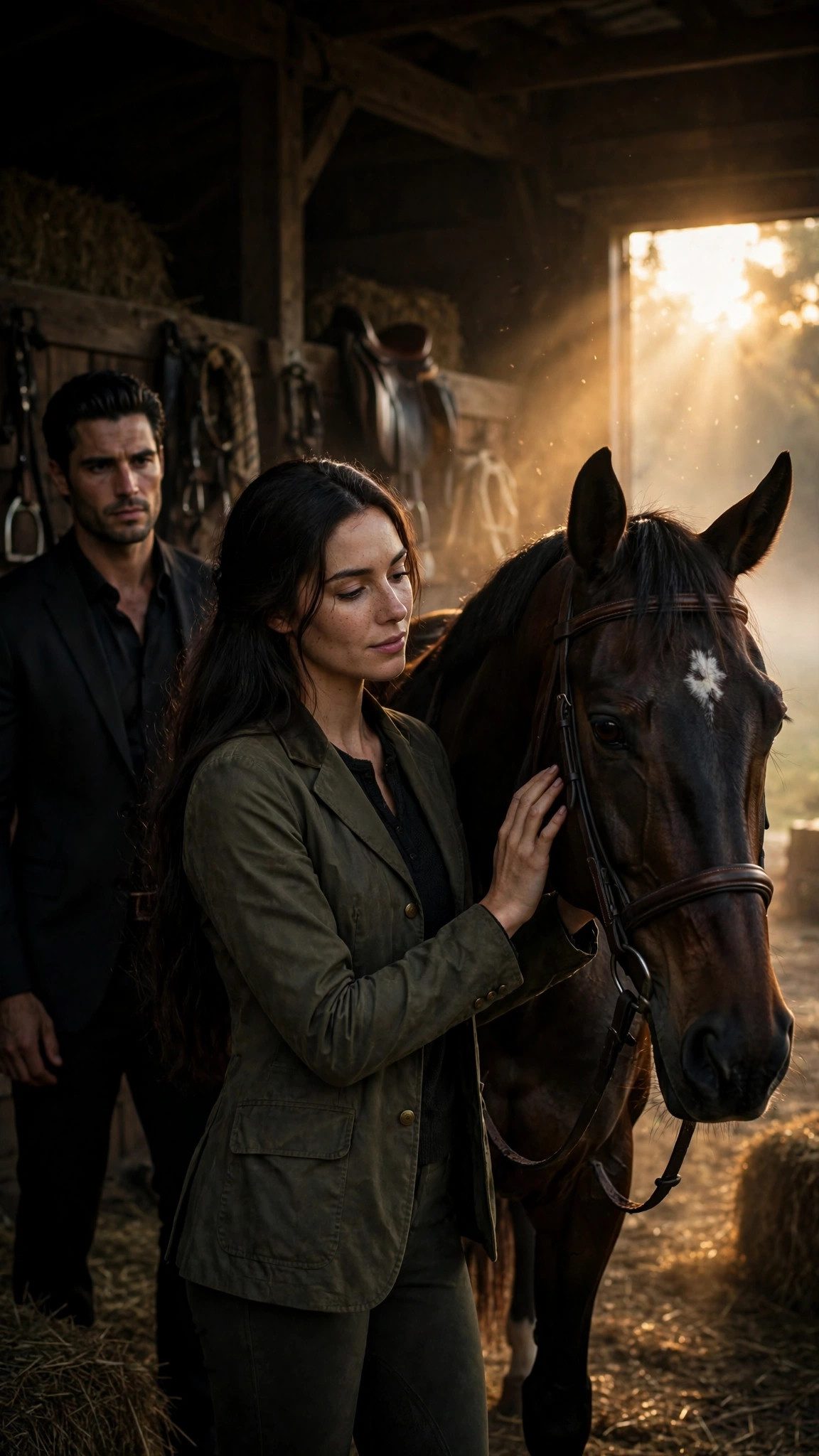
Twelve armed men reached for their guns when a sickening crack echoed through the barn, and Chicago's most feared mafia boss went rigid beneath my hands.
I felt it happen through my palms before I heard it. One moment Roman Bellori was lying on the old treatment table in the back of the stable, his breath slow and controlled, his body finally trusting me enough to let go. The next moment something deep inside his hip gave way with a sound like a green branch snapping, and every man in the barn moved at once.
"Don't," Roman said.
It was not a shout. It was barely louder than a breath. But twelve hands stopped halfway to twelve holsters, and twelve men froze where they stood, staring at me the way men stare at someone who has just done something unforgivable in front of them.
I did not move. I could not move. My hands were still pressed against Roman's hip, and beneath them his whole body had gone rigid, every muscle locked, his jaw clenched so hard I thought his teeth might crack next. His eyes were open and fixed on the rafters above us, and for one terrible second I was certain I had killed him. I had killed Chicago's most feared mafia boss on a treatment table in his own barn, and these twelve men were going to put me in the ground beside the horses.
Then Roman exhaled.
It was a long, ragged breath, the kind of breath a man takes when he has been holding something inside for a very long time and it finally lets go. The rigidity melted out of him all at once, like ice giving way in a river. His head fell back against the folded blanket. His hands, which had been curled into fists at his sides, opened slowly, finger by finger.
"Put them away," he said to the room, and his voice sounded different. Lighter. Younger, almost. "All of you. Put them away."
Nobody moved for a heartbeat. Then Garrett Sloan, who had been the first to reach for his gun, let his hand fall back to his side, his face white under his tan.
Roman sat up.
He did it slowly, carefully, the way a man does when he expects pain to stop him halfway. But there was no halfway. He swung his legs over the edge of the table and sat there, both feet flat on the straw-covered floor, his hands resting on his knees, staring down at his own legs like he had never seen them before.
Then he stood up.
He stood up without gripping the table. He stood up without shifting his weight to his left side first. He stood up the way other men stand up, the way men who have never been in pain stand up, and he took one step, and then another, and then he turned in a slow circle in the middle of the barn, looking down at his feet as if they belonged to a stranger.
"Eight years," he said quietly. "Eight years."
That was the moment I understood what the five days had done. Not just to his hip. To everything.
But to understand how I ended up with my hands on the hip of the most feared man in Chicago, you have to go back four months, to the day I arrived at Bellori Ridge with a duffel bag, a dead father's debt, and eleven years of learning how to listen to pain in animals that cannot tell you where it hurts.
My name is Hannah Peyton. I am twenty-nine years old, and I have spent eleven years learning to understand pain in animals that cannot tell me where it hurts.
My father taught me. He was a racetrack groom and a farrier's apprentice and, in the last years of his life, a gambler who could not stop. He taught me to watch a horse's ears before its eyes, to read the way it shifted its weight, to notice the stride that was half an inch shorter on one side. "Horses don't lie, Hannah," he used to say, wiping his hands on a rag that was never clean. "People lie. Horses just move the way the pain tells them to."
He died owing Roman Bellori one hundred and eighty thousand dollars.
I found out three days after the funeral, when a man in a suit I could not afford came to the little house outside Saratoga Springs and laid a folder on my kitchen table. Inside were my father's markers, his debts, his promises, all added up in neat columns. The man did not threaten me. He did not have to. He simply told me that Mr. Bellori would see me at Bellori Ridge on Monday, and that Mr. Bellori was a reasonable man, and that reasonable men preferred arrangements to unpleasantness.
I spent that weekend packing. I sold my father's truck. I gave his tools to a neighbor. I kept his old leather notebook, the one where he had written down every horse he ever worked on and what each one had taught him, and I kept my own notebooks, eleven years of observations about gaits and shoulders and hips and the small, stubborn ways a body protects itself from pain.
On Monday morning I drove to Bellori Ridge.
The estate sat outside Saratoga Springs, New York, behind iron gates and a long gravel drive lined with maple trees. The barns were white and immaculate. The pastures rolled away green and gold. The main house was a great grey stone pile with chimneys and ivy, and behind it I could see the training track, a dark oval against the morning light. It was beautiful in the way that only money can make a place beautiful, and it was terrifying in the way that only a man like Roman Bellori can make a place terrifying.
A groom met me at the yard and led me to the office. Roman was waiting.
He was thirty-four years old, and he was the most feared mafia boss in Chicago, and the first thing I noticed about him was that he never sat down.
He stood behind a desk the size of a small boat, his hands resting lightly on its edge, and he looked at me the way a man looks at a horse he is thinking of buying: carefully, without hurry, measuring everything. He was tall, dark-haired, with a strong jaw and eyes that did not blink often enough. He wore a black suit that fit him like it had been sewn onto him, a white shirt, a black tie. Everything about him was controlled and precise, except for one thing I noticed in the first ten seconds and did not understand for another month.
His weight was all on his left leg.
It was subtle. Most people would never have seen it. But I had spent eleven years watching horses shift their weight away from a sore leg, and a man is not so different from a horse when he is in pain. Roman's right foot was turned slightly outward. His right knee barely bent when he moved. When he walked around the desk toward me, his right stride was shorter than his left, and his pelvis tilted, just a fraction, like a table with one short leg.
"Miss Peyton," he said. His voice was deep and calm, the kind of voice that does not need to be loud to be obeyed. "Your father owed me one hundred and eighty thousand dollars. I am told you know horses."
"I do," I said. My voice came out steadier than I felt. "I know horses better than I know people."
"Good. Then we can make an arrangement." He picked up a folder from the desk and held it out to me. "You will manage my horses. You will train them, care for them, and keep them sound. Every month, a portion of your wages will go against the debt. If you do the work well, the debt will be gone in three years. If you do it badly, it will not be gone at all. Do you understand?"
"I understand," I said.
"One more thing." He set the folder down and looked at me for a long moment. "You will live here, on the estate. You will eat in the staff dining room. You will not ask questions about my business, and you will not repeat anything you hear. The men who work for me are not your concern. My guests are not your concern. Is that clear?"
"Clear," I said.
He nodded once, as if a contract had been signed, and then he did something that surprised me. He walked me to the door himself, and when he reached for the handle, his hand stopped halfway, and his fingers tightened on the brass for just a second, and a flicker of something crossed his face so fast I almost missed it.
Pain. I knew pain when I saw it. I had seen it in a hundred horses.
But I said nothing. I had been at Bellori Ridge for eleven minutes, and I already knew that noticing things about Roman Bellori was dangerous.
The groom showed me to a small cottage near the stables, clean and plain, with a bed and a desk and a window that looked out over the paddocks. That afternoon I walked the barns and met the horses. There were twenty-three of them, most of them thoroughbreds in training, a few broodmares, one old gelding named Bishop who had been retired after a tendon injury and now spent his days dozing in the sun.
And there was Sovereign.
Sovereign was a three-year-old colt, dark bay, almost black, with a white star on his forehead and a temper that had already earned him a reputation. He was fast, the grooms told me, fast enough to win, but he had been favoring his left shoulder for two weeks, and nobody could agree on why.
I spent an hour with him that first afternoon. I watched him walk. I watched him trot. I ran my hands down his legs and over his shoulders, feeling for heat, for swelling, for the small flinch that tells you where it hurts. His left shoulder was tight, the muscle bunched and guarded, but the real problem was lower, in the way he loaded his front feet. He was protecting the shoulder by changing how he moved, and the change was making everything else worse.
"Rest," I told the head groom, a wiry man named Ellis who had been at Bellori Ridge for twenty years. "No gallops for two weeks. Walking only, and cold water on that shoulder twice a day. If you keep running him, you'll turn a sore shoulder into a ruined horse."
Ellis looked at me for a long moment, then nodded. "We'll see what Mr. Bellori says."
That evening I ate in the staff dining room and went to bed early, exhausted. But I did not sleep well. I kept thinking about the way Roman had stood behind his desk, all his weight on one leg, and the way his hand had tightened on the door handle, and the flicker of pain on his face.
Horses don't lie, Hannah. People lie. Horses just move the way the pain tells them to.
The next morning, Roman sent for me.
I found him in the dining room of the main house, a vast room with a massive oak table and windows that looked out over the gardens. Twelve men in expensive suits sat around the table, eating breakfast, talking in low voices. At the head of the table stood Roman.
He always stood. That was the first thing everyone told me about him, as if it were a choice, as if it were a habit, as if it meant something about his character. People claimed it was because he never showed weakness. People claimed it was because a man who sits down can be cornered. People claimed a dozen things, and none of them were true.
I entered carrying a training report, and the room went quiet in the way rooms go quiet when a stranger walks in.
One of his men, a broad man with a heavy jaw named Garrett Sloan, looked me over slowly, from my boots to my hair, and then kicked a chair away from the table with his foot. The chair scraped across the floor and toppled over.
"Careful, sweetheart," Garrett said, loud enough for everyone to hear. "Those antiques probably have weight limits."
A few men laughed. My cheeks burned. I felt the report shake in my hands, and I hated that they could see it.
Before I could answer, Roman set down his knife. The sound was not loud, but the room went silent again, completely silent, the way a forest goes silent when a predator walks through it.
"Garrett," Roman said. "Put the chair back."
The laughter stopped. Garrett's face went stiff. He stood up, righted the chair, and pushed it back under the table without a word.
Roman turned to me. "The colt?"
I opened my folder and explained, as steadily as I could, that Sovereign's training was improving but his left shoulder needed rest. I told him about the two weeks of walking, the cold water, the risk of running him too soon. Roman listened carefully, his eyes on my face the whole time, not on the paper.
"Do it," he said.
As I turned to leave, he reached for his wineglass. His hand gripped the table instead. His right calf trembled, just once, a small shudder under his trouser leg. For one brief second, pain drained the color from his face.
Nobody reacted. Nobody else even noticed. But I noticed.
Roman wasn't standing because he wanted to intimidate people. He was standing because sitting hurt.
That night, I lay awake in my cottage and thought about what I had seen. A man who had not sat down in eight years. A man whose doctors said his spine was the problem. A man who walked like a horse with a sore hip.
And I thought about my father's notebook, and about the eleven years I had spent learning to see what other people missed, and about the debt that kept me at Bellori Ridge whether I liked it or not.
I did not know then that I was about to spend five days changing that man's life, and that those five days would change mine even more.