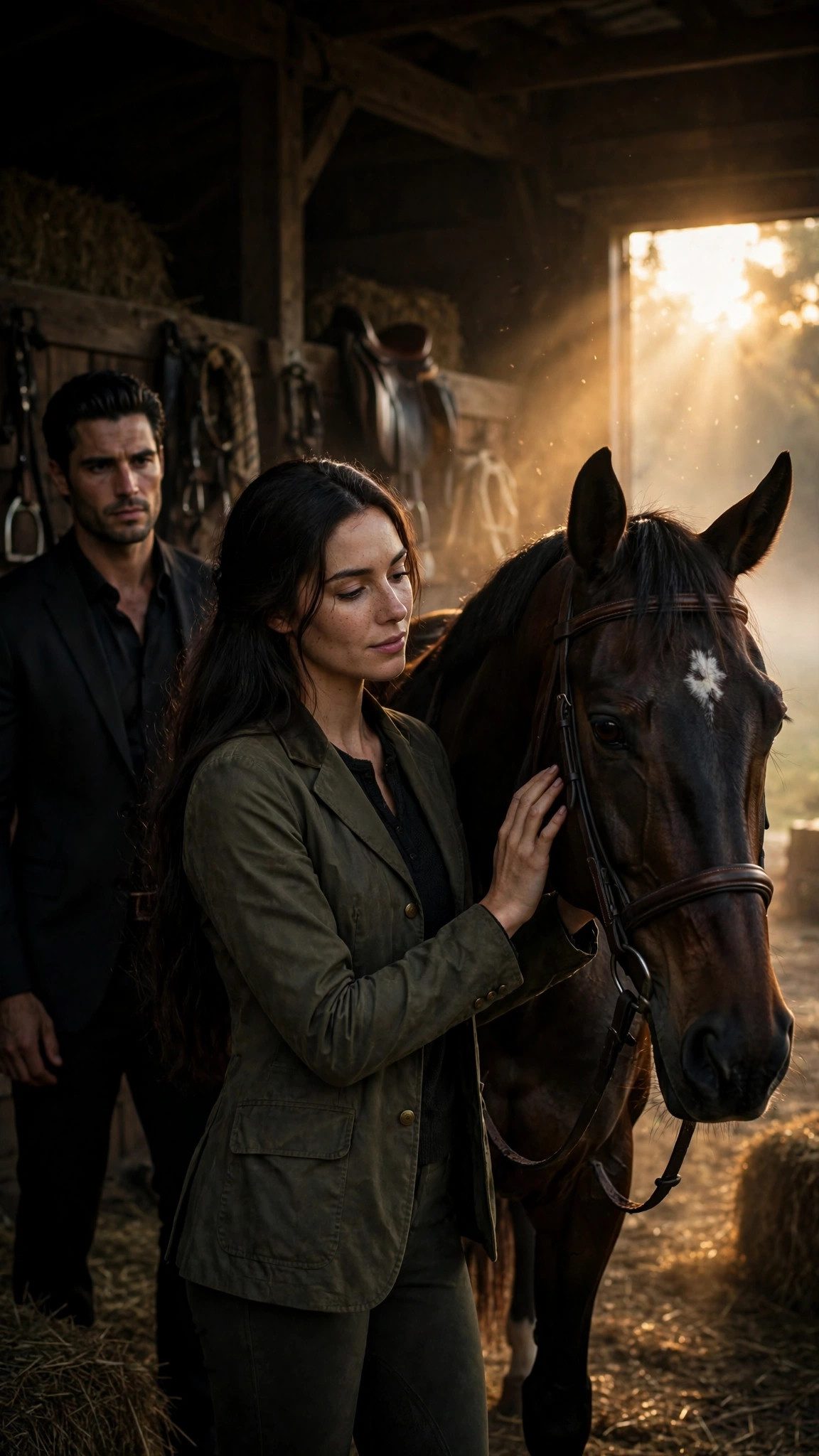
For a long moment Roman did not answer. We stood on the gravel path behind the barns, and the morning sun was warm on my face, and the mares grazed in the paddock beyond the fence, and nothing moved except the wind in the maple trees. I could feel my heart beating in my throat. I had said the most dangerous thing I had ever said to anyone, and now I had to wait to find out what it would cost me.
"You want to know about the accident," Roman said at last. It was not a question.
"If you'll tell me," I said.
He looked away, toward the track, and for a moment he was not the head of the Bellori family. He was a man remembering the worst day of his life.
"I was twenty-six," he said. "My father was still alive then. We were coming back from a meeting in the city, late at night, in the rain. A truck came through a red light and hit the side of our car. The car spun. It hit a barrier. I remember the sound of the metal folding, and I remember my father's hand on my shoulder, and then I remember waking up in a hospital with a broken collarbone and a pain in my back that never went away."
He paused, and his jaw tightened.
"My father died in that hospital three days later. Not from the crash. From the anesthesia, during a surgery to repair his leg. He went under and he never woke up. The doctors said it was a complication. They said it was rare. They said it was nobody's fault."
"I am sorry," I said quietly.
Roman shook his head, as if brushing away something he did not want to feel. "After the funeral, the pain in my back got worse. Avery ran tests. He found a disc pressing on a nerve. He said the crash had damaged my spine. He gave me injections. He gave me steroids. He told me surgery would fix it. I told him no. I have told him no for eight years."
"Did anyone examine your hip?" I asked again. "After the crash? Did anyone look at it at all?"
Roman was silent for a moment. Then he said, slowly, "They took X-rays of my chest and my spine and my collarbone. I don't remember anyone looking at my hip. The pain was in my back. Everyone assumed the back was the problem."
"Everyone assumed," I repeated. "But your body doesn't assume. Your body just moves the way the pain tells it to."
I took a breath and told him what I had seen, the way I would have told a trainer about a lame horse: plainly, without guessing, only what my eyes had observed. The shortened right stride. The pelvis tilted higher on the right. The foot turned outward. The way he shifted his weight to the left every time he stood still. The way his right calf trembled when he reached for something, as if the leg did not trust itself to hold him.
"A horse with a bad hip moves exactly like that," I said. "It shortens the stride on the sore side. It rotates the leg outward to avoid loading the joint. It shifts its weight to the other side. And because it moves wrong for years, the back starts to hurt too, because the back is doing work the hip is supposed to do. The back takes the blame for the hip. That's what my father used to say. Always check the hip first."
Roman listened without interrupting. His face gave nothing away. When I finished, he said, "You are a horse trainer."
"Yes," I said.
"And you think you know more than a doctor with thirty years of experience."
"I think I know how to watch a body move," I said. "That's all I'm claiming. I watched you walk, Mr. Bellori. Your hip is not moving the way a healthy hip moves. Your spine might be part of it. But it is not all of it. And if nobody has ever examined your hip, then nobody actually knows."
He stared at me for a long time. I could see the war going on behind his eyes: the man who trusted no one against the man who had lived in pain for eight years and was tired of it. The man who had been told by every expert that surgery was the only answer, and who would rather live in pain than go under anesthesia like his father. The man who had just been told, by a twenty-nine-year-old horse trainer who owed him a hundred and eighty thousand dollars, that the answer might be something else entirely.
"Come with me," he said at last, and turned back toward the house.
I followed him, my legs unsteady, my notebook clutched against my chest. We went into the main house, through the great hall with its stone fireplace and its portraits of Bellori men going back a hundred years, and into a study lined with books. Roman closed the door behind us and stood behind his desk, the same desk where he had offered me the arrangement four days earlier.
"Tell me exactly what you would do," he said. "If I let you look. If I let you try."
I had rehearsed this in my head all night, and it came out in a rush.
"First I would examine you. Not a doctor's examination. A movement examination. I would watch you walk, sit, stand, and lie down. I would feel the muscles around the hip and the pelvis, and I would find where it is tight and where it is weak. Then I would tell you honestly what I find, and if I find nothing, I will say so, and we will never speak of this again."
"And if you find something?"
"Then I would treat it the way I treat a horse with a hip injury. Five days. Gentle work, not force. Massage to release the muscles that have been guarding the joint for eight years. Careful manipulation to free the joint itself. Exercises to retrain the muscles to hold the pelvis level. Walking, not running. And at the end of five days, we would know whether it helped or not."
"Five days," Roman repeated. He sounded almost amused, as if I had proposed something absurd. "Eight years of pain, and you want five days."
"Five days to find out if I'm right," I said. "If I'm wrong, you've lost five days. If I'm right, you've lost eight years to the wrong answer. That's the trade."
He was quiet for a moment. Then he said, "Avery will say this is madness. He will say you are a horse trainer playing doctor, and that you could make it worse."
"He might be right," I admitted. "That's why I won't do anything forceful. No hard manipulation. No sudden movements. If something hurts, I stop. If you tell me to stop, I stop. That's the rule."
Roman walked to the window and looked out over the estate, his hands clasped behind his back. I watched his reflection in the glass, the tilt of his pelvis, the weight on his left leg, and I thought about how long he had been standing like that, how many years of mornings he had woken up and chosen to stand rather than sit because sitting hurt too much.
"There are conditions," he said finally, without turning around. "First: no one knows. Not Avery. Not Garrett. Not anyone. If word gets out that I am letting a horse trainer treat me, my enemies will hear about it, and my enemies would very much like to know that I am weak. Second: you do this in the barn, in the back room, where no one can see. Third: if you hurt me, if you make it worse, this arrangement ends, and so does your employment. Do you understand?"
"I understand," I said.
"And fourth." He turned around, and his eyes were very dark. "If you are wrong, Miss Peyton, I will not punish you for trying. But I will not forget that you tried. I do not like hope, Miss Peyton. Hope is a dangerous thing to give a man who has learned to live without it."
"I won't give you hope," I said. "I'll give you five days. That's all."
He studied me for a long moment. Then he nodded once, the same sharp nod he had given me on my first morning.
"Tomorrow morning," he said. "Six o'clock. The back room of the main barn. Tell Ellis you need the room for Sovereign's treatments. He will not ask questions. Ellis never asks questions."
I left the study with my heart pounding so hard I thought everyone in the house could hear it. I went back to my cottage and sat down at my desk, and I opened my notebooks, and I began to plan.
I wrote down everything I knew about hip injuries in horses: the signs, the treatments, the mistakes to avoid. I wrote down the muscles that guard a sore hip, and the way scar tissue forms around an old injury, and the way a joint that has not moved properly in years will fight you when you try to move it again. I wrote down the exercises that retrain the pelvis, and the stretches that release the hip flexors, and the slow, patient work of teaching a body to trust itself again.
And then, on a fresh page, I wrote down everything I knew about Roman Bellori: thirty-four years old, strong, proud, afraid of anesthesia, afraid of weakness, living in pain for eight years, standing because sitting hurt. A man who had been told by every expert that there was only one answer, and who had refused that answer because it meant trusting the same kind of room where his father had died.
I did not sleep that night. I lay awake listening to the wind in the maple trees, and I thought about the five days ahead, and about the crack I did not yet know was coming, and about the twelve armed men who did not yet know they would be reaching for their guns in a barn while a horse trainer's hands were on their boss's hip.
But that night, all I knew was this: tomorrow morning at six o'clock, I was going to put my hands on the most feared man in Chicago, and I was going to find out whether eleven years of listening to pain had taught me enough to save him.
That evening, as I was crossing the yard with a bucket of feed, Garrett Sloan stepped out of the shadow of the main barn and blocked my path.
"What did you say to him?" he asked.
I kept walking. "I don't know what you mean."
"Don't play stupid with me, sweetheart." He fell into step beside me, too close, his shoulder nearly brushing mine. "I saw you two on the gravel path this morning. I saw his face. He hasn't looked like that since before the accident, and I want to know what you said to him."
"Mr. Bellori asked me about Sovereign," I said. "That's all."
Garrett laughed, a short, ugly sound. "Sovereign. Right. You've been here four days and suddenly you're his confidante. Let me give you some advice, since you're new. Men like Roman don't have confidantes. They have employees, and they have enemies, and the line between the two is thinner than you think. Don't get ideas."
"I'm a horse trainer," I said. "I don't have ideas. I have horses."
He stopped walking and grabbed my arm, not hard enough to hurt, but hard enough to make his point. "You listen to me. Whatever you think you saw, whatever you think you know, you keep it to yourself. The boss has enough problems without a stable girl poking at them."
I looked down at his hand on my arm, and then I looked up at his face, and I thought about the chair he had kicked across the dining room floor, and the way Roman had made him pick it up again with three words.
"Let go of me, Mr. Sloan," I said quietly.
Something in my voice must have surprised him, because he let go. I picked up my bucket and walked on toward the stables, and I did not look back, but I could feel his eyes on me all the way across the yard.
Inside the stable, I went to Sovereign's stall and leaned my forehead against his warm neck, breathing in the smell of hay and horse and liniment. He stood perfectly still for me, the way horses do when they know you need a minute.
"He's afraid," I whispered to him. "Not of me. Of hoping. I know what that looks like. I saw it in my father every time he sat down at a card table and told himself this time would be different."
Sovereign blew softly through his nose and nudged my shoulder with his head, as if to say he understood, or as if to say he didn't, but he was here anyway.
I spent the rest of that evening in the tack room, preparing. I mixed liniment the way my father had taught me, warming the oil between my hands before I touched a sore muscle, because cold hands on a guarded muscle only make it guard harder. I laid out clean towels and a folded blanket for the treatment table. I read my father's notebook entry about the mare Clover three times, until I could recite it from memory: the way her hip had locked after a fall, the way every vet had blamed her back, the way my father had worked on her for five days, gently, patiently, a little more each day, until on the fifth day something inside her had let go with a sound like a knuckle cracking, and she had walked out of the stall sound for the first time in a year.
Five days. That was the number my father had written in the margin, underlined twice. Five days was how long it took a guarded joint to trust again.
I closed the notebook and sat there in the lamplight for a long time, listening to the horses settle for the night, and I thought about the man I would be treating in the morning, and about the twelve armed men who watched his every step, and about Garrett Sloan, who had already decided I was a problem.
I was afraid. I would be lying if I said I wasn't. But underneath the fear there was something else, something steadier: the same feeling I used to get when I put my hand on a sore horse and knew, before anyone else did, exactly where it hurt and exactly what it needed.
Tomorrow morning at six o'clock, I would find out whether I was right. And whether I was right or wrong, there would be no going back to being just the horse trainer who owed a dead man's debt. After tomorrow, I would be the woman who had either helped Roman Bellori or failed him, and either way, nothing at Bellori Ridge would ever be the same.