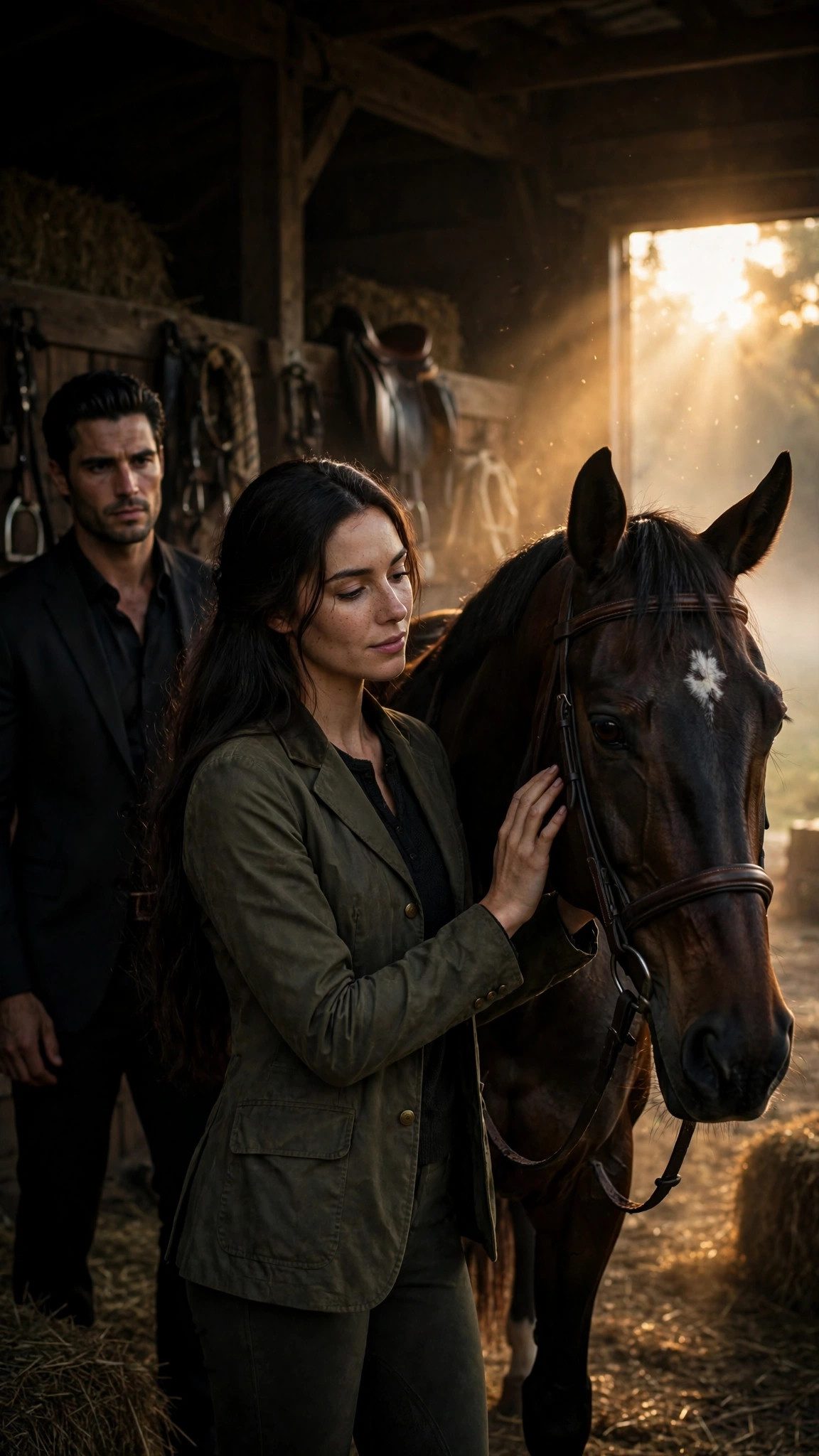
Day Two began the same way: six o'clock, the back room of the barn, the door closed, the lamplight warm on the blanket-covered table. Roman was already there when I arrived, standing by the window with his hands clasped behind his back, looking out at the yard where the grooms were beginning their morning work.
"You came," I said.
"I said I would," he replied. "I keep my word, Miss Peyton. Even when I am not sure it is wise."
He lay down on the table without being asked this time, and I noticed the difference immediately. Yesterday he had lain down like a man surrendering. Today he lay down like a man who had decided to cooperate. It was a small change, but it mattered. A guarded body does not heal. Only a body that trusts, even a little, can let go.
Day Two was deeper work. I pressed into the hip flexors, the thick bands of muscle at the front of the hip that had been shortened and tightened for eight years, and I felt them resist me, hard as rope. I worked slowly, breathing with him, waiting for each muscle to decide I was not a threat. Twice his breath caught and his hands clenched, and twice I stopped and waited, my hands still, until the pain passed and he nodded for me to go on.
"Tell me about the horses," he said at one point, his voice tight. "Talk about something else. It helps."
So I talked. I told him about Sovereign, about the way his shoulder was loosening, about the morning I had watched him trot in the round pen and seen his stride lengthen for the first time in weeks. I told him about Bishop, the old gelding, and the way he still thought he was a racehorse every time the saddle came out. I told him about my father, about the mare Clover, about the five days it had taken her hip to trust again.
"Your father sounds like a wise man," Roman said.
"He was wise about horses," I said. "He was a fool about everything else. But about horses, he was wise."
When I finished, Roman sat up, and this time he swung his legs over the side of the table and stood without bracing himself on it first. He took a few steps across the room, and his right stride was still short, but it was a fraction longer than it had been the day before, and he knew it. I could see it in his face.
"Day Three," he said, and left without another word.
Day Three was the hardest day.
I had planned to begin the gentle mobilization of the joint itself, moving the hip through its range a little at a time, asking it to remember how it used to move. But when I put my hands on him that morning, I could feel that his body was fighting me harder than it had on Day Two. The muscles were tighter. The guarding was stronger. It was as if his body had decided overnight that it had given enough, and it was not giving any more.
"You're tense," I said.
"I didn't sleep," he admitted. "Avery called last night. He wants to come on Friday with the surgical team. He says the injections are failing, and if I don't agree to the operation soon, the nerve damage could become permanent."
"And what did you tell him?" I asked.
"I told him I would think about it." He looked up at the ceiling. "He has been my doctor for eight years, Miss Peyton. He has watched me suffer for eight years. If you are wrong, and I turn him away, I am choosing a horse trainer over a surgeon."
"Then don't turn him away yet," I said. "Give me the five days. That's all I asked for. On the fifth day, you'll know. Your body will tell you, one way or the other."
He was quiet for a long moment. Then he nodded, and I went to work, and the work was slow and difficult, and twice I had to stop because the pain was too much, and twice he told me to go on, and by the end of the hour his hip was moving a few degrees further than it had the day before, and that was enough. That was what Day Three was for: not a breakthrough, but a few more degrees. A little more trust.
Afterward, as he was buttoning his shirt, he said something I did not expect.
"My father used to say that a man who cannot sit down cannot think clearly," he said. "He said a man needs to sit to make decisions, to listen, to be still. I have not sat still in eight years. I have made every decision standing up, in a hurry, with one foot already out the door. I wonder how many of those decisions I would have made differently if I could have sat down first."
I did not know what to say to that, so I said nothing. I just folded the blanket and put away the oils, and he left, and I stood alone in the back room of the barn, thinking about a man who had run an empire for eight years without ever once sitting down to think.
Day Four was different. Day Four was the day the exercises began.
I taught him to stand with his feet level and shift his weight slowly from side to side, feeling the pelvis stay even. I taught him to lie on his back and lift his right knee toward his chest, a few inches at a time, breathing out as the hip opened. I taught him to walk the length of the barn with his hands on his hips, feeling for the tilt, correcting it, step by step.
He was a terrible patient and a wonderful student. He hated every exercise. He did every one of them twice.
"Again," he would say, his jaw tight, sweat on his forehead. "Show me again."
And I would show him again, and he would do it again, and by the end of the hour he could walk the length of the barn with his pelvis almost level, his right stride almost as long as his left, and when he stopped at the far end and turned around, he was smiling. Not a big smile. A small, surprised smile, the smile of a man who has just discovered that his body can do something he thought it had forgotten how to do.
"Tomorrow," he said. "Day Five."
"Tomorrow," I agreed. "And Mr. Bellori, tomorrow I will ask the joint to do something it hasn't done in eight years. If it isn't ready, I will stop. I promise you that."
"I know," he said. And then, quietly, "Thank you, Hannah."
It was the first time he had called me by my first name.
That night I barely slept. I lay awake going over every detail in my mind: the range of motion I had measured, the resistance I had felt, the way the joint had moved on Day Three and the way it had moved on Day Four. I thought about the mare Clover, and the sound her hip had made on the fifth day, like a knuckle cracking, and the way she had walked out of the stall sound for the first time in a year.
I thought about the twelve armed men who followed Roman everywhere, and about Garrett Sloan, who had been watching the back room door, and about what would happen if the adjustment went wrong in front of them.
And I thought about Roman's face when he had smiled at the end of Day Four, and I thought about the five days, and about the title I did not yet know someone would give this story, and I understood, for the first time, that the five days were not just about his hip.
They were about trust. Five days of showing up. Five days of a man letting a woman put her hands on the one place he had never let anyone touch. Five days of a horse trainer and a mafia boss learning that the other one could be trusted.
Day Five dawned cold and clear. I was in the back room by five-thirty, and Roman arrived at six, and this time he was not alone.
Garrett Sloan was with him, and eleven other men, and they filled the doorway of the back room, their shoulders blocking the light, their faces hard.
"What's this?" I asked, my voice sharper than I intended.
"Garrett insisted on coming," Roman said. His face was calm, but I could see the tension in his jaw. "He told the men that something strange is happening in this barn. He told them you have been meeting me here in secret. He told them you might be hurting me."
"I have not been hurting you," I said.
"I know that," Roman said. "But they don't. And in my world, Miss Peyton, when twelve armed men think someone is hurting their boss, they do not ask questions first."
Garrett stepped forward, his hand resting on his holster. "Boss, with respect, we don't know what she's doing to you in here. We don't know what she's putting in those oils. For all we know, she's working for someone else. The Castellanos would pay a fortune to get to you through a stable girl."
"Garrett," Roman said, his voice low and dangerous. "I told you to put the chair back once. I will not tell you again."
"I'm just trying to protect you," Garrett said.
"Then protect me by standing over there and keeping your mouth shut," Roman said. "Miss Peyton is going to do her work. You are going to watch. And if you reach for your weapon, I will deal with you myself."
The men moved back, reluctantly, to the edges of the room. Garrett took a position by the door, his arms crossed, his eyes on me.
Roman lay down on the table.
"Do it," he said quietly. "Whatever you were going to do today, do it now. They're watching, so do it well."
My hands were shaking. I pressed them flat against the table for a moment, breathing slowly, the way I had taught Roman to breathe. Then I put my hands on his hip, and I felt for the joint, and I felt for the resistance, and I felt for the place where eight years of guarding had built a wall around the thing that needed to move.
It was ready. I could feel it. The muscles had let go. The scar tissue had softened. The joint was waiting, like a door that has been stuck for years and is finally loose in its frame.
"I'm going to move it now," I said softly, for Roman and for no one else. "One slow movement. Breathe out with me. Now."
I moved his leg the way I had moved it a hundred times in practice, gently, steadily, guiding the hip through its arc, and for a moment there was resistance, and then there was a sickening crack that echoed through the barn like a gunshot.
Twelve armed men reached for their guns.
Roman went rigid beneath my hands.
I froze, my hands still pressed against his hip, my heart hammering, certain that I had broken him, certain that Garrett Sloan was going to kill me where I stood.
"Don't," Roman said.
It was barely louder than a breath, but twelve hands stopped halfway to twelve holsters.
And then Roman exhaled, long and ragged, and the rigidity melted out of him, and he sat up, and he stood up, and he took a step, and then another, and he turned in a slow circle in the middle of the barn, and he looked down at his feet like they belonged to a stranger.
"Eight years," he said quietly.
Then he did something no one in that barn had seen him do in eight years.
He pulled a chair out from the wall, and he sat down in it.
He sat down all the way, his back against the chair, his feet flat on the floor, his hands resting on his knees, and he looked up at me, and his eyes were wet.
"It doesn't hurt," he said. "Sitting doesn't hurt."
Garrett Sloan's hand fell away from his holster. One by one, the twelve men lowered their arms. The barn was silent except for the horses shifting in their stalls and the wind in the maple trees outside.
And in that silence, I understood what the five days had done. Not just to his hip. To everything.
Roman stayed in the chair for a long time. He sat there with his hands on his knees, breathing slowly, as if he were learning how to sit all over again, as if his body needed time to believe what had just happened. The twelve men watched him, and I watched them watching him, and I could see the disbelief on their faces turning slowly into something else, something like awe.
Finally Roman stood up again, and this time he did not do it carefully. He stood up the way a man stands up when standing does not hurt, and he walked to the door of the back room, and he turned to face his men.
"What happened in this room stays in this room," he said. His voice was calm, but there was iron under it. "Miss Peyton has done something no doctor in eight years could do. She has my gratitude, and she has my protection. Any man who speaks of this outside these walls will answer to me. Is that understood?"
Twelve heads nodded.
"Garrett," Roman said. "Walk with me."
Garrett followed him out into the yard, and I stood alone in the back room with my hands still smelling of liniment and my heart still hammering, and I listened to the horses and the wind, and I thought about the sound the crack had made, and about the way twelve hands had stopped in midair at a single word from a man who had just learned how to sit down.
A few minutes later, Ellis came to the door with a bucket of water for Sovereign's shoulder, and he looked at me, and then he looked at the chair still sitting in the middle of the room, and then he looked back at me, and he smiled, a slow, knowing smile.
"Well," he said. "I always said that girl knew horses."
I laughed, and the laugh came out shaky, and Ellis pretended not to notice, and went back to his work.
I stayed in the back room for a while longer, folding the blanket, putting away the oils, cleaning the table the way my father had taught me to clean up after a treatment: everything in its place, everything ready for next time. Because there would be a next time. The hip was free, but eight years of bad habits would not disappear in one morning. There would be exercises. There would be check-ins. There would be mornings when it was stiff again, and mornings when it moved freely.
But the hardest part was over. The joint had trusted me. The man had trusted me. And in the silence of the barn, with the chair still sitting in the middle of the floor where a man who had not sat down in eight years had just sat, I understood that the five days had made something that could not be undone.
Not just a healed hip. A beginning.