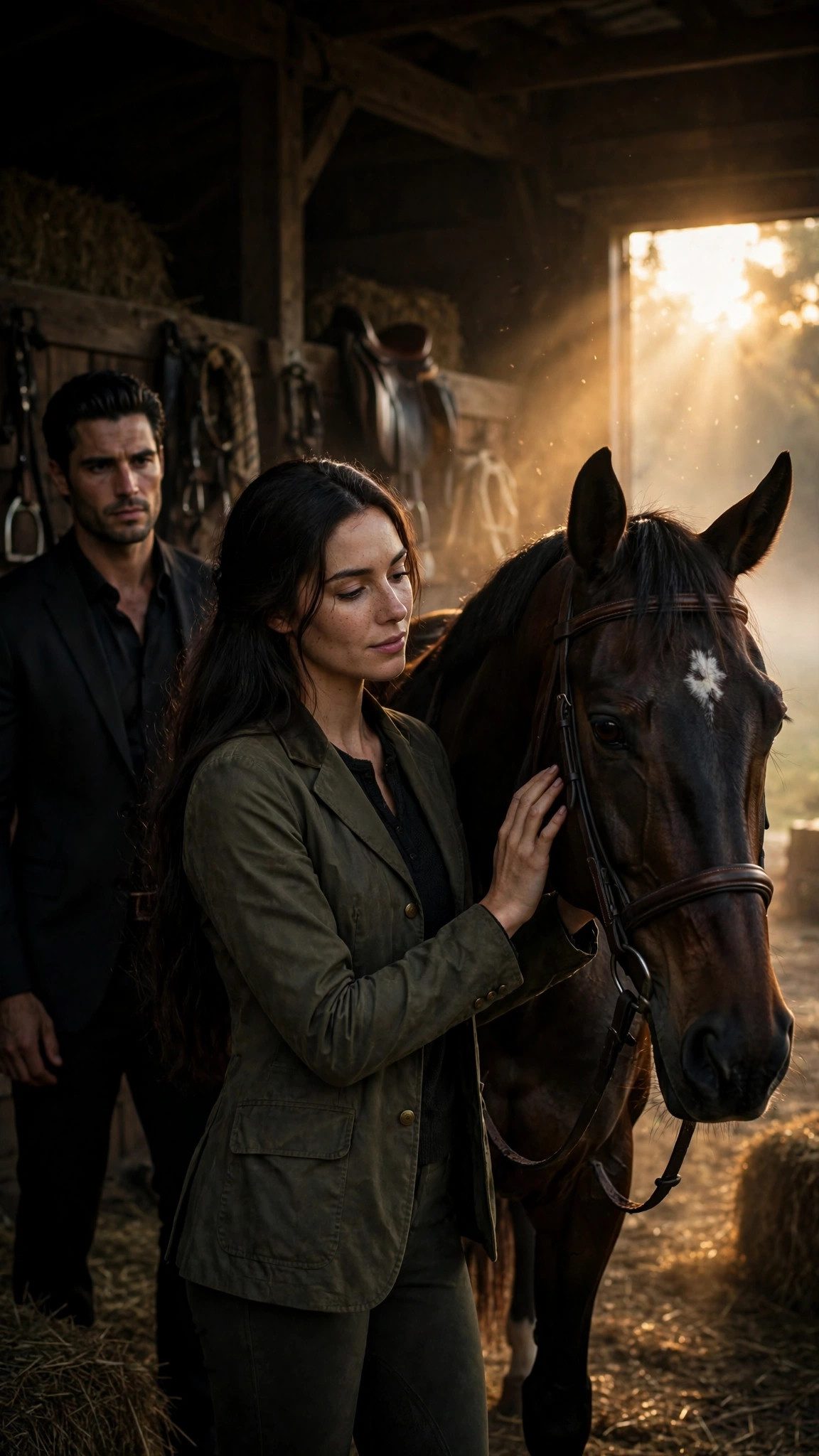
The morning of the ride dawned cold and gold, the kind of autumn morning that makes the whole world look newly washed. I was in the yard before six, saddling Sovereign myself, checking his girth twice, running my hand down his left shoulder and feeling the way the muscle moved freely under my fingers now, loose and warm and strong.
He was ready. Two weeks of walking, cold water, and patience had done what I had promised Roman they would do. The shoulder was sound. The colt was sound. And this morning, for the first time, he was going to run.
Roman came out of the main house as the sun was coming up over the maple trees. He was dressed for riding: dark trousers, boots, a black sweater, no suit, no tie. He looked younger in the morning light, and happier, too, in a quiet way, the way a man looks when he has slept well for the first time in years.
He had a horse waiting for him, a tall dark gelding named Onyx, and he mounted easily, without gripping the saddle, without shifting his weight, without the careful bracing I had watched him do for four months. He settled into the saddle like a man who had been riding all his life, which he had, and then he looked down at me, and he smiled.
"Are you ready, Hannah?"
"I've been ready for weeks," I said, and I mounted Sovereign, and the colt danced sideways with excitement, and I laughed, and Roman laughed too, and we rode out together toward the training track, the grooms watching from the fence, Ellis leaning on his pitchfork with a smile on his weathered face.
We walked the horses around the track once, slowly, letting them warm up, letting them feel the morning. Sovereign was eager, his ears pricked, his neck arched, his feet light on the ground. Onyx was steady beside him, calm and strong, the way a good horse is when it knows its rider trusts it.
"Let him go," Roman said when we reached the far turn. "Let him run."
I loosened the reins, and Sovereign took off like a released arrow.
The wind hit my face, and the world blurred into green and gold, and I felt the colt's stride lengthen underneath me, smooth and powerful, his shoulder moving freely, his whole body working the way a healthy horse's body works when nothing hurts. He ran the way he was born to run, and I rode him the way I had dreamed of riding him since the first day I had put my hands on his shoulder and told Ellis he needed rest.
We came around the far turn and down the straight, and I could hear Roman behind me, laughing, and I could hear Ellis shouting from the fence, and I could feel Sovereign's heart beating through the saddle, strong and steady, and I thought about my father, and about the notebook, and about the mare Clover, and about the five days, and I thought: this is what it was all for. Not the debt. Not the money. This. A sound horse, running free, on a cold gold morning.
When we pulled up at the finish, Sovereign was barely breathing hard, his ears still pricked, his eyes bright. Roman rode up beside me, and he was grinning, actually grinning, the way I had never seen him grin before.
"He's ready," Roman said. "He's ready to win. The autumn races are in three weeks, and Sovereign is going to win them."
"He is," I agreed. "He's sound, and he's fast, and he knows it."
We walked the horses back to the yard side by side, and the grooms took them, and Ellis gave Sovereign an extra handful of oats, and Roman and I stood together in the yard, watching the sun climb higher over the maple trees.
"Hannah," Roman said, and his voice was different from the voice I had first heard in his office four months ago. That voice had been deep and calm and controlled. This voice was deep and calm too, but underneath it there was something else, something warm and unguarded, something I had only heard once before, in the back room of the barn, when he had said my name for the first time.
"When I offered you the arrangement," he said, "I told you that you would manage my horses and pay off your father's debt. That was a contract. It was fair, and it was clear, and it is finished now. The debt is burned. You owe me nothing. You can leave tomorrow, and no one will stop you, and no one will think less of you for it."
He paused, and he looked at me, and his eyes were very dark and very steady.
"But I am asking you to stay. Not as my employee. Not as my trainer. Not because you owe me anything. I am asking you to stay because in five days, you did something no one else in my life has ever done. You saw me weak, and you did not use it. You saw me in pain, and you did not pity me. You put your hands on the one thing I have hidden from the world for eight years, and you treated it gently, and you gave it back to me."
He took a step closer, and his voice dropped, and he said the words slowly, carefully, the way a man says words he has rehearsed a hundred times and is still afraid of getting wrong.
"Hannah Peyton, I am not asking you to marry me because I need a wife, or because I need an heir, or because it would be convenient. I am asking you because in five days, you became the person I trust most in the world, and I do not want to live the rest of my life without you beside me. I am asking you because I love you. I think I started loving you the day you stood on that gravel path and told me my doctor was wrong, and I have loved you more every day since."
He stopped, and he waited, and the yard was very quiet, and the only sound was Sovereign munching oats in his stall and the wind in the maple trees.
I thought about the four months since I had arrived at Bellori Ridge with a duffel bag and a dead father's debt. I thought about the dining room, and the chair Garrett had kicked, and the way Roman had said "Put the chair back." I thought about the gravel path, and the examination, and the five days, and the crack in the barn, and the twelve armed men, and the burning papers. I thought about the man who had stood for eight years because sitting hurt, and who had sat down in a chair in front of me and said it didn't hurt anymore.
And I thought about the question he had asked me, and I knew that it was not a contract, and it was not a deal, and it was not an arrangement. It was a choice. He was giving me a choice, the way no one had ever given me a choice before. Stay or go. Yes or no. His or free.
"Yes," I said.
It came out simply, without flourish, the way the truest things always come out.
"Yes," I said again, louder, laughing a little because I could not help it. "Yes, Roman. I will stay. I will marry you. Not because I owe you anything. Because I love you too. I think I started loving you the day you made Garrett Sloan pick up that chair, and I have loved you more every day since."
He stared at me for a moment, as if he could not quite believe what he had heard, and then he did something I had never seen him do. He laughed. Not a small, controlled laugh. A real laugh, loud and surprised and joyful, the laugh of a man who has just been given something he did not dare to ask for.
And then he took my hands in his, and he kissed them, one at a time, gently, the way a man kisses the hands that have healed him.
We were married three weeks later, on the same day Sovereign won his first race.
It was a small wedding, in the chapel on the estate, with Ellis and Raphael and the grooms and the horses watching from the yard outside. I wore a simple white dress, and Roman wore a black suit, and when the priest asked me if I would take this man, I said yes, and when he asked Roman, Roman said yes, and when we walked out into the autumn sunlight, Sovereign was waiting at the fence, his dark head over the rail, his white star bright in the sun, as if he had come to see it for himself.
That evening, after the guests had gone, Roman and I sat on the porch of the main house, in two chairs side by side, watching the sun go down over the pastures. He sat all the way back in his chair, his feet flat on the floor, his hands resting on his knees, and I sat beside him, and I thought about how strange and wonderful it was that a dead father's debt had led me here, to this house, to this man, to this life.
"You know," Roman said, reaching over to take my hand, "my father used to say that a man who cannot sit down cannot think clearly. He said a man needs to sit to make decisions, to listen, to be still. I spent eight years making every decision standing up, in a hurry, with one foot already out the door. And then you came, and you taught me to sit down, and the first clear decision I ever made sitting down was to ask you to marry me."
"And the second?" I asked, smiling.
"The second," he said, squeezing my hand, "is that I will never make another important decision without you beside me. That is a promise, Hannah Bellori. Not a contract. A promise."
I leaned my head against his shoulder, and we sat there together as the light faded, and the horses settled in their stalls, and the maple trees turned black against the sky, and I thought about the five days.
Five days of showing up. Five days of gentle hands and patient work. Five days of a guarded joint learning to trust again, and a guarded man learning the same thing.
Five days that made her his. And five days that made him hers.
And sometimes, on quiet evenings, when the wind moves through the maple trees and the horses are sleeping in their stalls, I think about a gravel path, and a notebook, and a horse trainer who owed a dead man's debt, and a mafia boss who had not sat down in eight years, and I think about how the most important things in life are never the things you plan for.
They are the things you notice, if you know how to watch. And the things you heal, if you know how to listen. And the people you love, if you are brave enough to stay for five days, and then for the rest of your life.
The race itself was everything I had hoped it would be, and more than I had dared to expect.
We drove to the track on a bright October morning, Roman and I in the back of the black sedan, Ellis and Raphael in front, Sovereign in the horse trailer behind us, calm and ready. When we arrived, the grandstand was already full, and the air smelled of autumn and excitement, and I could feel my heart beating in my throat the way it had beaten on the morning of the fifth day.
Sovereign walked into the paddock like he owned it. He was dark and gleaming, his white star bright, his shoulder moving freely, his whole body loose and strong. The other trainers looked at him, and then they looked at me, and I could see them wondering who this woman was and where this horse had come from.
"He's ready," Ellis said, squeezing my shoulder. "Whatever happens, he's ready."
The race was a mile and an eighth, and Sovereign broke cleanly from the gate, and settled in third, and waited, the way I had taught him to wait, patient and calm, saving his strength. Around the far turn he began to move, picking off one horse and then another, and down the stretch he opened up, his stride lengthening, his shoulder free, his whole body doing exactly what it was born to do.
He won by two lengths.
I screamed. I actually screamed, right there in the grandstand, in front of everyone, and Roman laughed and picked me up off my feet and spun me around, and Ellis was shouting, and Raphael was clapping, and Sovereign was dancing in the winner's circle with a blanket of flowers around his neck, looking for all the world like he had known all along that he was going to win.
That night, after the celebrations were over, I sat at the desk in our cottage — our cottage now, not just mine — and I opened my father's leather notebook to a fresh page. I wrote down the date, and I wrote down Sovereign's name, and I wrote down the time of the race, and underneath it all, in my own handwriting, I wrote the words my father had written about the mare Clover, all those years ago.
"The back takes the blame for the hip. Always check the hip first."
And underneath that, I wrote something of my own.
"Five days. That is how long it takes a guarded joint to trust again. And five days is how long it takes a guarded heart to do the same. Show up every day. Do the work gently. Don't force it. And when it is ready, it will let go, and everything will change."
I closed the notebook and went to the window, and I looked out at the dark pastures, and I thought about my father, and about the debt, and about the man sleeping in the next room, the man who had not sat down in eight years and who now sat beside me every evening without even thinking about it.
My father had been a good horseman and a bad gambler, and he had left me a debt and a notebook. The debt was burned. The notebook was mine now, filled with his wisdom and my own, and it would go on my desk for the rest of my life, a reminder of everything he had taught me and everything I had learned since.
Horses don't lie. People lie. Horses just move the way the pain tells them to.
And if you know how to watch, and you know how to listen, and you are brave enough to stay for five days, you might just find that the pain was never the whole story. The whole story is what comes after the pain lets go.
The End.
THE END