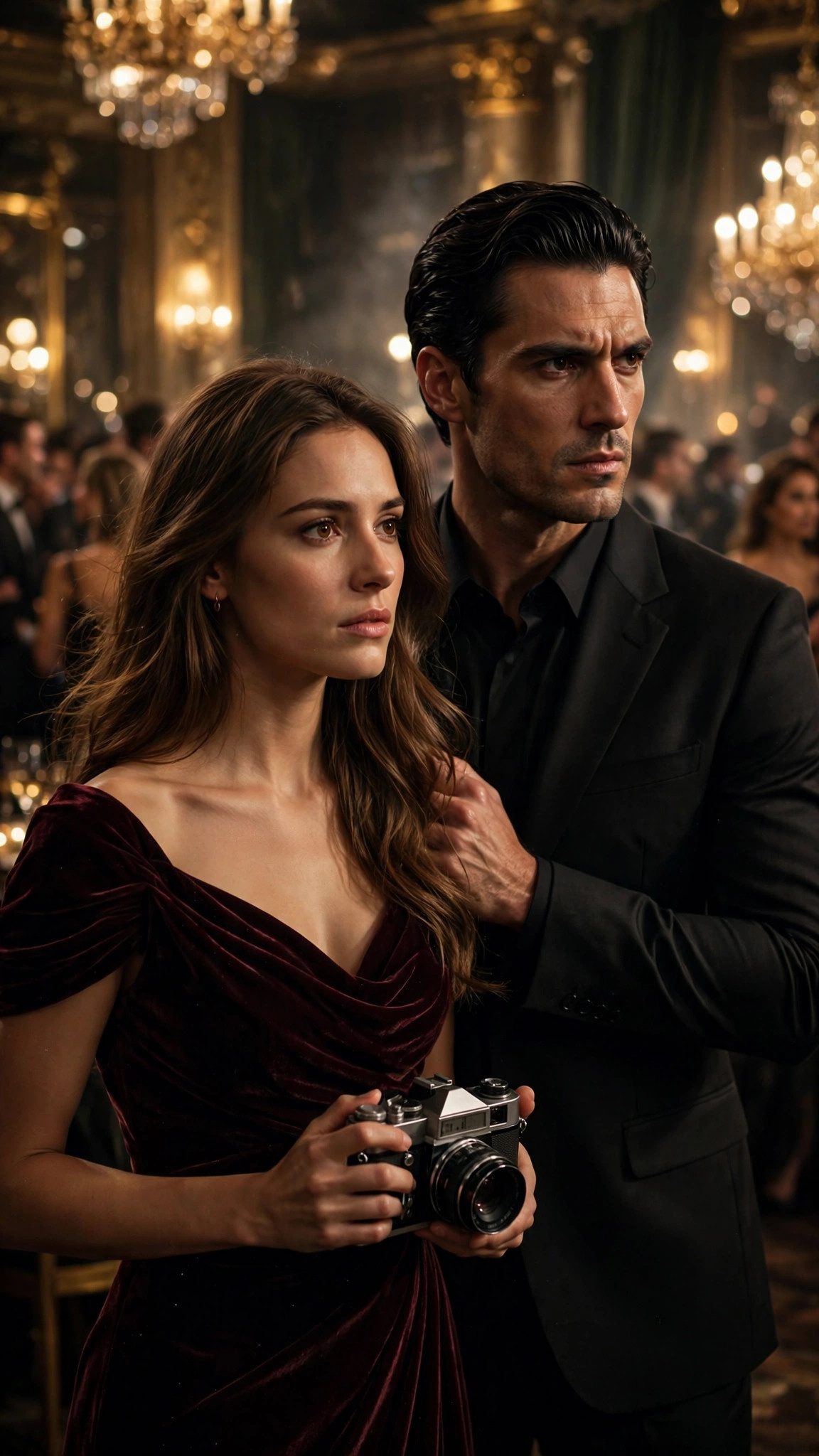
Sal arrived at my apartment in eleven minutes. I know because I counted them, standing at the window with the photograph in one hand and my phone in the other, watching the street below for a black car I did not recognize. When the knock came, three short raps, I almost did not open the door. Then Sal's voice came through the wood, calm and low, the way a man speaks when he does not want to frighten anyone.
"Miss Bennett. It's Sal. Mr. Moretti told me to come the moment you called. Open the door."
Sal was not what I expected. I had pictured a bodyguard, all muscle and menace, the kind of man who stands in doorways and says nothing. Sal was fifty-six years old, short, gray-haired, with a kind face and hands that looked like they had spent a lifetime fixing things. He wore a plain dark suit and a wedding ring, and when he came into my apartment, the first thing he did was look at the locks on my door and nod, as if approving of them.
"Good," he said. "Three locks. Mr. Moretti will be glad to hear that."
"Is he alive?" I asked. It was the only question that mattered, and I did not bother with pleasantries. "The photograph. The van. Is he alive?"
"We believe so," Sal said. "We have people looking. Now show me the photograph, and tell me everything, from the beginning, and do not leave anything out. Not the small things. The small things are usually the ones that matter."
I showed him the envelope, the photograph, and the camera, and I told him everything. I told him about Detroit and the birthday cake and Derek. I told him about the restaurant and the drink and the photograph of Marcus Blake taking cash from a restaurant employee. I told him about the family dinner and the way Marcus had pointed at my camera and the way King had said a single name, Blake, and the whole room had gone silent.
Sal listened without interrupting. When I finished, he picked up the photograph with two fingers, the way you pick up something that might be evidence, and he held it under the light of my kitchen lamp.
"Your ex-boyfriend," he said, looking at Derek's face. "You're certain."
"I lived with him for two years," I said. "I know his face. I know the way he stands. I know that watch. I gave him that watch for his twenty-ninth birthday. He is wearing it in this photograph."
Sal nodded slowly. "Then Mr. Moretti was right about you," he said. "He said you see what is actually there. Most people don't."
"Where is he?" I asked. "King. Where would they take him?"
"We are working on that," Sal said. "But I need you to come with me now. This apartment is not safe. Blake's men know where you live. They left this envelope here to frighten you, and frightened people make mistakes. You will stay at the house tonight, where we can protect you, and you will help us find him, because you are the only person who has seen the whole picture, literally."
"The house" turned out to be a brownstone on a quiet street in Lincoln Park, behind a high wall and a gate that opened without a sound. Inside, the house was warm and old and full of books, and it did not look like the home of a mafia boss at all. It looked like the home of a family. There were photographs on the walls, a piano in the corner, a kitchen that smelled like garlic and fresh bread. A woman in her sixties came out of the kitchen wiping her hands on an apron, and when she saw me, she put her arms around me as if we had known each other for years.
"I'm Rosa," she said. "I cook for this family. You are the photographer. King told me about you. He said you were brave. Come, eat something. You look like you haven't eaten all day."
I had not eaten all day. I sat at the kitchen table while Rosa put a plate of pasta in front of me, and I ate it, and I did not realize how hungry I was until I was halfway through. Sal sat across from me with a cup of coffee, and a younger man came in, tall, dark-haired, with a scar through his left eyebrow, and Sal introduced him as Enzo, King's cousin, the man who ran the family's legitimate businesses.
"Tell me about the photograph," Enzo said. "Not the story. The photograph itself. The light, the angle, the background. You are a photographer. You see things the rest of us don't."
I laid the photograph on the table, and I looked at it the way I had been trained to look at photographs, not as a frightened woman but as a professional. The van was dark, unmarked, with no license plate visible. King was being pushed toward the open doors, his hands bound in front of him, his head down. There were two men with him. One was Derek. The other I did not know.
"The light is late afternoon," I said, pointing. "See the shadows? They fall to the east, long and low. That means the sun is in the west, so this was taken between five and six in the evening. And look here, in the background, behind the van. There is a sign, half out of frame. You can only see three letters, but the shape of the sign, the color, the way it is mounted on the wall, that is a warehouse sign. And here, on the ground, there is a puddle, and the puddle is reflecting a number painted on the wall. I can see a seven, and maybe a three."
Enzo leaned in closer. "A warehouse," he said. "In the industrial district, by the river. There are only a few warehouses with painted numbers that big. Sal, get the list."
Sal was already on the phone. Rosa refilled my coffee. And for the first time since I had found the envelope, I felt something other than fear. I felt useful. I felt like the thing I was good at, the thing I had always been good at, might be the thing that saved him.
"There's something else," I said, and I pointed at Derek's wrist. "The watch. I gave it to him for his twenty-ninth birthday. It is a cheap watch, but it has a distinctive face, and I can see it clearly in this photograph. And look at his other hand. He is holding a phone. The case is red. Derek always had a red phone case. If his phone is on, if he has it with him, you might be able to find it."
Enzo looked at me for a long moment, and then he smiled, a real smile, the first one I had seen since I arrived.
"Mr. Moretti was right," he said. "You do see what is actually there."
That night, I slept in a guest room with a window that looked out over a small garden, and I did not sleep well. I kept thinking about King, about the way he had stood up in the nightclub and said, "She's with me," without hesitating, without calculating the cost. I kept thinking about the promise he had made in the dining room, his voice steady and certain: "I won't let anyone hurt you or the people you love."
I had never had anyone say that to me before. Not Derek. Not my father, who had left when I was twelve. Not anyone. And now the man who had said it was in a van somewhere, and I was the only person who had seen his face in that photograph and recognized the man beside him.
In the morning, Sal came to my door with coffee and news. "We found the warehouse," he said. "Number seventy-three, on the river, in the industrial district. The van was seen there yesterday evening. And we found something else. Your ex-boyfriend's phone. It is still on. It is moving. We are tracking it."
"Then let's go," I said.
Sal shook his head. "You stay here. This is dangerous work, Miss Bennett. Mr. Moretti would never forgive us if something happened to you while he was gone."
I looked at him, and I thought about the cake in the refrigerator in Detroit, and the two suitcases, and the three weeks of learning how to look at the world again, and I said the truest thing I had ever said to anyone.
"Mr. Moretti stood between me and the world," I said. "Now it is my turn to stand between him and the world. I am not staying here. I am coming with you. I am the one who recognized Derek. I am the one who can recognize him again. You need me."
Sal studied my face for a long time. Then he nodded, once, the way a man nods when he has decided to trust someone.
"Then you stay beside me," he said. "You do what I say, when I say it. And if I tell you to run, you run."
"Deal," I said.
Before we left, Enzo asked me to wait in the study, and he told me the story I had not known. He told it plainly, the way a man tells a story he has told too many times to people who did not understand it.
"Marcus Blake used to be one of us," Enzo said. He stood by the window with his hands in his pockets, looking out at the garden. "Twenty years ago, he ran the family's money through his businesses, restaurants, hotels, import companies. He was good at it. Too good. He started taking a little for himself. A little became a lot. When King found out, he gave Blake a choice. Prison, or the family. Blake chose prison. He served six years. When he came out, King let him live, let him rebuild a small business, on one condition. Never touch the family's money again. Never come near the family again."
"And the photograph?" I asked. "The cash from the restaurant employee?"
"That was Blake going back to his old game," Enzo said. "Skimming from a Moretti restaurant. The employee was his inside man. Your photograph proved it. That is why he wanted your camera. That is why he wants you quiet. And that is why King said what he said in the dining room. 'Do you now understand why you should have stayed in jail?' King was telling him that he had already been given one chance, and he had thrown it away."
"And Derek?" I asked. "How does my ex-boyfriend fit into this?"
Enzo turned from the window. "We don't know yet. But men like Blake always need men like Derek. Men who are desperate. Men who will do anything for money and tell themselves it isn't really a crime."
I thought about Derek then, and I had not let myself think about him properly since the night with the cake. I thought about how we had met, in college, in a photography class, of all places. He had been charming then, funny, full of plans. He had told me he wanted to open a restaurant one day. He had told me he loved the way I saw the world. And slowly, year by year, the plans had faded, and the charm had turned into something else, something small and mean. He had lost his job at the car dealership six months before my birthday. He had blamed me for that too. He had blamed me for everything, in the end, because blaming me was easier than looking at himself.
The watch I had given him for his twenty-ninth birthday had cost me two hundred dollars, money I had saved for months, and he had worn it for a week and then put it in a drawer and forgotten about it. The red phone case he had bought himself, because he said it made his phone easier to find. Small details. I had spent two years collecting small details about a man who had never bothered to collect any about me.
"He followed me to Chicago," I said, and the words felt strange in my mouth, like something I had known without knowing. "He must have followed me. He knew where I lived. He knew about the photograph. Blake paid him to watch me."
"Probably," Enzo said. "We will find out. And when we do, he will answer for it."
Rosa came in then, with a small bag, and she pressed it into my hands. Inside were a bottle of water, a sandwich wrapped in paper, and a rosary, old and wooden, the beads worn smooth by years of hands.
"For luck," she said, and she kissed my cheek. "My son was taken once, a long time ago, by men like these. The family brought him home. They will bring King home too. You be brave, photographer. You be brave, and you come back to me for dinner."
I put the rosary in my pocket, and I did not tell her that I was not sure I believed in luck anymore. But I believed in Sal, and I believed in Enzo, and I believed in the photograph in my bag, and that was enough.
We left the brownstone in three black cars, and I sat in the back seat of the middle car with my camera in my lap, and as we drove toward the river, I thought about the photograph I had taken of Marcus Blake, the photograph that had started all of this. I had taken it without thinking, the way a photographer does. Now I understood what King had understood the moment he saw it. A photograph is not just a picture. A photograph is proof. A photograph is a weapon. And I was going to use mine to bring him home.
Sal drove in silence for a while, and then, without taking his eyes off the road, he said, "Mr. Moretti talks about you, you know. Not much. He is not a man who talks much about anything. But he said you have the kind of eyes that make people tell the truth, even when they don't want to. He said that the first night, after the restaurant. He said, 'That woman looks at the world like it owes her an explanation.'"
I did not know what to say to that. I looked out the window at the city going past, at the warehouses getting closer, at the river shining gray under a gray sky, and I held my camera a little tighter, and I thought about the man who had stood up in a nightclub for a stranger, and I knew, with a certainty I had never felt about anything in my life, that I was going to bring him home, or I was going to die trying.