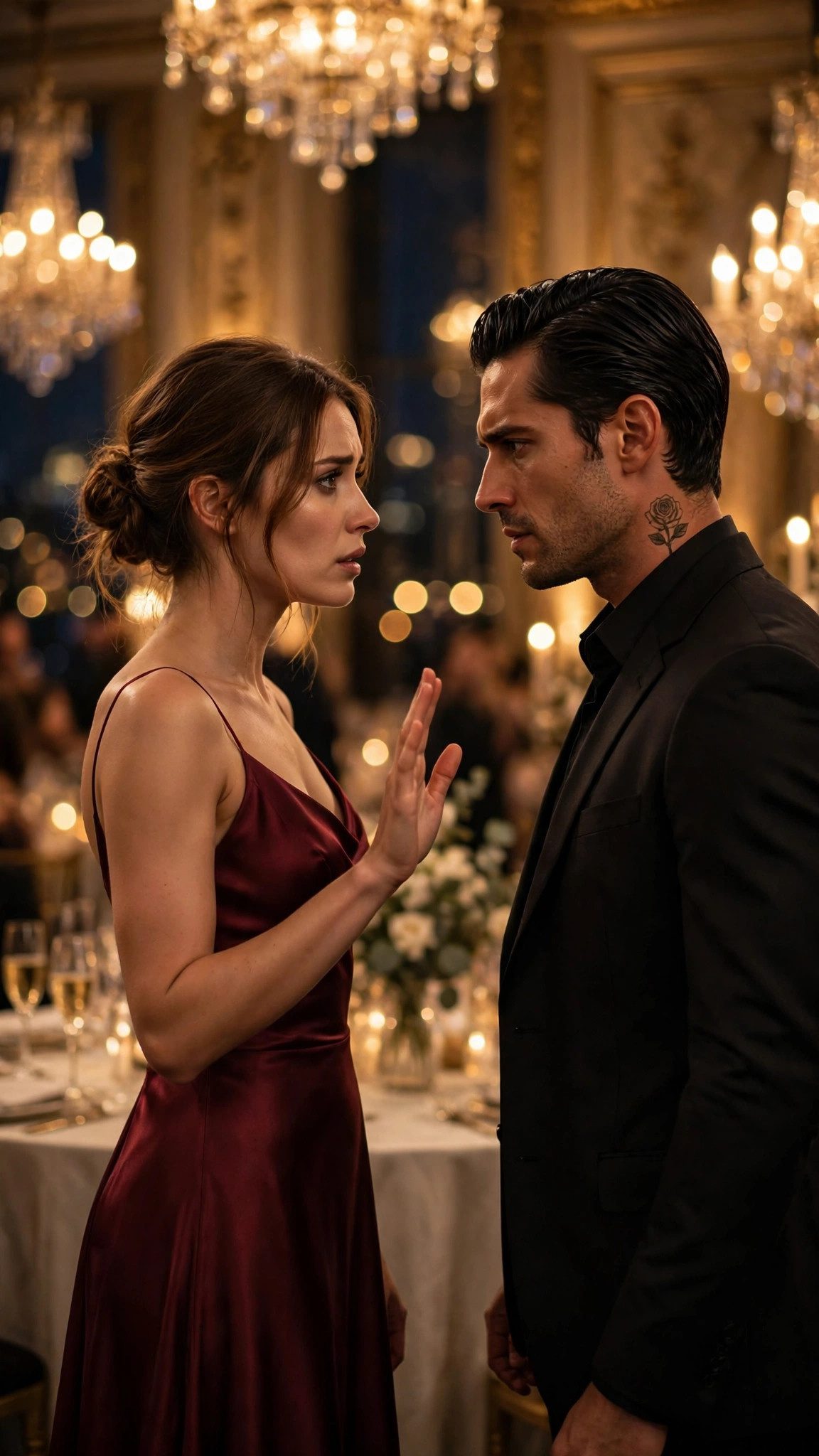
Three days after Rinaldi came to my hospital, I stood in front of the mirror in my little apartment and pinned my brown hair into a low loose bun, and I put on the burgundy satin gown, and I looked at myself for a long time.
The gown was the nicest thing I owned. I had bought it on sale three years ago for a cousin's wedding, and I had worn it twice since, and both times I had felt like a woman pretending to be someone richer and more elegant than she was. Tonight, looking at myself in the mirror, I did not feel like I was pretending. I felt like a woman going into battle.
Maya had called me that afternoon. "Are you sure about this?" she had asked. "The gala? With Whitfield there? With the whole board there?"
"I have to go," I had said. "My supervisor insisted. And Whitfield will be watching to see if I behave."
"And Gabriel?"
"Gabriel will be there," I said. "He's the hospital's biggest donor. Of course he'll be there."
"Then be careful, Hannah," Maya had said. "Because a man like Gabriel Veseri in a room full of powerful people is a man performing. And you are the only person in that room who knows what he looks like when he's not performing. That's dangerous. For both of you."
I had not known what she meant, then. I know now.
The Whitfield Hotel ballroom was everything I had expected and nothing I was prepared for. Crystal chandeliers hung from a ceiling painted with clouds. White tablecloths stretched across round tables, each one set with tall champagne glasses and small cards with donors' names written in gold ink. A string quartet played in the corner. Waiters in black jackets moved through the crowd with silver trays. The air smelled like lilies and money.
I found my table — the nurses' table, at the back, near the kitchen doors — and I sat down, and I smiled at the other nurses, and I tried to be the decoration I had been invited to be.
It lasted about twenty minutes.
Gabriel arrived, and the room changed, the way it always changed. Conversations lowered. Shoulders straightened. The mayor, who had been telling a loud story about his golf game, went quiet in the middle of a sentence. Mr. Whitfield, standing near the stage in his black tuxedo and bow tie, straightened his shoulders and smoothed his grey hair and put on his most welcoming smile, and he went to greet Gabriel like a man greeting a king.
Gabriel did not look at Whitfield. He looked across the ballroom, past the tables and the champagne and the string quartet, and he found me. His eyes settled on mine, dark and steady, and he crossed the room toward me, and the crowd parted for him the way water parts for a ship.
He stopped beside my table. He put his hand at the small of my back — warm, familiar, possessive — and he smiled at Mr. Whitfield, who had followed him across the room, and at the other donors who had gathered to see what Gabriel Veseri would do next.
"Miss Mercer," Whitfield said, with his polite board-chairman smile. "How good to see you. And how do you know Mr. Veseri?"
It was an innocent question. It was also a trap. Whitfield knew exactly how I knew Gabriel Veseri. He had called me into his office. He had written me a warning letter. He was asking the question in front of the whole ballroom because he wanted to see what I would say, and what Gabriel would say, and whether the nurse would remember her place.
Gabriel answered before I could.
"My girlfriend."
The word landed in the silence like a stone in still water. I felt it ripple outward — the donors' eyebrows rising, the nurses at my table going still, Whitfield's smile freezing on his face.
My girlfriend. The third time in six weeks. Without ever asking me. Without ever kissing me. Without ever calling what we were anything, in private, where it mattered.
Something in me snapped. Not loudly. Not dramatically. Quietly, the way a thread snaps when you have pulled it too tight for too long.
I stepped away from his hand at my back.
"I'm not your girlfriend."
The silence spread. I could feel every eye in the ballroom on us — the mayor, the donors, the board members, the waiters frozen with their silver trays. Nobody corrected Gabriel Veseri publicly. Everyone in that room knew it. And I was doing it anyway.
Gabriel's eyes settled on mine. "Hannah—"
"No." My voice did not shake. I was proud of that, because everything else in me was shaking — my hands, my knees, the champagne glass I had set down so hard it nearly tipped. "You don't get to act like we had a conversation that never happened."
"Hannah." His voice was low. Warning, or pleading — I couldn't tell which. "Not here."
"Where, then?" I said. "Because you've had six weeks to ask me anywhere, Gabriel. Six weeks of coffee and cars and dinners. Six weeks of deciding everything for me. And you never once asked me a single question."
The room was so quiet I could hear the string quartet in the corner, still playing, because nobody had told them to stop.
"You decide where the car waits," I said, and my voice was rising now, and I didn't care. "You decide when security follows me home. You decide I need dinner. You decide I need coffee exactly the way I like it. You keep doing things that feel like questions without ever asking one."
"You usually do need dinner," he said quietly.
"That's not the point!"
He reached for my hand. His fingers closed around my wrist — warm, sure, familiar — and he held it for one second, and I could feel my pulse hammering against his thumb, and for a moment I thought he was going to pull me toward him, the way he always did, the way he had always decided.
But he didn't pull. He just held my wrist, and he looked at me, and something in his face changed. The mask — the calm, powerful, untouchable mask — slipped, just a fraction, and underneath it I saw the man from the dark apartment, the man who couldn't sleep, the man who had said, "I'm trying."
"Hannah," he said, and his voice was rougher than I had ever heard it. "You're my favorite nurse."
It was the wrong thing to say. It was also the truest thing he had ever said to me. And the whole ballroom heard it.
I pulled my hand free.
And then Gabriel Veseri did something no one in that room had ever seen him do. He turned to face the ballroom — the donors, the board, the mayor, all of them — and he said, in a voice that carried to the edges of the room, "She's right."
The silence deepened. Mr. Whitfield's mouth opened, and then closed.
"She isn't my girlfriend," Gabriel said. "I never asked her."
I stared at him. My heart was beating so hard I was sure the whole ballroom could hear it.
"I wanted the answer," he said, looking at me and only at me, "so I behaved like I had received it."
Something in my chest cracked open. All the anger, all the six weeks of swallowed words, all the fear and the longing — it all came rushing up at once, and I didn't know whether I wanted to slap him or kiss him or cry.
"I didn't tell you no," I whispered. "I said I wasn't your girlfriend. That's different."
"Is it?" he asked.
And I had no answer for him, because I did not know anymore. I did not know what we were. I only knew that the whole ballroom was watching us, and that Mr. Whitfield was staring at me like I had just set fire to the hospital, and that my burgundy gown suddenly felt too tight, and that I needed air.
I turned and walked away from the table, through the ballroom, past the staring donors and the frozen waiters, and out onto the terrace, where the night air was cool and the city lights spread out below us like a field of stars.
I gripped the stone railing with both hands and I breathed. In. Out. In. Out. The way I breathed with frightened patients. The way I had breathed with Gabriel in the trauma bay, six weeks ago, when he was bleeding and I was the only person in the world who could keep him alive.
Behind me, the terrace door opened. I didn't turn around. I knew who it was. I could feel him the way you feel a change in the weather.
"Hannah."
"Go away, Gabriel."
"No."
I turned then. He was standing in the doorway, backlit by the ballroom, his black suit dark against the light, his face in shadow. He stepped out onto the terrace and closed the door behind him, and the music and the voices cut off, and suddenly it was just the two of us, alone for the first time since I had told him to stop calling me his girlfriend.
For the first time since I told him to stop calling me his girlfriend, we were completely alone.
"I meant what I said in there," he said. "You were right. I never asked you. I behaved like I had the answer because I wanted it so badly I couldn't bear to hear anything else."
"That's not an excuse," I said.
"I know. It's not an excuse. It's the truth." He came closer, slowly, the way you approach a frightened animal. "Hannah, you saved my life. And then you kept saving it, every day, in a hundred small ways. You asked me if I was still breathing. You asked me how much it hurt. You're the first person to actually ask me if I'm still breathing. You're the first person to ask me how much it hurts. You're the first person to actually listen. You're the first person to care. You're the first person I've ever trusted with my life."
He stopped in front of me. The city lights were behind him. His face was close to mine. I could see the scar on his jaw, and the rose tattoo on his neck, and the dark eyes that had looked at me in the trauma bay and said, I'm breathing.
"You're the first person I've ever loved," he said.
The words hung in the night air between us. I felt tears sting my eyes, and I hated them, because I did not want to cry, not now, not here, not when I had just found my voice in front of the whole city.
"Then ask me," I whispered. "Ask me, Gabriel. Ask me the question. Any question. Just ask me something, for once in your life, instead of deciding."
He looked at me for a long moment. I could see him struggling — fourteen years of never asking, fourteen years of Marco dying in the rain, fourteen years of a rule that had kept him alive and kept him alone, all of it rising up in him at once.
And then he did something I had never seen him do. He went down on one knee.
On the terrace of the Whitfield Hotel, in his black suit, with the city lights below us and the ballroom behind us, Gabriel Veseri knelt in front of me, and he took my hand, and he said, "Then marry me."
The world stopped. The city lights blurred. The music from the ballroom faded to nothing. All I could hear was my own heartbeat, and his voice, saying the words I had never expected to hear from him, in the last place I had expected to hear them.
"Marry me, Hannah," he said. "Not because I decided. Because I'm asking. I'm asking you right now. Will you marry me?"
I looked down at him — this powerful, feared, untouchable man, on his knees in front of a nurse in a burgundy satin gown — and I felt everything I had ever felt for him rise up in me at once. Love. Anger. Fear. Hope. And underneath it all, one clear, quiet thought.
Not like this.
"Gabriel," I said, and my voice was shaking now, but it was steady underneath the shaking, the way it had been in the trauma bay. "Get up."
He didn't move. "Hannah—"
"Get up." I pulled my hand free, gently. "I love you. I have never been in love with anyone in my life, and I am in love with you. But I will not marry you like this. Not on a terrace, in front of a ballroom full of people who just watched me humiliate you. Not as an answer to a fight. Not as a question you ask because you ran out of other things to decide."
He stood up slowly. His face was unreadable. "Then what do you want?"
"I want you to ask me," I said. "Really ask me. Not in front of a crowd. Not because I cornered you. I want you to come to me, alone, when there is no audience and no crisis and no one watching, and ask me the question — the real question — because you want to know the answer, not because you're afraid of it."
"And if I do?"
"Then I'll answer you," I said. "But not tonight. Tonight, I need to go home."
I walked past him, back through the ballroom, past the staring donors and Mr. Whitfield and the nurses at my table, and out into the night, where the black sedan was waiting, as it always was. I got in. I told the driver to take me home. And all the way home, I stared out the window at the city lights, and I thought about a man on his knees on a terrace, and a question he had finally asked, and the answer I had not given him.
Not yet.
I didn't know, then, that Dominic Rinaldi was done waiting. I didn't know that the rose on my pillow had only been the beginning. And I didn't know that before Gabriel Veseri could ask me anything properly, someone was going to try to take me away from him — and that this time, it would be my turn to save his life, in a way neither of us had expected.
In the car on the way home, Enzo was driving. He didn't say anything for the first ten minutes. Then, at a red light, he looked at me in the rearview mirror, and he said, "He stayed on the terrace a long time, Miss Mercer. I've worked for Mr. Veseri for eleven years. I have never seen him kneel for anyone."
"He knelt?" I said.
"On the terrace," Enzo said. "After you left. I saw it from the ballroom door. He stayed on his knees for a full minute, looking at the place where you had been standing. And then he stood up, and he straightened his jacket, and he walked back inside, and he thanked Mr. Whitfield for the evening, as if nothing had happened."
I stared out the window at the city lights, and I thought about Gabriel Veseri on his knees on a terrace, in front of no one, asking a question to an empty room. And I thought about how much it must have cost him — a man who had never asked anyone for anything in fourteen years — to kneel, and to ask, and to be told no.
Not yet, I had told him. Not like this.
I hoped he had heard the "not yet." I hoped he understood that it wasn't a no. It was a promise — that one day, when the time was right, when there was no audience and no crisis, I would give him my answer. I just needed him to ask me properly first.