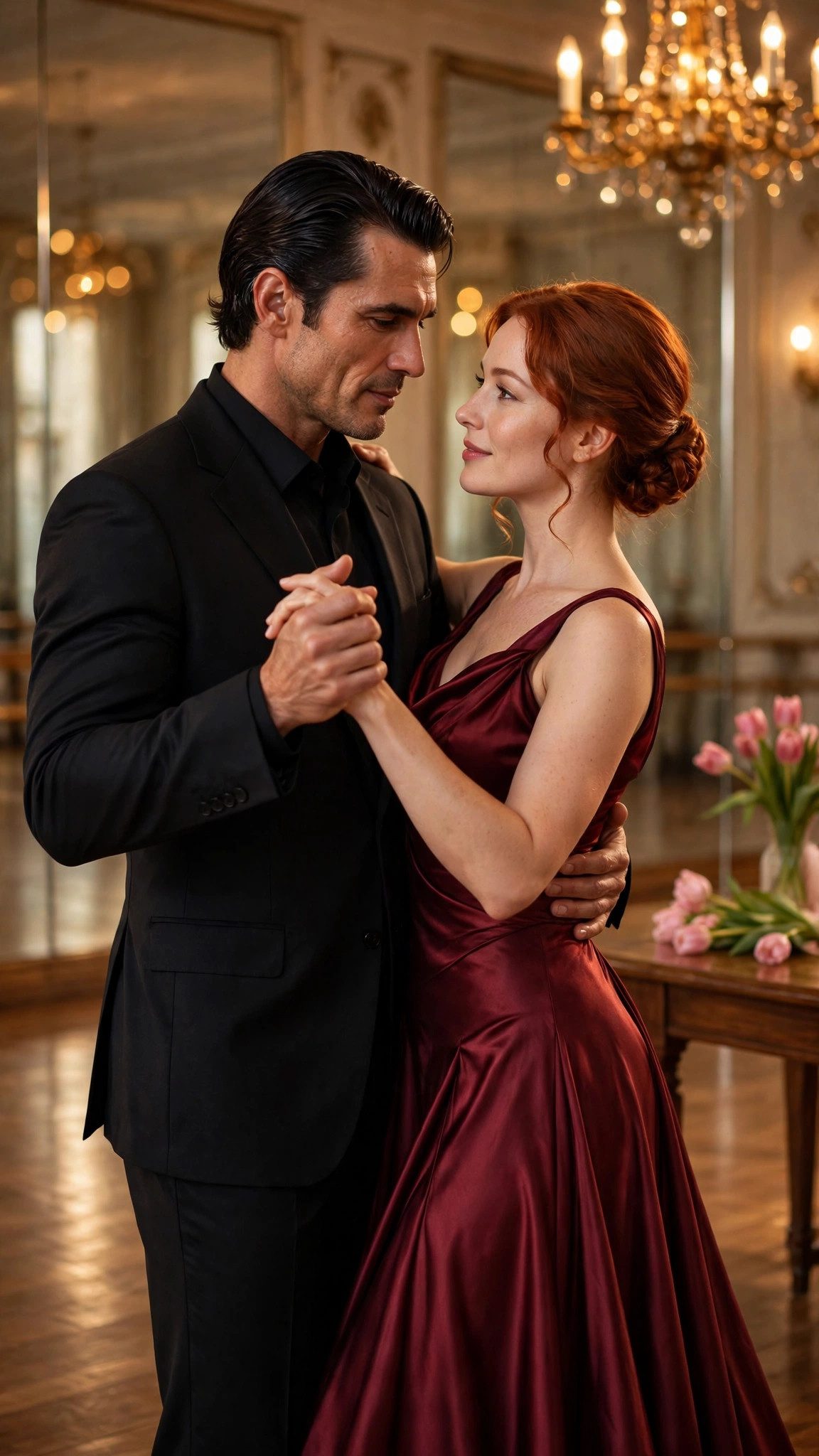
The trouble started on a Monday morning, with a phone call.
I was arranging tulips on the table by the mirror — the bunch Gabriel had brought me was still fresh, the petals just beginning to open — when my phone rang. It was Sal, Gabriel's driver, a big quiet man with a shaved head who had started waiting outside the studio during lessons, reading a newspaper in the front seat of a black car.
"Miss Donovan," he said, and his voice was wrong. Flat. Careful. "Mr. Moretti asked me to call you. His grandmother fell this morning. At home. In the garden. She is in the hospital. Northwestern Memorial. Room 412."
The tulips blurred in front of my eyes. "Is she —"
"She is awake," Sal said quickly. "She is talking. The doctors say she broke her wrist and bruised her hip, but she is awake, and she is asking for two things. Her pink purse. And you."
I did not remember driving to the hospital. I remember the elevator, and the smell of antiseptic, and the long white hallway, and then Room 412, where Rosa Moretti lay in a hospital bed with her white hair spread on the pillow and her wrist in a cast and her bright eyes fixed on the door as if she had been waiting for me.
"There you are, dear," she said, smiling. "I told them you would come."
Gabriel was standing by the window with his back to the room, his hands in his pockets, his shoulders up around his ears. He turned when I came in, and his face was gray. I had seen Gabriel Moretti furious. I had seen him cold. I had never seen him afraid.
"She fell in the garden," he said. "The roses. She was cutting roses for the birthday party and she fell. She lay there for twenty minutes before the housekeeper found her."
"Gabriel," Rosa said, in a small, firm voice. "Stop telling the story as if I died. I did not die. I fell. Old ladies fall. It is in the contract."
"Mrs. Moretti —" I began.
"Rosa," she corrected me. "You are family now, dear. Call me Rosa."
I went to the bed and took her good hand. It was small and warm and papery, and it held mine with surprising strength.
"Will you still waltz at your party?" I asked.
She laughed — a small, delighted sound, exactly like the laugh in my studio. "I will waltz at my party if I have to do it in a wheelchair, dear. Gabriel has promised to carry me if necessary. Haven't you, Gabriel?"
"I have promised no such thing," he said, but his voice was rough, and he came to the other side of the bed and took her other hand, very gently, as if she were made of glass.
"You have promised," she said firmly. "You promised when you were fourteen and I tried to teach you in the kitchen, and you are going to keep that promise now. Claire will make sure of it. Won't you, dear?"
"Yes," I said. "I will."
The doctors came in then, and they talked about the wrist and the hip and the need for rest, and they used words like "observation" and "physical therapy," and Gabriel listened with his arms folded and his jaw set, the way a man listens when he is memorizing the names of everyone he might need to blame. When they left, Rosa patted the bed beside her.
"Sit, dear," she said to me. "I want to tell you something, and I want Gabriel to hear it too, because he needs to hear it from someone who is not me."
I sat. Gabriel did not move from the window, but he was listening. I could tell by the stillness of his shoulders.
"I have watched my grandson for forty-two years," Rosa said. "I watched him grow up in a house where his father taught him that love is a weakness and kindness is a door you leave open for your enemies. I watched him become the man his father wanted him to be, because he thought that was the only way to survive. And I watched him become lonely, in a way that no amount of money or power or fear can fix."
"Grandmother," Gabriel said quietly. "Please."
"No," she said. "You will listen. I am eighty years old and I have a broken wrist and I have earned the right to say what I think." She squeezed my hand. "I chose your studio, Claire, because I watched you through the window for a month. I watched you teach a nervous bride who cried through her first lesson, and you did not hurry her. I watched you teach a retired couple, and the husband stepped on his wife's foot, and you made them both laugh. I watched you treat every person who walked through your door as if they mattered. And I thought: this woman can teach my grandson something no one else in his life has ever taught him. How to hold a person without owning them. How to ask instead of taking."
Gabriel's face was turned away, toward the window, toward the city spread out below. His shoulders were shaking. Just slightly. Just enough for me to see.
"She knew what he needed wasn't dance lessons," I said softly, more to myself than to her. "It was to learn how to be kind and connect with people."
"Exactly, dear," Rosa said, beaming. "You understand. I knew you would."
I stayed at the hospital until visiting hours ended. Gabriel walked me to the elevator in silence, and when the doors opened, he put a hand on my arm — gently, the way I had taught him, a hand that holds instead of grips.
"Thank you for coming," he said.
"She asked for me," I said.
"She asks for very few people," he said. "You should know that. In forty-two years, I have seen her ask for exactly three things. A waltz. Her pink purse. And you."
The elevator doors closed between us, and I rode down to the lobby with my heart hammering, and I thought about what Rosa had said. Family now. You are family now, dear.
Over the next few days, everything changed — and I do not mean in a good way.
Word spread through our neighborhood that something terrible had happened to Gabriel Moretti's grandmother. People whispered in the flower shop and the bakery and the laundromat. They thought Moretti was planning to hit the studio — that his grandmother's fall was somehow my fault, or that his grief would turn into rage, and that the little dance studio on the west side would pay for it.
Then the black cars appeared.
Tall men in dark suits began standing outside my studio, watching the door, watching the street, watching me work from their black cars. They scared my students away. The retired couple stopped coming. The nervous bride canceled. The office workers who had always wanted to learn the waltz suddenly remembered urgent business elsewhere.
I tried to pretend not to notice them. I taught my classes to empty rooms. I played the waltz for myself and danced alone across the polished floor, and I told myself it would pass. But it did not pass. The men stayed. The cars stayed. And every day, fewer people came through my door.
On Friday morning, a week after Rosa's fall, I walked out of the studio and straight up to the nearest black car, and I knocked on the window.
The window rolled down. Sal looked out at me, impassive.
"Miss Donovan," he said.
"Sal," I said. "You are scaring my students away."
"I am sorry, Miss Donovan," he said. "Mr. Moretti's orders. After what happened to his grandmother, he wants to be sure no one bothers you."
"No one is bothering me," I said. "You are bothering me. Your cars are bothering me. Your men standing on my sidewalk like a funeral procession are bothering me. Tell Mr. Moretti that if he wants to protect me, he can do it by letting my students come back."
Sal looked at me for a long moment. Then, very slowly, he nodded.
"I will tell him, Miss Donovan," he said.
That afternoon, Gabriel came to the studio himself. He did not come for a lesson. He came with a powerful hand and an unmistakable question on his face, and he stood in the middle of my empty floor and looked around at the silent mirrors and the wilting tulips and the chairs where my students used to sit, and he said nothing for a long time.
"Your students are gone," he said at last.
"Yes," I said. "Because your men are standing outside my door."
"My men are standing outside your door because someone has been asking questions about this building," he said. His voice was low and hard. "A developer. Vincent Castellano. He has been buying up this block, one building at a time. He made an offer on this building last month. The landlord refused. Now Castellano is making a different kind of offer."
"What kind of offer?" I asked, though I was not sure I wanted to know.
"The kind where your students stop coming," he said. "The kind where the flower shop next door loses its lease. The kind where a building that will not sell suddenly becomes a building no one wants to visit. He wants this block for a warehouse. He wants the property. And he does not care who he frightens to get it."
I stared at him. "And you knew this, and you did not tell me?"
"I am telling you now," he said. "And I am telling you something else. Castellano is not a man who takes no for an answer. He has men of his own. He has lawyers. He has money. And if he decides this building is his, he will not stop at scaring your students."
"Then what do we do?" I asked.
Gabriel looked at me, and for the first time since I had met him, I saw something in his eyes that was not anger and not fear. It was resolve. Cold, clear, absolute resolve.
"We do what my grandmother would do," he said. "We dance. And we do not let him take a single step of this floor."
That night, I went to see Rosa in the hospital. She was sitting up in bed, her wrist in its cast, her pink purse on the bedside table, watching a cooking show on the small television bolted to the wall.
"Ah, dear," she said, when I came in. "You look worried. Sit. Tell me."
I told her everything. The black cars. The students who had stopped coming. Vincent Castellano and his warehouse. She listened without interrupting, her bright eyes fixed on my face, and when I finished, she patted my hand with her good one.
"My grandson will fix this," she said, with complete confidence. "He fixes things. It is what he does. Sometimes he fixes them badly, and sometimes he fixes them the wrong way, but he fixes them. And you, dear — you will make sure he fixes this one the right way. That is why I chose you."
"What is the right way?" I asked.
She smiled. "The way where nobody gets hurt, and the studio stays yours, and my grandson learns that protecting someone does not mean owning them." She leaned back against her pillows. "Now go home, dear. It is late. And Claire —"
"Yes?"
"Bring tulips on Thursday," she said. "The pink ones. They are my favorite."
I went home that night and I sat in my kitchen with a cup of tea gone cold in my hands, and I thought about Rosa in her hospital bed, and Gabriel standing in my empty studio, and Vincent Castellano — a name I had never heard before that afternoon — who wanted to take the only thing I had ever built for myself.
And I thought about what Rosa had said. Protecting someone does not mean owning them.
I did not know then that Gabriel had already made his decision. I did not know that by the end of the week, he would walk into my studio and tell me he had bought the building. I did not know that the most feared man in Chicago was about to do the most dangerous thing a man like him can do — choose love over control, in front of everyone.
I only knew that my studio was empty, my students were gone, and the tulips on the table were wilting, and that somewhere across the city, an eighty-year-old woman with a broken wrist was counting the days until her birthday party, when her grandson would waltz with her in front of everyone.
I was not going to let her down. And neither, I suspected, was Gabriel.
The next day, I brought Rosa pink tulips.
The nurses on the fourth floor had already fallen in love with her — she was, one of them told me with a laugh, the favorite patient on the ward, because she tipped the orderlies with butterscotch candies from her purse and called every doctor "dear" and insisted on knowing all their names. When I came in with the tulips, she was sitting up in bed, telling a young nurse about the time Gabriel, at nine years old, had tried to cook her breakfast and set fire to a dish towel.
"He was so proud of those eggs," Rosa said, laughing, her eyes bright. "Burned black, every one of them. And he stood there with the dish towel smoking in his hand and said, 'Grandmother, I have decided cooking is not my talent.' And I said, 'Gabriel, my love, perhaps your talent is something else.' And do you know what he said? He said, 'My talent is protecting you.' He was nine years old, dear. Nine."
The nurse left, smiling, and Rosa patted the bed beside her, and I sat down, and I put the tulips in the plastic pitcher on her bedside table, next to the pink purse.
"Tell me about his mother," I said quietly. "Your daughter."
Rosa's smile faded a little, the way sunlight fades when a cloud crosses it. "My daughter, Sofia, died when Gabriel was twelve. An illness. Quick, and cruel, and there was nothing anyone could do. After that, his father became harder, and Gabriel became harder too, because he thought that was what his father wanted. But underneath —" she tapped her chest, over her heart — "underneath, he is still the boy who tried to cook me eggs and set fire to a dish towel. He is still the boy who wanted to protect me. He just forgot how to do it gently. That is all. He forgot."
"I will remind him," I said.
"I know you will, dear," Rosa said. "That is why I chose you. Now — tell me about the lessons. Has he stepped on your feet again?"
"Only twice this week," I said, and she laughed, and the sound of it filled the little hospital room like sunlight, and for a moment, with the tulips pink on the table and her hand warm in mine, it was easy to forget about black cars and threats and men who wanted to take my studio away.