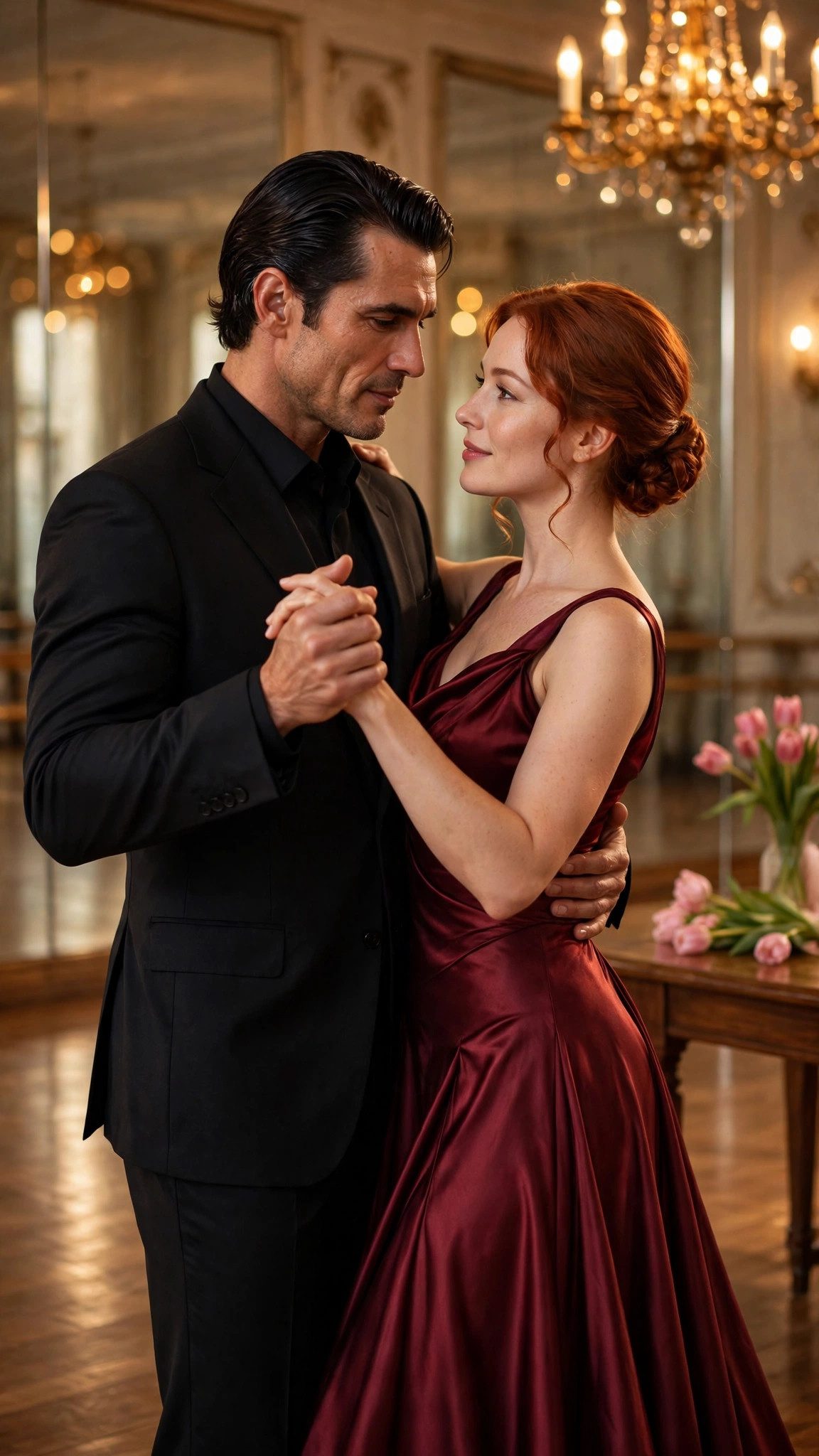
Friday morning dawned gray and cold, the kind of Chicago morning when the sky presses down on the rooftops and the wind comes off the lake with knives in it. I arrived at the studio at seven, as always, and I unlocked the door and I put fresh tulips on the table — the pink ones, Rosa's favorites — and I turned on the lights one by one and I waited.
Gabriel arrived at 3:47, exactly on time. He was alone. He was wearing a dark suit, and he was carrying a leather folder under one arm, and there was an unmistakable question on his face — the look of a man who has made a decision and is not sure how it will be received.
He did not take off his jacket. He did not step onto the floor. He stood in the middle of my studio, holding the folder, and he looked at me across the polished wood, and he said:
"This is the last lesson."
The words landed like a blow. The music was still playing — a slow waltz, looping softly from the sound system — and the tulips were pink on the table, and the mirrors held our reflections, and Gabriel Moretti was standing in my studio telling me it was over.
"What?" I said. My voice sounded very far away. "What do you mean, the last lesson? The party is in five weeks. Rosa —"
"Rosa will still have her waltz," he said. "That is not what I mean." He held up the folder. "Claire. I've decided to buy the studio."
For a moment, I could not breathe. I could not think. I could only stare at him, and at the folder in his hand, and feel my dreams shattering into pieces on the polished floor, one by one, like the glass from my broken window.
Buy the studio. Buy my studio. The studio I had built with eight years of mornings and tulips and waltzes. The studio that was mine. The studio that no one could take from me.
And when I finally lost it — when my voice finally came back, shaking with fury — I said the only thing I could say.
"To close it?" I demanded. "Is that it? You spent a month learning to waltz in my studio, and now you are going to buy it and close it, just like Castellano would have, only with better manners?"
He stepped closer. He lowered his voice. And he said something I was not expecting — something he had never said before, to me or to anyone, in a voice so quiet I had to lean in to hear it.
"Not to close it," he said. "To protect it."
I stared at him. "What?"
"Castellano made his offer to the landlord yesterday," Gabriel said. "Five times the market price, in cash, with a deadline of Monday. If the landlord refuses, Castellano has made it clear what will happen next. A fire. He did not say the word fire, but he did not need to. I have heard that tone before. I have used that tone before."
He opened the folder. Inside were papers — a deed, a contract, a lease — and he laid them on the table beside the tulips, and he turned them toward me so I could read.
"I bought the building this morning," he said. "The whole building. The studio, the flower shop, the apartments above. I paid the landlord double what Castellano offered. He signed an hour ago. The building is mine now. And this —" he tapped the lease — "this is a twenty-year lease on the studio, in your name, at the rent you pay now, locked for twenty years. No one can raise it. No one can break it. No one can take this floor from you. Not Castellano. Not anyone."
I looked down at the papers. My name was on them. Claire Donovan. Twenty years. My rent, locked. My studio, protected.
"But she said it has nothing to do with money," I whispered — and then I realized I did not know what I was saying, because the words were Rosa's, or mine, or both, tangled together in my head. What I meant was: this is not a purchase. This is not a transaction. This is something else entirely.
"I know," Gabriel said. "It has nothing to do with money. It has to do with the fact that someone tried to frighten you out of the only thing you have ever built, and I will not allow it. Not while I am alive."
He stepped closer still, until he was standing right in front of me, close enough that I could see the flecks of gold in his dark eyes, close enough that I could smell his cologne and the cold air still clinging to his suit.
"Claire," he said, very quietly. "The moment I stopped pretending not to care, something changed inside me. I have spent forty-two years taking what I wanted. I have never once asked for anything. I have never once protected something that was not mine. But this studio — you —" He stopped. His jaw worked. "I do not know how to say this properly. I was never taught. My father taught me to control. Rosa taught me to waltz. You taught me the difference."
Something changed inside me then. It was the feeling that, in a way, he hadn't told me — the feeling that everything I had believed about Gabriel Moretti, about dangerous men and cold men and men who take what they want, had been wrong, or at least incomplete. Because the man standing in front of me was not taking anything. He was giving. He was giving me my studio, my safety, my future — and he was asking for nothing in return except, perhaps, the one thing he had never learned to ask for.
I looked at the papers on the table. I looked at the tulips. I looked at Gabriel Moretti, standing in my studio in the gray afternoon light, holding a leather folder full of deeds and leases, looking at me the way a man looks at the only person in the world who can tell him whether he has done the right thing.
"Why?" I asked. My voice was shaking. "Why would you do this for me?"
He was quiet for a long moment. The waltz played on, soft and patient, one-two-three, one-two-three.
"Because," he said at last, "if you keep looking at me like that, we can never hang out again."
It was the same thing he had said to me weeks ago, standing among the tulips, and this time I understood it. It was not a warning. It was a confession. He was telling me that he felt it too — whatever this was between us, this thing that had started with a hand placed in waltz position and a pair of shoulders learning to relax — and that he did not know what to do with it, and that it frightened him more than any rival, any threat, any danger he had ever faced.
"Gabriel," I said, and my voice was steady now, my teacher's voice, the voice I use when a student is about to get something right for the first time. "Take off your jacket."
"What?"
"Take off your jacket," I said. "Roll up your sleeves. Step onto the floor. We are going to dance. And this time, you are going to lead."
He stared at me. Then, slowly, he took off his jacket and folded it over the chair. He rolled his sleeves up to his elbows. He stepped onto the floor, and he held out his hand, and I took it, and I placed his other hand on my waist, and I put my hand on his shoulder, and I looked up at him.
"One," I said. "Two. Three."
We danced. Around the floor, past the mirrors, past the tulips, past the table with the papers on it. One-two-three. One-two-three. And this time, he did not count under his breath. This time, he looked at me the whole time, and his shoulders were down, and his hands were gentle, and the most feared man in Chicago danced with me in my studio on a gray Friday afternoon as if there were nothing else in the world worth doing.
When the music ended, he did not let go of my hand.
"Claire," he said. "There is something else. Castellano is not finished. He will not accept losing this building. He will come after you, or after Rosa, or after me. I need you to know that. And I need you to know that I will not let him hurt you. Whatever it takes."
"Whatever it takes," I repeated. "Gabriel. What does that mean?"
"It means," he said, "that I am going to end this. Not with a brick. Not with a fire. With something he understands. I am going to make him an offer of my own."
That night, I could not sleep. I lay awake in my apartment above the studio — my apartment, in the building Gabriel now owned, in the building he had bought to protect me — and I thought about the papers on the table, and the twenty-year lease with my name on it, and the man who had given me all of it and asked for nothing.
And I thought about what Rosa had said in the hospital. Protecting someone does not mean owning them.
Gabriel had not bought my studio to own it. He had bought the building to protect it. He had given me a lease that no one could break, not even him. He had protected me the only way he knew how — and then he had stood in my studio and let me teach him, again, how to hold a person instead of controlling one.
I got up before dawn. I went down to the studio. I put on a waltz, and I danced alone across the empty floor while the sun came up over the rooftops, and I thought about Friday, and about what Gabriel was going to do, and about the birthday party in five weeks, and about the man who had walked into my life wearing a ten-thousand-dollar suit and looking like he wanted to fire everyone in the building.
I did not know then that Castellano would strike first, or that the next week would bring the worst night of my life — and the moment when Gabriel Moretti would have to choose, in front of everyone, between the man his father had made him and the man his grandmother had always believed he could be.
I only knew that my studio was mine for twenty years, that the tulips were pink on the table, and that the most dangerous man in Chicago had just done the most dangerous thing a man like him can do.
He had asked for nothing. And he had given me everything.
After we finished dancing, Gabriel showed me the plans.
He spread them out on the table beside the tulips — architectural drawings, crisp and white, with measurements and notes in the margins in his own handwriting. A floor plan. A community center, in Castellano's old warehouse, two blocks away. A dance floor in the middle, big enough for fifty couples. Classrooms along the sides. A kitchen. A garden out back, with roses.
"Rosa's roses," Gabriel said, tapping the garden on the plan. "She has always wanted a garden she could give to the neighborhood. And here —" he pointed to a room marked STUDIO B — "children's classes. Free. On Saturdays. Your classes, if you want them. Or someone else's, if you don't. But free. For the children on this block."
I stared at the plans. "Gabriel. This is — this is an entire community center."
"I bought the warehouse this morning," he said, as if he were telling me he had bought a loaf of bread. "Castellano signed an hour ago. He did not want to sell. I offered him twice what it is worth, and I told him the alternative was that I would buy every building he owns, one by one, and turn them all into dance studios. He signed."
"And the money?" I asked. "The building. The lease. The warehouse. Gabriel, this must have cost —"
"It cost what it cost," he said. "Money is the one thing I have never had to worry about, Claire. What I have worried about, my whole life, is whether any of it meant anything. Whether any of it was worth anything. And now I know. It is worth this." He gestured at the plans, at the studio, at the tulips. "It is worth a floor where people can dance. It is worth a garden where an old woman can cut roses. It is worth you, standing in your own studio, in your own building, teaching people to hold each other properly."
I could not speak. My throat had closed up entirely.
That evening, I called Rosa from the studio phone. She was home from the hospital by then, resting in her little house with the rose garden, and when she heard my voice, she laughed with delight.
"Claire, dear! Tell me everything!"
I told her. The building. The lease. The warehouse. The community center. The garden with her roses. She listened without interrupting, and when I finished, she was quiet for a long moment, and then she said, very softly, "I told you, dear. I told you from the beginning. My grandson fixes things. Sometimes he fixes them the wrong way. But when someone teaches him the right way —" her voice caught a little — "when someone teaches him the right way, he fixes them beautifully."
"Rosa," I said, "did you know? When you came into my studio that first morning, with your pink purse — did you know all of this would happen?"
"I knew," she said, "that my grandson needed someone who would not be afraid of him. I knew that you were that someone the moment I watched you teach that nervous bride. The rest —" she laughed, that small, delighted laugh — "the rest was Gabriel. He did it himself. He learned, dear. That is the thing about my grandson. Once he learns something, he never forgets it."
After I hung up, I sat in my studio for a long time, looking at the architectural plans on the table beside the tulips, and I thought about what Rosa had said. Once he learns something, he never forgets it.
Gabriel had learned to waltz. He had learned to hold a person instead of controlling one. He had learned to protect something without owning it.
And I had a feeling — a strong, certain feeling, the way a dancer feels the music change before the next bar begins — that he was about to learn the most important lesson of all.