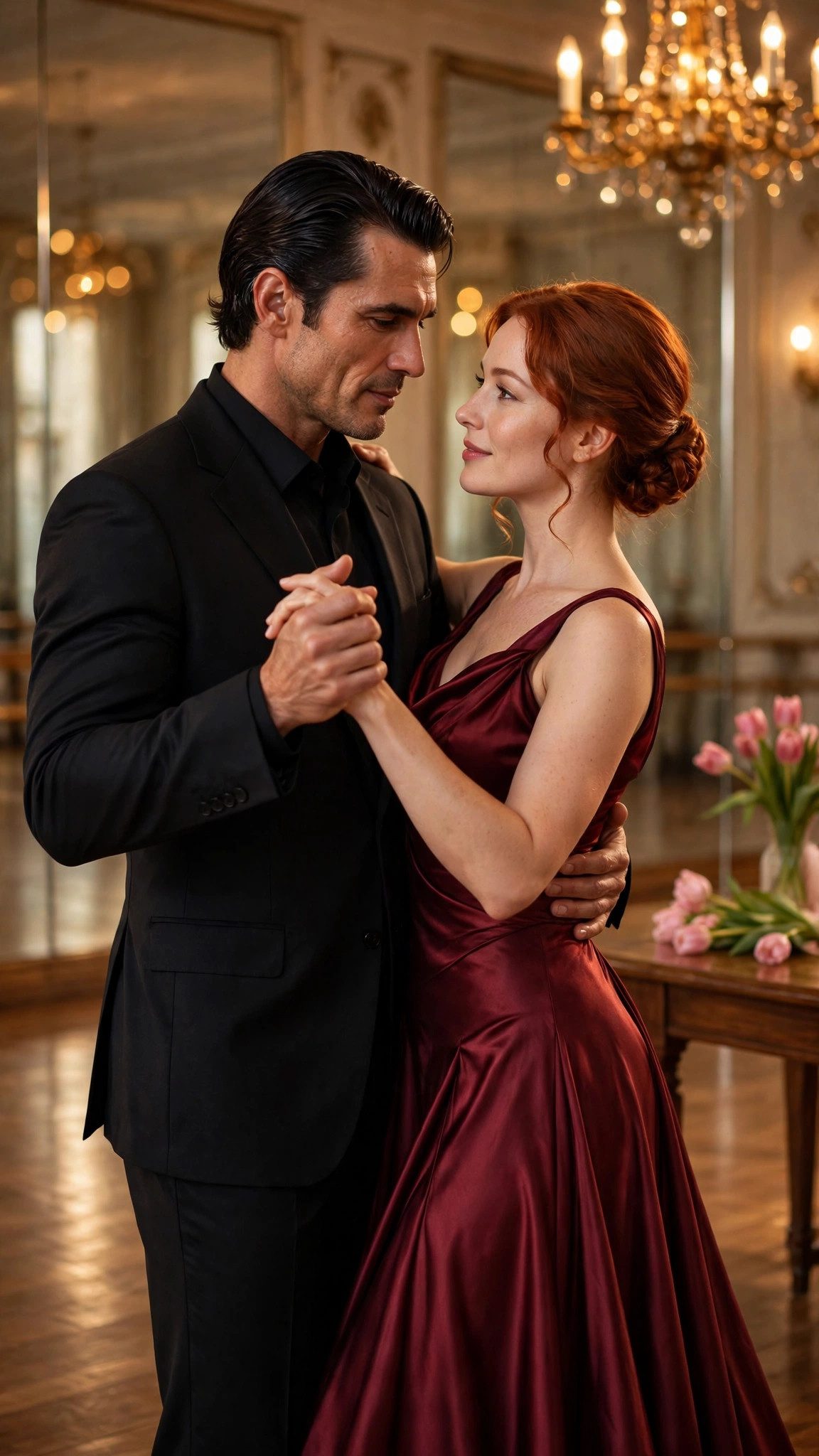
The night of Rosa Moretti's eightieth birthday party, it rained.
It was the soft, golden kind of rain that makes the city lights blur and the streets shine like polished wood, and by seven o'clock the house in Lake Forest was full of people — half of Chicago, just as Gabriel had predicted, in their finest clothes, drinking champagne and talking in low voices about business and family and the old woman who had brought them all together.
I arrived alone, in a dress I had bought specially for the occasion: deep burgundy satin, simple and elegant, with a neckline that showed my shoulders and a skirt that moved when I moved. My copper-red hair was pinned up in a low twist, the way I wear it when I dance. Jenna had done my makeup in her flower shop that afternoon, between customers, and she had pressed a single pink tulip into my hand as I left.
"For luck," she had said. "And for Rosa. She loves the pink ones."
The house was beautiful — a grand old place with high ceilings and polished floors and a ballroom at the back that had been cleared for dancing, with a string quartet in the corner and candles on every table and roses everywhere, white and pink, spilling out of vases in every room. I stood in the doorway for a moment, feeling very small and very out of place among the diamonds and the tailored suits and the women in gowns that cost more than my car.
Then I saw her.
Rosa was sitting in a chair by the fireplace, wearing a powder-blue gown with her rose brooch, her white hair waved and perfect, her wrist out of its cast at last, her enormous pink purse nowhere in sight — for once — and she was holding court like a queen, surrounded by grandchildren and great-grandchildren and old friends, laughing and telling stories with her hands.
When she saw me, her whole face lit up.
"There she is!" she cried, loud enough for the whole room to hear. "There is my dance teacher! Claire, dear, come here at once!"
Everyone turned to look at me. I felt my face burn. I crossed the room, very aware of the eyes on my burgundy dress and my copper hair and my simple shoes, and I knelt beside Rosa's chair and took her hand.
"Happy birthday, Rosa," I said.
"Happy birthday, indeed," she said, beaming. "You came. I knew you would come. And you wore the burgundy. I told Gabriel you would wear the burgundy. He did not believe me. He owes me twenty dollars."
I laughed. "Rosa, you bet on my dress?"
"I bet on everything, dear. It keeps me young." She leaned closer, conspiratorial. "Now. Listen to me. In one hour, the quartet will play a waltz. Gabriel will dance with me first — he promised, when he was fourteen, in my kitchen — and then he will dance with you. And when he does, you must remember everything you taught him. Hold your frame. Count one-two-three. And do not let him lead with his shoulders. He still does that when he is nervous."
"I will remember," I promised.
"Good," she said. "And Claire —"
"Yes?"
"Whatever he asks you tonight," she said, very quietly, so only I could hear, "remember that he has never asked anyone for anything in his life. Not once. So if he asks, it means everything."
My heart stopped. "Rosa — what is he going to ask me?"
She smiled, bright and mysterious, exactly the way she had smiled in my studio a hundred times.
"You will see, dear," she said. "You will see."
The hour passed in a blur of champagne and introductions and small talk with people whose names I forgot the moment they told me. Gabriel was across the room most of the time, talking to men in suits about business I did not understand, but every few minutes his eyes found mine across the crowd, and every time they did, something in my chest tightened, the way a violin string tightens before it sings.
And then the quartet began to play.
The room went quiet. The candles flickered. Gabriel crossed the floor to his grandmother's chair, and he knelt beside her, and he took her hand, and he said, very clearly, so the whole room could hear:
"Rosa Moretti. May I have this dance?"
She laughed — that small, delighted laugh, like a bell — and she stood up, slowly, leaning on his arm, and he led her to the middle of the ballroom, and the quartet played a waltz, and Gabriel Moretti danced with his eighty-year-old grandmother in front of half of Chicago.
He danced beautifully.
I stood at the edge of the floor with tears in my eyes, watching them — his frame perfect, his steps sure, his shoulders down, his hands gentle — and I thought about the first lesson, when he had stood stiff as a board in my studio and told me he attended meetings, not dances. I thought about the tulips in the dark, and the broken window, and the night in the smoke, and the morning he had bought a building to protect a dance studio. And I thought about Rosa, who had watched my classes through a window for a month and had known exactly what her grandson needed, long before he knew it himself.
When the waltz ended, the room erupted in applause. Rosa curtsied — actually curtsied, at eighty years old, in the middle of a ballroom — and Gabriel bowed, and then he took her hand and led her back to her chair, and he kissed her cheek, and he turned.
And he walked straight across the ballroom to me.
The quartet began a new waltz. The candles burned low. The whole room was watching, but I could not have told you who was in it, because there was only Gabriel, standing in front of me in his dark suit, holding out his hand, and saying the words he had practiced a hundred times in my studio, in a voice that was steady and clear and entirely his own:
"Claire Donovan. Will you save me the last dance?"
"Yes," I said.
He took my hand. He placed his other hand on my waist. I put my hand on his shoulder. And we danced.
One-two-three. One-two-three. Around the ballroom, past the candles, past the roses, past the watching faces, past everything. His frame was perfect. His steps were sure. His shoulders were down. And his eyes — his dark eyes — never left mine, not once, not for a single step.
"Claire," he said, as we turned beneath the chandeliers. "I have something to ask you."
"I know," I said.
"I have never asked anyone for anything," he said. "Not in forty-two years. My father taught me to take. Rosa taught me to waltz. You taught me the difference. And now I am going to do the hardest thing I have ever done. I am going to ask — and I am going to wait for the answer, instead of taking it."
The music slowed. The quartet played the final bars. Gabriel stopped dancing, right there in the middle of the ballroom, in front of half of Chicago, and he took both my hands in his, and he looked at me, and he said:
"Claire Donovan. You taught me to hold a person instead of controlling one. You taught me to ask instead of taking. You taught me that a man can be strong and gentle at the same time, and that the strongest thing a man can do is kneel and ask. So I am asking you now, in front of everyone I know, in the only way I know how to ask."
And then Gabriel Moretti — the most feared man in Chicago, the man who controlled warehouses and nightclubs and half the criminal operations in the city — went down on one knee, in the middle of his grandmother's eightieth birthday party, and held out a small velvet box, and inside it was a ring: a single diamond, set in gold, simple and perfect, like a tulip in the morning light.
"Will you marry me?" he said. "Properly. Not because I decided it. Not because I bought something. Because I am asking you, and because I will wait for your answer, whatever it is."
The room went silent. The candles flickered. Rosa, in her chair by the fireplace, had both hands pressed to her heart, and her bright eyes were shining with tears.
I looked down at Gabriel, on one knee, holding out a ring, waiting — actually waiting — for my answer. I thought about the first day he had walked into my studio, furious, in a ten-thousand-dollar suit. I thought about his hand in mine, learning to hold instead of grip. I thought about tulips in the dark, and a twenty-year lease, and a night in the smoke, and a man who had bought a building to protect a dance studio, and a grandmother who had known all of this from the very beginning.
"Yes," I said.
The room erupted. People cheered. The quartet burst into a joyful waltz. Rosa stood up from her chair and clapped her hands and cried, "I knew it! I knew it from the very first day!" — and Gabriel stood up and slid the ring onto my finger, and then he took me in his arms, right there in the middle of the ballroom, and he kissed me, gently, in front of everyone, the way a man kisses a woman he has asked for, properly, and waited for.
Later that night, when the party was winding down and the candles were burning low and the quartet was packing up their instruments, Rosa found me by the fireplace with a glass of champagne in my hand and my new ring catching the light.
"Well, dear," she said, smiling brightly. "How does it feel to be engaged to the most feared man in Chicago?"
"It feels," I said, "like being engaged to a man who can waltz."
She laughed. "Exactly, dear. Exactly. I told you from the beginning — if a man has forgotten how to be gentle, dancing can teach him again. And you, my dear, are the best teacher in Chicago."
"Rosa," I said, "did you know? From the very first day, when you came into my studio with your pink purse — did you know all of this would happen?"
She patted my hand with her small, warm fingers. "I knew," she said, "that my grandson needed someone who would not be afraid of him, and who would teach him to hold a person instead of controlling one. The rest — the tulips, the ring, the party — that was all Gabriel. He did that himself. He learned. That is the thing about my grandson, dear. Once he learns something, he never forgets it."
We stood together by the fireplace, watching Gabriel across the room, talking to Sal and laughing — actually laughing, the short, rough laugh I had first heard in my studio — and I thought about my life, and how it had changed in seven weeks, from a small, ordinary, carefully ordered life to something I had never dreamed of.
My studio was safe for twenty years. The block was safe. The flower shop was safe. The community center in Castellano's old warehouse would open in the spring, with a dance floor and my name on the door. And in the summer, Gabriel and I would be married — in my studio, he had insisted, on the polished wooden floor, with tulips on the table and Rosa in the front row with her pink purse — and he would waltz with me down the aisle, one-two-three, one-two-three, in front of everyone we loved.
I am Claire Donovan. I am thirty-six years old, with copper-red hair, a curvy figure, and a small ballroom dance studio on Chicago's west side. I teach ordinary people to waltz. Retired couples. Nervous brides and grooms. Men who want to surprise their wives on anniversaries.
And one mafia boss, forty-two years old, tall, dark-haired, in an expensive suit, who walked into my studio wearing a ten-thousand-dollar suit and looking like he wanted to fire everyone in the building — and who stayed, and learned, and asked, properly, the way a man asks when he has finally learned the difference between holding a person and controlling one.
He learned to waltz. And in learning to waltz, he learned to be kind. And in learning to be kind, he learned to love.
And that, dear reader, is how the most feared man in Chicago became the gentlest man I have ever known — one lesson at a time, one-two-three, one-two-three, all the way home.
The morning of the party, I taught one last lesson.
The Hendersons came at ten o'clock, as they always did on Saturdays, and Mrs. Henderson took one look at my hair — pinned up in a low twist, with a single pink tulip tucked behind my ear — and she clapped her hands and said, "Oh, Claire, you look beautiful! Is tonight the night?"
"Tonight is Rosa's birthday party," I said.
"And?" Mrs. Henderson said, raising an eyebrow. "Is tonight the night he finally asks you properly? Because Mr. Henderson and I have been taking bets, dear, and I have money on tonight."
"Do not listen to her," Mr. Henderson said, but he was smiling. "She has had money on tonight since the first week. She says a man who brings tulips in the dark is a man who is working up to something."
I laughed, and I taught them the waltz, one-two-three, one-two-three, and when the lesson ended, Mrs. Henderson hugged me and whispered, "Whatever he asks you tonight, dear — say yes. A man who learns to waltz for the woman he loves is a man worth having."
Sal drove me to Lake Forest that evening, in the big black car, and the rain came down soft and golden on the windshield, and the city lights blurred past the windows like a dream. Sal did not say much — Sal never says much — but as we turned into the long driveway of the house, with the lights glowing in every window and the roses wet with rain in the garden, he glanced at me in the rearview mirror and said, "You look beautiful, Miss Donovan. Mr. Moretti is a lucky man."
"Thank you, Sal," I said.
"He does not know I am telling you this," Sal said, "but he has been practicing all week. In his office. With a chair. Rosa caught him twice. She pretends she did not see, but she told me herself. He has been practicing the proposal, Miss Donovan. With a chair. In his office. A man who has faced down half of Chicago, practicing a proposal with a chair."
I laughed, and then I nearly cried, and then I laughed again, because it was the most Gabriel thing I had ever heard — the most feared man in Chicago, rehearsing the bravest thing he would ever do, alone in his office, with a chair for a partner.
"Thank you for telling me, Sal," I said.
"Anytime, Miss Donovan," he said, and he opened my door, and he held an umbrella over me as I walked up the steps to the house, to the lights, to the music, to Rosa, to Gabriel, to the rest of my life.
The End.
THE END