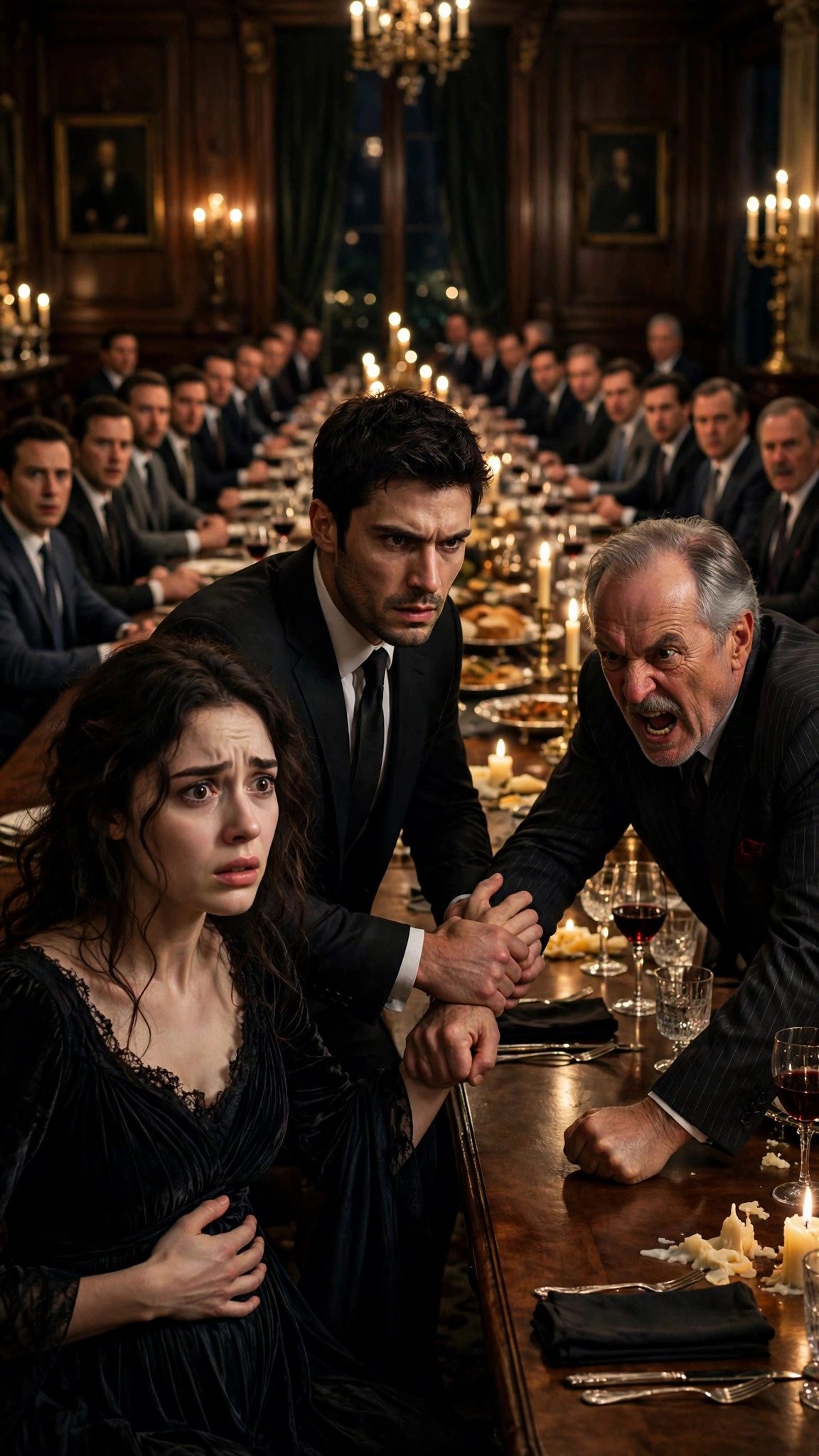
The man who had married me to keep my mother alive was standing between me and twenty of the most dangerous men in Boston, and I was about to vomit on his shoes.
I pressed my hand flat against my stomach, the way I had been doing for three days without noticing, and tried to breathe through my nose. The dining room of the Varenna mansion smelled of candle wax and red wine and roast lamb, and all of it turned in my stomach at once. Twenty powerful men sat around a table long enough to seat a small army, and every one of them was looking at me.
"Tell me whose baby that is."
Luca's uncle slammed his fist on the table so hard the crystal jumped. Aldo Varenna was sixty-four years old, with gray hair combed back from a lined face and a dark pinstripe suit that cost more than my mother's first month of treatment, and he was staring at me like I was a thief he had caught in his house.
"Tell me whose baby that is," he said again, louder, and he leaned across the table toward me, his face going red. "The contract forbade children. You were told. Everyone in this family was told."
The silence in the room was so heavy that my own fear became my only thought. I could hear the candles hissing. I could hear my own heartbeat in my ears. I could feel the eyes of twenty men on my face, on my hand, on the small curve under my dress that I had been trying not to think about for a week.
Luca rose from his chair beside me. He did not raise his voice. He never raised his voice. That was what made people afraid of him.
"Step away from my wife," he said.
Aldo did not step away. "Your wife signed a contract, Luca. One year. Financial support for her mother. No children. No heirs. You know why. You were told twelve years ago that you could never father children, and you accepted it, and this family accepted it, and now this girl—"
"Do not call her a girl," Luca said, and his voice dropped lower, and the whole room seemed to lean back from the table at once. "Do not finish that sentence, Aldo."
I felt his hand close around mine under the table. His fingers were warm and steady, and mine were shaking so hard I thought he must feel every tremor. He squeezed once, gently, the way he had squeezed my hand in the hospital corridor on the night my mother nearly died, and I understood that he was not angry with me. He was angry for me. That was the difference between Luca Varenna and every other man I had ever known, and it was the reason I was standing in this room at all.
"Luca," I whispered. "Please. Not here."
But it was already here. It had been here since the morning I stood in the bathroom of our apartment with a small white stick in my hand and watched two pink lines appear, one after the other, like a door opening and closing at the same time.
When the dinner ended — if you could call what happened next an ending, because nobody ate another bite and nobody said another word, and the twenty men filed out of the dining room in a silence that felt like a funeral — Luca took me into his private study, glanced at the hand I had unconsciously placed over my stomach, and asked one question.
"Evelyn," he said quietly, closing the door behind us. "Tell me the truth."
I could not lie to him anymore. And something lined up too perfectly, and I had known it for days, and I had been too afraid to say it out loud, because saying it out loud would mean that everything his family believed about him, everything he believed about himself, had been built on a lie.
What I was about to tell him would not just change our marriage. It could expose a twelve-year-old lie at the heart of his family's empire.
My name is Evelyn Varenna. I am twenty-seven years old, and eleven weeks ago, I married a man I had once been terrified to meet.
Luca Varenna.
Thirty-five.
Tall.
Dark-haired.
Dangerously handsome.
And the ruthless heir to one of Boston's most powerful mafia families.
He controlled shipping operations, luxury hotels, private security firms, and an underground empire that made wealthy businessmen nervous. People lowered their voices whenever he entered a room. Waiters went pale when he asked for a table. Men who had built their whole lives on being feared went quiet when his name came up in conversation.
But I did not marry him because I wanted power.
I married him because my mother was dying.
Her cancer treatment cost thirty-eight thousand dollars a month, and the hospital was about to discontinue her care. The bills had been coming for two years, and my father had sold the house I grew up in, and then he had sold his car, and then he had sold his mother's jewelry, and there was nothing left to sell except me.
When my father realized he could not pay it, he arranged a marriage through an old family connection to a man who had been watching me since childhood.
My father was safe, and I was worth nothing to him. That was the arithmetic of my childhood, and I had learned it early: my father loved my mother, and he tolerated me, and when the money ran out, he did what he had always done, which was to trade whatever he had for whatever he needed.
But when he saw my mother crying, he did it anyway. He sat at her hospital bedside and held her hand and told her that he had found a way to pay for everything, and my mother cried because she knew what the way was, and she cried because she also knew that it would save her life.
I agreed to the marriage contract without protest: a union for one year, financial support for my mother, and nothing beyond that. One year of my life in exchange for my mother's life. It seemed like a fair trade. It seemed like the only trade.
Our wedding was formal, fast, and completely empty of emotion. I wore a dress I had not chosen. I said words I had not written. I signed a contract that said, in plain English, that children were never part of the arrangement, and I signed it with a steady hand, because I had already decided that I would never love the man I was marrying, and a woman who will never love her husband does not worry about children.
That was the plan. That was the whole plan.
But something unexpected began to happen.
Luca, the cold and distant man, began to protect me.
When his nephew threatened me, Luca drove me away that same night and refused to let me live near them. When a business associate tried to touch me, Luca personally ended that relationship the next day. And when my mother had a difficult night in the hospital, he stayed awake beside me until the doctors called.
And somewhere between late-night conversations and quiet mornings, I started falling for the man behind the terrifying reputation.
That was why I almost panicked when I discovered the pregnancy.
The contract clearly stated that pregnancy was forbidden. Luca had believed he was infertile for twelve years and had accepted that his family line would end with him. He had told me so himself, on our wedding night, in a voice so flat and so practiced that I knew he had said it a hundred times before, to himself, to his father, to the mirror.
"I cannot give you children, Evelyn," he had said. "I want you to know that now, so there are no misunderstandings later. Twelve years ago, a doctor told me it was impossible. I have accepted it. My family has accepted it. The line ends with me."
I had nodded, because it made the contract easier. A marriage with no children was a marriage with an ending. A marriage with an ending was a marriage I could survive.
But no one in the family knew the truth.
Until that night at dinner.
His uncle slammed the table and demanded to know whose child I was carrying. Luca's eyes swept the room, and the silence was so heavy that my own fear became my only thought.
When the door closed, Luca pulled me into his study. He closed the door behind us and said quietly, "Evelyn, tell me the truth."
I could not lie to him anymore. And something lined up too perfectly.
And after taking a pregnancy test, I found myself staring at something neither Luca nor I had ever expected. Two pink lines.
It was Luca's child.
But I had discovered something else at the same time. Something that changed everything.
I discovered it three days after the test, on a morning when Luca had already left for the day and the apartment was quiet except for the sound of Rosa moving around in the kitchen. I was standing at the bedroom window, looking out at the city, with my hand on my stomach and the test hidden in my dresser drawer, when Rosa knocked on the door and came in with a tray.
"Breakfast, Mrs. Varenna," she said, and she set the tray on the table by the window, and she looked at me the way a woman looks at another woman when she knows something and is waiting to be asked.
"Rosa," I said, "can I ask you something?"
"Of course, Mrs. Varenna."
"How long have you worked for Mr. Varenna?"
"Eleven years," Rosa said. "Since he was twenty-four. Since the year of the accident."
"The accident," I said. "The car accident. When he was twenty-three."
Rosa nodded, and she poured the tea, and she did not look at me. "He was in the hospital for three weeks. His father stayed with him every day. And after he came home, his uncle Aldo came to see him, and he brought a paper from a doctor, and after that, Mr. Luca was never the same. He stopped talking about the future. He stopped talking about a family. He built his business, and he built his walls, and he lived behind them for twelve years."
"Did you ever wonder," I asked, very carefully, "whether the paper was true?"
Rosa was quiet for a moment. Then she said, "Mrs. Varenna, I am a cook. I am not a doctor. But I will tell you this: a man who cannot be a father does not sit in a hospital waiting room for six hours, holding his wife's hand, because her mother had a bad night. A man who has given up on children does not do that. A man who has given up does not care that much."
I thought about that night in the waiting room — Luca in his suit, holding my hand, asking the doctor to call him personally if anything changed — and I realized that Rosa was right. A man who had accepted that he would never be a father would not have sat there for six hours. A man who had accepted it would have gone home. Luca had stayed. Luca had always stayed.
"Thank you, Rosa," I said. "Thank you for telling me."
"What little girl?" I asked.
"You did not see it," Rosa said. "Last Sunday, when you were at the hospital, Mr. Luca came home early, and we went to the market together, and there was a little girl in the park, chasing pigeons, and she fell down, and Mr. Luca picked her up, and he brushed the dirt off her knees, and he gave her a coin for an ice cream, and he watched her run back to her mother with a look on his face I had never seen before. It was the look of a man who wants a child very badly, and who has decided that he will never have one."
I thanked Rosa, and I ate my breakfast, and I sat by the window for a long time, and I thought about what she had said. A man who wants a child very badly. A man who has decided he will never have one. A man who was told, twelve years ago, by his own uncle, that it was impossible. And I thought about the way Luca had looked at me on our wedding night, when he told me the line ends with him — not with pride, and not with relief, but with a kind of quiet resignation, the look of a man who has made peace with a loss he does not fully understand.
And I thought about the charity dinner, when I was sixteen, when my mother had taken me to a grand hotel ballroom in a borrowed dress, and I had danced with my father, and a tall young man with dark hair had stood by the windows and watched me. I had not known who he was then. I had not known that he would remember me for eleven years, and that he would ask for me by name, and that he would pay for my mother's life with a year of his own.
And I thought about the contract, which I had signed without reading the fine print, because I had been too tired and too frightened to read it properly. I went to the drawer where I kept my copy, and I read it again, slowly, and I saw what I had missed the first time: the no-children clause was not in the main body of the contract. It was in an appendix, on a separate page, in different type, as if it had been added later, by someone else, for a reason that had nothing to do with me.
It might not be the pregnancy test itself.
It might be the fact that someone had spent twelve years making my husband believe he could never become a father.