I was twenty-six years old when I first learned what my life was worth, and the answer was thirty-eight thousand dollars a month.
That was the price of the drug that kept my mother alive. Not a cure. Not a surgery. A drug, delivered through an IV line in a hospital room on the fifth floor of Boston General, that slowed the cancer in her bones just enough that she could sit up and eat half a bowl of soup and ask me about my day.
Her name was Margaret Hale. She was fifty-two, and before the cancer she had been the kind of woman who sang while she cooked and who knew the names of every child on our street. After the cancer, she was a woman in a hospital bed who weighed less than I had weighed at sixteen, and who apologized to the nurses every time she needed help to the bathroom.
My father, Thomas Hale, was a man who had spent his whole life being respected in the wrong rooms. He had been a junior partner at a shipping firm that went under in 2019, and after that he had been a man who made phone calls and waited for calls that never came. He loved my mother the way some men love a house they cannot afford to keep — fiercely, and helplessly, and with a growing terror that one day the bank would simply take it.
He did not love me. I do not say that to be cruel. I say it because it is the truest thing I know about my father, and because everything that happened later only makes sense if you understand it first.
When I was nine, I fell off my bicycle and broke my wrist, and my father looked at the cast and said, "Your mother will have to drive you to school now. I do not have time for this." When I was fourteen, I won a regional science prize, and my father said, "Good. Maybe you can get a scholarship and stop costing me money." When I was nineteen and I told him I wanted to study nursing, he said, "Fine. Nurses always have work. At least you will not be a burden."
My mother was the only person who ever looked at me like I mattered. She read to me at night. She taught me to make soup. She told me, when I was twelve and crying over a boy who had laughed at my shoes, that a woman's worth is not decided by the men who notice her, but by the life she chooses when nobody is watching.
She was dying, and I would have done anything to keep her. That was the whole of my moral education: I would do anything.
The hospital's billing office called on a Tuesday in March. I remember the day because it was raining, and because I had just come off a twelve-hour shift at the home-care agency where I worked, changing bandages and checking blood pressure for elderly people who could not afford a nurse of their own. The woman on the phone was polite and tired, the way people are when they have delivered the same sentence a hundred times.
"Miss Hale, your mother's account is ninety days past due. The balance is one hundred and fourteen thousand dollars. If we do not receive a payment plan this week, we will have to discontinue the treatment."
I stood in the kitchen of the apartment I shared with my mother — the apartment my father had already sold the house to pay for, the apartment with the peeling paint and the radiator that clanged all night — and I did the arithmetic in my head. My salary was forty-one thousand dollars a year. The drug alone was thirty-eight thousand a month. The numbers did not fit together in any universe. They never had.
That night my father came to the hospital. He sat beside my mother's bed and held her hand, and my mother looked at him with eyes that were too large for her face now, and she said, "Tom, don't. Don't do what you're thinking."
"There is a way," my father said, and he did not look at me. "There is an old connection. The Varenna family. They have money, and they have a son, and the son needs a wife for one year. A contract marriage. They will pay for everything. All of it. The drug, the hospital, the nurses. All of it, for a year."
My mother started to cry. She cried the way a person cries when they are too weak to sob, which is to say she lay still and the tears ran down into her hair.
"Don't," she whispered. "Don't sell her, Tom."
"I am not selling her," my father said, and his voice cracked, and for one moment I saw that he was not a cold man but a frightened one, a man who had run out of everything except his daughter. "I am saving you. That is all I am doing. I am saving you."
I stood in the doorway of that hospital room and I understood, with a clarity that felt like ice water, that my father had already decided. He had decided the moment the billing office called. He had decided before he drove to the hospital. He had come not to ask me, but to tell me, and to make it sound like a choice.
So I made it a choice. I walked into the room, and I took my mother's other hand, and I said, "Tell me the terms."
One year. A formal marriage, legally binding, with a contract that specified everything: financial support for my mother's treatment, a residence in the Varenna family's Boston apartment building, a monthly allowance for my personal expenses, and nothing beyond that. No children — the clause was underlined twice, in the copy my father showed me, as if someone had wanted to be very sure I understood it. No claim on the Varenna business. No claim on the Varenna name after the year ended. At the end of twelve months, we would divorce quietly, and my mother would have had a year of treatment, and I would have my life back.
"And the man?" I asked. "What is he like?"
My father hesitated. It was the first time I had ever seen him hesitate about anything to do with money.
"His name is Luca Varenna," he said. "He is thirty-five. He is the heir. People are afraid of him, Evelyn. I will not lie to you about that. But he is also the reason this is possible. He asked for you by name."
"By name?" I said. "He doesn't know me."
"He has known of you since you were a child," my father said, and he looked away, toward the window, toward the rain. "Your mother took you to a charity dinner once, when you were sixteen. The Varenna family hosted it. He saw you there. He asked about you afterward. He never forgot. Men like Luca Varenna do not forget things."
I did not know what to do with that information. A man I had never met had been watching me since I was sixteen, and now he was buying a year of my life to pay for my mother's medicine. It should have frightened me more than it did. But I was so tired — tired of the bills, tired of the hospital smell, tired of watching my mother shrink a little more every week — that fear felt like a luxury I could no longer afford.
My mother squeezed my hand. Her fingers were thin and cold, and her wedding ring hung loose on her finger, and she said, "Evelyn. You don't have to do this. I have lived my life. I am not afraid to go."
"Mama," I said, and I bent down and kissed her forehead, and I could feel the bones of her skull under my lips. "You are not going anywhere. Not this year. I promise you that."
I signed the contract three days later, in a lawyer's office on the fortieth floor of a glass tower in downtown Boston, with a fountain pen that cost more than my monthly rent. Luca Varenna was not there. His lawyer was there, a thin man with a thin smile, and my father was there, and the lawyer read the terms aloud in a voice like dry paper, and when he reached the clause about children he paused and looked at me.
"Do you understand this clause, Miss Hale?" he asked.
"I understand it," I said.
"Mr. Varenna wishes you to know," the lawyer said, "that he is unable to father children. This has been medically established for twelve years. The clause is a formality. It is there to protect both parties."
I nodded, and I signed, and the pen scratched against the paper, and that was the sound of my life changing.
I met Luca Varenna for the first time four days before our wedding, at a dinner his family hosted to inspect me. I wore a dark blue dress my mother had helped me choose from a charity shop, and I stood in a room full of people who were richer than anyone I had ever met, and I waited to be afraid.
He walked into the room, and the conversation stopped. Not all at once — it stopped the way a wave stops, in sections, as people noticed him and went quiet. He was tall, taller than I had expected, with dark hair and a face that looked like it had been cut from something hard, and eyes so dark they were almost black. He wore a black suit that fit him like it had been sewn onto him, and he moved through the room like a man who owned every inch of floor he walked on.
He stopped in front of me. He looked at me for a long moment — not at my dress, not at my shoes, but at my face, the way a person looks at something they have been waiting a long time to see.
"Miss Hale," he said, and his voice was deep and quiet, and it went through me like a bell. "Thank you for coming."
"Thank you for having me," I said, and my voice sounded steady, which surprised me, because nothing else about me was steady.
"I know what this is," he said, and he did not lower his voice, and he did not look away. "I know what you are giving up, and I know why. I want you to know that while you are my wife, no one will hurt you. No one in my family. No one in my business. No one, anywhere. That is my promise to you, and I do not break my promises."
It was the strangest proposal I had ever heard, and it was not a proposal at all. It was a contract, spoken aloud, by a man who looked like a villain in a film and who spoke like a man making a vow.
Our wedding was formal, fast, and completely empty of emotion. I wore a white dress I had not chosen. I said words I had not written. I signed my name in a book, and a priest said a prayer, and Luca Varenna put a ring on my finger, and his hand was warm and steady, and I thought: one year. Three hundred and sixty-five days. I can survive anything for one year.
On our wedding night, in the bedroom of his Manhattan penthouse, he stood across the room from me and said the thing he had practiced for twelve years.
"Evelyn," he said. "I cannot give you children. I want you to know that now, so there are no misunderstandings later. Twelve years ago, a doctor told me it was impossible. I have accepted it. My family has accepted it. The line ends with me."
I nodded, because it made the contract easier. A marriage with no children was a marriage with an ending. A marriage with an ending was a marriage I could survive.
That was the plan. That was the whole plan.
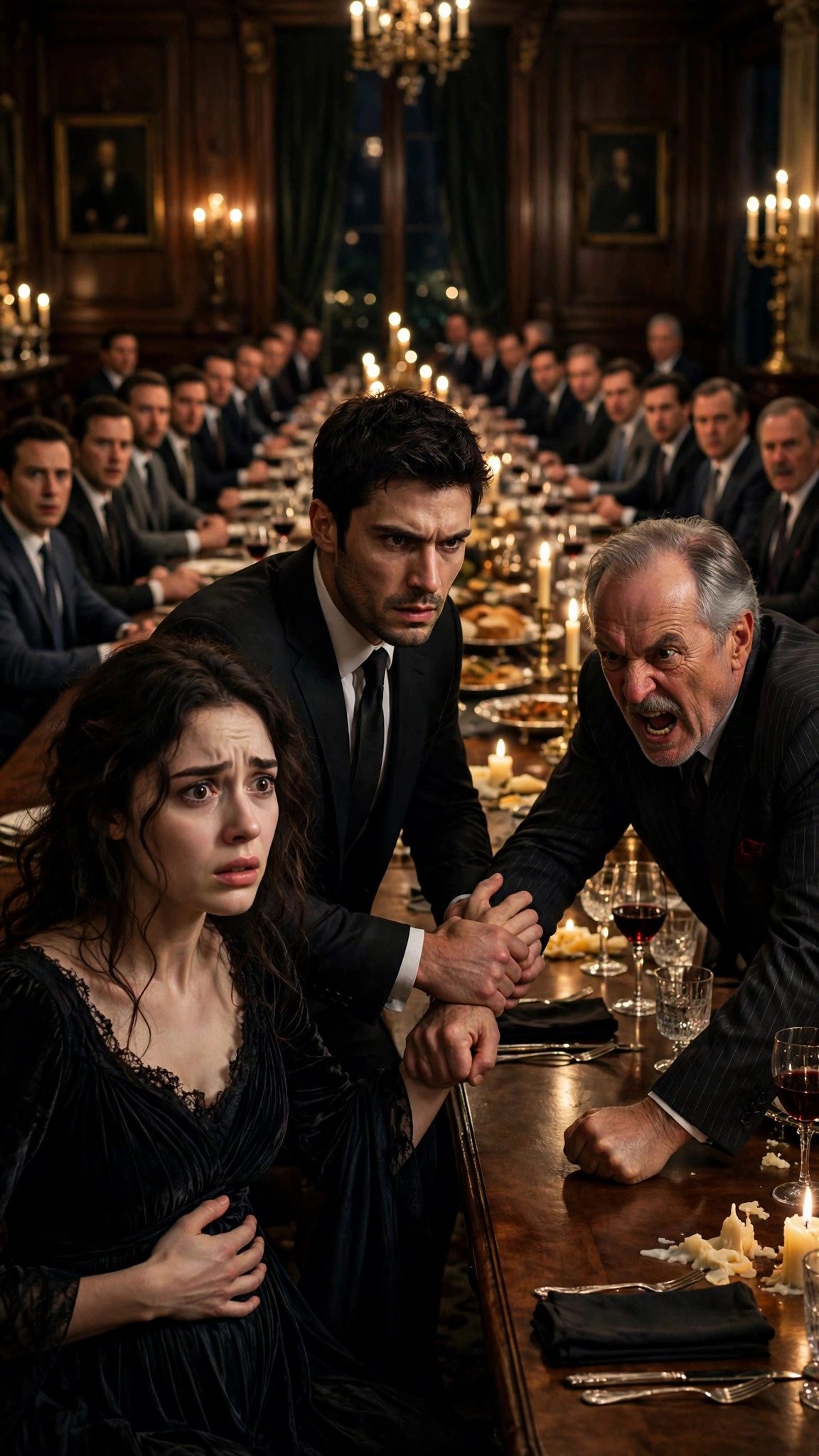
I had no idea that the doctor had been lying, or that the lie had been bought and paid for, or that the man who had bought it was sitting at the far end of the dinner table that night, watching me with the patient, hungry eyes of a man who had waited twelve years for his plan to work.
The morning after the wedding, I went to see my mother. I took the bus, because I did not yet know that there was a car waiting for me, and I walked up the five flights of stairs to her room, because the elevator was broken again, and I found her sitting up in bed, eating toast, with color in her cheeks for the first time in weeks.
"Well?" she said, and she put down her toast, and she looked at me the way only a mother can look at a daughter — straight through every wall I had built. "How was it?"
"It was fine, Mama," I said, and I sat on the edge of her bed, and I took her hand. "It was formal and fast, and the dress was too tight, and I did not cry, and I think that means I did it right."
"Evelyn," my mother said, and her voice was soft, and her eyes were wet. "I want you to listen to me. I did not ask for this. I did not want you to sell a year of your life for me. But you did it anyway, and now I am going to tell you something I have never told you before: your father is not a bad man. He is a frightened man. And frightened men do terrible things, and then they spend the rest of their lives being sorry for them. Do not hate him, Evelyn. Hate is too heavy to carry for a year."
"I don't hate him, Mama," I said, and it was true, mostly. "I just don't understand him."
"You will," my mother said. "One day, when you have a child of your own, you will understand what a parent will do to keep a child alive. And then you will forgive him. And then you will forgive yourself for needing to be saved."
I stayed with her for two hours that morning, and we talked about nothing — about the nurses, about the food, about a book she was reading — and when I left, she called after me from the doorway, "Evelyn! The ring suits you. It really does."
I looked down at the ring on my finger. It was a plain gold band, chosen by a lawyer, with no stone and no inscription. It did not suit me. It did not suit anyone. But my mother had said it did, and my mother was the only person in the world who had ever looked at me and seen something worth saving, and so I wore it, and I wore it every day after that, and I never took it off — not even when I began to wish, quietly and secretly, that it had been chosen by the man who had put it on my finger, and not by his lawyer.