I had been late for four days before I admitted it to myself.
I told myself it was stress. I told myself it was the new apartment, the new life, the new food, the late nights at the hospital. I told myself that a woman under as much pressure as I was under could miss a period for any number of reasons, and that it meant nothing, and that I was being foolish for even thinking about it.
But on the fourth day, I went to the pharmacy on the corner, and I bought a pregnancy test, and I carried it home in my coat pocket like a secret, and I locked the bathroom door, and I sat on the edge of the bathtub and waited.
Two pink lines.
I stared at them for a long time. I stared at them until they blurred, and then I wiped my eyes and stared at them again, and they were still there, two thin pink lines, as clear as handwriting.
It was Luca's child.
I knew it with a certainty that went deeper than logic. I had not been with anyone else. I had not even looked at anyone else. There was only Luca, and there had only ever been Luca, since the night of our wedding, since the night he had stood across the bedroom from me and told me, in his flat, practiced voice, that he could never give me children.
And now I was carrying his child.
I sat on the edge of the bathtub for a long time, and I did not cry. I wanted to cry, but I could not, because crying would have meant admitting that something had happened, and I was not ready to admit it yet. Instead, I did what I had always done when I did not know what to do: I made a list.
One: the contract forbade children. If Luca's family found out, they would say I had broken the contract. They would say I had trapped him. They would say I had planned it.
Two: Luca believed he was infertile. If I told him I was pregnant, he would not believe me. He would think I was lying. He would think the child belonged to someone else. And the thought of Luca looking at me the way Aldo had looked at me — like I was a thief — was worse than anything else I could imagine.
Three: my mother. The treatment was working. Her latest scan had shown the tumors shrinking, slowly, but shrinking. If the marriage ended early, if the contract was voided, if the money stopped — the treatment would stop, and my mother would die. That was the arithmetic. That was always the arithmetic.
I hid the test in the back of my dresser drawer, under a stack of scarves, and I went downstairs, and I made tea, and I sat by the window and watched the city, and I tried to think.
What I needed was proof. Not proof that I was pregnant — the test was proof enough of that. I needed proof that the child was Luca's, and that Luca could be a father, and that the twelve years he had believed he was infertile had been built on something false.
And that was when I remembered the study.
Luca's study was the one room in the apartment I never entered. It was his private place, with its dark wood and its locked drawers and its smell of leather and cigar smoke, and I had respected that boundary for eleven weeks. But that afternoon, while Luca was out at a meeting, I stood in the doorway of the study, and I looked at the desk, and I thought about the envelope.
I had seen it once, weeks earlier, when I had gone into the study to bring Luca a cup of coffee and he had been on the phone. There had been a large brown envelope on his desk, old and yellowed at the edges, with a hospital's name printed on it in faded ink. He had covered it with a newspaper when he saw me, quickly, the way a person covers something they do not want seen.
I had not thought about it again. Until now.
I went to the desk. The top drawer was unlocked. Inside, under a stack of papers, was the envelope. It was heavier than I expected. I opened it, and inside there were two sheets of paper, both from the same clinic, both with the same date — twelve years ago — both with Luca's name on them.
The first report said: "Semen analysis: Azoospermia. No sperm detected. Diagnosis: irreversible infertility."
The second report said: "Semen analysis: Normal. Sperm count 68 million per milliliter. Motility 72%. Morphology normal. Diagnosis: fertile."
Two reports. Same man. Same day. Same clinic. One said he could never be a father. The other said he could.
My hands were shaking so hard I could barely hold the papers. I sat down in Luca's chair, and I read them again, and again, and I understood, with a clarity that felt like ice water, that someone had shown Luca the first report and hidden the second one. Someone had spent twelve years making my husband believe he could never become a father.
And something lined up too perfectly.
I looked at the second report more closely. At the bottom, in small print, was a line I had almost missed: "Copy to: Mr. Aldo Varenna (family representative)."
Aldo. Luca's uncle. The man who had insisted on the no-children clause in my marriage contract. The man who had slammed his fist on the dinner table and demanded to know whose baby I was carrying.
I put the reports back in the envelope, and I put the envelope back in the drawer, and I sat in Luca's chair for a long time, and I tried to think about what to do next.
What I needed was a third opinion. An independent one. A doctor who had nothing to do with the Varenna family, who had never met Aldo, who had never been paid by anyone to write anything.
I made an appointment the next morning with a fertility specialist across town, a woman named Dr. Sarah Lindqvist, whose clinic had no connection to the Varenna family and no reason to lie to me. I told her I was pregnant, and I told her my husband had been told twelve years ago that he was infertile, and I asked her if it was possible that the original diagnosis had been wrong.
Dr. Lindqvist was a practical woman in her fifties, with gray hair and kind eyes, and she did not look surprised.
"Miss Varenna," she said — and I was startled to hear my married name, because I had almost forgotten that I had one — "a diagnosis of azoospermia is not a matter of opinion. It is a laboratory result. It is either true or it is not. If your husband is the father of your child, then the original diagnosis was false. There is no third possibility."
"Could it have been a mistake?" I asked. "A lab error?"
"A lab error happens once," she said. "It does not last twelve years. But there is a way to know for certain. We can test your husband. A new sample, a new analysis, in my laboratory, with no one from his family involved. If the result is normal, then the original report was falsified. And if it was falsified, someone falsified it on purpose."
I went home that afternoon, and I waited for Luca to come home, and when he did, I did something I had never done before: I asked him for something.
"Luca," I said, "will you come with me to a doctor tomorrow? Not your family's doctor. A different one. I need you to take a test. I need you to trust me."
He looked at me for a long moment. He did not ask what kind of test. He did not ask why. He looked at my face, and he saw something there — I do not know what, fear or hope or both — and he said, "All right. I will come with you."
The next morning, we drove to Dr. Lindqvist's clinic, and Luca gave a sample, and we waited in a small white room with a plastic plant in the corner, and Luca held my hand, and neither of us spoke, and after two hours Dr. Lindqvist came in with a folder in her hands.
"Mr. Varenna," she said, and she opened the folder, and she looked at him directly, the way a doctor looks at a patient when she is about to change his life. "Your results are completely normal. Your sperm count is sixty-one million per milliliter. Your motility is seventy percent. There is nothing wrong with you. There has never been anything wrong with you."
Luca was very still. He looked at the folder. He looked at me. He looked back at the folder.
"Twelve years," he said, very quietly. "For twelve years, I believed I could never be a father. I made peace with it. I built my life around it. I told my wife on our wedding night that the line ends with me."
"Mr. Varenna," Dr. Lindqvist said gently, "someone lied to you. The original report was falsified. I cannot tell you who did it. But I can tell you that the man sitting in front of me is perfectly capable of fathering a child."
On the drive home, Luca did not speak. He drove with both hands on the wheel, and his knuckles were white, and I watched the city go past the window, and I thought about the envelope in his desk drawer, and the second report, and the line at the bottom that said "Copy to: Mr. Aldo Varenna."
"Luca," I said, finally, "there is something else. Something I found. I need to show you."
He pulled the car over to the side of the road, and he turned off the engine, and he looked at me, and I took a breath, and I told him about the two reports, and the envelope, and Aldo's name at the bottom of the real one.
And then I told him the last thing. The thing I had been afraid to say for a week.
"Luca," I said, "I am pregnant. It is your child. I know that because there has never been anyone else. And I know that because Dr. Lindqvist just told us that you can be a father. And I know that because someone spent twelve years making you believe you could not be, and I think I know who it was."
Luca was silent for a long time. Then he started the car, and he drove us home, and he did not speak again until we were standing in the hallway of our apartment, and he took my face in his hands, very gently, and he said, "Evelyn. Thank you for telling me the truth."
I did not tell Luca about the test. Not yet. I needed time to think, and I needed proof, and I needed to understand what I had found in his desk before I asked him to believe any of it.
The next morning, I went back to the pharmacy on the corner, and I bought two more tests, and the pharmacist — an older woman named Mrs. Alvarez, with silver hair and kind eyes — looked at me over her glasses and said, "Honey, the first one is usually right. But it never hurts to be sure."
"I know," I said. "I just want to be certain."
"Being certain is a good thing," Mrs. Alvarez said, and she put the tests in a paper bag, and she folded the top down twice, the way a person folds a secret. "Whatever it says, you will handle it. Women always do. We are stronger than we think we are, and then one day we find out how strong, and we are surprised."
I took the tests home, and I took them both, and they both said the same thing: two pink lines. Two pink lines. There was no doubt left. There was only the question of what to do next.
I called my mother that afternoon. I did not tell her about the pregnancy. I did not tell her about the reports. I told her only that I was happy, and that Luca was kind to me, and that the treatment was working, and she said, "Good. That is all I have ever wanted for you, Evelyn. To be happy, and to be safe. And if you are both of those things, then I can rest."
After I hung up, I sat at the kitchen table with my laptop, and I searched for the Meridian Fertility Clinic. I found an old website, half-broken, with a phone number that no longer worked. I found a news article from eight years ago: "Meridian Fertility Clinic Closes Amid Financial Difficulties." I found a second article, from six years ago: "Dr. Emiliano Ferrante, 71, Dies of Heart Attack." There was a photograph of Dr. Ferrante — a thin man with white hair and a serious face — and I stared at it for a long time, and I wondered what two hundred and ten thousand dollars had looked like to a man like that. I wondered if he had spent it. I wondered if he had regretted it. I wondered if, on the last day of his life, he had thought about the young man whose future he had stolen.
I closed the laptop, and I went to the window, and I watched the city, and I made a decision: I would not tell Luca about the pregnancy until I could also tell him about the lie. Because if I told him about the baby first, he would think I was lying about the baby. And if I told him about the lie first, he would think I was making it up to explain the baby. The only way was to tell him both things at once, with proof in my hands, and a doctor's voice behind me.
So I made the appointment with Dr. Lindqvist. And I waited. And I hid the test in the back of my dresser drawer, under a stack of scarves, and I went downstairs, and I made tea, and I sat by the window and watched the city, and I tried to think about what my life would look like in a year, and in five years, and in ten — and for the first time since I had signed the contract, I let myself imagine a future that did not end in twelve months.
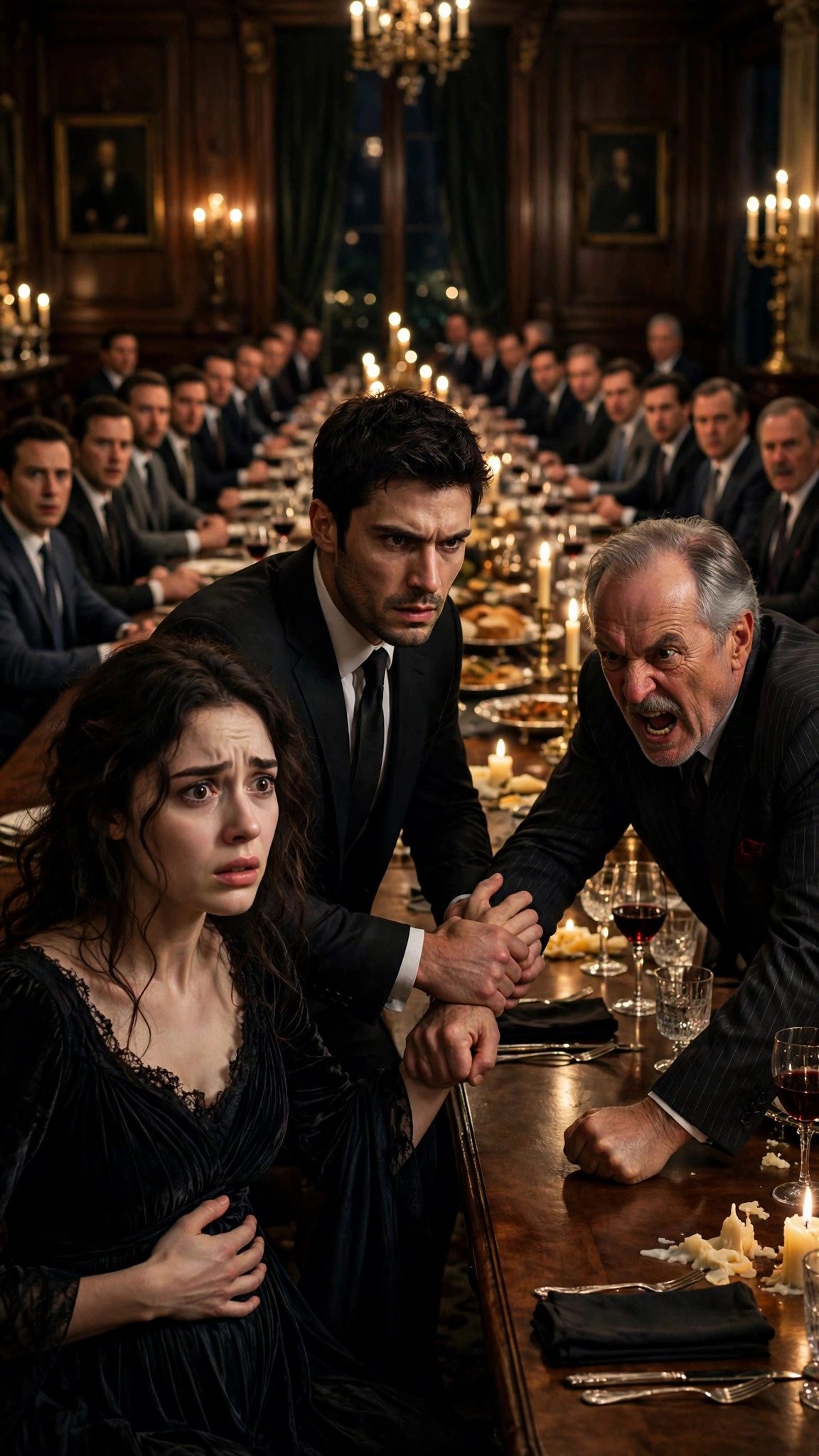
That night, there was a private dinner at the Varenna mansion. Twenty powerful men. A long table. Candles. Red wine. Roast lamb.
And I nearly vomited in front of all of them.