The first week of my marriage, I learned that Luca Varenna's apartment was not a home. It was a fortress with good furniture.
It occupied the top two floors of a building on Beacon Hill, and it had floor-to-ceiling windows that looked out over the whole of Boston, and a kitchen I never used because a woman named Rosa came every morning to cook, and a bedroom the size of my old apartment, and a silence that followed me from room to room like a second person.
Luca was rarely there. He left before dawn and came home after midnight, and when he was home he worked in his study with the door closed, and when he was not working he stood at the windows and looked at the city the way a general looks at a map. He was polite to me. He was careful with me. He asked me every morning if I had slept well, and every evening if I needed anything, and he said goodnight to me from the doorway of my bedroom like a man saying goodnight to a guest.
We did not share a bed. The contract had not required it, and Luca had not asked, and I had not offered. I slept in the guest suite, and he slept in the master bedroom, and between us there was a hallway that felt longer every night.
But something unexpected began to happen, and it happened in small moments, the way a tide comes in — not all at once, but one wave at a time, until you look down and realize the water is at your feet.
It happened the first time I went to visit my mother without him. I took the bus to the hospital, because I did not want to ask for a car, and I sat with my mother for two hours, and when I came back to the apartment, Luca was standing in the hallway, and he looked at me the way a person looks at someone who has been gone too long.
"Where were you?" he asked.
"The hospital," I said. "I went to see my mother."
"You should not take the bus at night," he said. "Not in this city. Not as my wife."
"I am not your wife," I said, before I could stop myself. "Not really. I am a contract."
He was quiet for a moment. Then he said, "You are my wife. The contract does not change that. It only changes how long it lasts."
After that, a car waited for me every morning. A driver named Joseph, a kind man in his fifties with a daughter my age, who opened the door for me and asked about my mother and never once looked at me the way other men in Luca's world looked at me — like I was a thing that had been purchased and might be purchased again.
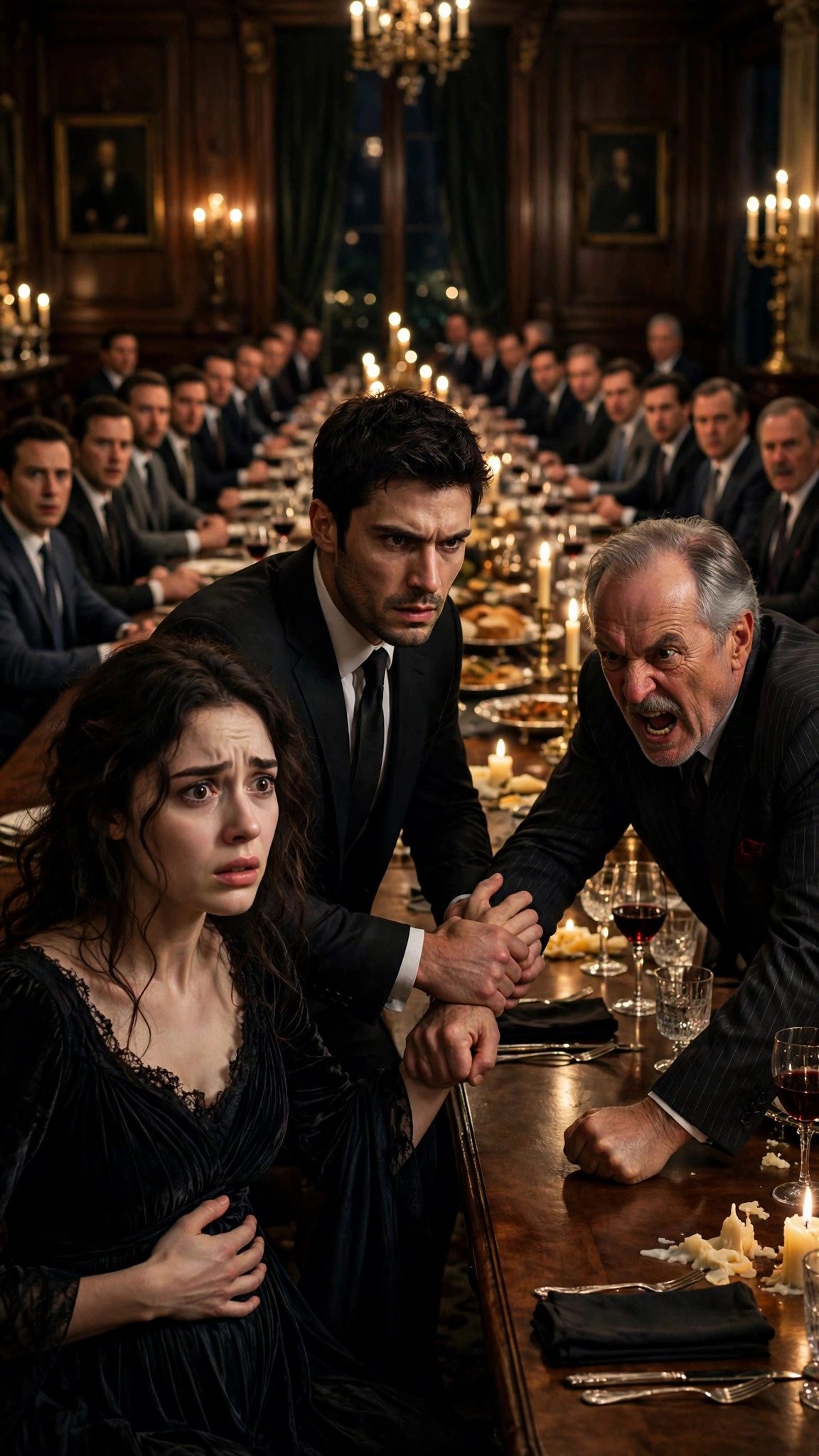
It happened again three weeks into the marriage, at a family dinner at the Varenna compound in the suburbs. I had been a Varenna for twenty-one days, and I had met perhaps thirty members of the family, and I had learned that they fell into two categories: the ones who ignored me, and the ones who watched me.
Rocco Varenna watched me. He was Luca's nephew, twenty-six years old, with his uncle Aldo's narrow eyes and his grandfather's temper, and he had been drinking since noon. He cornered me in the hallway outside the dining room, while the rest of the family was still at the table, and he put his hand on the wall beside my head, and he leaned in close enough that I could smell the whiskey on his breath.
"You know what you are, don't you?" he said. "You're a nurse's aide from nowhere. A girl whose father sold her to pay a hospital bill. My uncle Aldo says the contract was a mistake. He says Luca should have married a real Varenna girl. Someone with blood."
I tried to step around him. He moved with me.
"You're going to learn your place in this family," he said, and his hand moved from the wall to my arm, and his fingers closed around my wrist. "And your place is on your knees."
I do not remember deciding to scream. I remember the hallway going very quiet, and I remember Rocco's hand leaving my wrist, and I remember Luca standing in the doorway at the end of the hall, and I remember the look on his face — not anger, exactly, but something colder and more final than anger, the look of a man who has just decided that something in his world needs to be removed.
"Let go of my wife," Luca said.
Rocco let go. He laughed, the nervous laugh of a man who has just realized he has made a terrible mistake and is trying to pretend he has not.
"Come on, Uncle Luca," he said. "I was only joking. She knows I was joking."
Luca walked down the hallway, slowly, and Rocco backed away from me, and Luca did not raise his voice and did not raise his hand, and that was somehow worse than if he had.
"Get your coat," Luca said to me. "We are leaving."
"Luca," Aldo said, appearing in the doorway behind him. "It was a joke. The boy was drinking. Do not make a scene over a joke."
Luca turned and looked at his uncle, and the whole hallway went still.
"A joke," Luca said. "A joke is something everyone laughs at. My wife was not laughing."
He drove me away that same night, and he refused to let me live near them. He moved me out of the compound's guest wing — where I had been staying during family events — and into the Beacon Hill apartment full time, and he told the family that if Rocco ever came within ten feet of me again, Rocco would be the one who left Boston, not me.
In the car, on the way home, I sat with my hands in my lap, and I stared out the window at the highway lights, and I said, "You didn't have to do that."
"Yes," Luca said, "I did."
"Why?" I asked. "I'm only here for a year. I'm only a contract."
He was quiet for a long time. The highway hummed under the tires. Then he said, "A man who lets his family hurt his wife is not a man. The contract says one year. It does not say I have to watch you be hurt for one year."
I did not know what to say to that. So I said nothing, and I looked out the window, and I felt something in my chest shift, very slightly, like a door opening one inch in a house I had thought was empty.
It happened again a month later, at a charity gala at one of Luca's hotels. I wore a dark green dress that Rosa had helped me choose, and I stood beside Luca while he talked to men in suits about shipping routes and hotel occupancy rates, and I tried to be invisible, which was my job at those events: stand, smile, say nothing, be beautiful and silent.
A business associate named Anthony Greco, a man in his fifties with a diamond ring and a habit of standing too close to women, put his hand on the small of my back and let it slide lower, and said, "Luca, you have excellent taste. Perhaps you could lend her to me for an evening, when you are done with her."
The room went quiet. Not all at once — in sections, the way it had gone quiet the first night I met Luca, as people noticed what was happening and went still.
Luca looked at Greco's hand. He looked at Greco's face. He took my arm, gently, and moved me behind him, and he said, in a voice so quiet that only the people nearest us could hear it, "Take your hand off my wife, Anthony."
Greco laughed. He took his hand away, slowly, making a show of it. "Relax, Luca. I was only—"
"Our business is finished," Luca said. "As of tonight. My office will send your people the termination papers in the morning. You will not call me. You will not come to my hotels. You will not speak to my wife again."
Greco's face went white. "Luca. The Greco contract is worth four million a year. You can't—"
"I can," Luca said. "And I have."
He took my hand, and he led me out of the ballroom, and in the elevator going down, I stood beside him and I looked at our reflections in the mirrored wall, and I saw a woman in a dark green dress standing next to a man who had just thrown away four million dollars a year because someone had touched her without permission.
"Luca," I said. "That was four million dollars."
"Yes," he said.
"Why would you do that for me?"
He looked at me in the mirror, and for the first time since I had met him, I saw something in his face that was not control. It was not anger. It was not calculation. It was something simpler and more dangerous than any of those things.
"Because you are my wife," he said. "And because no one touches my wife."
It happened again, a week later, on the night my mother had a difficult night in the hospital. The nurses called at two in the morning — her blood pressure had dropped, her breathing had gone shallow, the doctors were talking about moving her to intensive care — and I sat in the waiting room with my coat still on, shaking, and I called Luca, because he was the only person I could think of to call.
He came. He did not ask why I had called. He did not tell me to calm down. He sat beside me in the waiting room for six hours, in a suit that cost more than my mother's hospital bed, and he held my hand, and when the doctor finally came out at dawn and said that my mother was stable, that she would be all right, that the crisis had passed, Luca stood up and said to the doctor, "Whatever she needs. Whatever it costs. I want the best of everything. I want her to have a private room, and a private nurse, and I want you to call me personally if anything changes."
The doctor nodded, and he wrote something down, and Luca turned to me, and his eyes were red from lack of sleep, and he said, "She is going to be all right, Evelyn. I promise you that."
And somewhere between late-night conversations and quiet mornings, I started falling for the man behind the terrifying reputation.
I fell for him the way you fall for a person you have decided not to love — slowly, and then all at once, and then with a kind of helplessness that felt like drowning. I fell for the way he asked Rosa to make my favorite soup. I fell for the way he remembered that my mother liked yellow flowers. I fell for the way he stood between me and the world, every single time, without ever being asked, without ever making a show of it, as if protecting me were simply what he did, the way other men breathed.
By the eleventh week of our marriage, I was in love with my husband, and my husband believed he could never give me a child, and I had signed a contract that said children were forbidden, and I had accepted all of it, and I had made my peace with all of it.
It happened again, in the middle of the seventh week, in the most ordinary way possible: over lunch.
Luca came home in the middle of the day, which he never did, and he found me in the kitchen, trying to make soup the way my mother had taught me, and failing, because the kitchen was too big and too clean and too silent, and I did not know where anything was.
"You are doing it wrong," he said, and he took the spoon from my hand, and he stirred the pot, and he added salt, and he tasted it, and he nodded. "Your mother taught you?"
"Yes," I said. "She taught me everything I know about cooking. Which is not much."
"She taught you well," he said, and he ladled the soup into two bowls, and he set them on the table, and he sat down across from me, and for the first time since our wedding, we ate a meal together, just the two of us, in the middle of the day, with no one watching.
"Tell me about her," he said. "Your mother. What is she like, when she is not in a hospital bed?"
I told him. I told him about the singing while she cooked, and the names of every child on our street, and the way she could make a meal out of nothing, and the way she had read to me at night until I fell asleep. I told him about the time she had walked three miles in the rain to bring me a forgotten lunchbox, and the time she had stayed up all night sewing a costume for a school play, and the time she had told me that a woman's worth is not decided by the men who notice her.
Luca listened. He did not interrupt. He did not look at his phone. He listened the way a person listens when they are hearing something they have never heard before, and I realized, as I was talking, that no one had ever asked me about my mother before. Not my father. Not a friend. Not anyone. And here was this man — this feared, powerful, dangerous man — sitting across a kitchen table from me, asking me about my mother's soup, and listening as if it were the most important thing in the world.
"She sounds like a remarkable woman," he said, when I had finished.
"She is," I said. "She is the best person I know."
"Then I would like to meet her," Luca said. "Properly. Not as a name on a hospital bill. As your mother."
Two days later, he came with me to the hospital. He wore a dark suit, and he carried a bouquet of yellow flowers — my mother's favorite — and he stood in the doorway of her room, suddenly awkward, a man who could walk into any room in Boston and command it, standing in a hospital doorway like a boy on his first date.
"Mrs. Hale," he said, "I am Luca Varenna. I am your daughter's husband. I have come to thank you."
"Thank me?" my mother said, and she laughed, a real laugh, the first one I had heard from her in months. "For what?"
"For raising her," Luca said, and he set the flowers on the table, and he pulled up a chair, and he sat beside her bed, and he stayed for an hour, and he asked her about her life, and her garden, and her favorite books, and when we left, my mother took my hand, and she said, "Evelyn. That man loves you. I do not know if he knows it yet. But he loves you. I can see it in the way he looks at you when he thinks no one is watching."
I did not answer her. I could not answer her, because I was afraid that if I said it out loud, it would not be true.
And then, on a Tuesday morning, I stood in the bathroom of our apartment with a small white stick in my hand, and I watched two pink lines appear, one after the other, like a door opening and closing at the same time.