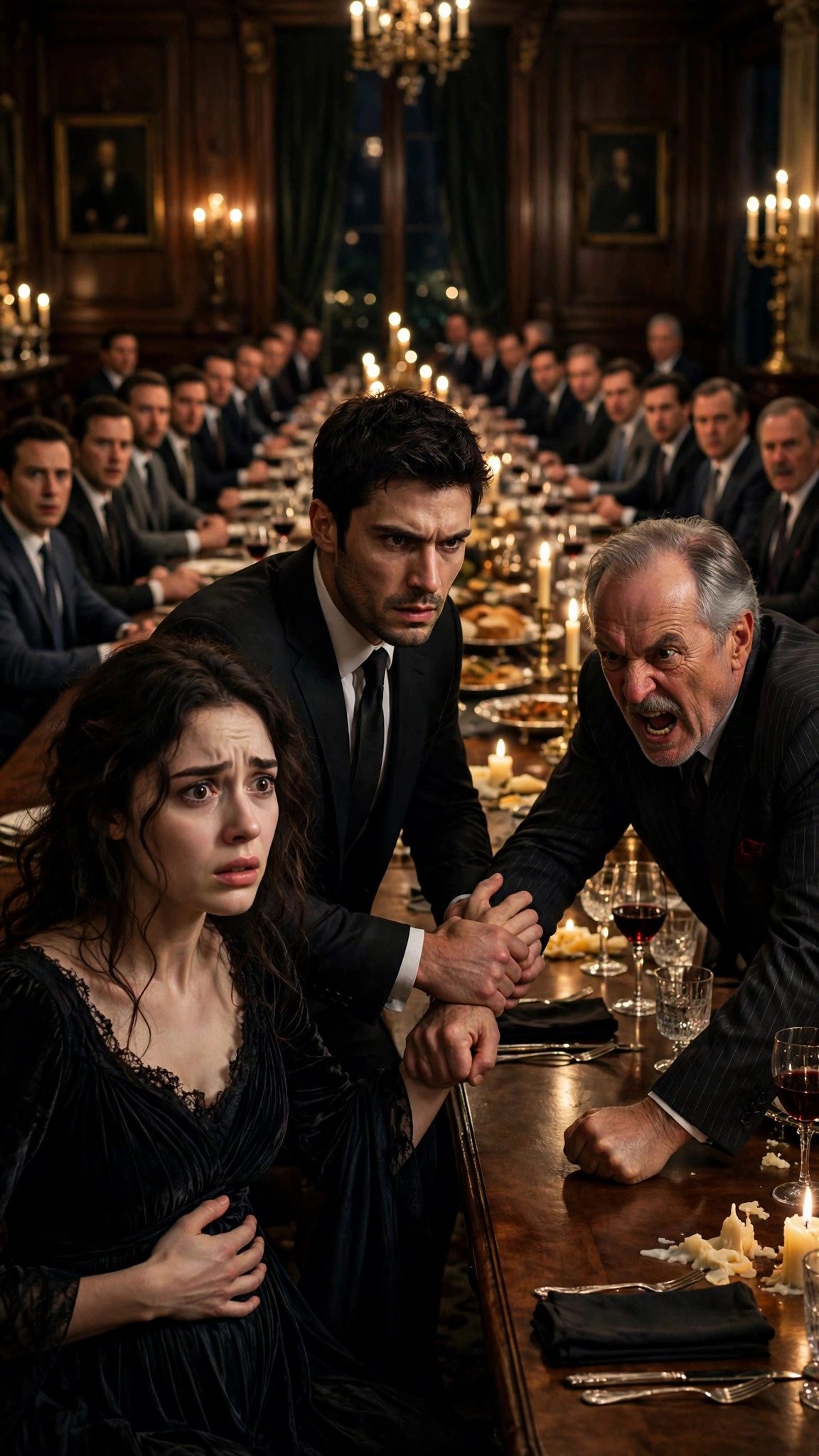
The dinner was Aldo's idea. He called it a family dinner, but it was not a family dinner. It was a tribunal, and I was the accused, and the twenty men around the table were the jury.
I knew it the moment we walked into the dining room. The table was set for twenty-two, and the chairs were all occupied except for two at the far end — ours — and every man in the room stood up when we entered, and none of them smiled.
Aldo sat at the head of the table, in the chair that had belonged to Luca's father, and he watched us walk to our seats with the patient, hungry eyes of a man who has waited twelve years for his plan to work.
"Luca," he said, as we sat down. "Evelyn. How good of you to come. I hope you are feeling well, Evelyn. You looked a little pale when you came in."
"I am fine," I said, and my voice sounded steady, which surprised me, because nothing else about me was steady.
"Good," Aldo said, and he smiled, and his smile did not reach his eyes. "Good. Because there is something I would like to discuss with the family tonight, and it concerns you."
The first course came. Soup. I lifted my spoon, and the smell of it hit me — cream and butter and something rich — and my stomach turned over, hard, and I put the spoon down, and I pressed my hand flat against my stomach, the way I had been doing for three days without noticing.
Aldo watched my hand. He watched it the way a hunter watches a deer step into a clearing.
"My dear," he said, and his voice was loud enough for the whole table to hear. "Are you unwell?"
"I am fine," I said again.
"Are you sure?" Aldo said. "Because you have been holding your stomach all evening. And a woman holds her stomach for only two reasons, in my experience. One is that she has eaten something bad. The other is that she is carrying a child."
The room went silent. Twenty men put down their forks. Twenty men looked at me.
"Tell me whose baby that is."
Aldo slammed his fist on the table so hard the crystal jumped. "The contract forbade children. You were told. Everyone in this family was told. You signed a contract, Evelyn Hale, and you broke it, and now you will tell this family whose child you are carrying, because it cannot be Luca's. Luca cannot father children. He has known that for twelve years. So tell me. Tell all of us. Whose is it?"
I could not speak. My throat had closed. My hands were shaking. I felt Luca's hand close around mine under the table, warm and steady, and I held on to it like a rope.
Luca rose from his chair. He did not raise his voice. He never raised his voice.
"Step away from my wife," he said.
Aldo did not step away. "Your wife signed a contract, Luca. One year. Financial support for her mother. No children. No heirs. You know why. You were told twelve years ago that you could never father children, and you accepted it, and this family accepted it, and now this girl—"
"Do not call her a girl," Luca said, and his voice dropped lower, and the whole room seemed to lean back from the table at once. "Do not finish that sentence, Aldo."
Aldo leaned across the table toward me, his face going red, his hand reaching for my arm as if he meant to drag the answer out of me by force.
Luca moved faster than I had ever seen him move. His hand closed around his uncle's wrist, and he held it, firmly, in midair, and he did not let go.
"Do not touch my wife," Luca said. "Not tonight. Not ever."
Aldo stared at him. The whole room stared at him. For a moment, nobody moved, and the candles hissed, and the crystal trembled on the table, and I thought that the whole world had stopped.
Then Luca let go of Aldo's wrist, and he turned to me, and he said, very quietly, "Come with me, Evelyn."
He took me out of the dining room, past the twenty silent men, past the untouched soup and the trembling crystal, and down the hallway to his private study, and he closed the door behind us, and he turned to me, and he glanced at the hand I had unconsciously placed over my stomach, and he asked one question.
"Evelyn," he said quietly. "Tell me the truth."
As I stood there, in the study, with the two reports in my mind and the pregnancy test hidden in my dresser drawer, I thought about the first dinner I had ever attended at the Varenna compound — the dinner where I had met Aldo for the first time, three weeks into my marriage. He had raised his glass that night, too, and he had said, "To family. To loyalty. To the future of this house." And he had looked at me, and he had smiled, and I had thought, at the time, that he was simply an old man who liked to make toasts.
Now I understood. He had not been toasting the future. He had been toasting his own plan. He had been standing at the head of the table, in Luca's father's chair, drinking to a future in which Luca died without an heir, and his son took everything, and I — the contract wife, the girl from nowhere — was simply a detail he had not bothered to plan for.
He had not planned for me to fall in love with Luca. He had not planned for me to look in a desk drawer. He had not planned for a second report, or a bank ledger, or a son who kept copies of his father's crimes. He had planned for twelve years, and he had planned for everything — except for a woman who refused to be afraid.
I could not lie to him anymore. And something lined up too perfectly, and I had known it for days, and I had been too afraid to say it out loud, because saying it out loud would mean that everything his family believed about him, everything he believed about himself, had been built on a lie.
I could not lie to him anymore. And something lined up too perfectly, and I had known it for days, and I had been too afraid to say it out loud, because saying it out loud would mean that everything his family believed about him, everything he believed about himself, had been built on a lie.
"Luca," I said, and my voice shook, and I made it steady, because this was the most important thing I would ever say to him. "The child is yours. I know that because there has never been anyone else. But that is not the whole truth. The whole truth is that you were never infertile. Someone made you believe you were. Someone falsified the report twelve years ago, and hid the real one in your desk, and the real one says you are perfectly healthy, and the copy of the real one was sent to Aldo."
Luca was very still. He looked at me for a long moment, and I saw a dozen things cross his face — disbelief, and hope, and rage, and a kind of grief so deep it frightened me, the grief of a man who has just learned that twelve years of his life were stolen from him.
"Show me," he said.
I went to the desk. I opened the top drawer. I took out the brown envelope, and I laid the two reports on the desk, side by side, and I pointed to the line at the bottom of the real one.
"Copy to: Mr. Aldo Varenna," I said. "And I went to a doctor, Luca. An independent doctor. Dr. Sarah Lindqvist. You went with me. You heard what she said. Your results are normal. They have always been normal. Someone lied to you, and someone paid for that lie, and the person who benefited from it is the person who has been sitting at the head of your father's table, telling the family that the line ends with you."
Luca picked up the two reports. He read them. He read them again. His hands did not shake. His face did not change. But I saw his jaw tighten, and I saw his eyes go dark, and I understood that I was watching a man decide something, and that the decision, once made, could not be unmade.
"Twelve years," he said, very quietly. "For twelve years, I believed I would never hold my own child. I accepted it. I built my life around it. I told you, on our wedding night, that the line ends with me. And all that time, my uncle knew. All that time, he was waiting for me to die without an heir, so that his son could take what was mine."
"Luca," I said, and I put my hand on his arm. "What are you going to do?"
He looked at me, and he put his hand over mine, over my stomach, very gently, and he said, "I am going to find out exactly what he did. And then I am going to end it."
He opened the study door, and he walked back into the dining room, and the twenty men were still sitting there, in the silence, with their untouched soup going cold, and Aldo was still sitting at the head of the table, in Luca's father's chair, and Luca walked to the end of the table, and he stood behind Aldo's chair, and he said, in a voice that carried to every corner of the room, "The dinner is over. Everyone out. Except you, Aldo. You stay."
The twenty men filed out of the dining room, one by one, in a silence that felt like a funeral. And I stood in the doorway of the study, with my hand on my stomach, and I listened to the sound of their footsteps fading down the hallway, and I thought: this is the moment everything changes.
The drive to the mansion took forty minutes, and I spent all of them staring out the window at the highway lights, with my hand on my stomach and my heart beating too fast. Luca drove in silence, and Joseph sat in the front seat, and neither of them spoke, and I was grateful for the silence, because I did not trust my voice.
I had spent an hour getting dressed. I had chosen a dark evening gown, elegant and simple, with long sleeves, because I wanted to look like a woman who belonged at a table with twenty powerful men, and not like a girl who had been bought to pay a hospital bill. Rosa had helped me with my hair, pulling it back into a low knot, and she had said, "You look beautiful, Mrs. Varenna. You look like a queen." And I had thanked her, and I had looked at myself in the mirror, and I had seen a woman I barely recognized — a woman with dark wavy hair and a pale, fearful face, wearing a gown that cost more than my old apartment's rent, about to walk into a room full of men who had already decided what she was.
When we arrived, the mansion was lit up like a palace. Cars lined the driveway. Men in suits stood on the front steps, smoking cigars, talking in low voices, and they went quiet when they saw us, the way men always went quiet when Luca walked into a room.
Inside, the dining room was warm and bright, and the table was set with crystal and silver, and the candles were already lit, and the smell of roast lamb came from the kitchen, and for a moment — just a moment — it looked like an ordinary family dinner. Like the kind of dinner my mother used to make on Sundays, when my father was still kind, and the world was still simple.
But it was not ordinary. I knew it the moment Aldo stood up and raised his glass and said, "To family. To loyalty. To the truth, whatever it may be."
He looked at me when he said the word "truth." He looked at me the way a hunter looks at a deer step into a clearing.
The soup came, and I lifted my spoon, and the smell hit me, and my stomach turned over, and I put the spoon down, and I pressed my hand flat against my stomach. I saw Aldo notice. I saw the men at the far end of the table notice. I saw Giuseppe Moretti, the oldest man in the family, frown slightly, the way a man frowns when he sees something he does not like but cannot yet name.
And then Aldo said it. "Tell me whose baby that is."
After the dinner ended — after the twenty men filed out in silence, after Luca took me into the study, after I showed him the two reports and told him about Dr. Lindqvist and the pregnancy — we stood in the study together, in the dark, with only the desk lamp burning, and Luca put his hand over mine, over my stomach, very gently, the way a man touches something precious and breakable.
"Evelyn," he said, and his voice was rough, and I realized that he was trying not to cry, and that he had not cried in front of anyone in twelve years. "If this is true — if what you are telling me is true — then I have lost twelve years of my life. Twelve years of believing I would never be a father. Twelve years of building walls around myself because I thought there was nothing inside worth protecting. And you — you found the truth in a drawer, in my own house, in my own desk, because you were brave enough to look."
"I was not brave," I said. "I was terrified. I am still terrified."
"Then we are terrified together," Luca said, and he kissed the top of my head, very gently, and he held me, and we stood there in the dark study, with the two reports on the desk and the future of our family balanced on a knife's edge, and I thought: this is the moment everything changes.
What I was about to tell him would not just change our marriage. It could expose a twelve-year-old lie at the heart of his family's empire.
And now, finally, it had.