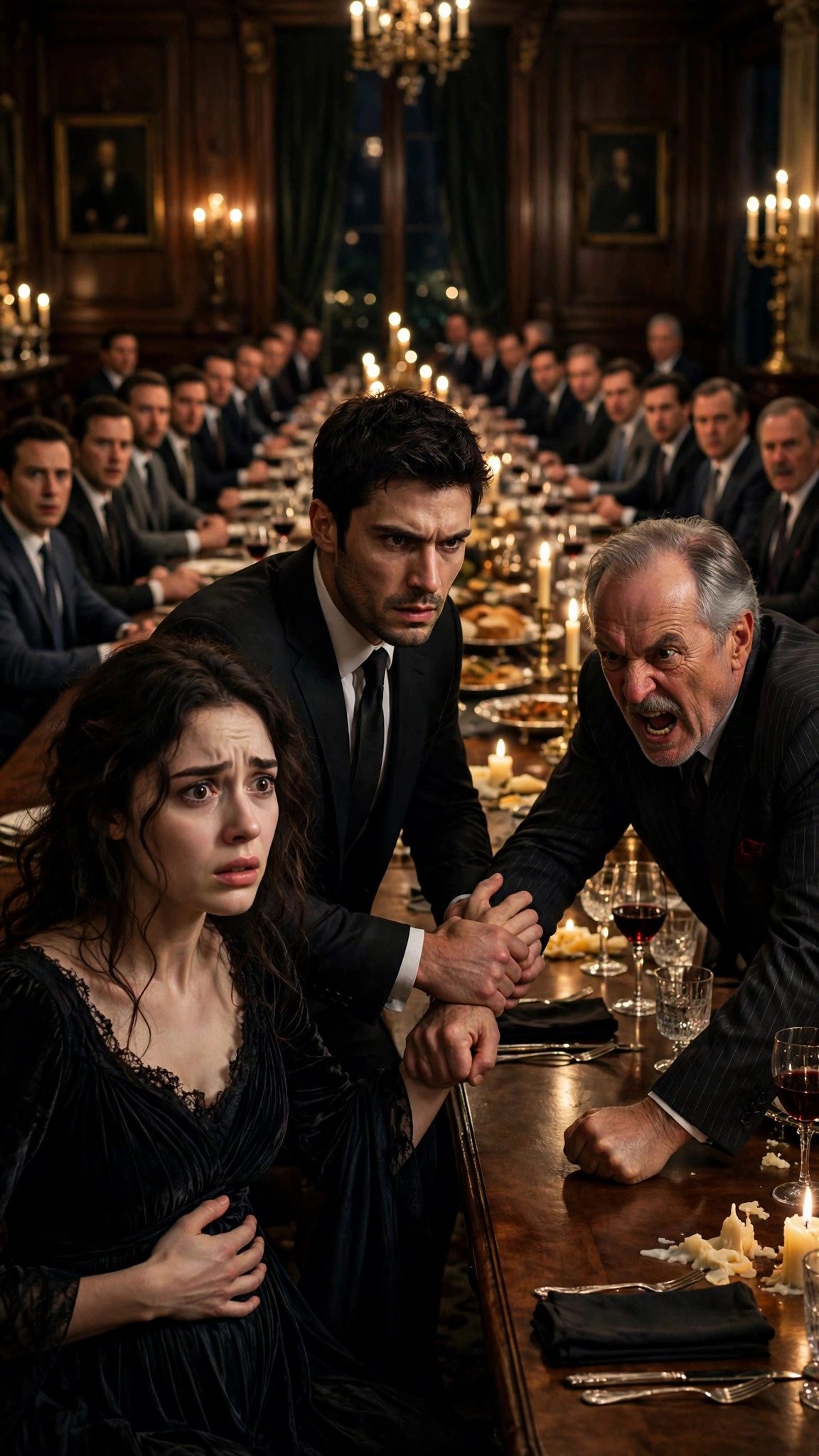
I did not hear what Luca said to Aldo in the dining room that night. Luca asked me to wait in the study, and he closed the door, and for twenty minutes I sat in his chair and listened to the murmur of voices through the wall — Aldo's voice, rising and falling, and Luca's voice, low and steady, like a river running under ice.
When Luca came back, his face was calm. Too calm. The kind of calm that comes after a storm has already done its damage.
"He denies it," Luca said. "Of course he denies it. He says the second report is a forgery. He says you made it up. He says I am being manipulated by a girl who wants to save her mother's treatment by giving me an heir."
"Then we prove it," I said. "We go to the clinic. We find the records. We find the truth."
"The clinic is gone," Luca said. "The Meridian Fertility Clinic closed eight years ago. Dr. Ferrante, the doctor who signed the report, died six years ago. Heart attack. There is nothing left to find."
"There is always something left to find," I said, and I stood up, and I took his hand. "Luca. I was a home-care aide. I know how medical records work. A clinic does not close and simply vanish. The records go somewhere. The billing goes somewhere. The payments go somewhere. And if someone paid a doctor to falsify a report, there is a record of the payment, because men like Aldo do not pay in cash. They pay in transfers. They pay in favors. They pay in ways that leave a trail."
Luca looked at me for a long moment. Then he said, "All right. Tomorrow morning. We will find the trail."
We started with the bank. Luca's family owned a private bank in Boston, a small institution that handled the Varenna accounts and the accounts of a dozen other families, and the bank's records went back forty years. Luca called the bank's president at seven in the morning, and by nine o'clock we were sitting in a conference room with a stack of ledgers, and a thin, nervous accountant named Mr. Okafor was laying out twelve years of transfers on the table in front of us.
"Mr. Varenna," Mr. Okafor said, "I have found what you asked for. Between 2014 and 2016, there were fourteen transfers from an account controlled by Mr. Aldo Varenna to an account held by Dr. Emiliano Ferrante, at the Meridian Fertility Clinic. The total was two hundred and ten thousand dollars."
"Two hundred and ten thousand dollars," Luca repeated, very quietly.
"Yes, sir," Mr. Okafor said. "And there were three more transfers, in 2015, from the same account to a laboratory technician named Paul Hensley, who worked at the clinic. The total was forty thousand dollars."
I felt Luca's hand tighten around mine under the table.
"And the reports?" Luca asked. "Can you tell me which report was real?"
Mr. Okafor shook his head. "The bank cannot tell you that, sir. But I can tell you this: the transfers to Dr. Ferrante began one week after your car accident, sir. The accident when you were twenty-three. The accident after which you went to the clinic for testing."
Luca went very still. I remembered the accident. He had mentioned it once, in passing, during one of our late-night conversations — a car that had run a red light, a hospital stay, a long recovery, and after it, a visit to a fertility clinic, because his father had insisted, because the family needed to know if the heir could produce an heir.
"After the accident," Luca said slowly, "my father took me to the clinic. Dr. Ferrante did the tests. A week later, Aldo came to my room, and he told me the results. He said the doctor had found no sperm. He said it was permanent. He said he was sorry. And he showed me the report."
"And the real report?" I asked Mr. Okafor.
"Was sent to your late father, sir," Mr. Okafor said. "According to the clinic's mailing records — which we obtained from the laboratory's archive, which was sold to a records company when the clinic closed — the real report was mailed to your father, at the family compound, on the same day. Your father filed it in his desk. He died three years later, of a heart attack, before he ever told you."
Luca closed his eyes. For a moment, he looked like a man who had been holding his breath for twelve years and had only just remembered how to breathe.
"My father knew," he said. "My father knew I was fertile, and he died before he could tell me. And Aldo knew that my father knew. And Aldo waited."
We went to the clinic's archive next. The records company kept its files in a warehouse in South Boston, in rows of gray metal cabinets that smelled of dust and old paper. A clerk named Mrs. Delaney, a woman in her sixties with reading glasses on a chain, led us to the cabinet marked "Meridian Fertility Clinic, 2013–2016," and she pulled out a folder, and inside it was the original laboratory worksheet for Luca's test.
The worksheet was in Dr. Ferrante's handwriting. It said: "Sperm count 68 million/mL. Motility 72%. Morphology normal. Result: NORMAL."
And underneath it, in a different hand — Paul Hensley's hand, the laboratory technician — was a note: "Per Dr. Ferrante: prepare second report. Diagnosis: azoospermia. Patient copy to be given to family representative (A. Varenna). Original to be mailed to father."
Mrs. Delaney looked at the note, and she looked at Luca, and she said, "I'm sorry, Mr. Varenna. I didn't know. I just file the papers."
"It's all right," Luca said, and his voice was gentle, which surprised me, because I had expected rage. "You did your job. Thank you."
We drove to the family compound that afternoon. Aldo was waiting for us in the library, sitting in the chair that had belonged to Luca's father, with a glass of whiskey in his hand, and his son Enzo standing beside him.
Enzo Varenna was thirty-one, with his father's narrow eyes and his mother's kind mouth, and he looked at us the way a man looks at a storm he has known was coming for a long time.
"Uncle Luca," Enzo said, and he stepped forward, and he held up his hand. "Before you say anything, I want you to know: I did not know. I swear to you, on my mother's grave, I did not know what my father did."
Aldo stood up. "Enzo. Be quiet."
"No, Father," Enzo said, and his voice shook, and he did not back down. "I will not be quiet. Not anymore. I have known for three years that something was wrong. I found the bank statements. I found the transfers. I asked you about them, and you told me it was family business, and you told me not to ask again. But I kept the copies. I kept them because I knew that one day, someone would ask."
He took a folder from inside his jacket, and he handed it to Luca, and Luca opened it, and inside were copies of the same transfers Mr. Okafor had found — fourteen payments to Dr. Ferrante, three to Paul Hensley — and a letter, in Aldo's handwriting, to a lawyer, dated twelve years ago.
The letter said: "Ensure that the marriage contract for Luca Varenna's future wife contains a clause forbidding children. The clause must be absolute. It is essential to the succession."
Luca read the letter twice. Then he folded it, very carefully, and he put it back in the folder, and he looked at his uncle.
"Why?" Luca asked. "Twelve years. Why?"
Aldo was silent for a long moment. Then he set down his whiskey glass, and he looked at Luca, and for the first time since I had met him, he did not look powerful. He looked old. He looked like a man who had spent twelve years carrying a weight that had finally become too heavy.
"Because your father was going to give you everything," Aldo said. "The shipping. The hotels. The security firms. All of it. And I was his brother, and I had served this family for forty years, and I was going to get nothing. Nothing but a title and a chair at the end of the table. And then you had your accident, and I saw my chance. If you could never have an heir, then when you died, everything would go to my son. To Enzo. It was not personal, Luca. It was business. It was always business."
"It was my life," Luca said. "Twelve years of my life. You took twelve years of my life, and you took my father's last years, and you took my wife's peace, and you call it business."
"It was business," Aldo said again, but his voice was smaller now.
Luca was quiet for a moment. Then he said, "Here is what is going to happen, Aldo. You are going to leave Boston. Tonight. You are going to take nothing with you except what you can carry in one suitcase. Your accounts are frozen. Your properties are seized. Your name is struck from the family. If you ever come back, if you ever contact my wife, if you ever contact my child, I will not be as merciful as I am being now."
"And Enzo?" Aldo asked.
"Enzo stays," Luca said, and he looked at his cousin, and his voice softened, very slightly. "Enzo did not know. Enzo brought me the proof. Enzo is family. You are not. Not anymore."
Aldo picked up his glass, and he drank the last of the whiskey, and he set the glass down on the table, and he walked out of the library without looking back. I watched him go, and I felt no triumph. I felt only a kind of tired sadness, for a man who had wanted everything and had ended up with nothing, and for a family that had let him do it for twelve years because no one had thought to ask a question.
That night, Luca called a meeting of the family council — the five oldest men in the Varenna family, the men who decided matters of succession and marriage and war. He laid the two reports on the table. He laid the bank records on the table. He laid Aldo's letter on the table. And he told them everything.
"My wife is pregnant," he said. "The child is mine. The contract's clause forbidding children was written at Aldo's instruction, to protect a lie. I am asking the council to void that clause, and to recognize my wife as the true Mrs. Varenna, and my child as the heir to this family."
The five old men looked at the papers. They looked at each other. They looked at me.
And then the oldest of them, a man named Giuseppe Moretti, who had known Luca's father for fifty years, stood up, and he walked around the table, and he took my hand, and he said, "Mrs. Varenna. Welcome to the family. Truly welcome. We are sorry it took us twelve years to see what was in front of us."
The council voted unanimously. The clause was voided. The contract was rewritten — not as a one-year arrangement, but as a marriage, with no end date, and no conditions, and no lies.
The council meeting took three hours. I sat beside Luca at the long table in the family compound, with the two reports and the bank records and Aldo's letter laid out in front of us, and the five oldest men in the Varenna family looked at the papers, and then they looked at me, and then they looked at each other, and nobody spoke for a long time.
Giuseppe Moretti spoke first. He was eighty-one years old, with white hair and hands that shook slightly when he picked up the bank records, and he read them slowly, with his reading glasses perched on the end of his nose.
"Fourteen transfers," he said, finally. "Two hundred and ten thousand dollars. To a doctor who is now dead. And a letter, in Aldo's own hand, about a clause in a marriage contract." He set the papers down, and he looked at Luca. "I knew your father for fifty years, Luca. I knew Aldo for sixty. And I am telling you now, in front of this council, that I believe you. I believe your wife. And I believe that Aldo Varenna has shamed this family in a way that cannot be undone."
The second man, a quiet man named Carlo Benedetti, who had said perhaps ten words in the entire meeting, nodded slowly. "I was there," he said, "the night of Luca's accident. I was at the hospital. I saw Aldo come out of the doctor's office with a paper in his hand. I thought nothing of it at the time. I thought he was bringing good news. I have thought about that night for twelve years, and I have never understood why Aldo looked so pleased. Now I understand."
The third man, Franco Russo, who had always been Aldo's closest friend, was silent for a long time. Then he stood up, and he walked to the window, and he stood there with his back to the table, and he said, "I defended Aldo for forty years. I told people he was a loyal brother. I told people he was a good man. I was wrong. And I am sorry, Luca. I am sorry that none of us asked the question your wife asked. I am sorry that it took a twenty-seven-year-old girl from nowhere to see what five old men could not see."
Enzo was waiting for us outside the council room when the meeting ended. He stood in the hallway, alone, with his hands in his pockets, and he looked at me, and he said, "Mrs. Varenna. I want to apologize to you. Not for what my father did — I cannot apologize for that, because it is not mine to apologize for. But for the way I treated you. At the family dinner, in the hallway, when Rocco threatened you — I was there. I saw it. And I said nothing. I am sorry for that. And I want you to know that if you need anything — anything at all, now or ever — you can come to me."
I looked at him, and I saw a man who was trying very hard to be better than his father, and I said, "Thank you, Enzo. That means a great deal to me. And for what it is worth — your father made his choices. You are making yours. That is what matters."
He nodded, and he shook Luca's hand, and he walked away down the hallway, and I thought: this family is not what I thought it was. It is not a single thing. It is a dozen different people, making a dozen different choices, and some of them are good, and some of them are terrible, and the difference between them is not blood. It is character.
And my mother, when I told her the news the next morning in her hospital room, cried for the first time in months — not from pain, but from happiness — and said, "Evelyn. My girl. You are going to be a mother. And I am going to be a grandmother. And I am going to live to see it."