At 8:17 that night, inside his study, with Chicago glowing beyond the windows, my husband finally looked me in the eye and said, "I don't want you as my wife, Claire. I never did."
Dominic Russo did not shout. He did not throw his whiskey glass against the wall. He stood behind his desk, cold and controlled, and delivered the sentence the way a man closes a business deal — cleanly, finally, without looking back.
For one second, I almost cried.
Then I remembered my father had already taught me what tears were worth when he used me to settle a debt.
Eight months. Eight months of marriage, and this was the first time he had said my name like it meant anything at all — only to tell me it meant nothing.
I had set the table for two that evening. Good china. Linen napkins. The wine he liked. Risotto Mrs. Alvarez had helped me make, standing beside me in the kitchen with her sleeves rolled up, telling me to stir slowly and not to rush the broth. No roses. Roses would have made my hope look desperate.
It was our eight-month anniversary. For reasons I still could not explain, I had decided to try.
Dominic came home an hour late. He loosened his tie the moment he stepped through the door, the way he always did, like the tie was a leash and the house was the only place he could breathe. He looked at the table. He looked at the two plates, the two glasses, the two chairs pulled close together. He understood immediately.
"I have work," he said.
Then he turned toward the stairs.
I followed him. Maybe a woman with more pride would have eaten alone and pretended the ache in her chest was nothing. I was tired of pretending. I was tired of eight months of careful politeness, of sleeping alone in the master suite while my husband slept in his study or a guest room, of learning his habits the way a stranger learns a house — he drank black coffee, he hated candles, he preferred the lamps dim enough to hide whatever he was thinking.
I opened his study door without knocking.
"I said I have work," he told me.
"And I heard you. But your wife set a table for you, so your papers can wait two minutes."
His eyes sharpened. "Go to bed, Claire."
"No." My voice shook, but I held his gaze. "Tell me why you married me."
"You know why."
"Because of my father's debt?"
His silence answered.
Then I asked the question I had avoided for eight months. "Did you ever want me at all?"
Dominic looked at me for a long time. The city lights moved across his face like slow water. His jaw tightened once, the way it did when he was deciding something, and then it was gone, and there was nothing left in his expression at all.
"No."
Something inside me finally snapped. It was not loud. It was not dramatic. It was the quiet sound of the last thread giving way.
"I don't want you as my wife, Claire," he added. "I never did."
I nodded once and walked away.
Upstairs, in the closet of the master suite, behind all the gray dresses and respectable coats he preferred, I found the red dress. The red satin dress Dominic had once told me was too dangerous to wear. He had said it the morning after the first gala I attended as his wife, standing in this same bedroom with his tie still undone, his voice flat as a closed door. Burn it, he had said. Don't wear it again.
I had kept it anyway. I had kept it because it was the only thing in that house that felt like mine.
I put it on.
The satin slid over my shoulders like water. The back dipped low, bare skin to the small of my back, and the skirt moved when I moved, red as a warning. I looked at myself in the mirror and saw a woman I had not seen in eight months — a woman with color in her cheeks and fire in her eyes, a woman who had stopped begging.
Then I called my best friend.
"Tessa, where is Adrian Cross throwing his party tonight?"
She went silent. "Your husband's worst enemy?"
"Yes."
"Claire. Tell me you're not serious."
"Tell me where it is, Tessa."
A pause. Then, quiet: "Lincoln Park. His mansion on Astor Street. Claire, whatever you're thinking — don't. Adrian Cross is not a man you walk up to in a red dress."
"That's exactly what I'm going to do," I said, and hung up.
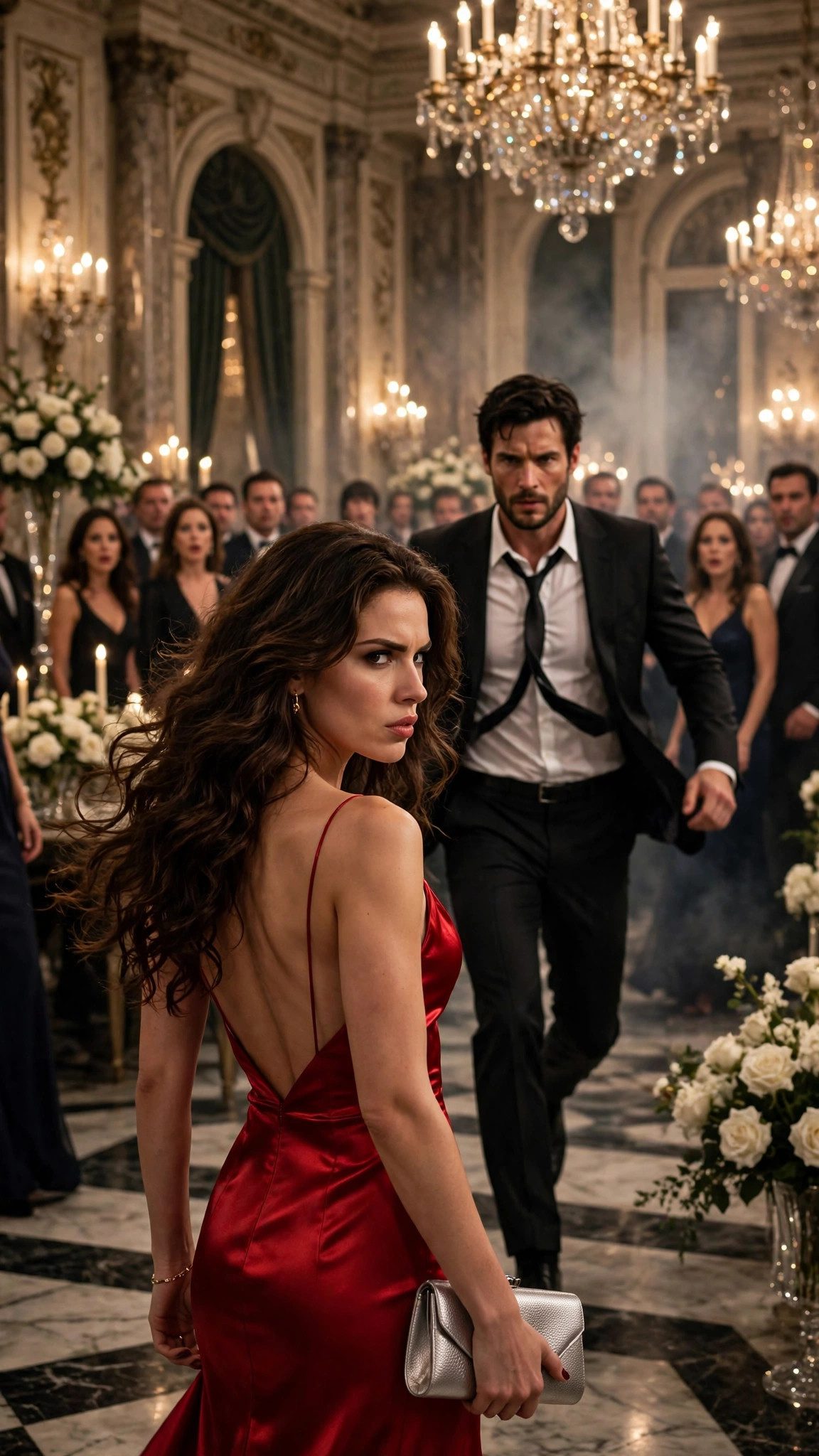
Twenty minutes later, I was stepping into Adrian Cross's Lincoln Park mansion in red. The ballroom was all crystal chandeliers and white roses and marble floors, and every conversation stopped when I walked in. The string quartet faltered. A waiter froze with a tray of champagne halfway to his shoulder. Across the ballroom, Adrian Cross slowly raised his glass toward me, a smile spreading across his face like a man who had just been handed a gift.
And then the doors behind us slammed open.
Every head turned. The air in the room changed — the way air changes before a storm, electric and heavy and suddenly hard to breathe. Dominic Russo stood in the doorway, his black suit dark against the light of the hall, his tie loosened, his eyes fixed on me across a hundred staring guests.
He crossed the ballroom in long, steady strides, and the crowd parted for him the way water parts for a blade. He stopped in front of me. Up close, his face was a wall of cold control, but his eyes — his eyes were burning.
"Say it here, Dominic," I said, and my voice did not shake at all. "Say it in front of everyone."
"I don't want you as my wife, Claire," he said, loud enough for the whole room to hear. "I never did."
The room held its breath.
Adrian Cross stepped forward, his champagne glass still raised, his smile never wavering. "Careful, Dominic," he said smoothly. "A man should be sure before he throws away something beautiful."
Dominic did not look at him. He looked only at me. And then his gaze flicked, just once, toward Adrian — and I saw something in his face I had never seen before. Not coldness. Fear.
"What did Adrian tell you about Noah?" he asked.
My blood went cold. Noah. My little brother. The boy I had raised after our mother died, the boy I had protected from our father's debts and his own bad choices for as long as I could remember.
Adrian's smile widened. "She already knows, Dominic," he said softly. "I told her everything."
The string quartet had gone completely silent. Two hundred guests stood frozen around us, champagne in their hands, watching the wife in the red dress, the husband who had rejected her, and the enemy who had been waiting all night for exactly this moment.
And I realized, standing there in the dress Dominic had once told me to burn, that I had walked into something far bigger than a rejected wife's revenge.
I had walked into a war.
But before I tell you how that night ended — before the wrist grab, before the truth about Noah, before the night my husband finally told me why he had really married me — I have to tell you how it began. Because the story of the red dress did not start in that ballroom. It started eight months earlier, on the day my father sold me to settle a debt, and the day a man I did not know put a ring on my finger and kissed my cheek like a stranger.
My name is Claire. I was twenty-six years old, and I had already buried my mother, raised my little brother, and learned that love in my family was something men traded like currency. My father, Robert Hale, was a charming man with a gambler's hands and a debtor's smile. He had taught me to cook before I was ten, to balance a checkbook before I was twelve, and to lie to creditors before I was fifteen. He had also taught me, without ever saying it, that tears were worth nothing. The men who came to our door did not care about tears. They cared about money, and when the money ran out, they cared about collateral.
When my mother died, I was nineteen and Noah was ten. I became his mother that winter, in every way that mattered. I made his lunches. I helped with his homework. I sat up with him when he had nightmares about the men shouting downstairs. I told him that as long as I was there, nothing bad would touch him. I believed it, because I had to.
By the time I was twenty-six, my father's debts had grown teeth. The men he owed were no longer the kind who shouted. They were the kind who waited, patient and smiling, and then took what they were owed in pieces — the car, the house, the shop my father had run for twenty years. And then they came for Noah.
I still remember the night they came to the house. I was at the kitchen table, helping Noah with algebra, when the knock came — three slow knocks, polite as a priest. My father opened the door, and two men in dark coats stood there, and the older one said, "Mr. Hale. We need to talk about your son."
My father tried to laugh it off. I stood in the doorway with my hands shaking and told them to leave. The older man looked at me the way a man looks at a painting he is considering buying, and said, "Pretty girl. Shame about the debt."
That was the night I understood that my father had run out of things to sell, except me.
Three days later, a black car came for me. Not the debt collectors' car. A different one — cleaner, quieter, with a driver who opened the door and said, "Mr. Russo would like to speak with you, Miss Hale."
I did not know who Mr. Russo was. I knew the name, the way everyone in Chicago knew the name: Dominic Russo, thirty-four years old, head of the Russo family, the man who owned half the shipping on the lake and all of the silence around it. I had never seen his face. I had only heard the stories — that he never raised his voice, that he never lost his temper, that his enemies simply disappeared, quietly, like debts written off a ledger.
The car took me to a building downtown, to an office with a view of the whole city, and there he was. Dominic Russo. Tall. Dark-haired. A black suit that fit him like armor. He stood behind his desk with his hands flat on the wood, and he looked at me the way he would look at a contract he was about to sign.
"Your father's debt has been purchased," he said, without any greeting at all. "By my family. The men who held it before us were going to take your brother. That will not happen now."
"Why?" I asked. My voice sounded small in that big room. "Why would you do that?"
"Because I am offering you an arrangement," he said. "Your father stays alive. Your brother stays untouched. In exchange, you become my wife."
I stared at him. "That's not an arrangement. That's a purchase."
"It is a marriage," he said. "A legal one. You will live in my house. You will want for nothing. And no one will ever come to your door again."
"And what do you get?" I asked.
He was quiet for a moment. His eyes moved over my face, and for one second I thought I saw something there — something tired, something almost human — and then it was gone.
"I get a wife," he said.
There had been no proposal. No romance. No flowers, no ring box opened on one knee, no question at all. Two weeks later, in a small chapel with no guests and no music, Dominic Russo slipped a ring onto my finger, kissed my cheek, and treated me with the careful politeness reserved for strangers.
That night, in the Lake Forest mansion that was now my home, he showed me to the master suite and then he left. He slept in his study. I slept alone. And in the morning, Mrs. Alvarez — the housekeeper, a small fierce woman with graying hair and kind eyes — brought me coffee and said, "He is a good man, Mrs. Russo. He is just not a warm one. Give him time."
I gave him eight months.
Eight months of gray dresses and respectable coats, of dinners eaten alone, of learning that my husband drank black coffee and hated candles and preferred the lamps dim enough to hide whatever he was thinking. Eight months of watching him come home late, loosen his tie, and disappear behind his study door. Eight months of being a wife in name only, a stranger in a beautiful house, a woman who had been bought to settle a debt and then shelved like a book no one intended to read.
And then, on our eight-month anniversary, I set a table for two. I made risotto. I wore my best dress. I decided to try — one last time — to be a wife instead of an arrangement.
That was the night he looked me in the eye and said he never wanted me.
That was the night I put on the red dress.
And that was the night the doors of Adrian Cross's ballroom slammed open, and Dominic Russo walked in with fear in his eyes, and asked me what Adrian had told me about Noah.
I did not know the answer yet. But I was about to learn it — and when I did, everything I thought I knew about my marriage, my husband, and the red dress would turn out to be wrong.