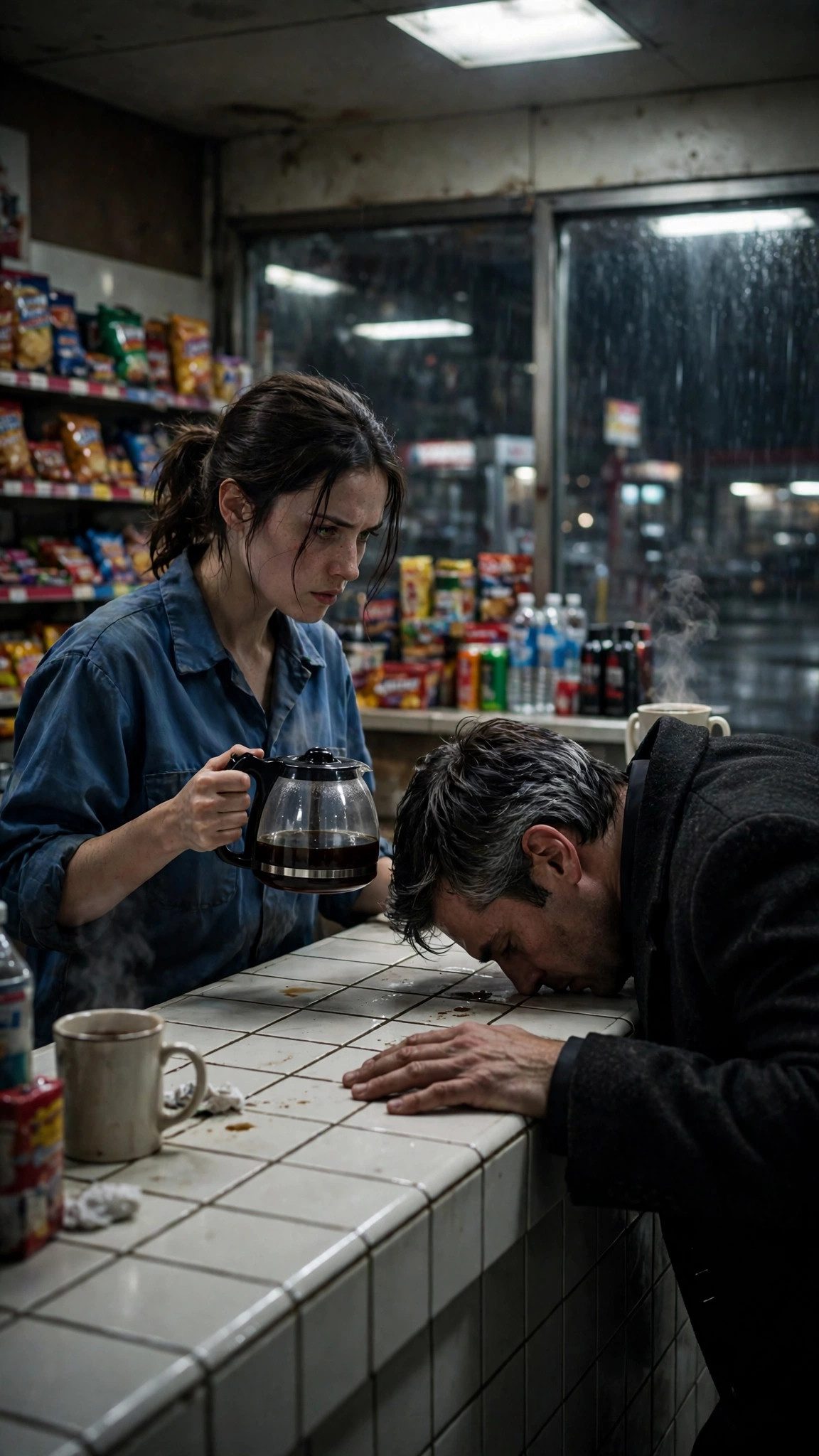
The trial took four months.
I testified on a Tuesday, in a courtroom with high windows and wooden benches, and I told the jury everything — the coffee pot, the gun, the messages, the word useful. Falco sat at the defense table in a gray suit, his hands folded, his face like a closed door, and he didn't look at me once. Rook testified too, and so did Dale, and so did Marco, who cried when the prosecutor asked him about the Tuesday afternoon he had walked through my station in a baseball cap.
The jury took six hours. Guilty, on every count. Falco got twenty-five years. Rook got fifteen. Marco got eight, with the possibility of parole in five. Dale got six, and when they led him out of the courtroom, he looked at me, and I saw something in his eyes that I hadn't expected.
Shame. Not fear. Shame.
I didn't forgive him. I didn't have to. But I understood him a little better than I had before — a small man, given a small amount of power, who had sold the only thing he had that was worth anything, and discovered too late that it wasn't enough.
After the trial, I went back to work. Not at the gas station — the station had closed by then, and the sign had come down, and the lot was empty, and the coffee brewer was gone. I went to work on Boon's.
It took three months to build. The old diner on the corner had been closed for two years, and it needed everything — new floors, new wiring, new pipes, a new counter, a new espresso machine that cost more than my car. Carmine's men did the work. Tony hung the sign. Sal painted the walls. Earl brought a truckload of lumber and refused to let me pay him for it. Marcus installed the shelves and told me the story of the night he hit the floor so fast he thought he'd broken his nose, and he laughed, and I laughed, and for the first time in a long time, the story felt like something that had happened to someone else.
My father came to the opening. He sat in a chair by the window, wrapped in his blanket, his breathing thin but steady, and he watched the door, and he smiled when people came in. He didn't say much. He didn't need to. His eyes said it for him.
"Your mother would have loved this," he told me, when the crowd had thinned and the afternoon light was coming through the window. "She always said you were meant for more than a gas station counter."
"I know, Dad," I said, and I put my hand over his, and his hand was warm, and it didn't shake as much as it used to.
The opening was a success. The coffee sold out by noon. The local paper ran a photograph of me behind the counter, and the headline said, "Local Woman Opens Coffee Shop After Daring Rescue," and I laughed when I read it, because it made it sound like I had planned the whole thing.
The first week of Boon's was the hardest week of my life, and the best.
I woke up at four every morning, the way Carmine's mother had woken up to knead her dough, and I ground the beans, and I wiped the counter, and I opened the door at six, and the regulars came in — the night nurse Priya, who had followed me from the gas station and now ordered tea at my counter; Earl, who stopped by on his runs and told the other truckers that my coffee was the best on the highway; Mrs. Alvarez from the pharmacy, who brought me a plant for the window and told me to water it twice a week.
I named a drink after my father. "The Sheriff's Black," I wrote on the chalkboard menu, in careful letters. "Strong. No sugar. No apologies." It became the most popular thing on the menu. Truckers ordered it. Nurses ordered it. A police officer ordered it one morning and laughed, and said his captain would love it, and came back the next day with three more officers.
By the end of the first month, Boon's had regulars. There was the night nurse Priya, who came in before her shift and ordered tea and told me about the hospital. There was a police officer named Daniels, who ordered the Sheriff's Black and told me his captain had framed the menu on the wall of the station. There was a food blogger from the city, a young woman with a camera, who wrote that our coffee was "the best on this side of the Hudson, poured by a woman with a story worth hearing," and after that, the line stretched out the door on Saturday mornings.
My father came every day. He sat by the window in his chair, and he watched the street, and he greeted the regulars by name, and he told them stories about his years as sheriff, and they listened, because he told them well. His breathing was easier. The new medicine was working. The doctors said his numbers were better than they had been in years, and I thought about the letter that had said "Paid in full," and I thought about the man who had paid it, and I thought about how a life can change in a single night, if you are brave enough to let it.
I named the espresso machine after my mother. I wrote her name on a little brass plate — "Rose" — and I screwed it onto the side, and every morning when I turned it on, I thought of her, and of the diner where she had worked, and of the three coffee pots she had broken in one week. The machine hissed and steamed, and the smell of fresh coffee filled the shop, and it felt like she was there, in a way, watching over the counter.
Carmine came every morning at dawn, before the shop opened, and he sat on the same stool, and he ordered black coffee, and we talked. He told me about his mother, and the bakery, and the city when he was a boy. I told him about my father, and the sheriff's star, and the range. We talked about the trial, and the family, and the future, and the things we were afraid of, and the things we hoped for, and slowly, day by day, the talking became the best part of my morning.
Friday came, and seven o'clock, and Carmine picked me up in his sedan, and Tony drove, and we went to a restaurant with tablecloths and candles, and Carmine ordered for both of us, and he told me about the first time he had ever been to a restaurant like that — he had been nineteen, and he had worn a borrowed suit, and he had been so nervous he had knocked over a glass of water, and the waiter had pretended not to notice. I told him about the first time I had ever been to a restaurant like that — I had been sixteen, and my father had taken me for my birthday, and he had worn his best shirt, and he had told the waiter it was my birthday, and the waiter had brought me a slice of cake with a candle in it, and my father had sung, off-key, and I had been embarrassed, and I had loved it.
We went to dinner again the next week. And the week after that. And then it was winter, and the shop had a Christmas tree in the window, and the regulars brought ornaments, and my father sat by the window in his chair, and he watched the snow fall on the street outside, and he smiled, and his breathing was easier, and the doctors said the new medicine was working, and I thought about the hospital letter that had said "Paid in full," and I thought about the man who had paid it, and I thought about the life I was building, one cup at a time.
On Christmas Eve, Carmine came to the shop after closing, and he stood by the counter, and he looked at the tree, and he looked at the chalkboard menu, and he looked at me, and he said, "Gemma, I have something to ask you."
"What is it?" I said.
He took a breath. "I spent twenty-two years building a life I didn't want, for reasons that made sense when I was nineteen and don't make sense anymore. And then, one night, in a gas station at three-fourteen in the morning, a woman I had never met poured me a cup of coffee and threw a pot of scalding coffee at a man who was trying to kill me, and I realized that I had been waiting my whole life for someone who would do that. Not because she owed me anything. But because it was the right thing to do."
He reached into his coat, and he took out a small box, and he opened it, and inside was a ring — simple, gold, with a single stone that caught the light from the Christmas tree.
"I'm not asking you tonight," he said. "I'm asking you to think about it. And when you're ready — whenever that is — I'll be here. Every morning. Black coffee. Just the way I like it."
I looked at the ring. I looked at him. I looked at my father, asleep in his chair by the window, and the tree, and the shop, and the life I had built out of small, ordinary things.
"Yes," I said.
He stared at me. "Yes?"
"Yes," I said, and I laughed, and he laughed, and he took the ring out of the box, and he put it on my finger, and it fit, and outside the window the snow fell on the street, and the world was quiet, and the coffee was good, and the moment — the moment my father had told me about, the moment that came to me in a gas station at three-fourteen in the morning — never really left.
It just changed. It became a life. It became this life. And I wouldn't trade it for anything in the world.
I hadn't planned anything. I had just poured a cup of coffee, and the moment had come to me, and I had taken it.
Carmine came at dawn on the second day, before the shop opened, before the sun was fully up. He stood outside the door in his dark wool coat, and he waited, and I unlocked the door, and I let him in, and he walked to the counter, and he sat down on one of the stools, and he looked around at the clean walls and the new espresso machine and the little table by the window, and he nodded, once, like a man approving of something he had helped build.
"Black coffee, please," he said.
I reached for a cup. My hands were steady. I poured, and I set it down in front of him, and he lifted it to his lips, and he closed his eyes, and he took a slow sip.
"Good coffee," he said. "The best I've had in years."
"Thank you," I said.
"No," he said. "Thank you. You kept your end of the deal. The first cup was mine."
"And the second?" I asked.
He set the cup down, gently, like it mattered. "The second cup," he said, "is for the man who would like to take you to dinner. Properly this time. No guns. No hitmen. No gas station at three in the morning. Just dinner. At a restaurant with tablecloths. And if you say no, I'll understand, and I'll still come back for coffee every morning, and nothing will change."
I looked at him. I looked at the man who had walked into my gas station in a dark wool coat and ordered black coffee, and who had looked at me across the counter while a gun was pressed to the back of his head, and who had trusted me with his life, and who had paid my father's bills, and who had bought me a coffee shop, and who was now sitting on a stool in my shop, asking me to dinner like a man who had never asked anyone for anything in his life.
"Yes," I said. "I'd like that."
He smiled. Not the sharp smile. Not the cold smile. A real smile, warm and unguarded, the smile of a man who has just been given something he didn't expect.
"Good," he said. "Friday. Seven o'clock. I'll pick you up."
"Friday," I agreed. "Seven o'clock."
I thought about the card in my pocket, and the phone number written in black ink, and the man who had given it to me, and I thought about the night he had walked into my station and ordered black coffee, and how none of us — not me, not him, not the men on the floor — had known how that night would end. We had all just been people, standing in a room, making choices. And the choices had made all the difference.
He finished his coffee, and he stood up, and he put a few bills on the counter, neatly, like he was setting a table, and he walked to the door, and he stopped, and he turned back.
"Gemma," he said.
"Yes?"
"One last cup?" he said, and he smiled, and I knew he was joking, and I knew he was remembering the night in the gas station, and the gunman, and the words that had started everything.
I picked up the pot, and I poured another cup, and I set it down in front of him, and I smiled back.
"No," I said. "Not the last cup. The first of many."
He lifted the cup, and he drank, and outside the window the sun came up over the city, and the street filled with people, and the smell of fresh coffee drifted out the door and down the sidewalk, and my father sat by the window in his chair, and he watched it all, and he smiled.
My name is Gemma Boon. I'm twenty-eight years old, and I own a coffee shop on a corner in the city, and I pour coffee for people who say thank you, and every morning, before the sun is fully up, a tall man in a dark wool coat walks through my door and orders black coffee, and I pour it, and he drinks it, and the world is quiet, and the coffee is good, and the moment — the moment my father told me about, the moment that came to me in a gas station at three-fourteen in the morning — never really left.
It just changed. It became a life.
The End.
THE END