I set the table for two at seven o'clock.
Good china. Linen napkins. The wine he liked — the Barolo from the cellar, the one Mrs. Alvarez said he saved for occasions that mattered. Risotto, stirred slowly, the way Mrs. Alvarez had taught me, with the broth added one ladle at a time so the rice would drink it in and grow rich and golden. No roses. Roses would have made my hope look desperate.
Mrs. Alvarez watched me from the kitchen doorway, her arms folded, her face unreadable.
"You look beautiful, Mrs. Russo," she said at last.
"Thank you," I said. "Do you think he'll come home?"
She was quiet for a moment. "He always comes home," she said. "The question is whether he stays."
I wore my best dress. Not red — not yet. A soft gray-blue dress, the color of the lake on a cloudy morning, the kind of dress Dominic preferred. Respectable. Quiet. The kind of dress that didn't draw the eye.
I lit the lamps low, the way he liked them. I put on music — something soft, piano, the kind of music that fills a room without demanding anything. And then I sat down at the table, and I waited.
At eight o'clock, the front door opened.
Dominic came in an hour late, the way he always did. He loosened his tie the moment he stepped through the door, and then he stopped, and he looked at the table. The two plates. The two glasses. The two chairs pulled close together. The candlelight — no, not candles, he hated candles — the low lamplight, warm on the china.
He understood immediately. I saw it in his face — the flicker of something, surprise or guilt or fear, gone before I could name it.
"I have work," he said.
Then he turned toward the stairs.
I followed him. Maybe a woman with more pride would have eaten alone and pretended the ache in her chest was nothing. I was tired of pretending. I was tired of eight months of careful politeness, of sleeping alone in the master suite while my husband slept in his study, of learning his habits the way a stranger learns a house.
I opened his study door without knocking.
"I said I have work," he told me.
"And I heard you. But your wife set a table for you, so your papers can wait two minutes."
His eyes sharpened. "Go to bed, Claire."
"No." My voice shook, but I held his gaze. "Tell me why you married me."
"You know why."
"Because of my father's debt?"
His silence answered.
Then I asked the question I had avoided for eight months. "Did you ever want me at all?"
Dominic looked at me for a long time. The city lights moved across his face like slow water. His jaw tightened once, the way it did when he was deciding something, and then it was gone, and there was nothing left in his expression at all.
"No."
Something inside me finally snapped. It was not loud. It was not dramatic. It was the quiet sound of the last thread giving way.
"I don't want you as my wife, Claire," he added. "I never did."
I nodded once and walked away.
I walked upstairs, past the table I had set for two, past the risotto going cold on the plates, past the wine I had poured and would never drink. I walked into the master suite and closed the door, and I stood there in the dark for a long moment, listening to my own breathing, feeling the last eight months settle over me like dust.
And then I opened the closet.
Behind all the gray dresses and respectable coats he preferred, behind the quiet colors and the careful fabrics, I found the red dress. The red satin dress Dominic had once told me was too dangerous to wear. The dress I had worn to the first gala, the dress Adrian Cross had watched across a ballroom, the dress my husband had told me to burn.
I had kept it anyway. I had kept it because it was the only thing in that house that felt like mine.
I put it on.
The satin slid over my shoulders like water. The back dipped low, bare skin to the small of my back, and the skirt moved when I moved, red as a warning, red as a fire. I looked at myself in the mirror and saw a woman I had not seen in eight months — a woman with color in her cheeks and fire in her eyes, a woman who had stopped begging.
I took my mother's wedding ring from the drawer where I kept it — the ring my father had tried to sell, the ring I had taken from his hand — and I slipped it onto my right hand, next to the ring Dominic had given me. Two rings. One from a mother who had loved me. One from a husband who had not.
Then I called my best friend.
"Tessa, where is Adrian Cross throwing his party tonight?"
She went silent. "Your husband's worst enemy?"
"Yes."
"Claire." Her voice dropped to a whisper. "Tell me you're not serious. Tell me you're not going to walk into Adrian Cross's house in that dress."
"Tell me where it is, Tessa."
"Lincoln Park. His mansion on Astor Street. The big one with the white columns. Claire, whatever you're thinking — don't. Adrian Cross is not a man you walk up to in a red dress. He's a man who collects beautiful things, and he doesn't give them back."
"That's exactly what I'm going to do," I said, and hung up.
The drive to Lincoln Park took twenty minutes. Twenty minutes of red satin and cold air and my heart beating too fast in my chest. I parked on the street, a block away from the mansion, and I sat there for a moment with my hands on the steering wheel, looking at the white columns and the lights in the windows and the black cars lined up along the curb.
I could have turned around. I could have gone home. I could have taken off the dress and eaten the cold risotto alone and gone to bed and woken up the next morning as the same quiet wife in the same gray dresses.
I didn't.
I got out of the car. I walked up the steps. I handed my keys to the valet, and I walked through the front doors of Adrian Cross's mansion in red.
Every conversation stopped.
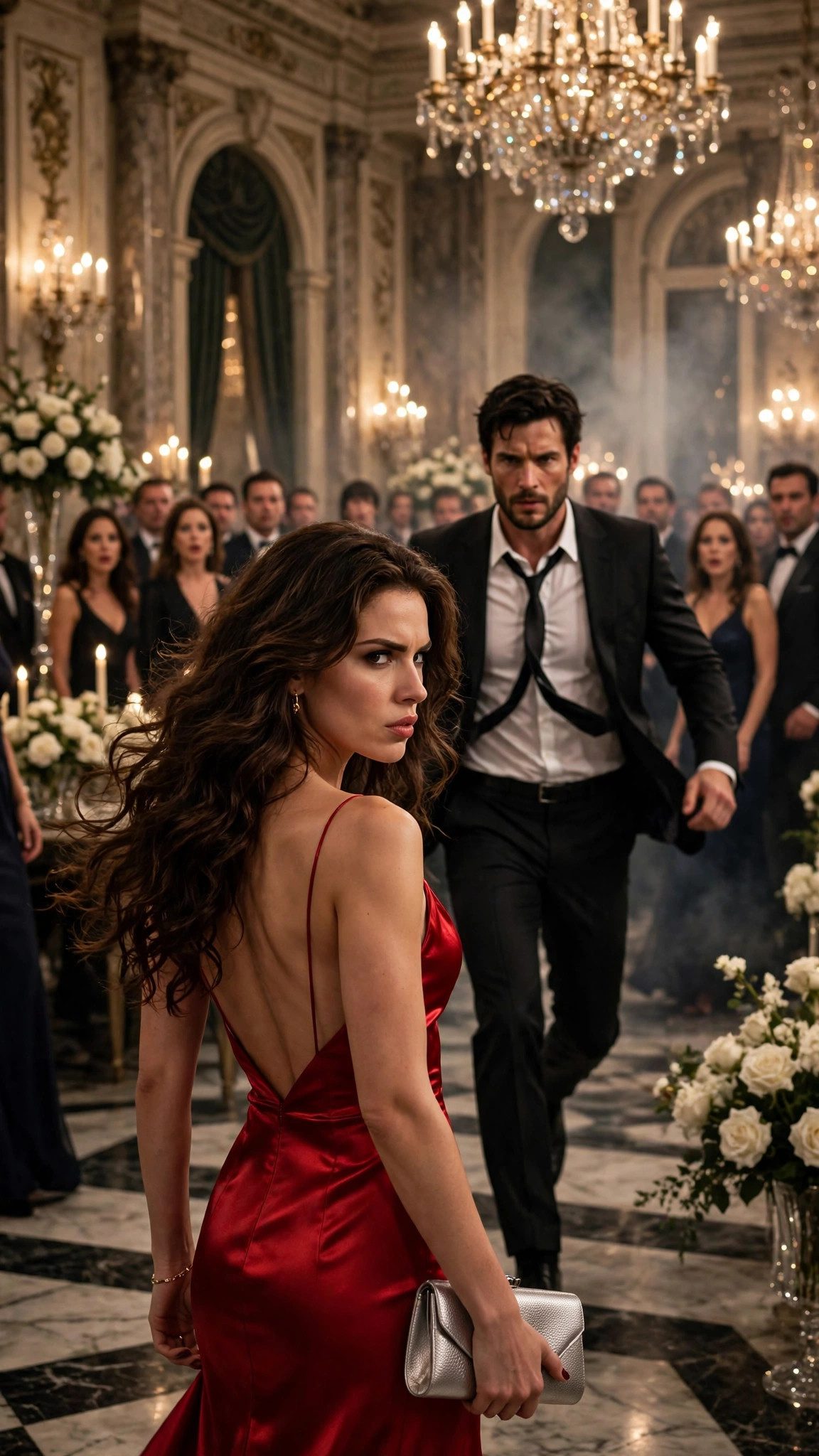
The ballroom was all crystal chandeliers and white roses and marble floors, and two hundred guests in black and white turned to look at me — the woman in red, alone, walking through the middle of the room like she owned it. The string quartet faltered. A waiter froze with a tray of champagne halfway to his shoulder. A woman in pearls put her hand to her mouth.
And across the ballroom, standing by the bar with a champagne glass in his hand, Adrian Cross slowly raised his glass toward me, a smile spreading across his face like a man who had just been handed a gift.
"Mrs. Russo," he said, loud enough for the whole room to hear. "What an honor. I was hoping you'd come."
He crossed the room to me, smooth and unhurried, and when he reached me he took my hand — not to kiss it, but to hold it, just for a moment, his fingers warm and certain around mine.
"You look extraordinary," he said quietly. "Red suits you. It always did. Your husband was a fool to hide you in gray."
"I'm not here for compliments," I said.
"I know why you're here," Adrian said. "You're here because your husband told you tonight that he never wanted you. You're here because you finally understand what I've known for months — that Dominic Russo is a man who takes what he wants and discards what he doesn't. And you're here because you want to know what I told you about Noah."
My blood went cold. "Tell me."
Adrian leaned in, his voice dropping to a murmur meant only for me. "Your brother owes me forty thousand dollars. He borrowed it to fix your father's car, and then he borrowed more, and now the debt is mine to collect. But I am not an unreasonable man, Mrs. Russo. I don't want your brother's money. I want something else. Your husband keeps his shipping schedules in his study — the routes, the manifests, the names of the men who move his cargo. Bring me those schedules, and Noah's debt disappears. Tonight. All of it."
"You're asking me to betray my husband."
"I'm asking you to save your brother," Adrian said. "The same way your husband saved your father. Debts and marriages, Mrs. Russo. In our world, they are the same thing. And your husband — " His smile sharpened. "Your husband has known about Noah for weeks. He has known since the first package your brother carried. He said nothing to you. Ask yourself why."
"Because he was protecting me," I said, but my voice sounded uncertain even to my own ears.
"Was he?" Adrian said softly. "Or was he protecting himself? A wife who knows too much is a wife who can be used, Mrs. Russo. Dominic knows that. He has always known that. That is why he keeps you in gray dresses and locked rooms. That is why he told you to burn this dress. Not because it was dangerous, Claire. Because it made you visible. And a visible wife is a weapon in the wrong hands."
He raised his glass again, and the room seemed to lean in, two hundred guests holding their breath, waiting to see what the woman in red would do.
And then the doors behind us slammed open.
Every head turned. The air in the room changed — the way air changes before a storm, electric and heavy and suddenly hard to breathe. Dominic Russo stood in the doorway, his black suit dark against the light of the hall, his tie loosened, his eyes fixed on me across a hundred staring guests.
He crossed the ballroom in long, steady strides, and the crowd parted for him the way water parts for a blade. He stopped in front of me. Up close, his face was a wall of cold control, but his eyes — his eyes were burning.
"Say it here, Dominic," I said, and my voice did not shake at all. "Say it in front of everyone."
"I don't want you as my wife, Claire," he said, loud enough for the whole room to hear. "I never did."
The room held its breath.
Adrian Cross stepped forward, his champagne glass still raised, his smile never wavering. "Careful, Dominic," he said smoothly. "A man should be sure before he throws away something beautiful."
Dominic did not look at him. He looked only at me. And then, in one fast movement, his hand closed around my wrist — hard, possessive, unmistakable. The room gasped. A woman near the bar dropped her glass, and it shattered on the marble floor, the sound ringing through the silence like a bell.
"Let go," I said.
Dominic did not let go. He pulled me closer, his face inches from mine, his voice low and rough, meant only for me.
"What did Adrian tell you about Noah?" he asked.
My blood went cold. Noah. My little brother. The boy I had raised after our mother died, the boy I had protected from our father's debts and his own bad choices for as long as I could remember.
Adrian's smile widened. "She already knows, Dominic," he said softly. "I told her everything."
The string quartet had gone completely silent. Two hundred guests stood frozen around us, champagne in their hands, watching the wife in the red dress, the husband who had rejected her, and the enemy who had been waiting all night for exactly this moment.
Dominic's grip on my wrist tightened. His eyes searched my face, and I saw it then — the fear. Not coldness. Not anger. Fear. The fear of a man who has finally found something he cannot afford to lose, and is watching it slip through his fingers in front of two hundred witnesses.
"Claire," he said, and his voice was barely a whisper now. "Whatever he told you — whatever he offered you — don't believe him. Please. I'm begging you."
It was the first time Dominic Russo had ever begged for anything.
And I realized, standing there in the dress he had once told me to burn, with his hand around my wrist and Adrian Cross smiling behind him, that I had walked into something far bigger than a rejected wife's revenge.
I had walked into a war. And my little brother was standing in the middle of it.
The drive to Lincoln Park took twenty minutes, and every one of those minutes felt like an hour. I drove past the lake, dark and flat under the night sky, past the lit windows of restaurants where people were laughing over dinner, past the whole glittering city that had never once noticed a girl like me — a girl from a small house with a gambler father and a little brother she had raised alone. I thought about Noah, sitting somewhere in the city with a phone in his pocket and a debt on his shoulders, waiting for his sister to save him the way she always had. I thought about Dominic, sitting in his study with his papers and his whiskey, believing he had pushed me away far enough to keep me safe. I thought about my mother, and the promise I had made her on a cold February day — take care of your brother, don't let them take him — and I pressed my foot down harder on the gas. The red dress was not a costume. It was a declaration. And by the time I parked on Astor Street and walked up the steps of Adrian Cross's mansion, I was no longer afraid. I was done being afraid. I had been afraid for eight months, and fear had gotten me nothing but silence.