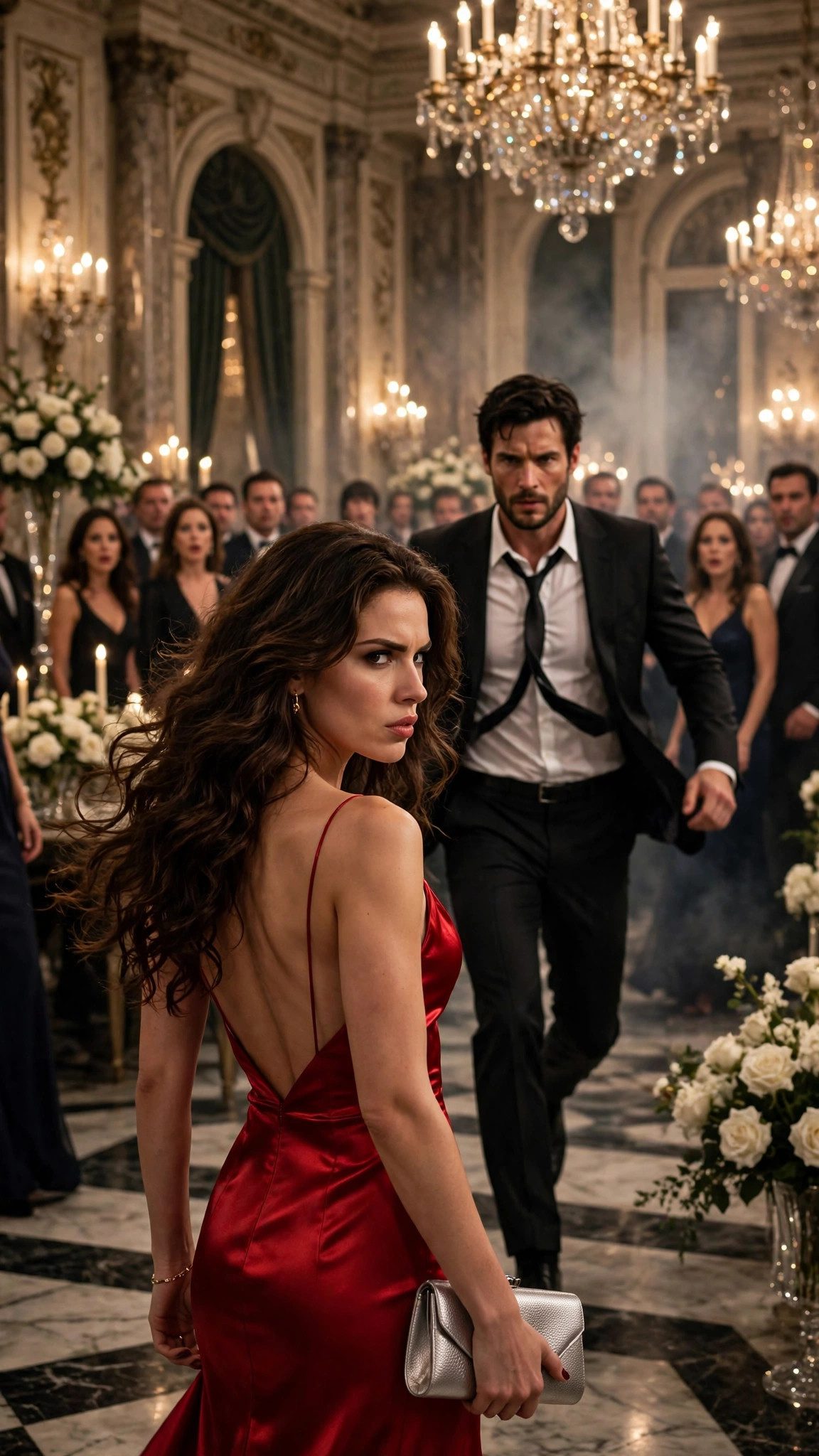
The ballroom was so silent I could hear the ice settling in someone's glass.
Dominic's hand was still around my wrist. His eyes were locked on mine, and behind the fear I saw something else — something I had never seen in his face before, not in eight months of marriage. Resolve. The look of a man who has finally stopped running from a decision.
"Let go of her," Adrian said. His voice was still smooth, still smiling, but there was an edge underneath it now, like a blade under silk. "You're making a scene, Dominic. In front of all your friends."
"She is my wife," Dominic said.
The words landed in the room like a dropped glass. Two hundred guests heard them. I heard them. And for the first time in eight months, I believed them.
"Your wife," Adrian repeated, amused. "The wife you told, not ten minutes ago, that you never wanted. The wife you keep in gray dresses and locked rooms. Forgive me, Dominic, but that doesn't sound like a man claiming his wife. That sounds like a man who has just realized he threw away the only weapon his enemy can't buy."
Dominic released my wrist. Slowly. Deliberately. He stepped back half a step, and then he turned to face Adrian Cross, and the whole room seemed to hold its breath — because whatever was about to happen, everyone in that ballroom knew it would be the thing they talked about for years.
"You told my wife that her brother owes you forty thousand dollars," Dominic said. His voice was calm. Level. The voice of a man closing a business deal. "You told her that if she brought you my shipping schedules, the debt would disappear."
Adrian's smile did not waver. "I offered the lady a choice. That's all."
"Here is my answer to your offer," Dominic said. He reached into his jacket and pulled out a folded piece of paper. He held it up, high enough for the nearest guests to see the bank's letterhead, the numbers, the signature at the bottom. "This is a cashier's check for forty thousand dollars, made out to you, Adrian. It pays Noah Hale's debt in full. As of tonight, the boy owes you nothing."
A murmur rippled through the room. Adrian's eyes narrowed, just slightly — the first crack in his smile all night.
"And this," Dominic continued, reaching into his jacket again and pulling out a small black device, no bigger than a matchbox, "is a recording. Of your man telling a seventeen-year-old boy that if he didn't carry your packages, you'd send men to his father's house. Of your man telling a minor that his sister would pay for his mistakes. I have the original. My lawyer has a copy. And as of an hour ago, so does a detective I happen to know at the Chicago Police Department."
The smile left Adrian's face entirely.
"You've been using a child to get to me," Dominic said, and his voice dropped, low and cold and absolutely final. "You coerced a minor. You threatened his family. You tried to turn my wife into a spy. That ends tonight."
Adrian looked around the ballroom — at the two hundred guests watching, at the phones in people's hands, at the waiters standing frozen with their trays — and I saw him calculate. He was a patient man. He had been waiting for months. But he was also a smart man, and a smart man knows when the room has turned against him.
"You're bluffing," he said, but his voice was tight now. "That recording wouldn't hold up in court."
"It doesn't need to," Dominic said. "It only needs to hold up in this room. And in the rooms where your business partners drink. And in the rooms where the families who do business with you decide whether you're a man of honor or a man who threatens children."
Adrian was quiet for a long moment. Then he laughed — a short, sharp sound with no humor in it at all.
"You've changed, Dominic," he said. "The old Dominic would have shot me in this ballroom and apologized to the host on his way out. This Dominic — " He looked at me, and his eyes were cold and bright. "This Dominic has a weakness now. A wife in a red dress. A brother-in-law in debt. Enjoy them, Dominic. Weaknesses have a way of becoming funerals."
He turned to me. "Mrs. Russo. It was a pleasure. The dress suits you. I hope you keep it — you'll need something to wear to the next war."
And then he walked out of his own ballroom, his champagne glass still in his hand, his men falling in behind him like shadows.
The room erupted. Guests surged forward, talking all at once, phones out, glasses raised, everyone wanting to be near the drama, everyone wanting to tell someone what they had just seen. Dominic ignored them all. He took my arm — gently this time, his hand warm and steady around my elbow — and he led me through the crowd, out the front doors, and into the cold night air.
His car was waiting at the curb. The driver opened the door. Dominic helped me in, and then he got in beside me, and for a long moment neither of us said anything. The city moved past the windows, lights and shadows, and my heart was still beating too fast, and my wrist still tingled where his hand had been.
"Is Noah safe?" I asked at last.
"Yes," Dominic said. "My men picked him up an hour ago. He's at the house in the suburbs — a safe house. Not your father's house. A place Adrian doesn't know about. He'll stay there until this is over."
"Over?" I said. "Is it over?"
Dominic was quiet for a moment. "Tonight, yes. Adrian won't move against a boy in front of two hundred witnesses. But this isn't over, Claire. Adrian has been trying to destroy me for five years. Tonight I embarrassed him in his own house. He won't forget that."
"Then why did you do it?" I asked. "Why did you come? Why did you pay the debt? Why did you bring the recording?"
He turned to look at me then, really look at me, and in the dim light of the car I saw his face without the wall for the first time — tired, and afraid, and honest.
"Because you wore the red dress," he said quietly. "And I knew that if I didn't come, Adrian would take you the way he tried to take Noah. And I would rather go to war with every family in Chicago than let that happen."
I stared at him. "You told me you never wanted me."
"I lied," he said.
The words hung in the air between us, simple and devastating.
"I've been lying to you since the day I met you, Claire. Not about the important things — your father is safe, your brother is safe, no one in my house will ever hurt you. That was all true. But the rest of it — the coldness, the distance, the gray dresses, the study door closed every night — all of that was a lie. And I need you to know why."
He took a breath. "My father bought your father's debt because he wanted leverage. He wanted a family he could control, a girl he could marry off to one of his captains to seal an alliance. He showed me your file — your photograph, your history, the debt, your brother — and he said, 'Take the girl. She's pretty enough. It'll keep the Hales quiet.'"
"And you did," I said.
"I did," Dominic said. "But not for the reason he thought. I took one look at your file and I saw a girl who had raised her little brother alone, who had worked two jobs, who had gone to the police to protect him. And I thought — if I don't take this arrangement, my father will give her to someone worse. So I took it. I married you to keep you out of my father's hands. And then my father died, six months ago, and the arrangement became mine — and I kept it, because by then I knew that if I let you go, the men who used to hold your father's debt would come back for you. And for Noah."
"And the distance?" I asked. "The study? The silence?"
"Because in my world, Claire, a wife is a target. My enemies can't reach me. But they can reach the people I love. My father taught me that the only way to protect what you love is to pretend you don't love it. So I pretended. I kept you in gray dresses so no one would look at you twice. I kept my distance so no one would know you mattered to me. I told you to burn the red dress because the night you wore it to that gala, Adrian Cross asked three different people who you were. Three. In one night. And I knew, the moment he asked, that he had marked you."
"So you pushed me away to protect me," I said.
"I pushed you away because I was terrified," Dominic said, and his voice cracked — the first crack I had ever heard in it. "I was terrified that if I let myself love you, I would lose you the way my father lost my mother. She died when I was twelve, Claire. A car bomb, meant for my father. She was in the wrong place because she loved him and she wanted to be near him. And my father — my father never forgave himself. He turned to stone that day. And I swore I would never do that to anyone. I swore I would never love anyone enough to get them killed."
He looked down at his hands. "And then I met you. And I broke that promise in the first week. And I have been terrified every day since."
I sat there in the dark car, listening to the most powerful man in Chicago tell me that he had been afraid of me — afraid of loving me, afraid of losing me, afraid of the red dress and the gray dresses and everything in between — and I felt the last eight months rearrange themselves in my mind, like a picture turning right-side up.
The coldness had been fear. The distance had been protection. The gray dresses had been armor. And the man who had told me he never wanted me had just walked into his worst enemy's ballroom, in front of two hundred people, and paid forty thousand dollars and risked a war to save my brother.
"Why did you tell me you never wanted me?" I asked. "Tonight. In the study. Why did you say that?"
"Because Adrian's men were watching the house," Dominic said. "Because I knew he was going to make his move tonight, and I knew the only way to keep you out of it was to make you angry enough to stay away from me. I thought — if she hates me, she won't come near me. If she hates me, Adrian can't use her against me. I thought I was protecting you."
"You were protecting yourself," I said.
"Yes," he said. "I was. I was protecting myself from the one thing I was afraid of most — that you would look at me the way you're looking at me right now, and I wouldn't know what to do about it."
The car pulled up in front of the Lake Forest mansion. The driver opened the door. Dominic got out first, and then he held out his hand to me — not to pull me, not to possess me, but to help me, the way a husband helps his wife out of a car.
I took his hand.
We walked into the house together, past the table I had set for two, past the cold risotto and the unopened wine. Mrs. Alvarez was waiting in the hallway, her face worried, and when she saw us — my red dress, his loosened tie, our hands still joined — she put her hand to her heart and said, "Thank God."
"Is Noah all right?" I asked her.
"He called an hour ago," she said. "He's safe. He's asking for you. He says to tell you he's sorry, and that he loves you, and that he'll never carry another package for anyone."
I nodded, and I felt tears sting my eyes for the first time all night — not tears of sadness, but tears of relief, of eight months of silence finally breaking open.
Dominic led me upstairs, to the master suite, and he stopped in the doorway, the way he had stopped the night he told me to burn the dress. But this time he didn't tell me anything. He just looked at me, in the red dress, in the lamplight, and he said, "You were right. About everything. The table. The two minutes. All of it. I'm sorry, Claire. I'm sorry for eight months."
And then he did something he had never done before.
He asked me a question.
"Will you let me try again?" he said. "Not as an arrangement. As a husband. Will you let me earn you?"
I looked at him — this tall, dark, cold man who had just gone to war for my brother, who had just told me the truth for the first time in eight months — and I thought about the red dress, and the gray dresses, and the table for two, and the boy I had promised to protect.
"Yes," I said. "But you're going to have to start by eating the risotto. It's cold, and I'm not making it twice."
When we reached the mansion, Mrs. Alvarez was waiting in the hallway with a blanket and a pot of tea, as if she had known exactly when we would come home and exactly what we would need. She took one look at my red dress and Dominic's loosened tie and our hands still joined, and she put her hand to her heart and closed her eyes for a moment, the way a woman does when a prayer is answered.
"I made tea," she said, as if that explained everything. "And there is soup, if you're hungry. You both look like you could use soup."
"We could use soup," Dominic said, and his voice was softer than I had ever heard it. "Thank you, Mrs. Alvarez."
She nodded, and as she turned back toward the kitchen, she said over her shoulder, "I told you, Mrs. Russo. I told you he was a good man. I told you he was just not a warm one. But look at him now." She smiled, a small fierce smile. "Look at him now."