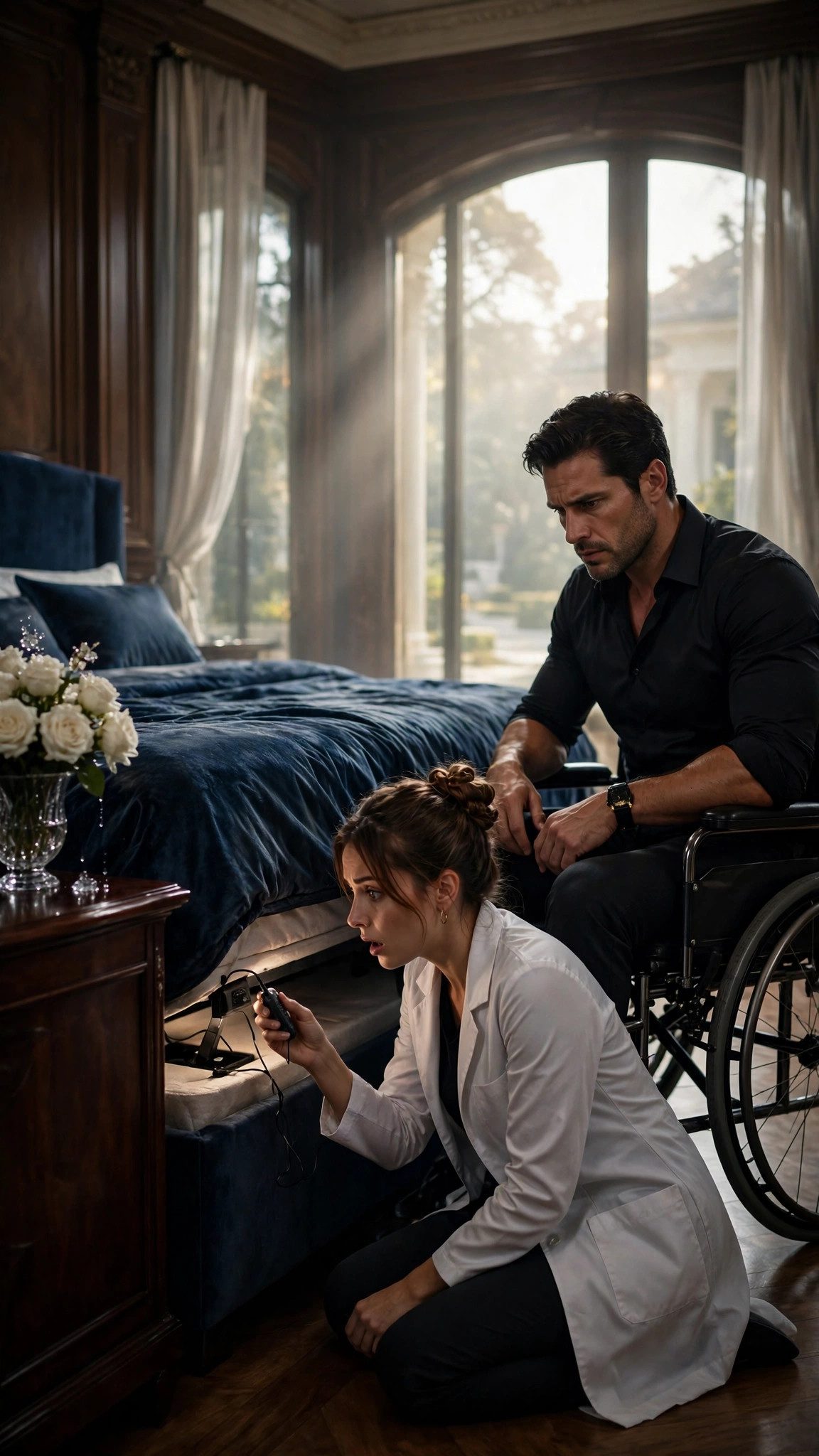
Three months after the gala, Vincent Corvino stood up.
It was not a miracle. It was not sudden. It was slow, and painful, and frustrating, and it happened one small step at a time, the way all important things happen.
It started with the tingle in his left foot. Then it spread to his right foot. Then to his ankles. Then, one morning, to his calves. The doctors were cautious. They said the nerve had been damaged, not severed, and that the swelling had finally gone down enough for signals to get through. They said it might continue. They said it might stop. They said no one could promise anything.
Vincent did not need promises. He needed work.
He worked harder than he had ever worked at anything in his life. He did physical therapy for four hours a day, every day, with Tessa standing over him, telling him to push harder, telling him not to quit, telling him that a man in a chair who decides what happens next does not give up.
Tessa was different now. She still did not soften her voice. She still said what she saw. But there was something new in her face when she looked at Vincent. It was respect. It was the look of a woman who had watched a man decide to live, and had decided to help him do it.
"You are the most stubborn patient I have ever had," she told him one afternoon, as he gripped the parallel bars and tried to shift his weight from one foot to the other. "Most people would have quit by now. Most people would have accepted the chair and moved on."
"I'm not most people," Vincent said, sweating, his arms shaking.
"No," Tessa said. "You're not. You're the man who chose patience over rage. You're the man who went to a widow's house and said he was sorry. You're the man who is going to walk again, because you have decided to walk again. And when you do, I want to be there to see it."
Lauren was there for every session. She sat in the corner of the therapy room, reading, watching, waiting. She brought white roses, still, every three days. But now she brought them because she loved him, not because she was afraid. And she spoke to him now. She spoke to him all the time. About the foundation. About the community center. About the scholarship fund. About Elena Marchetti's daughter, who had started nursing school and who sent Lauren a letter every week, thanking her.
"She writes beautiful letters," Lauren said one evening, as they sat on the porch of the mansion, watching the sun set over the lake. "She wants to work in a trauma ward. She wants to help people who have been hurt the way her father was hurt. She wants to make something good out of something terrible."
"She will," Vincent said. "She's strong. Like her mother."
Lauren looked at him.
"Are you strong?" she asked.
Vincent thought about it. He thought about the bullet. He thought about the chair. He thought about the listening device under the mattress, and the photograph, and the receipt, and the note that had told him to ask instead of accuse.
"I am learning to be," he said.
The community center opened in the spring, on the South Side, in a building that had once been a warehouse. It was named the Frank Marchetti Community Center. There was a job training program for dockworkers. There was a scholarship fund for their children. There was a garden in the back, full of tomatoes, just like the one at Elena Marchetti's house.
Elena came to the opening. She wore a gray dress, not black, and her hair was pulled back, and she stood beside Vincent as he cut the ribbon. The newspapers took photographs. The television cameras filmed it. And for the first time in six years, Elena Marchetti smiled in public.
"You did this," she said to Vincent, as they stood together in the new building, surrounded by children and workers and neighbors.
"We did this," Vincent said. "All of us. Together."
Adrian Voss was sentenced to fifteen years in prison. Silas Kane was sentenced to twenty. Marcus Hale, the coffee guy, was given probation and community service, and he spent it working at the community center, sweeping floors and planting tomatoes, trying to make up for what he had done.
Elena Marchetti was not charged. The prosecutor, after hearing Vincent's statement, decided that justice had already been served. She had lost her husband. She had almost lost her soul. That was punishment enough.
On the first anniversary of the shooting, Vincent and Lauren went back to the restaurant where it had happened. They sat at the same table, in the same seats, and they ordered the same dinner. Lauren wore a red silk dress. Not the same one from the motorcycle, all those years ago. A new one. But the same color. The same fire.
"I was sitting right here," Lauren said, "when I heard the shot. I ran outside, and you were on the pavement, and I thought you were dead. I thought I had lost you. And in that moment, I understood something I had never understood before. I understood that I loved you more than I loved anything in the world. More than my pride. More than my fear. More than my own life."
Vincent took her hand across the table.
"I was standing under the awning," he said, "checking my phone, thinking about work. I was thinking about a freight contract. I was thinking about money. And then the world went white, and I woke up in a hospital, and you were holding my hand, and I understood something too. I understood that the empire didn't matter. The money didn't matter. The power didn't matter. The only thing that mattered was you. And I almost lost you, not because of a bullet, but because I stopped asking you how you were doing."
Lauren smiled. It was the smile from the gala, all those years ago, the smile of a woman who was not afraid of anything.
"Ask me now," she said.
"How are you doing?" Vincent asked.
"I'm happy," Lauren said. "For the first time in a long time, I'm happy. Are you?"
Vincent thought about the chair, and the bars, and the long, slow road back to standing. He thought about Elena Marchetti, and the community center, and the scholarship fund. He thought about Tessa, and Cole Ramsey, and Daniel Hart, and all the people who had helped him find the truth.
"I'm happy," he said. "And I'm standing."
He was not standing at the table. Not yet. But he was standing in the way that mattered. He was standing up for the truth. He was standing up for his marriage. He was standing up for a widow he had never looked at, and for a dockworker he had never met, and for a future that was better than the past.
Three months later, on a warm evening in late summer, Vincent Corvino stood up for real.
It happened in the therapy room, with Tessa on one side and Lauren on the other, and the parallel bars in front of him. He gripped the bars. He took a breath. He shifted his weight. And he stood.
Not for long. Not steadily. His legs shook. His arms burned. Sweat ran down his face. But he stood, on his own two feet, for the first time in nine months.
Tessa cried. She had never cried in front of a patient before, and she did not apologize for it.
Lauren cried too. She put her arms around him, carefully, so as not to knock him over, and she whispered in his ear, "You did it. You did it."
Vincent laughed. It was the laugh from the gala, all those years ago, the laugh of a man who had finally met someone who was not afraid of him. Except this time, he was laughing at himself, at the chair, at the bullet, at the whole terrible, wonderful year.
"I did it," he said. "We did it."
That night, Vincent and Lauren went for a ride on the motorcycle. Not far. Just along the lakefront, the way they had done all those years ago. Vincent drove, slowly, carefully, with Lauren's arms around his waist and her cheek pressed against his back. The wind was warm. The engine was loud. The lights of the skyline blurred into gold.
And as they rode, Vincent thought about the thing beneath the mattress. The listening device. The photograph. The receipt. The note.
He thought about how a small black rectangle, hidden under a bed, had nearly destroyed his marriage. And how the truth, spoken out loud in a study on a quiet afternoon, had saved it.
He thought about Elena Marchetti, and Frank, and the fire, and the trial. He thought about Silas Kane, and Adrian Voss, and Marcus Hale. He thought about Cole Ramsey, and Daniel Hart, and Tessa Morgan, who had never softened her voice for anyone.
And he thought about Lauren, in her red silk dress, laughing at the city lights, holding on tight as the motorcycle carried them home.
Vincent Corvino had spent thirty-four years believing that respect was more valuable than money and fear was more reliable than either. His father had taught him that.
But Vincent had learned something his father never knew. He had learned that the truth was more valuable than respect, and that love was more reliable than fear.
And as the motorcycle rolled along the lakefront, with the city lights blurring into gold and Lauren's arms around his waist, Vincent Corvino finally understood what it meant to stand.
It did not mean standing on two feet. It meant standing up for the people you loved. It meant standing up for the truth, even when the truth was painful. It meant standing up for a future that was better than the past.
Vincent Corvino was standing. And he would never sit down again.
Six months later, on a warm evening in early autumn, Vincent and Lauren renewed their vows in the garden behind the mansion. It was a small ceremony, just family and a few old friends, with white roses everywhere and a string quartet playing softly in the corner.
Lauren wore white. Not the white of a bride, but the white of a woman starting over. Vincent wore a dark suit, and he stood beside her with the help of two braces and a cane, and he did not sit down once, not even when the minister told him he could.
"I take you again," Vincent said, holding Lauren's hands, "not because I have to, but because I choose to. I choose you. I choose us. I choose the truth. And I choose to spend the rest of my life proving that I am worthy of you."
Lauren cried. She had cried a lot that year, but these were happy tears, the kind that come when something broken has finally been mended.
"I take you again," she said, "because you are the man who chose patience over rage. Because you are the man who went to a widow's house and said he was sorry. Because you are the man who stood up, when everyone told you that you never would."
Tessa was there, standing at the back of the garden, watching with her arms folded. She had stayed with Vincent for nine months, longer than any nurse ever stays with a patient, and she had become something more than a nurse. She had become a friend. She had become family.
After the ceremony, she came up to Vincent and shook his hand, the way she had shaken it on her first day.
"You're not a patient anymore," she said. "You're a man who can stand. There's a difference. Men who can stand decide what happens next. And I think you've decided well."
"Where will you go?" Vincent asked.
"Back to the hospital," Tessa said. "There's a trauma ward that needs a nurse who doesn't soften her voice. There are patients who need someone to tell them the truth. I'll be fine. And you," she said, looking at him, "you'll be fine too. You don't need me anymore. You have Lauren. You have your legs. You have your life back."
She hugged him then, briefly and fiercely, and then she walked to her car and drove away, and Vincent watched her go, thinking about how a blunt, exhausted nurse with brown hair in a knot had changed his life by refusing to lie to him.
That night, at the Corvino Foundation's annual gala, Vincent danced with Lauren for the first time in a year. It was not a waltz. It was not graceful. His legs were still weak, and he leaned on her more than he wanted to admit. But they moved together, slowly, across the floor, while the orchestra played and five hundred people watched, and Lauren laughed, and Vincent laughed, and the chandeliers shone above them like stars.
Elena Marchetti was there too, sitting in the front row, wearing a gray dress, smiling. Her daughter Maria was beside her, in her nursing school uniform, holding her mother's hand. The community center was thriving. The scholarship fund had already sent three young people to college. The garden behind the center was full of tomatoes.
And as Vincent danced with his wife, in the grand ballroom of the Drake Hotel, with the city lights shining through the tall windows and the music playing softly, he thought about the thing beneath the mattress. The listening device. The photograph. The receipt. The note.
He thought about how a small black rectangle, hidden under a bed, had nearly destroyed everything he loved. And how the truth, spoken out loud in a study on a quiet afternoon, had saved it all.
He thought about his father, who had believed that respect was more valuable than money and fear was more reliable than either. And he thought about how wrong his father had been, and how right he had been, all at the same time. Respect was valuable. Fear was reliable. But neither of them could save a marriage. Neither of them could heal a bullet wound. Neither of them could bring a widow's husband back to life.
Only the truth could do that. Only the truth, and love, and the courage to ask instead of accuse.
Vincent Corvino was standing. And he would never sit down again.
The End.
THE END