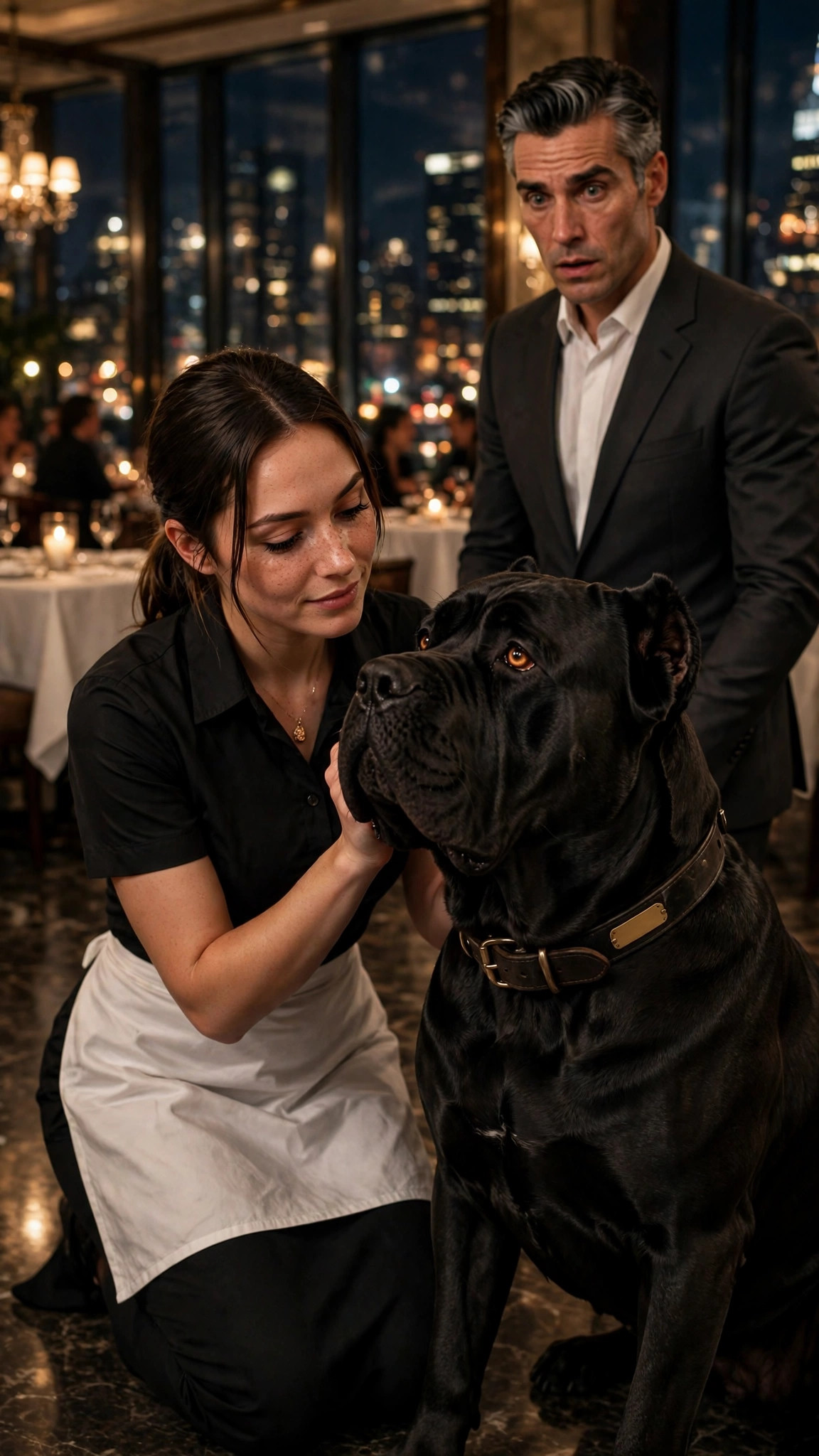
The vet's name was Dr. Patel, and she had kind eyes and a voice that sounded like she had delivered bad news many times before. She sat with us in her small office, Orion lying on the floor between Dante and me, his huge head on his paws, and she told us that Orion was nine years old, which for a dog his size was already a long life, and that his kidneys were failing, and that his hips were worse than we thought, and that he probably had six months. Maybe a year, if we were lucky and careful.
"He's not in pain right now," Dr. Patel said gently. "But he will be, eventually. When that time comes, you'll know. Dogs tell you. They stop eating. They stop getting up. They look at you a certain way, and you understand."
Dante didn't say anything. He stared at the floor, and his hands were clenched into fists on his knees, and I could see the muscle jumping in his jaw.
Orion lifted his head and looked at Dante, and then he looked at me, and he heaved a great sigh and put his head back down, as though to say, it's all right, I've had a good life, don't make a fuss.
On the drive home, Dante was silent. When we got to the penthouse, he went to the window and stood there for a long time, looking out at the park, and I stood beside him, and Orion lay down at our feet, and none of us said anything.
Finally, Dante spoke. "My mother bought him when he was eight weeks old. She raised him. When she died, he sat by her door for three days. And when I found you — when he chose you — I thought it was a sign. I thought my mother was telling me something. That it was time. That I was allowed to be happy."
"It was a sign," I said. "It still is. He's not gone yet, Dante. He's here. He's with us. And we have six months, or a year, and we're going to make them the best months of his life."
Dante looked at me, and his eyes were wet, and he didn't try to hide it. "What do we do?"
"We do what my mother would have done," I said. "We take care of him. We give him the softest bed and the best food and long slow walks in the park. And we give him a family. Because that's what he's been waiting for, all these years. Not a master. A family."
And so we did. The next six months were the happiest of my life, and I think they were the happiest of Dante's too. I started culinary school in September, and Dante drove me there every morning, and Orion came with us, sitting in the back seat with his head out the window, his ears flapping, looking for all the world like the happiest dog alive. In the evenings, I cooked in Dante's kitchen — real food, the kind my mother used to make, and the kind his mother used to make — and Dante sat at the small table and watched me, and Orion lay between our chairs with his head on both our feet.
Dante kept his promise. He started selling the businesses that needed guns and guards, and he kept the ones that didn't — the restaurants, the hotels, the shipping company that ran on contracts instead of fear. It took months, and it cost him more money than I could count, and twice men came to the penthouse to argue with him, and twice Dante sent them away with a look. But he did it. He walked away from the empire his father had built, and he built something else instead: a life.
In November, I graduated from culinary school — top of my class, because I had been cooking in restaurant kitchens since I was seventeen and I knew things the other students didn't. Dante was in the front row, wearing a suit that probably cost more than the school, and Orion was asleep under his chair, and when they called my name, Dante stood up and clapped so hard that everyone in the room turned to look at him, and he didn't care at all.
Before December, there was the autumn — the hardest and best season of my life. The restaurant, Orion's Table, opened in October, and the first month was chaos. A food critic came on the third night and ordered everything on the menu and wrote a review that called my cooking "honest and unafraid," which made me cry in the kitchen. A customer sent back a sauce and said it was too salty, and I stood in the walk-in refrigerator for ten minutes, breathing hard, before Dante came in and said, "Fix it and move on. Every chef has a bad sauce. The good ones learn from it." A regular — an old woman named Mrs. Chen, who came every Tuesday — told me my dumplings reminded her of her grandmother's, and that was the best compliment I had ever received in my life.
Dante's transition took longer. In September, he called a meeting with his capos — the men who had run his businesses for years — and he told them he was going legitimate. Old Vinnie, who had been with Dante's father before Dante was born, stood up and said, "You can't walk away from this life, Dante. It doesn't let you walk away." And Dante said, "Watch me." And Vinnie said, "They'll kill you. The Castellanos, the others — they'll see it as weakness." And Dante said, "Let them try. I have something worth more than territory now." He bought Vinnie out — paid him enough to retire to Florida and never think about New York again — and he bought out two others, and the rest stayed, because they were loyal to Dante, not to the life, and they followed him into the legitimate businesses: the restaurants, the hotels, the shipping company that ran on contracts instead of fear.
And Orion — Orion had the best autumn of his life. In October, Dante rented a beach house in the Hamptons for a long weekend, and we took Orion to the ocean for the first time. He had never seen the sea. He stood at the edge of the water and stared at it, and then he ran straight in, all four legs churning, his ears flapping, barking with joy, and Dante laughed so hard he had to sit down in the sand. Orion chased seagulls up and down the beach until his legs gave out, and then he lay in the sun and let the waves wash over his paws, and Dante carried him up the stairs to the house that night because his hips were too stiff to climb, and Orion didn't even pretend to mind. He just rested his head on Dante's shoulder and sighed, the way he always did, like the world was exactly as it should be.
In December, Dante gave me a gift. It was a small restaurant on the ground floor of a brownstone in the West Village, with a kitchen in the back and six tables in the front and a window that looked out onto a street full of trees. The first night I cooked in that kitchen, my hands were shaking so hard I could barely hold the knife. Dante stood in the doorway and watched me, and he didn't say anything, and then he came in and he rolled up his sleeves and he washed the lettuce, and he chopped the onions the way his mother had taught him, crying a little from the onions and pretending he wasn't, and Orion lay on the kitchen floor with his head on his paws, watching us both. I made the pasta sauce — his mother's sauce, with the basil torn by hand and the pinch of sugar — and Dante tasted it, and he closed his eyes, and he said, "That's it. That's her sauce. That's exactly it." And I cried, standing there in my own kitchen, with flour on my apron and a mafia boss washing lettuce beside me, and I thought about my mother, and Mrs. Delgado, and Teresa, and every woman who had ever taught me that food is love you can taste, and I knew that this — this kitchen, this man, this dog — was home. He had bought the building, and he had renovated the kitchen, and he had put my name on the lease.
"It's yours," he said. "Not a debt. Not a favor. A gift. Because you told me you wanted to be a chef, and a chef needs a kitchen."
I cried. I cried for a long time, and Orion put his head in my lap, and Dante held my hand, and I thought about my mother, who had believed in small kindnesses, and my father, who had pulled a boy out of a river and died for it, and I understood, finally, what my mother had meant all those years ago. Be kind. You never know what someone is carrying. You never know what your kindness will do.
I named the restaurant Orion's Table. The first night we opened, the dining room was full, and Dante sat at table twelve — because of course he did, because some jokes write themselves — and Orion lay beside his chair with his gray muzzle on his paws, and every person who walked in the door stopped and stared at the enormous black dog, and then they smiled, because he was the gentlest animal they had ever seen.
On Christmas Eve, after the last customer had gone and Rosa had gone home and the kitchen was clean, Dante took my hand and led me to table twelve. Orion was asleep under the table, snoring softly. The restaurant was lit by candles. Outside, snow was falling on the street.
"Olivia Marshall," Dante said, and he went down on one knee, and he took a small box out of his pocket, and inside the box was a ring — simple, gold, with a single diamond that caught the candlelight. "I have spent nineteen years looking for you. I found you because my dog chose you. I stayed because you chose me. Will you marry me? Properly. Not because of a debt, not because of a dog, not because of anything except that I love you, and I want to spend the rest of my life coming home to you."
I looked at him — at the gray eyes, at the silver at his temples, at the man who had once been the most feared in New York and was now kneeling in front of me in a restaurant I owned, with a ring in his hand and hope on his face — and I said yes. I said yes before he had finished the question.
Orion woke up then, and he lifted his head, and he looked at us, and his tail thumped once against the floor, and Dante laughed, and I laughed, and the ring went on my finger, and it fit perfectly.
But before the wedding, there was the first anniversary of Orion's Table — one year after we opened, and the dining room was full, and Dante stood up in the middle of dinner and made a speech. He was terrible at speeches. He said, "A year ago, my wife opened this restaurant, and I thought she was crazy, and I was right, but it turns out crazy was exactly what this place needed." And everyone laughed, and then he got serious, and he said, "This restaurant is named after a dog who taught me that love doesn't ask permission. He just walks up to you and puts his head on your knee, and you can either push him away or you can let him stay. I let him stay. And then I let her stay. And I have never been happier." There wasn't a dry eye in the room. After dinner, we hung a portrait on the wall by the door — a painting a local artist had done of Orion, enormous and black and beautiful, with his amber eyes looking straight at whoever walked in. Underneath it, Dante had a small brass plate made. It said: "Orion — he chose us." Every guest who came in stopped to look at it, and every guest asked who Orion was, and I told them, every time, the whole story: the restaurant, the dog, the waitress, the mafia boss. And every time, they said the same thing: "That can't be a true story." And I said, "Every word of it is true."
We were married in the spring, in a small ceremony in the restaurant, with Rosa crying in the front row and Rocco standing at the door in a suit that didn't quite fit and Miso the cat asleep in a sunbeam on the windowsill. Orion walked down the aisle beside me, wearing a bow tie that Dante had tied around his collar with great ceremony and very little skill, and when the minister asked if anyone objected, Orion barked once, loudly, and everyone laughed, and Dante said, "That's his blessing. That's the only one I need."
Orion lived for eleven more months after our wedding. He died in his sleep, on a soft bed in our room, with his head on Dante's foot and his paw on mine, on a quiet night in October, nineteen years to the month after the night my father pulled Dante out of the river. The vet said he hadn't suffered. The vet said he had simply gone to sleep and not woken up, the way old dogs do when they have had a good life and they know they are loved.
We buried him in the garden behind the restaurant, under the oak tree, and Dante carved his name into a stone himself: ORION — HE CHOSE US.
I still work at the restaurant. Dante still sits at table twelve. And sometimes, when the dining room is quiet and the candles are lit and the snow is falling outside, I look at the empty space beside his chair, and I swear I can feel a huge, warm head pressing against my leg, and I hear a tail thump once against the floor, and I remember the night a dog chose a waitress, and a waitress chose a mafia boss, and a mafia boss chose to become a man who could be loved.
My mother was right. Be kind. You never know what someone is carrying. And you never know what your kindness will do.
It might just save your life. It might just give you a home.
The End.
THE END