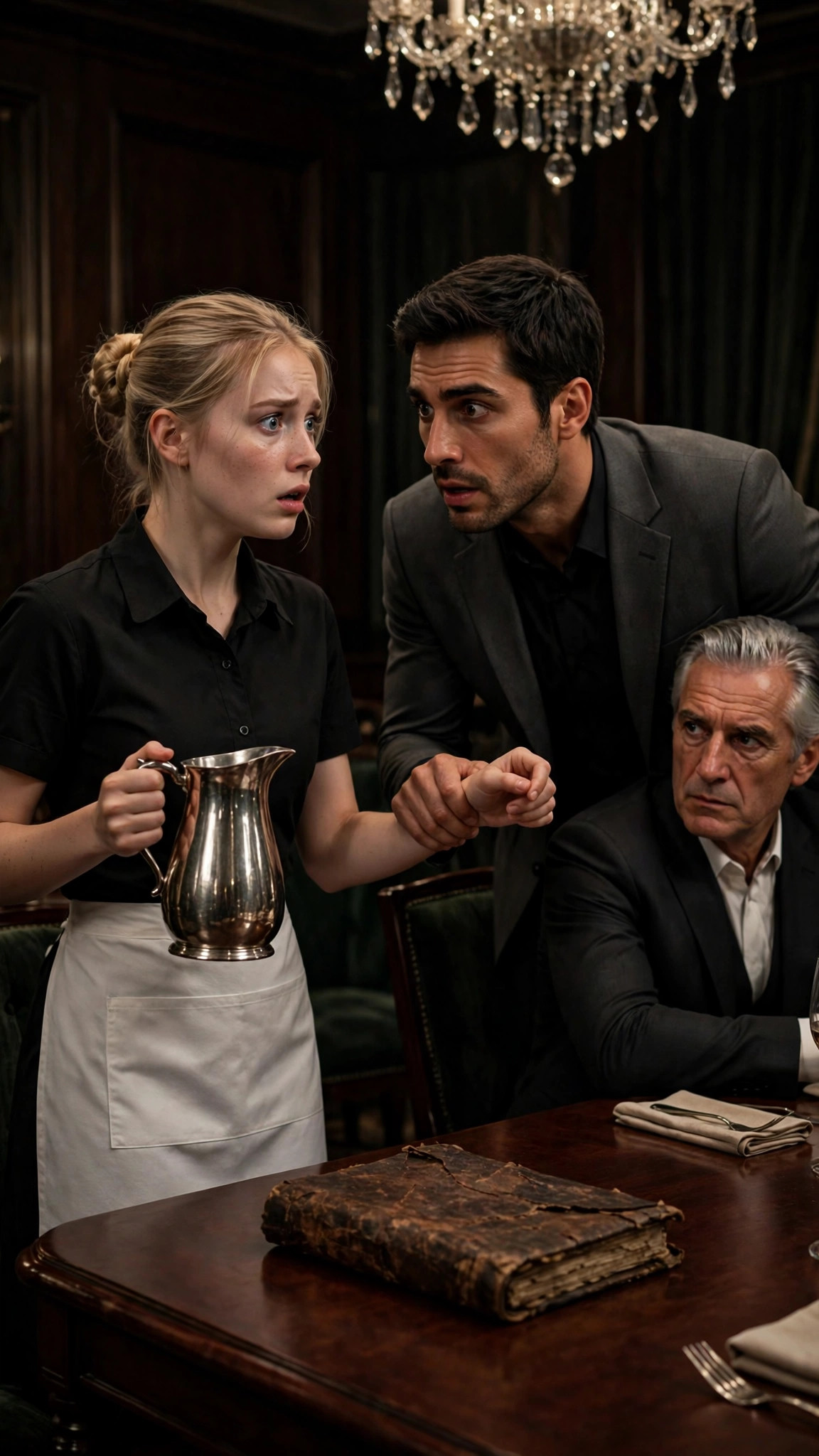
"Translate this and I'll give you ten million dollars."
Dominic Russo laughed as he slammed an ancient leather journal onto the mahogany table, certain no one alive could read it. Crystal glasses jumped against the wood. Every conversation in the Sapphire Dining Room died at once, the way conversations die when a man like Dominic Russo decides they should.
Seconds later, I quietly spoke one sentence from its pages, and the silence got even deeper.
Dominic thought the journal held the night's biggest secret. He was about to discover that the waitress standing beside him was far more dangerous.
My name is Elena Marsh. I am twenty-four years old, and I have survived New York by making sure powerful people never remember my face. I wait tables at The Sterling, a Manhattan restaurant where billionaires celebrate mergers and politicians whisper over thousand-dollar wine. The most frightening guests prefer the private rooms, where men in tailored suits calmly discuss who will become rich and who might disappear. I made myself invisible. Plain blonde bun. No makeup. No jewelry. Few words. A black uniform, a white apron, a water pitcher, and a face nobody would pick out of a crowd if their life depended on it.
What nobody knew was that my father had spent his life studying forgotten languages and impossible codes. While other children watched cartoons, I learned extinct alphabets, obscure dialects, and ciphers during our travels through Europe and the Mediterranean. By the time he died, I spoke eight languages fluently and could decipher several more. None of that paid his medical debt. So I carried plates.
The first time my father showed me a dead language, I was nine years old, and it was raining in Queens, and the kitchen table was covered in photocopies of a letter no one had been able to read for forty years.
"It came from a soldier," my father said, spreading the pages out like a map. "He wrote it in a prison camp, in a code he invented because the guards read everything. He wrote it to his wife. He wanted her to know he was alive, and that he loved her, and that he was coming home."
I looked at the pages. They were covered in strange, looping letters, lines that curled like vines, numbers in the margins that made no sense at all.
"I can't read it," I said.
"Not yet," my father said. "But you will. Look here." He pointed at a line of letters. "This is Corsican. Not the Corsican they speak in the markets. The old one. The one the shepherds used when they didn't want the tax men to understand them. And this—" he pointed at the numbers in the margin "—this is Soviet prison shorthand. The prisoners had no paper. They had to say everything in as few marks as possible. Every dot is a word they couldn't afford to write. And this—" he pointed at a string of letters at the bottom of the page that looked like nothing at all "—this is a Cold War cipher. A code inside a code inside a code. A dead language wearing a dead code like a coat."
He smiled at me, the way he always smiled when he was about to teach me something wonderful. "It looks impossible, Ellie. It always looks impossible. But a code is not a wall. A code is a door with a keyhole. And if you are patient enough, you can learn the shape of the key just by looking at the lock."
We worked on that letter for three weeks. Every evening after school, we sat at the kitchen table, and my father taught me the letters, one by one, until the strange shapes stopped being strange and started being sentences. And on the last night, when I finally read the whole letter aloud, my father put his hand on my shoulder, and he said, "You did it, Ellie. You read the dead."
The letter said: "I am alive. I love you. I am coming home."
The soldier never came home. My father told me that later, quietly, when I was old enough to understand. But his wife kept the letter for forty years, because it was the last time anyone had spoken to her in a language only she and her husband understood.
That was the night I understood what my father did. He did not study dead languages because they were dead. He studied them because they were the only languages in which people told the truth.
The morning of the night I drew the short straw, I woke up in my small apartment in Queens, and the first thing I saw was the envelope on the kitchen counter. It had a window in it, the way bills always have windows in them, and I did not need to open it to know what it said. Eighty-seven thousand dollars. A little smaller than last month, because I had paid a little more than the minimum, because I had worked a double shift on Sunday and Rosa had given me her Saturday night tips.
I made coffee in the chipped blue mug my mother had left me, and I sat at the kitchen table, and I looked at the battered leather notebook on the shelf above the sink. My father's notebook. Full of alphabets and ciphers and notes in his cramped, careful handwriting. I had not opened it in months. I opened it that morning, and I ran my fingers over the first page, where he had written, in his own hand, "To Ellie, who reads the dead. Love, Papa."
I closed the notebook. I put it back on the shelf. I finished my coffee. I put on my black uniform and my white apron, and I pulled my blonde hair back into the plainest bun I knew how to make, and I checked my face in the mirror. No makeup. No jewelry. No expression. A girl nobody would remember.
I left my apartment and walked to the subway, the way I walked every day, past the bodega on the corner and the laundromat with the broken neon sign and the bookstore with the dusty window. In the bookstore window, there was a linguistics textbook, open to a page of alphabets, and I stopped and looked at it, the way I always stopped and looked at it, because the letters on that page were letters my father had taught me, and seeing them in a shop window felt like hearing his voice in a crowd.
I thought about Budapest that morning, the way I thought about Budapest on mornings when I needed to feel less alone. The flat with the radiators that clanked all night. The old woman downstairs who sang the same song every evening at six. My father, sitting at the kitchen table with a pot of coffee gone cold, showing me a page of Cold War cipher and saying, "Look at the keyhole, Ellie. Don't look at the door. Look at the keyhole. The door will lie to you. The keyhole never lies."
He had been right about that, the way he was right about most things. Doors lie. People lie. Languages, if you know how to read them, do not lie.
I took the subway to Manhattan, and I walked the last six blocks to The Sterling, and the city was loud and bright and indifferent, the way New York is always loud and bright and indifferent, and I liked that about it. In a city of eight million people, a girl who wants to be invisible can be invisible. That was the bargain I had made with New York. I would carry its plates and pour its water, and it would let me disappear.
When I arrived at The Sterling, the lunch shift was ending and the dinner shift was beginning, and the kitchen smelled like garlic and butter and fresh bread, and Rosa was already there, tying her apron, humming a song in Spanish. "You look tired, niña," she said.
"I didn't sleep well," I said, and it was true, and it was also not the whole truth, because the whole truth was that I had dreamed about my father, and about the letter, and about the soldier who never came home, and I had woken up with his voice in my head, saying, "You read the dead, Ellie. You read the dead."
Rosa patted my shoulder. "Nobody sleeps well on a Tuesday," she said. "Tuesdays are for the short straw."
She was right. Tuesdays were for the short straw. And tonight, the short straw would be mine.
That is how I ended up in the Sapphire Dining Room on the night that changed everything. I had drawn the short straw. That was the rule at The Sterling: the private rooms rotated, and the waitress who drew the short straw served the room nobody else wanted. The Sapphire Room was the one nobody wanted, because the men who booked it did not look at you like a waitress. They looked at you like furniture that might be listening.
Dominic Russo was waiting inside. He sat at the head of the mahogany table in a charcoal suit, looking more like a Fortune 500 CEO than New York's most feared crime boss. His dark hair was neatly styled. His hands were still. He had the kind of face that made people lower their voices without knowing why. Silas and Gabriel, his silent enforcers, stood near the door like two walls that had learned to wear suits. Across from Dominic sat Constantine, an Eastern European weapons broker with a smile that made my skin crawl. He was fifty-five, angular, salt-and-pepper hair, and he smiled the way men smile when they believe they have already won.
"We agreed to twenty percent," Dominic said.
"Times change," Constantine replied. "My risk increased. So did my price."
I silently refilled their glasses. Water, nothing else. In rooms like this, you pour water and you do not exist.
Constantine pulled a battered leather journal from his jacket and placed it on the table. The leather was cracked and dark with age, the pages swollen, the binding held together with a strip of something that might once have been a belt. "Then perhaps you'll understand after reading our updated ledger."
Dominic motioned toward a nervous man named Arthur. Arthur was in his fifties, pale, thinning brown hair, a dark business suit that did not fit him the way Dominic's suit fit Dominic. He had the look of a man who had spent his whole life being the smartest person in the room until the night he wasn't.
"Read it," Dominic said.
Arthur opened the journal. I was pouring water beside him when my eyes accidentally crossed the first page. My blood turned cold.
It looked like an ancient Corsican dialect tangled with Soviet prison shorthand, then buried beneath a Cold War intelligence cipher. I had seen something disturbingly similar while helping my father decode an old military letter, years ago, at our kitchen table in Queens. My father had called it a dead language wearing a dead code like a coat. Nobody alive was supposed to be able to read it. Nobody except the two of us.
Arthur's hands began trembling. "I can't read this."
Dominic's eyes narrowed. "What?"
"It's encrypted. Dead language, mixed systems. Without the original key, nobody can translate it."
Constantine leaned back, smiling. "My people understand it. Your experts can waste weeks. By then, my shipment will already be moving."
Dominic slowly stood. His chair scraping against the floor sounded like a threat. "You expect me to negotiate blind in my own city?"
"It's business."
"No," Dominic said quietly. "It's disrespect."
He seized the journal and slammed it onto the table. Crystal glasses jumped against the wood. Then he laughed. "Translate this," he said, looking around the room. "I'll give ten million dollars to anyone who can read a single page."
Nobody moved. My heart hammered against my ribs. Stay invisible. That instinct had kept me safe for years. I could lower my eyes, carry my pitcher back to the kitchen, and remain the forgettable waitress everyone believed I was. Then I saw Constantine smiling.
And before common sense could stop me, I looked directly at the journal. I read the first sentence aloud.
Arthur's face drained of color. Constantine stopped smiling. Dominic slowly turned toward me. For several unbearable seconds, nobody breathed. His eyes moved from the journal to my face as if he were seeing me for the first time.
Then he asked the one question I'd spent years making sure no powerful man would ever have reason to ask.
"Who are you?"
I should have kept walking. That was what my mother used to say, in the back of my head, whenever I was about to do something stupid: keep walking, Elena, this is not your business, keep walking. But my mother had been gone for eleven years, and my father had been gone for three, and the only voice left in my head was my father's, and my father had taught me that a dead language is only dead until someone alive decides to speak it.
I was twenty-four years old, and I had spent my whole life making sure no one like Dominic Russo would ever ask me who I was. In the Sapphire Dining Room, under the crystal chandelier, with a ten-million-dollar journal open on the table and a weapons broker staring at me like I had just pulled a gun, I understood that my life of being invisible was over.
Dominic Russo was still looking at me. His hand came down on my wrist, not hard enough to hurt, hard enough to hold. He did not raise his voice. He did not need to. In a room full of men who killed people for a living, the quietest voice in the room was the most dangerous one.
"Say that again," he said.
I looked at the journal. I looked at Constantine. And I said it again, slowly, in English this time, so that every man in the room would understand exactly what the dead language had said.
"The Castellano guns leave Pier Nine at midnight," I said. "Bought with Russo money."
Constantine's smile disappeared completely. Arthur made a small sound in the back of his throat, like a man who had just watched his own future change. Silas took one step forward from the wall. Gabriel's hand moved, very slightly, toward the inside of his jacket.
Dominic did not let go of my wrist. He looked at Constantine, and then he looked back at me, and in his eyes I saw the exact moment a man like him understands that the most valuable thing in the room is not the journal, and not the shipment, and not the ten million dollars he had just offered to a stranger.
It was the waitress who could read the dead.