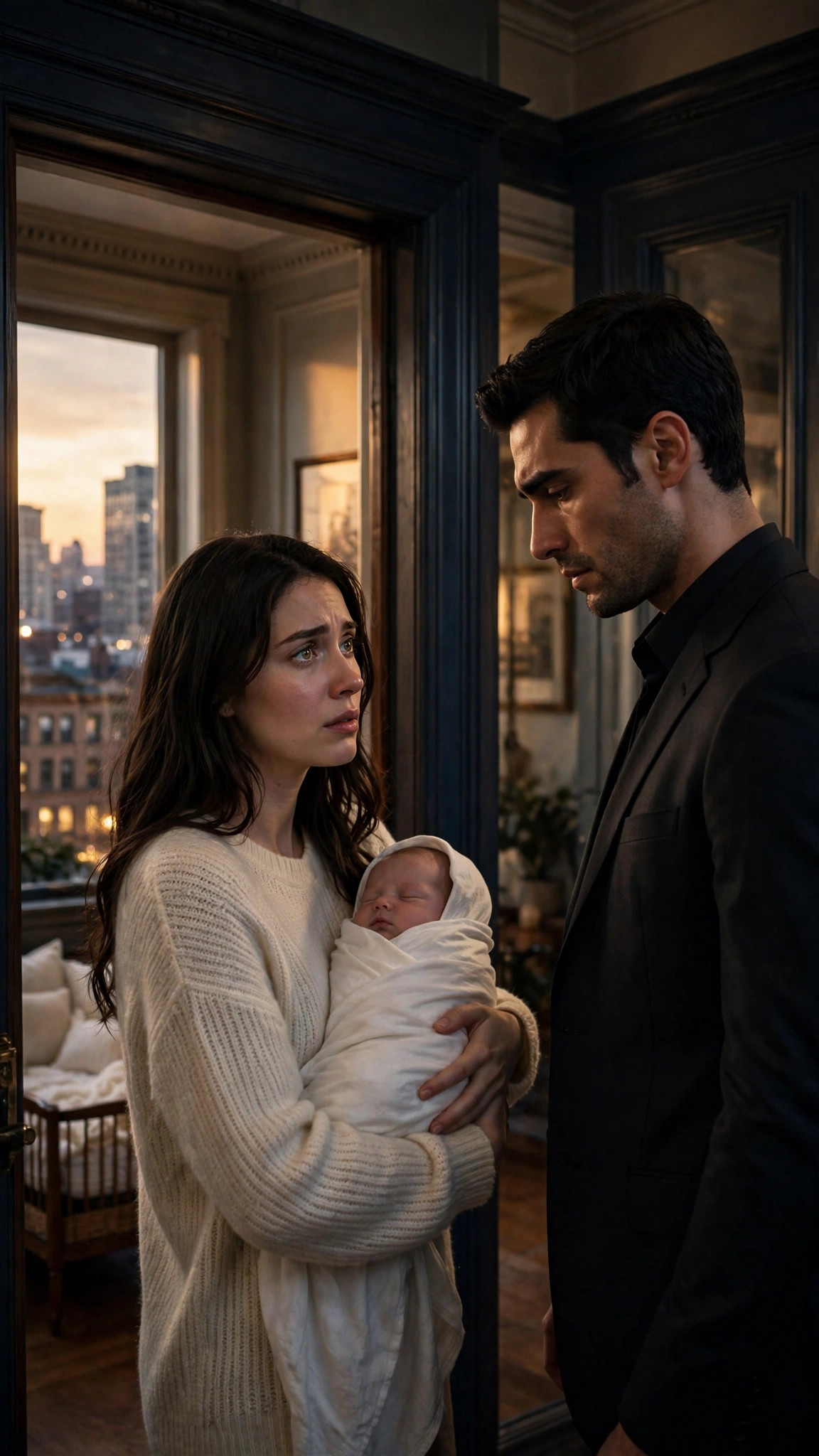
Fifteen days after I nearly bled to death giving birth to his son, my husband finally remembered he had a wife waiting at home.
I heard the car before I saw it. The low growl of the engine rolled up our driveway at 6:47 in the evening, and for one foolish second my heart lifted, because I thought it might be the nurse, or my mother, or anyone at all who had come to check on me. Then I saw the black sedan through the front window, and behind it the second car with the tinted windows, and my heart sank back into my chest like a stone into deep water.
Vincent was home.
I was standing in the middle of the living room with Elias asleep against my shoulder, one hand pressed to the scar under my shirt where the surgeon had cut me open to save us both. The stitches pulled when I moved too fast. Everything pulled. My body was still a house with the windows blown out, and I had been holding it together with my own two hands for fifteen days.
I did not run to the door. I did not cry. I stood there, and I waited, and I watched him walk toward me like a man approaching a house he was afraid might not let him in.
He stopped a few feet away. He looked at the baby first. Then he looked at me, and he held his breath, and he said, "Madison, I'm back."
I looked into his eyes. His eyes were the same dark eyes I had known since I was nine years old. They were the eyes of the boy who had once held my hand in a hospital waiting room and told me not to be afraid. They were also the eyes of the most feared mafia boss in Chicago, a man who controlled nearly half the underground business on the South Side, a man whole neighborhoods crossed the street to avoid.
"I know," I said calmly. "I'm sorry. You're late."
It was the first time I had ever used that tone with him. He had never seen me before — not this version of me. For fifteen days, he had left me alone, and something in me had quietly finished becoming a different woman.
He opened his mouth. He closed it again. Behind him, through the open door, I could see his mother sitting in the second car, old and still, watching us with eyes that had seen more than either of us had today. Eleanor Carter had warned me once, a long time ago, before my wedding: "Don't believe Vincent's story until you see it with your own eyes." I had not understood her then. I was beginning to understand her now.
Vincent took one step toward the cradle by the window. "This is the baby, right?" he asked.
"What else would it be?" I said.
He flinched. Good. Let him flinch. For fifteen days I had signed papers alone, cried alone, bled alone, and learned the name of every nurse on the night shift because there was no one else to talk to at three in the morning while my son lay in a glass box fighting to breathe. Vincent Carter had missed all of it. He had missed the worst night of my life, and now he stood in my living room asking me if the baby in the cradle was the baby.
"Why are you looking at me like that?" he asked.
"Because you're my husband," I said, "and you're late."
I had not always been able to speak to him like that. There had been a time when Vincent Carter's voice could make my whole body go still, the way it did for everyone else in Chicago. But I had met him long before Chicago learned to fear him. I had met him when we were both children, in a hospital waiting room, on the worst day of my young life, and he had held my hand and told me a story about a lion who was afraid of the dark, and I had believed him when he said the dark could not hurt me if I did not let it.
That was the boy I had married. That was the boy I had been waiting for, for fifteen days, while his son lay in the neonatal unit and the birth certificate sat on my kitchen table with one line left empty — the line where a father's name belonged.
Vincent's name belonged next to mine. He had not been there to write it.
I remember the hospital waiting room as if it were yesterday. I was nine years old. My father had collapsed at the docks, and the ambulance had brought him to County General, and my mother had left me in the waiting room with a coloring book while the doctors worked on him behind doors I was not allowed to open. The chairs were orange plastic. The clock on the wall ticked too loudly. A vending machine hummed in the corner, and every time it hummed I thought it was my father's heart, starting again.
A boy sat down next to me. He was eleven, maybe twelve, with dark hair and a scraped knee and a paperback book he was not reading. He looked at my coloring book, and he looked at my hands, which were shaking, and he said, "You're scared."
"My dad is sick," I said.
"Mine too," he said. "My grandpa brought me. He says waiting is the hardest part of being a man."
He held out his hand. "I'm Vincent," he said. "Hold my hand. It helps."
I held his hand. His palm was warm and a little sweaty, and he told me the story of the lion who was afraid of the dark, and the lion's mother who told him that the dark was only the night putting on its coat, and that nothing in it could hurt a lion who knew his own name. I do not remember whether my father lived or died that night — he lived, for eleven more years, long enough to walk me down the aisle at my first communion and to teach me how to change a tire and to die quietly of a bad heart when I was twenty — but I remember Vincent's hand. I remember that a stranger's child had been kinder to me in one hour than the whole world had been in a week.
We lost each other after that. Chicago is a big city, and children scatter. I grew up in Bridgeport with my mother and my grandmother, in a narrow brick house where the radiators knocked and the kitchen always smelled of garlic and coffee. My mother worked double shifts at the diner on Halsted, and she used to tell me, while she counted her tips at the kitchen table, "Even if your husband is a wealthy man, your family will go hungry, but you will never get hungry. You are the backbone of your family and a pillar of support." I did not understand her then either. I thought she was talking about money. She was talking about something else entirely — about the fact that a woman holds a family up from the inside, and that no amount of a man's wealth can do that job for her.
My grandmother lived with us until I was sixteen. She had hands like dried leaves and opinions like a judge, and she used to say, "Sometimes, a person's true character is revealed not through grand gestures of love, but through how they respond when you're weak." She said it while shelling peas, without looking up, as if it were a fact about the weather. I wrote it down in a notebook because it sounded important, and then I forgot about it for twelve years.
I met Vincent again when I was twenty-four, at a charity gala at the Drake Hotel, where I was working as an event coordinator and he was standing by the bar in a black suit, watching the room the way a general watches a battlefield. He looked at me across a sea of champagne glasses, and he stopped mid-sentence, and he walked straight toward me, and he said, "You were the girl in the waiting room."
"And you were the boy with the lion," I said.
He smiled then — the real smile, the one Chicago almost never saw — and he said, "I never forgot your hand."
We were married eighteen months later, in a small church in Bridgeport, with my mother crying in the front pew and his mother, Eleanor, watching from the second row with her hands folded and her mouth in a thin line. Eleanor had taken me aside the night before the wedding, in the kitchen of the house I was about to leave, and she had said, "Don't believe Vincent's story until you see it with your own eyes." I had laughed, because I thought she was warning me about mafia gossip, about the stories people told in Chicago about the Carter family. She had not laughed. She had held my face in both her hands and said it again, slower, as if it were a spell: "With your own eyes, Madison. Promise me."
I promised. I did not know what I was promising.
The first two years of our marriage were good. I will not lie about that, because the good years are part of the story, and without them none of the rest makes sense. Vincent came home for dinner. He learned to cook pasta the way my grandmother had taught me, badly and with too much garlic. He held my hand in the car the way he had held it in the waiting room, like it was the most natural thing in the world. He told me about the legitimate side of his business — the hotels, the restaurants, the real estate — and he never told me about the other side, and I never asked, because I had decided, the way wives of powerful men decide, that there were rooms in my husband's life I would not open.
When I got pregnant, he wept. He put his head against my stomach and wept, and he whispered to the baby in a voice so soft I had to lean down to hear it, and he said, "I'm going to be better than my father was. I'm going to be there. I promise."
He meant it. I know he meant it. That is the worst part. He meant every word, and then the world took his promise and broke it in half, and he let it happen, and I was the one left holding the pieces.
The trouble started in my seventh month. My blood pressure climbed, and would not come down. My ankles swelled until my shoes did not fit. The doctor said the words "preeclampsia" in a calm voice, and then she said them again, louder, when I did not react, and then she was admitting me, and then the machines were beeping, and then my cervix was opening too early, and the baby was in distress, and someone was putting a clipboard in front of me, and I was signing paperwork alone, and Vincent never answered a single call.
I called him eleven times. I called his office. I called his driver. I called his mother. Eleanor answered on the third ring, and her voice was thin and strange, and she said, "He can't come to the phone right now, Madison. I'm sorry. I am so sorry." And then she hung up, and I never heard from her again, not once, not in fifteen days.
They cut me open at 2:14 in the morning. A C-section, emergency, life or death, mine and the baby's both. The last thing I remember before the anesthesia took me was the nurse's hand on my forehead, and her voice saying, "Stay with us, sweetheart. Stay with us." And then there was nothing, and then there was a white ceiling, and a silent ward, and a nurse leaning over me with kind eyes, telling me gently that the baby had been in the neonatal unit all night, that he was alive, that he was fighting, that he was strong.
"He's your son," she said. "He's beautiful. He looks just like his father."
I cried then, because the birth certificate was on the table beside my bed, and the line for the father's name was empty, and Vincent's name belonged next to mine, and he had not been there to write it.
Each day passed, and he never came home. The baby grew stronger. I grew weaker, and then stronger again, in the way a body does when it has no choice. My friend Rosa sent me a photograph on the fourth day. It showed Vincent sitting in a luxury hotel downtown, leaning across a table toward a woman, laughing at something she had said. The woman had long dark hair and a red dress, and I knew her face the way you know a face from a yearbook you have not opened in a decade.
It was Vanessa Reed. Vincent's college sweetheart. The one he had thought would be his wife, before me.
I stared at that photograph for a long time. I stared at it until the screen went dark, and then I lit it again, and I stared at it some more, and I thought of my mother, counting her tips at the kitchen table, telling me I was the backbone of my family. I thought of my grandmother, shelling peas, telling me that a person's true character is revealed by how they respond when you are weak. And I thought of Eleanor's warning, the one I had promised to remember, and I finally understood what she had meant.
Don't believe his story until you see it with your own eyes.
I was putting on my wedding ring — I had taken it off in the hospital because my fingers had swollen — when his car pulled up outside. Fifteen days. Fifteen days of silence, and then his car, and his mother in the car behind him, and him walking toward my door like a man who was afraid I would give in.
He stopped a few feet away. He held his breath. "Madison, I'm back."
I looked into his eyes, and I said the truest thing I had ever said to him.
"I'm sorry. You're late."