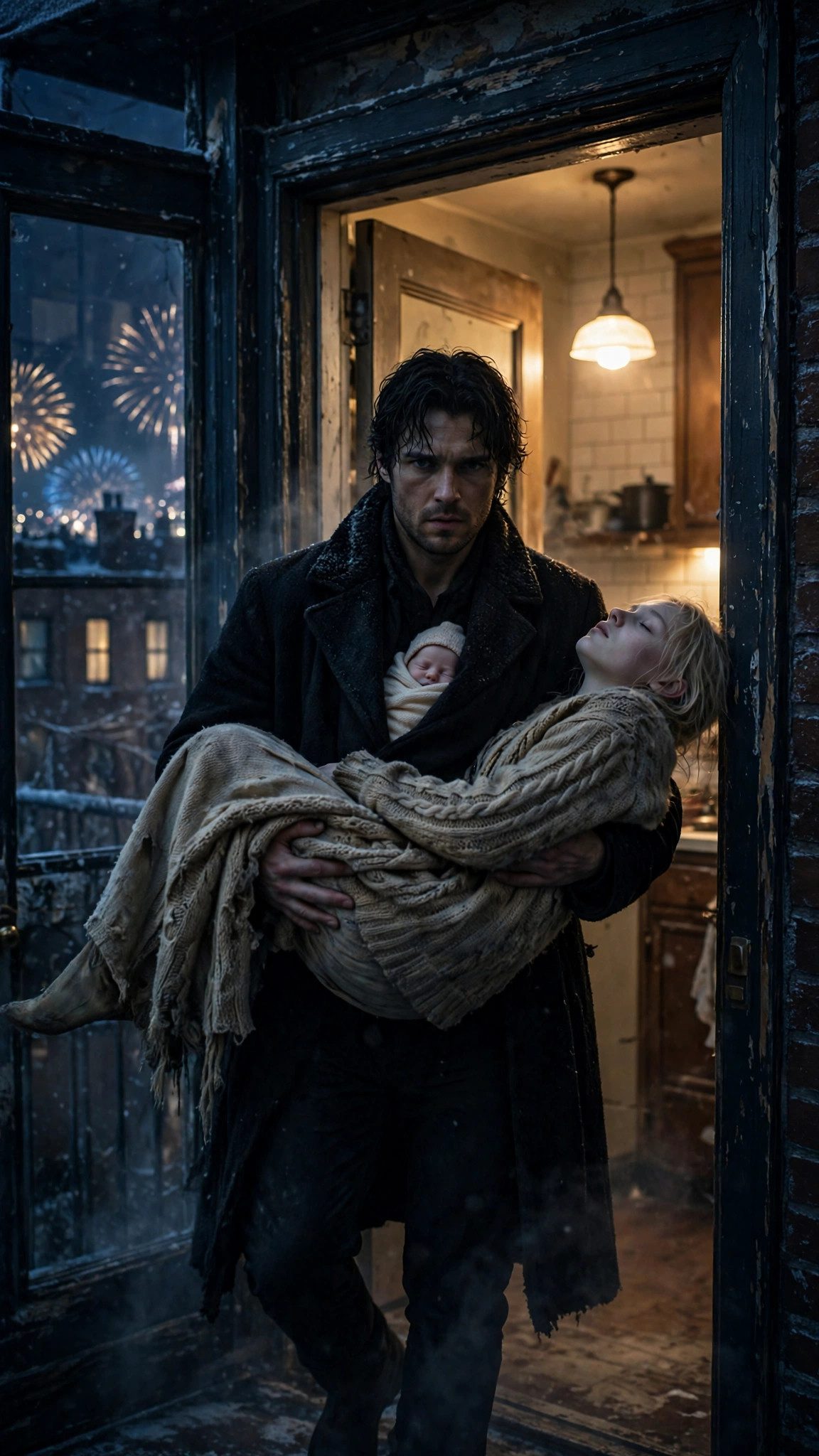
One year later, on New Year's Eve, I stood in the doorway of our apartment and watched my wife get ready for the evening, and I thought about the last time I had stood in that doorway.
A year ago, I had come home to darkness and cold and silence. A year ago, my wife had been bleeding and starving in a kitchen chair, and my son had been trembling beneath a blanket too thin for winter, and my family had been celebrating in South Beach with money that was meant to keep them alive.
Tonight, the apartment was warm. The lights were on. Music was playing — soft jazz, the kind Maya liked, the kind that made her hum while she moved around the room. The refrigerator was full. The heat was on. And in the living room, Liam was sitting on the floor in a tiny suit, banging a wooden spoon against a pot and laughing at the noise he was making, while Rosa clapped her hands and laughed with him.
Maya came out of the bedroom in a deep green dress, the color of pine trees in winter, and she turned in a slow circle for me, the way she used to when we were first dating and she wanted my opinion on something she was wearing.
"Well?" she said.
"You look beautiful," I said. And she did. She was healthy now. Her cheeks were full. Her hair was shiny. Her eyes were bright. She looked like the woman I had married, and she looked like someone new, too — someone stronger, someone who had been through something terrible and had come out the other side with her head held high.
"You're staring," she said.
"I'm allowed to stare," I said. "You're my wife."
She laughed, and she came over and kissed me, and Liam banged his spoon against the pot, and Rosa said, "All right, enough, you two. Go. Have your evening. The baby and I will be fine."
We were going to a small restaurant in Manhattan, just the two of us, for the first time in over a year. Chloe was meeting us there. My mother was not coming — not yet. She had been invited to the vow renewal we were planning for the spring, and she had cried when I told her, and she had said she would be there, and she would be on her best behavior, and she would bring the silver rattle, and I had believed her. But tonight was just for us. Tonight was for Maya and me.
In the cab, Maya took my hand. "Do you remember last year?" she asked. "Do you remember what you said to me in the cab, on the way to the hospital?"
"I said I would never leave your side again," I said.
"You said that," Maya said. "And you kept your word. You have been here every single day. Every night. Every appointment. Every feeding. You have not missed a thing."
"I missed eleven days," I said. "I'll never forgive myself for those eleven days."
Maya squeezed my hand. "David, listen to me. You came home. That's what matters. You walked through that door, and you saw what was happening, and you did something about it. A lot of men would have believed their mother. A lot of men would have told themselves their wife was exaggerating. You didn't. You believed me. You chose me. You chose Liam. And you have chosen us every single day since then. That is what a husband does. That is what a father does. And that is enough. It has to be enough, because it is everything."
The restaurant was small and warm, with candles on the tables and a string quartet in the corner. Chloe was already there, sitting at a table by the window, wearing a red dress and looking happier than I had seen her in years. She stood up when we came in, and she hugged Maya, and she hugged me, and she said, "Happy New Year, you two. You made it. You actually made it."
We sat down. We ordered dinner. We talked about normal things — Liam's first steps, which he had taken three days earlier, wobbling across the living room floor with his arms out like a tiny tightrope walker. Chloe's new job. Rosa's granddaughter, who was getting married in the spring. The restaurant. The music. The year that was ending, and the year that was about to begin.
At midnight, the lights dimmed, and the staff brought out champagne, and everyone in the restaurant stood up and counted down together. Ten. Nine. Eight. Seven. Six. Five. Four. Three. Two. One.
Fireworks exploded over Manhattan, just like they had a year ago. But this time, I was not in a cab with my wife burning with fever beside me. This time, I was standing in a warm restaurant with my wife in my arms, and she was healthy, and my son was safe at home with a woman who loved him, and my sister was smiling at us from across the table, and the year that was ending had been the hardest year of my life, and the year that was beginning felt like a gift.
I kissed Maya at midnight. I kissed her the way I had kissed her on our wedding day — like she was the only person in the room, like she was the only person in the world. And when I pulled back, she was crying, and she was laughing, and she said, "David Romano, you are the best thing that ever happened to me."
"You're the best thing that ever happened to me," I said. "You and Liam. Both of you. Forever."
In the spring, we renewed our vows. It was a small ceremony, in a garden, with forty people — the same number as our first wedding, but different people. Chloe was there, in a blue dress, holding Liam's hand. Rosa was there, crying before the ceremony even started. Elena, my new head of operations, was there, looking slightly confused by the whole thing but happy for us. And my mother was there, sitting in the back row, wearing a plain gray dress, holding the silver rattle in her lap, and crying quietly through the entire ceremony.
Maya wore a white dress, simple and beautiful, and she carried a bouquet of white roses, and when she walked down the aisle toward me, Liam walked beside her, holding her hand, taking careful, wobbling steps in his tiny suit. The string quartet played. The sun shone. And when the officiant asked if I would take Maya as my wife, again, for the rest of my life, I said, "I do," and I meant it more than I had the first time, because this time I knew what those words cost, and I knew what they were worth.
After the ceremony, my mother came up to us. She was nervous. Her hands were shaking. She held out the silver rattle to Liam, and he took it, and he shook it, and the bell made its soft, clear sound, and he laughed.
"Thank you for inviting me," she said to Maya. Her voice was quiet. "I know I don't deserve to be here. I know what I did. I will spend the rest of my life trying to make it right."
Maya took her hand. "You're here," she said. "That's a start."
The reception was held in the garden, under strings of lights that glowed gold as the sun went down. There was music. There was dancing. There was a cake that Maya had made herself — white frosting, fresh strawberries, three tiers, exactly like the cake at our first wedding, except this time she had help. Chloe had been in the kitchen with her all morning, flour on both of their aprons, laughing at each other's mistakes. Rosa had supervised from a chair in the corner, offering opinions on everything and apologizing for none of them.
I danced with Maya under the lights, the way we had danced at our first wedding, and the way we had danced in the restaurant on New Year's Eve. She put her head on my shoulder, and I held her close, and I thought about how far we had come. A year ago, she had been sitting on a hard plastic chair in a freezing kitchen, bleeding and starving, afraid to call me because she thought she would lose her son. Tonight, she was dancing in a white dress in a garden full of people who loved her, and she was laughing, and she was free.
Chloe danced with Liam, spinning him around in the air while he squealed with delight. Elena danced with Rosa, who insisted she was too old to dance and then danced for twenty minutes straight. Even my mother danced — once, slowly, with Tony, who had known our family for fifteen years and who had seen everything, and who treated her with a kindness she did not expect and had not earned.
When the music slowed, I took the microphone. I had not planned a speech. I am not a man who makes speeches. But I stood there, in the garden, with my wife beside me and my son asleep in Rosa's arms, and I looked at the forty people who had come to celebrate with us, and I found that I had something to say.
"A year ago," I said, "I came home to an empty apartment and a note on the refrigerator, and I thought I had lost everything. I thought my family was gone. I thought my wife was gone. I thought my son was gone. And I was wrong. My family was not gone. My family was right here, waiting for me to see it clearly for the first time. My wife, who survived eleven days of cruelty and never stopped loving her son. My son, who held on to my finger in the back of a cab and refused to let go. My sister, who chose the truth when it would have been easier to look away. And all of you, who showed up tonight to celebrate something that almost didn't happen."
I paused. The garden was quiet. The lights glowed. Maya was crying, and she was smiling, and she was holding my hand so tightly it hurt.
"So thank you," I said. "Thank you for being here. Thank you for believing in us. And thank you, Maya, for marrying me twice. I promise you, I will spend the rest of my life earning it."
Everyone cheered. Maya kissed me. Liam woke up and started crying, and Rosa handed him to me, and I held him against my chest, and he quieted down, and he looked up at me with his mother's eyes, and he smiled.
The next morning, I woke up before Maya did, and I went into the nursery, and I stood over Liam's crib and watched him sleep. He was lying on his back with his arms thrown wide, the way babies do when they feel completely safe, and the silver rattle was on the blanket beside him, and the morning light was coming through the window, and I thought about the first time I had held him — in the back of a cab on New Year's Eve, wrapped inside my coat, his tiny hand curled around my finger. I thought about how far we had come from that night. I thought about the hospital, and the storage room, and Miami, and the café, and the garden, and all the days in between, and I understood something I had not understood before: that a family is not something you are given. It is something you build, day by day, choice by choice, and the choices that matter most are the ones you make when no one is watching, and the ones you make when everything is falling apart.
Liam opened his eyes. He saw me standing there, and he smiled, and he reached up with both hands, and I picked him up, and I held him against my chest, and I carried him into the kitchen, and I made coffee, and I waited for Maya to wake up, and I thought about how ordinary it all was, and how extraordinary it was, too.
That night, after everyone had gone home, Maya and I sat on the couch in our apartment, and Liam slept in his crib, and the apartment was warm, and the refrigerator was full, and the heat was on, and I thought about the night a year ago when I had unlocked the door at 11:27 p.m. and found my wife bleeding in a cold kitchen.
I thought about the note on the refrigerator. I thought about the pharmacy bag on the high shelf. I thought about the face in the security camera, looking directly into the lens. I thought about all the things that had nearly broken us, and all the things that had not.
And I thought about my father, and what he used to say about family. A man with no family is a man with no spine. He was right, in a way. But he was wrong about what a family was. A family was not the people you were born to. A family was not the people who shared your blood. A family was the people who showed up when it mattered. The people who told the truth. The people who stayed. The people who, when they failed you, did the hard work of earning their way back.
I had a family now. A real one. A wife who had survived eleven days of cruelty and come out stronger. A son who smiled at me like I was the whole world. A sister who had chosen the truth over comfort. And a mother who was learning, slowly, what it meant to love someone without controlling them.
It was not the family I had been born into. It was better. It was the family I had chosen, and the family that had chosen me, and it was forever.
Maya leaned her head against my shoulder. "What are you thinking about?" she asked.
"I'm thinking about how lucky I am," I said.
She smiled. "Me too," she said. "Me too."
Outside, the city was quiet. Inside, the apartment was warm. And in the crib, our son slept, safe and loved, beneath a blanket that was thick enough for winter.
The End.
THE END