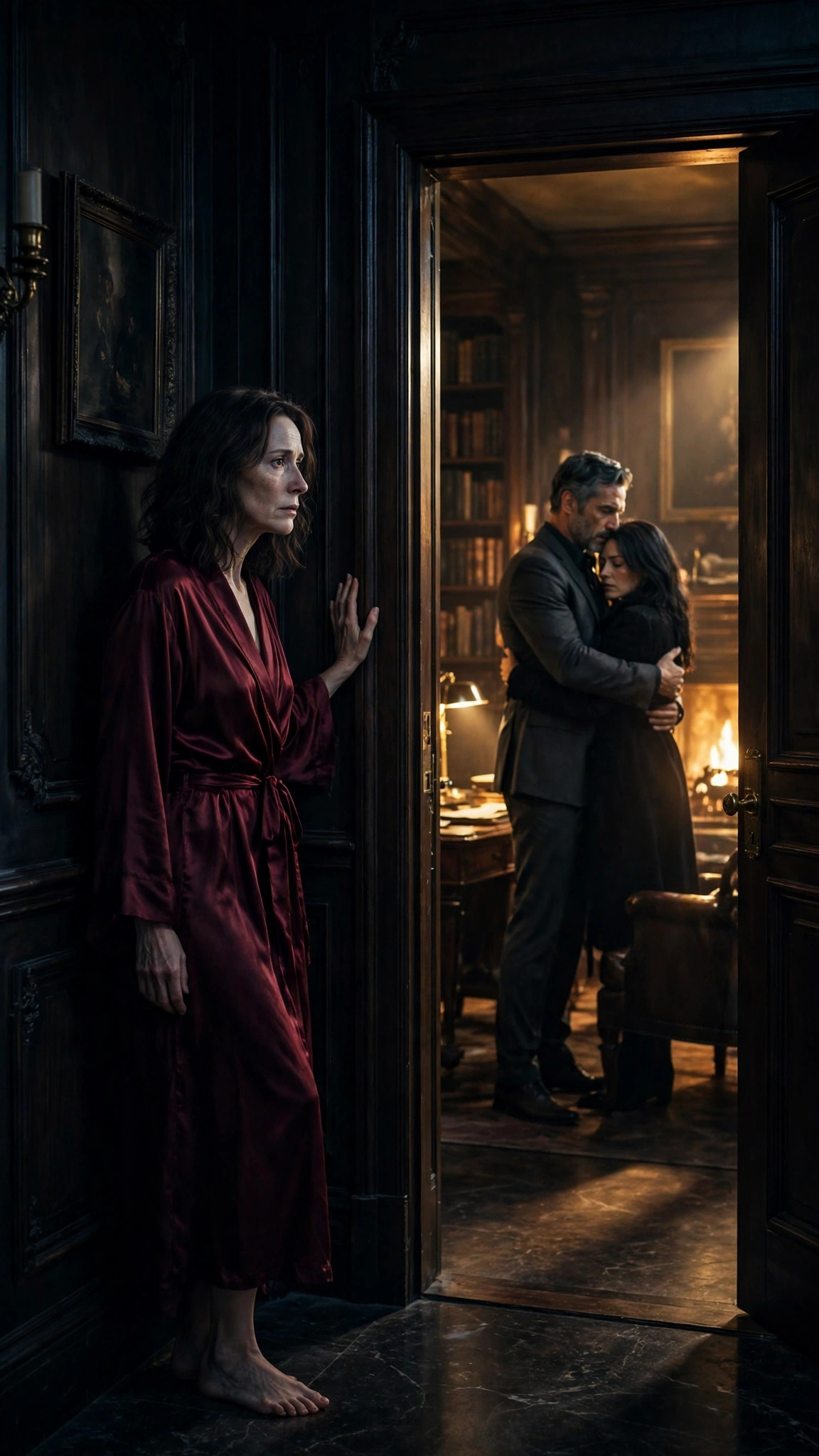
At 12:17 in the morning, I watched my husband kiss the woman he had sworn belonged to his past, and I did not scream, confront him, or give him the chance to explain what my own eyes had already seen.
I stood barefoot outside Adrian's half-open study door with my hand pressed flat against the wall, the cold plaster steadying me, and I watched Elena Russo's hand rest against my husband's cheek. I watched his arm circle her waist. I watched her lean in, and I watched him lean toward her, and then she kissed him.
For one terrible second, Adrian kissed her back.
That second was enough.
I turned away before either of them saw me. I did not run. Running would have made noise, and noise would have brought questions, and questions would have given him the chance to explain, and I had spent fifteen years believing my husband when he told me Elena Russo was his past. I was not going to spend one more minute listening to him tell me what my own eyes had already told me.
My name is Claire Bellandi, and for fifteen years, I believed my husband when he told me Elena Russo was his past.
The Bellandi organization made my husband one of the most feared men in the city. He built it through discipline, fear, and decisions that left no room for emotion. But with me, Adrian was different. Or at least I thought so.
That night, I stood barefoot outside Adrian's half-open study door, and I understood that everything I thought I knew about my marriage might have been a story I had told myself because I wanted it to be true.
I walked back to our bedroom without making a sound. The hallway was long and dark, the marble floor cold under my feet, and every step felt like walking away from a life I had spent fifteen years building. I did not cry. I had cried enough in my life to know that tears would not change what I had seen. Tears would only make my eyes swollen in the morning, and I needed my eyes clear.
No suitcase. No dramatic note. No slammed doors.
Adrian's estate had cameras, motion sensors, armed guards, coded gates, and men trained to notice unusual behavior. If I wanted to leave, I could not leave like his wife. I had to disappear like someone escaping him.
I stood in our bedroom in the dark and looked at the bed where I had slept beside Adrian Bellandi for fifteen years. The sheets were still warm where I had left them. His side of the bed was empty. He was downstairs in his study with Elena Russo, and I was standing in the dark deciding whether the woman I had been for fifteen years was going to survive the night.
She was not.
I removed my wedding ring and placed it beside my phone on the nightstand. The ring was heavy. It had always been heavy, but I had never noticed the weight until that moment, when I set it down and my hand felt lighter than it had felt in fifteen years.
Then I found a piece of hotel stationery I had saved from our anniversary trip. I had kept it in the drawer of my nightstand for three years, a small white card with the hotel's name pressed into the corner in gold letters. I had saved it because it reminded me of the week Adrian and I had spent pretending we were ordinary people, a week when he had held my hand in public and laughed at bad jokes and eaten breakfast with me at a small table by a window. I had saved it because I thought we would go back there someday.
My hand trembled only once as I wrote five words.
You made your choice. Goodbye.
Five words. Fifteen years. That was the exchange rate.
I folded the card and placed it beside my ring, and then I stood in the dark bedroom and listened to the house. The estate was never truly quiet. There was always the hum of the security system, the soft footsteps of guards changing positions, the distant sound of the gates. But tonight the house sounded different. Tonight the house sounded like a cage, and I was the only person inside it who had just realized the door was locked from the outside.
I had four hours until dawn. I had four hours to become someone else.
I lay back down in the bed and stared at the ceiling and listened to the house breathe around me. The ceiling was white and smooth and expensive, and I had stared at it on a hundred sleepless nights over fifteen years, but tonight it looked like the lid of a box, and I was the thing inside the box, and someone had just shown me that the box had never been mine.
I thought about the robe I was wearing. Deep burgundy silk, the one Adrian had given me on our tenth anniversary. I had loved that robe. I had worn it on quiet mornings when the house was still asleep and I could pretend, for an hour, that I was an ordinary woman in an ordinary house with an ordinary husband who came home from an ordinary job. Tonight the silk felt cold against my skin, and I understood that I had been dressing up in someone else's life for a very long time.
My mind kept going back to the study door. To Elena's hand on his cheek. To his arm around her waist. I tried to be fair. I tried to be the woman I had always believed I was, the woman who had said, only three nights earlier, that she would not make another woman risk dying because she was jealous of someone her husband had loved before she existed. I tried to remember that Elena was in danger. I tried to remember that Adrian had told me she had nowhere else to go.
But fairness had a limit, and that limit was one second. One second of his mouth on hers. One second in which the man I had trusted for fifteen years had kissed another woman in the house I had made a home, while I stood barefoot in the hallway in the robe he had given me.
I thought about the first time I had ever seen Elena Russo. It had not been three nights ago. It had been twenty years ago, in a photograph Adrian kept in the bottom drawer of his desk, a photograph I had found by accident in our second year of marriage, back when I still opened his drawers without thinking twice. A young woman with dark hair and a laughing mouth, standing beside a young Adrian on a beach I did not recognize, his arm around her shoulders, both of them sunburned and grinning like people who believed the world belonged to them. I had asked him who she was, and he had said, "Someone from before you," and he had said it the way a man says a thing he has already buried, and I had believed him, because I was twenty-nine and in love and I wanted to believe that the past was past.
I had never seen her in person until the rain brought her to our door. She was older now, of course. We all were. But standing in our foyer in a wet coat, with rain in her hair and fear in her eyes, she had looked at Adrian the way a person looks at the only safe place left in the world, and Adrian had looked at her the way a man looks at a debt he has never finished paying.
I thought about the conversation three nights earlier, the one where he had told me she was in danger. Her cousin's organization had fractured during a territory dispute, and someone had threatened her attendance at an upcoming charity gala. "The estate is the safest place for her." "How long?" "Forty-eight hours." "There's nowhere else?" "Not somewhere I trust." I had studied his face while he said it, looking for the lie, looking for the crack, looking for anything that would tell me this was not what he said it was. At forty-eight, Adrian wore control as naturally as other men wore suits. He could make armed men nervous with a look, but I had always been able to see past it. Or so I believed.
"Then bring her here," I had said. His expression had shifted. "You don't have to agree because you think it's expected." "I'm not agreeing because I'm your wife." "Then why?" "Because if she's truly in danger, I won't make another woman risk dying because I'm jealous of someone he loved before I existed." He had stared at me. Then he had quietly thanked me.
Now, lying in the dark, I understood how foolish those words had been. I had opened my own door to the woman who would end my marriage, and I had done it out of kindness, and the kindness had been returned with a kiss in my husband's study at twelve seventeen in the morning.
The clock on the nightstand said 1:04. Then 1:30. Then 2:00. Time moved the way it moves when you are waiting for something terrible to finish happening. I listened for footsteps in the hallway. I listened for Adrian's voice. I listened for the sound of the study door opening and closing, and when it finally came, soft and careful, I held my breath and counted his steps as they passed our bedroom door and continued down the hall toward the guest wing. Toward her.
That was when I knew. Not when I saw the kiss. When I heard his footsteps go toward her room at two in the morning, I knew that whatever I had seen in the study was not a moment. It was a direction. And I was not going to stand in the hallway of my own house and watch my husband walk in that direction one more time.
I got up. I did not turn on the light. I knew this room in the dark better than I knew any room in the world, and I moved through it like a ghost through a house that had already forgotten her.
I had four hours until dawn. I had four hours to become someone else.
I knew exactly how I was going to leave, because fifteen years earlier, before money and guards and bulletproof windows, I had worked nights at the bakery that still delivered to this house every morning. I knew the estate's routines the way only someone who had once been invisible inside a rich man's house could know them. The guards watched the front gate and the garden walls and the driveway. They watched the places where important people came and went. They did not watch the service corridor. They did not watch the kitchen. And they never searched the bakery truck.
There was one weakness in Adrian's security system, and I knew about it because I had built my knowledge of it back when I was nobody, back when I was a girl in an apron who carried trays of bread through the back doors of houses like this one and learned which doors the guards never checked.
The eastern delivery gate automatically opened for the bakery truck every morning at 4:42. Security never searched it. Adrian trusted the driver. More importantly, he trusted me.
At 4:36 a.m., I stepped into the service corridor wearing one of the housekeeper's spare coats. Rosa's coat. Rosa had worked in this house for nine years, and her spare coat hung on a hook in the laundry room, grey wool, too big for me, smelling faintly of lavender and bleach. I buttoned it up to my throat and pulled the collar high, and in the dim light of the corridor I looked like any other woman who worked in this house before dawn.
My heart was beating so hard I was certain the guards would hear it through the walls.
At 4:41, I slipped through the kitchen while the night guards changed positions. I had timed it in my head a hundred times since midnight, counting the minutes, counting the steps, counting the seconds between the moment the night guard at the east door turned to speak to his replacement and the moment the kitchen door swung shut behind me. The kitchen was warm and smelled of bread and coffee, and for one terrible moment I thought about the mornings I had spent in this kitchen, drinking coffee with Rosa while Adrian slept upstairs, mornings when I had believed my life was mine.
One minute later, the bakery truck rolled toward the gate.
Nobody saw me climb into the empty storage compartment beneath the rear shelving. The compartment was narrow and smelled of flour and old wood, and I curled myself into it the way I had curled myself into small spaces as a girl, back when the world was too big and too loud and the only safe place was somewhere nobody thought to look. The truck's engine shook the metal around me. The gate opened. The truck rolled forward, and I held my breath, and the estate fell away behind me like a dream I had finally woken from.
I heard the guard's voice through the metal of the compartment, muffled and bored, saying something to Enzo, and I heard Enzo answer, easy and familiar, the way a man answers a question he has answered a hundred times before. Then the wheels turned onto the street, and I lay in the dark with flour in my hair and my heart hammering against my ribs, and I did not breathe until I felt the truck turn the corner and pick up speed, and the estate was behind us, and no one had searched the truck, and no one had looked in the compartment, and no one had seen me at all.
By sunrise, I had vanished from the most heavily guarded estate in Chicago, leaving Adrian Bellandi with only my wedding ring and five words that would tell him exactly why.
At 5:41, Adrian would sit on our bed holding my wedding ring. He would order every gate locked. Every camera checked. Every guard questioned. And eventually, he would discover something far worse than the fact that his wife had left him.
The camera covering the eastern service entrance had gone dark exactly six minutes before I disappeared.
I hadn't disabled it.
Someone else had.
And as the bakery truck carried me beyond Adrian's walls, into a grey Chicago morning that smelled of rain and exhaust and freedom, I realized I might not have been the only person waiting for an opportunity to get me out of that house.