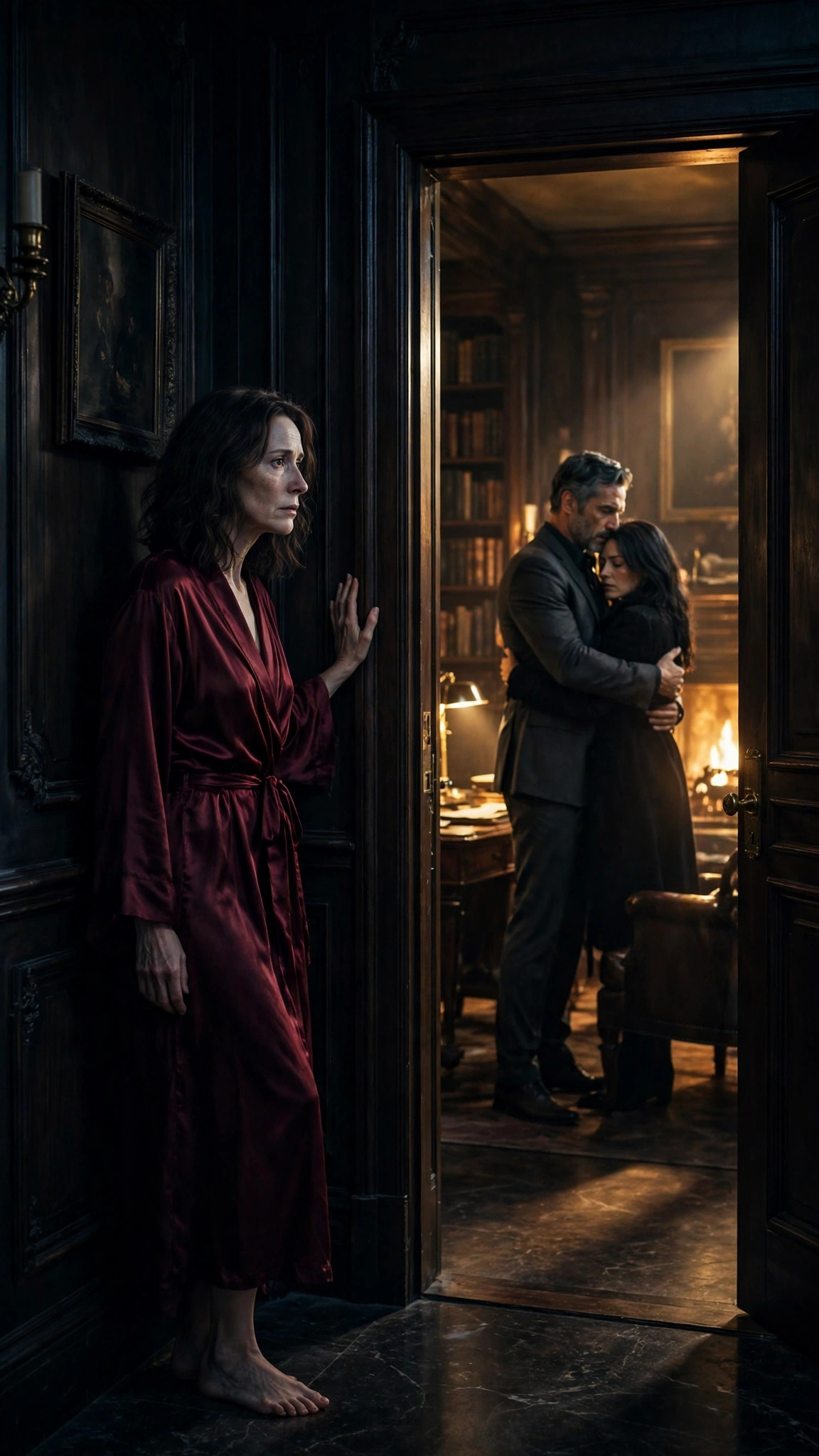
Fifteen years earlier, I was nobody.
I was twenty-nine years old, and I worked the night shift at Bellini's Bakery on Taylor Street, and my hands always smelled of flour no matter how many times I washed them. I kneaded dough at midnight. I pulled trays of bread from the ovens at two in the morning. I swept the floor at four, and I watched the city wake up through the bakery window at five, and I went home to a small apartment above a laundromat and slept through the noise of the day, and I did it all again the next night.
I liked the night shift. The night was honest. The night did not pretend to be anything it was not. The people who came to a bakery at three in the morning were people who could not sleep, or people who worked while the rest of the city dreamed, or people who were running from something and needed a warm room and a cup of coffee while they decided what to do next. I understood all of them. I was all of them.
Adrian Bellandi came in at 3:12 on a Tuesday in November. I remember the time because the clock above the counter had stopped at 3:12 three weeks earlier, and old Mr. Bellini kept saying he would fix it, and he never did, so every customer who looked up at that clock saw 3:12, and I had started to think of it as the bakery's own private time, the hour when the night was deepest and the bread was warmest.
He was tall, and he wore a dark coat, and he had the kind of face that made the room quieter when he entered it. Not because he was loud. Because he was still. He stood at the counter the way a man stands when he is used to being watched, and he ordered black coffee, no sugar, and a roll, and he paid with a twenty and told me to keep the change, and then he sat by the window and read a newspaper while the coffee went cold.
He came back the next night. And the night after that. Always at the same time, always the same order, always the same table by the window. He never spoke more than a few words. "Coffee." "Thank you." "Good night." I started to look forward to the sound of the door opening at 3:12, which was ridiculous, because I did not know his name and he did not know mine, and for all I knew he was a man who simply liked coffee at three in the morning.
On the fourth night, I asked him.
"You come here every night," I said, setting his coffee down. "Do you ever sleep?"
He looked up at me, and his eyes were dark and tired in a way that had nothing to do with one bad night, and he said, "Not well."
"Me neither," I said. "That's why I'm here."
He almost smiled. It was not quite a smile. It was the beginning of one, the way a door opens a crack before you decide whether to walk through it.
"I'm Claire," I said.
"Adrian," he said.
That was the whole conversation. But the next night, he asked me how long I had worked at the bakery, and I told him three years, and he asked me if I liked it, and I told him the truth, which was that I liked the bread and the quiet and the way the ovens made the whole room smell like morning even when it was the middle of the night. And the night after that, he asked me what I did during the day, and I told him I slept and I read and I walked along the river when the weather was good, and he nodded like a man filing away information he intended to keep.
It went on like that for weeks. Small conversations. Short sentences. Coffee going cold while we talked about nothing important, which is how the most important conversations always begin.
I did not know who he was. Not really. I knew his first name, and I knew he wore expensive coats, and I knew the men who sometimes waited for him outside in black cars were not the kind of men who waited for ordinary people. But in the bakery, at three in the morning, he was not a feared man. He was a tired man who liked his coffee black and his bread warm, and I was a tired woman who liked the quiet, and for an hour every night, neither of us had to be anyone else.
The oven broke in January. It was the old oven, the one Mr. Bellini had bought secondhand twenty years earlier, and it died in the middle of the night shift with a sound like a sigh, and I stood in front of it with flour on my hands and thought about how I was going to tell Mr. Bellini that we had no bread for the morning.
I came in the next night, and the oven was fixed. Not repaired. Replaced. A new oven, still smelling of factory oil, installed and working, with a note taped to the door in Mr. Bellini's handwriting: "A gift. Don't ask."
I knew. Of course I knew. There was only one man who came to the bakery at three in the morning and had the means and the habit of fixing things without being asked.
I waited for him that night, and when he came in, I did not bring him his coffee. I stood behind the counter with my arms crossed, and I said, "You bought my bakery an oven."
"I bought the neighborhood its bread," he said.
"That's the same thing, and you know it."
He looked at me for a long moment, and then he said, very quietly, "I don't like the idea of you working in the cold."
"Then you should have brought me a coat," I said. "Not an oven."
"I'll bring a coat tomorrow," he said.
He did. A grey wool coat, soft and warm, too expensive for a bakery girl, and when I tried to refuse it, he said, "Take it, Claire. Please. I need to know you're warm."
That was the first time I understood that Adrian Bellandi was not a man who took things. He was a man who protected things, fiercely and quietly and without asking permission, and the things he chose to protect became the center of his world.
He asked me to marry him six months later, at the bakery counter at dawn, with the smell of fresh bread around us and the city waking up outside the window. He did not kneel. He did not produce a ring from a velvet box. He simply looked at me across the counter and said, "Marry me, Claire. I will keep you safe for the rest of your life."
I said yes, but I said it with one condition.
"Never lie to me," I told him. "I don't care what you do out there. I don't care who you are when you leave this bakery. But with me, you tell the truth. Marriage without trust is just surveillance with matching rings."
He took my hand, and his hand was warm and steady, and he said, "I will never lie to you."
I believed him. I believed him for fifteen years.
The wedding was small. Mr. Bellini baked the cake. Enzo, the delivery driver, drove us to the church in the bakery truck, because Adrian's car was in the shop and Enzo insisted, and I laughed until my ribs hurt, because there is nothing in the world less like a wedding carriage than a bakery truck, and nothing in the world more like us.
We lived in a small apartment above a bookshop for the first two years. Adrian came home every night. He ate dinner at our table. He asked me about my day, and I asked him about his, and he told me what he could, and I did not ask him about the rest, because we had an agreement: the truth, but not every detail. The truth about what mattered. The truth about us.
Then the organization grew, and the money came, and the threats came with it, and one night Adrian came home with blood on his cuff and a look on his face I had never seen before, and he said, "We need walls, Claire. Real walls. Men at the gates. Cameras."
I did not argue. I had seen what the world did to men like Adrian, and I had seen what it did to the people they loved. So we moved into the estate, and the estate became a fortress, and the fortress became our life, and somewhere along the way, the man who had once sat in a bakery at three in the morning and talked to me about nothing became a king, and I became a queen in a house with cameras on every corner and guards at every gate.
I told myself it was the same marriage. I told myself the walls were only walls. I told myself that love was love, whether it lived in a small apartment above a bookshop or in a mansion with motion sensors.
I was wrong. Walls change things. Walls make you forget what the outside sounds like. Walls make you forget that there was ever a time when your husband came to you because he wanted your company, not because the house was the safest place in the city.
Elena Russo was part of that forgetting. Adrian told me about her in our third year of marriage, on a night when the rain was coming down hard and we were sitting by the fire with two glasses of wine. He told me she had been his first serious love, twenty years earlier, before the organization, before the money, before any of it. They had parted when he chose the life he was building and she chose to leave Chicago. She married into the Russo family. Her husband died years ago. She stayed with the family because it was the only family she had left.
"She's my past, Claire," he had said, and he had said it the way a man says a thing he has already buried. "You are my present. You are my future."
I believed him. I believed him because I wanted to believe that the past was past, and because the man who had fixed my oven and brought me a coat and asked me to marry him across a bakery counter had never lied to me.
Not once. Not ever. That was the deal.
I found her photograph once, in the bottom drawer of his desk, in our second year of marriage. A young woman with dark hair and a laughing mouth, standing beside a young Adrian on a beach I did not recognize, his arm around her shoulders, both of them sunburned and grinning like people who believed the world belonged to them. I asked him who she was. He told me. I put the photograph back, and I never opened that drawer again, because some doors, once closed, should stay closed.
That was the deal. That was the marriage. That was the life I had built, one night at a time, in a bakery and then in a fortress, with a man I believed would never lie to me.
There were nights, in the first years at the estate, when I could not sleep for the silence. The house was so big that the silence had rooms of its own. I would get up in the dark, put on my robe, and go down to the kitchen, and I would bake bread the way I had learned at Bellini's, my hands in the dough, the flour on the counter, the ovens warming the room until it smelled like morning.
Rosa found me there one night, at three in the morning, up to my elbows in flour.
"Mrs. Bellandi," she said, and then she stopped, and she looked at me, and she said, "Claire. You bake like a woman who misses something."
"I miss the noise," I told her. "I miss the ovens and the trays and the men coming in at three in the morning because they can't sleep. This house is too quiet. It's like living inside a held breath."
She nodded, and she rolled up her sleeves, and she helped me shape the loaves, and while we worked she told me about her village in Sicily, about the bread her mother used to make, about the way a house sounds when it is full of people who love each other. "A house is not walls, Claire," she said. "A house is the people who come home to it. If the people stop coming home, the walls are just a prison with good furniture."
I never forgot that. I thought about it on the nights when Adrian came home late, when the gates opened and closed and his footsteps sounded in the hallway like a stranger's. I thought about it when the cameras went up on the eastern wall, and then the western wall, and then the garden, until there was nowhere in that house where a person could stand without being watched. I thought about it when I realized that I had stopped baking bread at night, because the kitchen at three in the morning had started to feel like the only room in the house that still belonged to me, and I was afraid that if I kept going down there, I would have to admit why.
Rosa understood. She never asked me about Adrian. She never asked me about the organization, or the guards, or the men in black cars. She just made coffee, and she set out two cups, and she waited, and on the nights when I needed to talk, I talked, and on the nights when I needed silence, she gave me silence, and that was the closest thing to friendship the estate ever allowed me.
"The house is not the marriage," she told me once, wiping flour from her hands. "Remember that, Claire. The house is not the marriage."
I remembered it. I held onto it like a rope. And for fifteen years, I believed it was true.
And then the rain brought her to our door, and the past walked into my house wearing a wet coat, and I opened my own door to her, and I told myself I was being kind.
I was being kind. That was the worst part. I was being kind, and kindness was the door she walked through.