At 4:36 a.m., I stepped into the service corridor wearing one of the housekeeper's spare coats.
Rosa's coat. Grey wool, too big for me, smelling faintly of lavender and bleach. I had taken it from the hook in the laundry room, and my hands had shaken as I buttoned it, because taking Rosa's coat felt like the first truly dishonest thing I had done in fifteen years of marriage, and I knew Rosa would understand, and I knew she would forgive me, and I knew that knowing did not make it any easier.
The service corridor was narrow and dim, lit by a single bulb that buzzed faintly, and the walls were painted a pale green that had not been refreshed in years, because no one important ever walked down this corridor, and the people who did walk down it were not the kind of people anyone thought to impress. I had walked down this corridor a hundred times in the last fifteen years, carrying trays, carrying laundry, carrying the small invisible tasks of running a large house, and no one had ever looked at me twice. That was the point. In this corridor, I was not the wife of the most feared man in Chicago. I was just a woman in a grey coat, going about her work before dawn.
My heart was beating so hard I was certain the guards would hear it through the walls.
I knew the rhythm of the house the way a musician knows a song. The night guards changed positions at 4:41. For ninety seconds, the east door was watched by no one, because the guard coming off duty walked west to the security room and the guard coming on walked east from the kitchen, and for ninety seconds, the kitchen door and the east door were both unguarded, and the service corridor belonged to whoever was quiet enough to use it.
I had counted those ninety seconds in my head a hundred times since midnight. I had rehearsed them the way other women rehearsed speeches or prayers. At 4:41, I slipped through the kitchen while the night guards changed positions.
The kitchen was warm and smelled of bread and coffee, and Rosa had already been there, because Rosa was always there before dawn, and the coffee pot was on, and there was a tray of rolls cooling on the counter, and for one terrible moment I thought about the mornings I had spent in this kitchen, drinking coffee with Rosa while Adrian slept upstairs, mornings when I had believed my life was mine.
I did not stop. I could not stop. Stopping would have meant thinking, and thinking would have meant staying, and staying would have meant standing in the hallway of my own house and watching my husband walk toward another woman one more time.
I went out the back door into the cold yard, and the air hit my face like a slap, and the sky was the grey of early morning, not quite dark and not quite light, and the delivery gate was already opening, because it opened automatically every morning at 4:42 for the bakery truck, and the truck was rolling toward it, slow and heavy, its headlights cutting through the dark.
I had practiced this in my mind a hundred times, but practicing and doing are different things, and as I moved across the yard, low and fast, my coat flapping around my legs, I could hear my own breathing loud in my ears, and I could hear the blood pounding in my head, and I kept thinking that at any second a light would come on, a voice would shout, a hand would close around my arm, and it would all be over before it had even begun. But no light came on. No voice shouted. The yard stayed dark and silent, and the truck kept rolling toward the gate, and I reached the back of it, and I put my hand on the cold metal of the compartment door.
One minute later, the bakery truck rolled toward the gate.
Nobody saw me climb into the empty storage compartment beneath the rear shelving. The compartment was narrow and smelled of flour and old wood, and I curled myself into it the way I had curled myself into small spaces as a girl, back when the world was too big and too loud and the only safe place was somewhere nobody thought to look. The truck's engine shook the metal around me. The gate opened. The truck rolled forward, and I held my breath, and the estate fell away behind me like a dream I had finally woken from.
The truck drove for ten minutes before it stopped. I heard the engine cut, and I heard the driver's door open and close, and I heard footsteps, and then the compartment door opened, and light came in, and a man's face looked down at me.
Enzo. The delivery driver. My old coworker from Bellini's, fifteen years ago, when we had both been young and the nights had been long and the bread had been warm.
He did not look surprised. He looked at me the way a man looks at something he has been expecting for a very long time.
"Claire," he said.
"Enzo," I said. "Please. Don't tell him."
He was quiet for a moment. Then he said, "Get out of the compartment. Sit up front. If anyone stops us, you're my sister, and I'm driving you to work."
I climbed out, my legs stiff, my coat too big, my hair wild, and I sat in the passenger seat, and Enzo closed the door, and he drove, and neither of us spoke for a long time, because there are some things that do not need to be said between people who have worked the same night shift in the same bakery.
Finally, he said, "Where do you want to go?"
"Somewhere Adrian can't find me in an hour," I said.
He nodded. "My sister Sofia has a flat above her bakery in Pilsen. Nobody knows about it except family. You can stay there as long as you need."
"Sofia won't mind?"
"Sofia has been waiting fifteen years for you to leave that house," he said. "She used to say the bakery lost its best girl the day you married Adrian Bellandi. She'll be glad to have you back."
I laughed, and the laugh surprised me, because I had not expected to laugh ever again, and the laugh turned into something else, something wet and shaking, and Enzo reached over and squeezed my hand once, hard, and then he let go, because some comforts are better delivered quickly, before they can become a reason to turn back.
At 5:41, Adrian would sit on our bed holding my wedding ring.
I knew his morning routine as well as I knew my own. He woke at 5:30. He reached for me first, always, his hand finding my side of the bed before his eyes were even open. That morning, his hand would find cold sheets. He would sit up. He would see the ring on the nightstand, beside my phone. He would see the card, folded, with five words written in my handwriting.
You made your choice. Goodbye.
He would read it once. He would read it twice. And then the man I had married, the man who built his life on discipline and fear and decisions that left no room for emotion, would do the one thing he had never learned to do in fifteen years of marriage.
He would feel something he could not control.
He would order every gate locked. Every camera checked. Every guard questioned. The estate would go into lockdown the way a body goes into shock, every system firing at once, every man at his post, every door sealed. And eventually, he would discover something far worse than the fact that his wife had left him.
The camera covering the eastern service entrance had gone dark exactly six minutes before I disappeared.
I hadn't disabled it. Someone else had.
Adrian would learn that the camera had been disabled manually, from the security panel inside the house, by someone who knew the code. He would learn that the panel had been opened at 4:30, six minutes before I walked down the service corridor, and closed again at 4:31, and that no alarm had sounded, because whoever opened it knew how to silence the alarm too.
He would stand in the security room with Nico Ferrante, the night-shift guard captain, and he would look at the dark screen where the eastern camera should have been showing the delivery gate, and he would ask Nico who had access to that panel, and Nico would list the names, and Adrian would hear his own name, and Nico's name, and the names of three other men, and he would understand that the list was short, and the list was people he trusted, and one of them had helped his wife disappear, or one of them had wanted her gone.
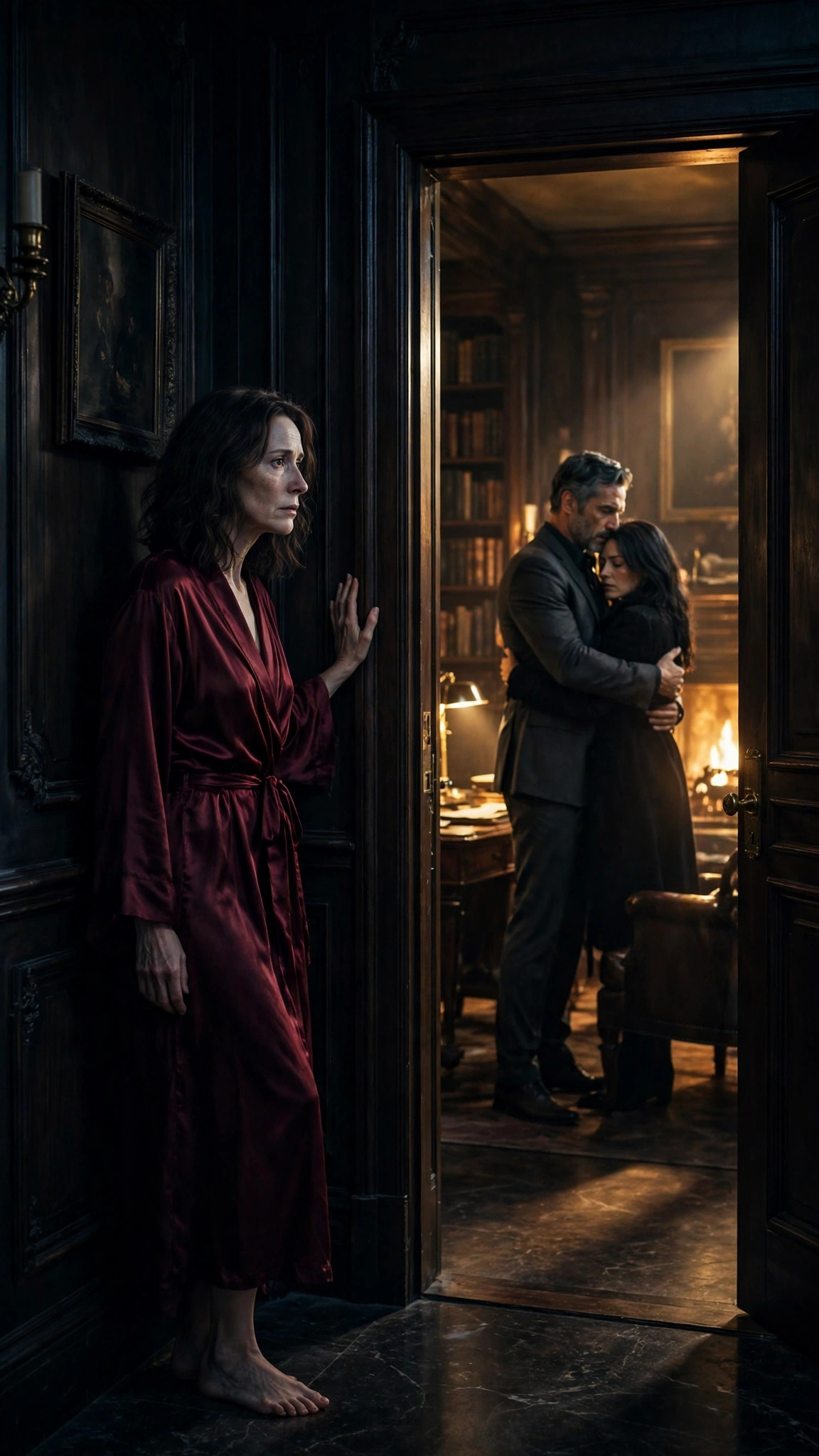
Elena would come downstairs in her robe, her hair loose, her face pale, and she would see the note on the nightstand, and she would read the five words, and she would understand what she had done, and she would say nothing, because there was nothing to say that would make it better.
And Adrian would sit on our bed holding my wedding ring, and he would look at the empty side of the bed where I had slept for fifteen years, and he would ask himself the question I had been asking myself since midnight: had he lost his wife because of one second, or had he lost her a long time ago, one small silence at a time, and the kiss was only the moment she finally saw it?
I did not know the answer. I was sitting in the passenger seat of a bakery truck, watching Chicago wake up through a dirty windshield, with flour on my coat and freedom in my lungs, and I did not know the answer.
Enzo drove me to Pilsen, to a narrow street where the buildings were brick and the signs were in Spanish and English, and he parked behind a small bakery with a hand-painted sign that read SOFIA'S, and he led me up a narrow staircase at the back, and he knocked twice on a green door, and a woman opened it.
Sofia was older than Enzo by a few years, with grey in her hair and flour on her apron and eyes that missed nothing. She looked at me, standing in Rosa's too-big coat with my hair wild and my face pale, and she did not ask a single question. She simply stepped aside and said, "Come in, Claire. You're home."
The flat was small and warm. There was a kitchen with a wooden table. There was a bedroom with a narrow bed and a window that looked out over the street. There was a bathroom with a mirror, and I stood in front of that mirror for a long time, looking at the woman staring back at me.
She did not look like the wife of the most feared man in Chicago. She looked like a woman who had worked the night shift at a bakery and had flour on her hands and had just done the bravest thing she had ever done in her life. Her hair was loose. Her eyes were red. Her mouth was set in a line I did not recognize. She looked tired, and frightened, and free, all at the same time.
Sofia brought me coffee and bread, and she sat across from me at the wooden table, and she said, "Enzo told me what happened. Not everything. Just enough. You can stay here as long as you need. No one knows about this flat except family, and family doesn't talk to men like Adrian Bellandi."
"He'll find me," I said. "He has men everywhere. He has cameras and informants and people who owe him favors. He'll find me by tonight."
"Maybe," Sofia said. "But he'll have to find you first, and finding is not the same as taking. You're not his prisoner, Claire. You're his wife. And a wife can walk away."
I thought about that. I thought about the fifteen years I had spent inside walls, and the cameras, and the guards, and the coded gates, and I thought about the fact that I had never once, in all those years, considered the possibility that I could simply leave. Not because the doors were locked. Because I had locked them myself, from the inside, with love and loyalty and the belief that a marriage was a place you stayed, no matter what.
"He'll come himself," I said. "He won't send men. He'll come himself, and he'll stand in the street, and he'll look up at this window, and he'll wait. That's what he does. He waits. He is very good at waiting."
"Then let him wait," Sofia said. "You don't owe him an answer today. You don't owe him anything today. Today, you drink your coffee, and you eat your bread, and you rest. Tomorrow is tomorrow."
Enzo stood in the doorway, his cap in his hands, and he said, "I have to go back. The truck is due at the estate by seven. If I'm late, they'll notice. If they notice, they'll ask questions."
"Enzo," I said. "Thank you. If Adrian asks you—"
"If Adrian asks me," Enzo said, "I'll tell him I drove my route and I saw nothing. And it will be the truth, because I didn't see you climb into that compartment, Claire. I didn't see anything at all."
He smiled, a small, tired smile, and he left, and Sofia closed the door behind him, and the flat was quiet, and the smell of bread came up from the bakery below, and for the first time in fifteen years, I was in a room that belonged to no one but me.
But I knew this: the camera had gone dark at 4:30, and I had not touched it, and someone had wanted me out of that house badly enough to blind the most heavily guarded estate in Chicago.
And as the bakery truck carried me beyond Adrian's walls, I realized I might not have been the only person waiting for an opportunity to get me out of that house.