Three nights before everything ended, Adrian told me Elena was in danger.
We were in the dining room, and the rain was coming down outside the tall windows in sheets, and the candles on the table were burning low. Dinner had been quiet. Adrian had barely touched his food. He had been on the phone all afternoon, his voice low, his answers short, and when he finally put the phone down, he looked at me across the table the way a man looks at his wife when he is about to ask her for something he knows she does not want to give.
"Elena Russo is in danger," he said.
I set my fork down. "What kind of danger?"
"Her cousin's organization has fractured. There's a territory dispute. Someone has threatened her attendance at an upcoming charity gala." He said it the way he said everything about his world, flat and factual, as if danger were a weather report. "The estate is the safest place for her."
"How long?" I asked.
"Forty-eight hours."
"There's nowhere else?"
"Not somewhere I trust."
I studied his face. At forty-eight, Adrian wore control as naturally as other men wore suits. He could make armed men nervous with a look, but I had always been able to see past it. Or so I believed.
"Then bring her here," I said.
His expression shifted. "You don't have to agree because you think it's expected."
"I'm not agreeing because I'm your wife."
"Then why?"
"Because if she's truly in danger, I won't make another woman risk dying because I'm jealous of someone he loved before I existed."
He stared at me. Then he quietly thanked me.
I wish I could say I meant every word of it. I did mean it, in the moment, in the candlelight, with the rain coming down and my husband looking at me like I was the only decent thing left in his life. But there was another part of me, a smaller and meaner part, that whispered that I was inviting the past into my house and handing it a key.
Fourteen hours later, rain was hammering Chicago when Elena arrived at our estate in a black SUV.
I watched from the front window as the car came up the drive, its headlights cutting through the rain, and I watched her step out, and I watched Adrian go down the steps to meet her with an umbrella, and I watched the way he put his hand on her elbow, the way a man puts his hand on the elbow of a woman he has known for a very long time.
She was beautiful. I had expected her to be beautiful, and she was, in the way that women who have survived difficult lives are beautiful, not soft and not young, but sharp and clear, like a knife that has been kept clean. Her hair was dark and pulled back. Her coat was black and wet. Her eyes found mine the moment she stepped into the foyer, and she looked at me the way a woman looks at the wife of the man she once loved, with a mixture of gratitude and guilt and something else I could not name.
"Mrs. Bellandi," she said. "Thank you. I know what this costs you."
"Claire," I said. "And it costs me nothing. You're in danger. That's all that matters."
She smiled, but the smile did not reach her eyes. "You're kind. Adrian always said you were kind. He said it was the thing he loved most about you."
I did not know what to say to that. I showed her to the guest room instead, the blue room at the end of the east wing, with the tall windows and the view of the garden. I put fresh towels in the bathroom. I turned down the bed. I did all the small, ordinary things a woman does when a guest comes to her house, and all the while I was thinking about the photograph in the bottom drawer of Adrian's desk, and the beach I did not recognize, and the two young people grinning like the world belonged to them.
That first night, we ate dinner together, the three of us, and the conversation was careful and polite, the way conversations are when everyone at the table is avoiding the same subject. Elena talked about the charity gala, about the children's hospital, about the work she did for the foundation. Adrian talked about security, about the guards, about the new cameras on the eastern wall. I talked about the garden, about Rosa's cooking, about the rain. We were three people having three separate conversations at the same table, and the rain kept coming down outside, and the house kept holding its breath.
After dinner, Elena and Adrian went into the study, and the door closed, and I went upstairs to our bedroom, and I sat on the edge of the bed in my burgundy silk robe and listened to the house.
I told myself it was business. I told myself he was protecting her. I told myself that forty-eight hours was forty-eight hours, and then she would be gone, and the house would go back to being mine.
But I lay awake until two in the morning, listening to the murmur of their voices through the floor, and I thought about the fact that my husband was downstairs in his study with the woman he had loved before me, and the door was closed, and I was upstairs alone.
The second night was worse.
Elena came to find me in the garden room, where I was reading, and she sat down across from me with a cup of tea, and she said, "Can I ask you something, Claire?"
"Of course."
"Do you ever feel like a stranger in your own house?"
I looked at her. The question was so close to the truth of my life that for a moment I could not speak.
"Sometimes," I said finally. "The house is big. It takes a while to learn all its rooms."
She nodded, and she looked out the window at the rain, and she said, "Adrian told me you worked in a bakery. Before all this."
"I did. Night shift. Three years."
"He told me that's how he fell in love with you. He said you were the only person in Chicago who talked to him like he was an ordinary man."
I felt something twist in my chest. "He told you that?"
"He tells me things," she said, and then she stopped, and she looked down at her tea, and she said, "I'm sorry. That was the wrong thing to say."
"No," I said. "It's all right. He can have friends. He can have a past. I knew about you before you came here. I always knew."
She looked at me then, really looked at me, and I saw something in her eyes that I had not expected. Not triumph. Not guilt. Fear. Raw, undisguised fear, the kind of fear that lives in a person who has been threatened and knows the threat is real.
"Claire," she said, very quietly, "if something happens to me while I'm here, I want you to know that I never meant to come between you and Adrian. I came because I had nowhere else to go. And I stayed because he asked me to. But I would never, ever take what is yours."
I believed her. In that moment, in the garden room, with the rain coming down and her hands shaking around her teacup, I believed her completely.
That night, I slept better. I told myself the fear in her eyes was real, and the danger was real, and my jealousy was small and ugly and unworthy of the woman I had promised myself I would be.
The third night, the phone rang at eleven.
I was already in bed, reading, when I heard Adrian's voice from the study, low and sharp, and then Elena's voice, higher, frightened, and then silence, and then footsteps on the stairs, and then a knock on our bedroom door.
Adrian came in, and his face was the face he wore when the organization was in trouble, the face of a man who had just received news he did not want.
"Vitale has moved up the timeline," he said. "The gala is tomorrow night, and his men have been seen near the Russo house. Elena can't leave. Not yet. Not until it's over."
"How long?" I asked.
"I don't know. A few more days. Maybe a week."
I looked at him, and I looked at the door, and I thought about the forty-eight hours that had already become seventy-two, and I thought about the fear in Elena's eyes, and I thought about the woman I had promised myself I would be.
"Then she stays," I said.
He came to the bed, and he took my hand, and he said, "Thank you, Claire. I know what I'm asking."
"You're asking me to trust you," I said. "So trust me back. Tell me the truth. All of it. What is Vitale after?"
He was quiet for a long moment. Then he said, "Elena knows where the Russo money is. The ledger. The accounts. If Vitale gets to her, he gets the organization. If he gets the organization, he gets the docks, and the docks are everything. She is the key, Claire. That's why she's here. That's why she's in danger."
I nodded. I understood. I had spent fifteen years married to a man whose world ran on ledgers and docks and keys, and I understood that a woman who knew where the money was hidden was a woman with a target on her back.
"Then she stays," I said again. "And we keep her safe. That's what this house is for."
He kissed my forehead, and he went back downstairs, and I lay awake for a long time, listening to the rain, listening to the house, listening to the murmur of voices from the study below, and I told myself that I was doing the right thing, and I told myself that trust was a choice you made every day, and I told myself that I had made it.
On the afternoon of the third day, Elena came to my room, and she closed the door behind her, and she held out her phone with both hands, the way a person holds something that might explode.
"Look," she said.
On the screen was a photograph of the charity gala venue, the grand ballroom with its chandeliers and its white tablecloths, and across the photograph, in red letters, someone had written: SHE WILL NOT LEAVE ALIVE.
"It came this morning," Elena said. Her voice was steady, but her hands were shaking. "Anonymous number. Adrian traced it. It bounced through six countries and died in a dead server in Prague. He says it's Vitale. He says Vitale wants me to know that the gala is his stage, and I am his performance."
I looked at the photograph for a long time. The ballroom looked so ordinary. So bright and clean and civilized. It was hard to believe that someone could look at a room full of chandeliers and see a killing ground.
"Have you told Adrian?" I asked.
"He's the one who showed it to me," she said. "He found it first. He checks my phone every morning. He checks everything. He has doubled the guards. He has men on the roof now. He has men at every gate." She laughed, a short, broken sound. "Your husband is very thorough, Claire. I have never felt so protected in my life. And I have never felt so afraid."
I took her hand. Her fingers were cold. "You're safe here," I told her. "This house has cameras and motion sensors and armed guards and coded gates. No one gets in here without Adrian knowing."
"I know," she said. "That's what frightens me. If Vitale wants me badly enough to send that photograph, then he wants me badly enough to try. And if he tries, then this house stops being a house, and it becomes a battlefield. And you will be in the middle of it."
"Then I'll be in the middle of it," I said. "I chose this life, Elena. Fifteen years ago, I married a man who builds fortresses. I knew what I was choosing."
She looked at me, and her eyes filled with tears, and she said, "You are braver than I am. I ran from my life. You stayed in yours."
After she left, I went downstairs and found Rosa in the kitchen, and I told her about the photograph, and she crossed herself, and she said, "Men like Vitale don't send warnings, Claire. They send warnings when they want you to be afraid. Fear makes people make mistakes. Don't be afraid. Be ready."
"Ready for what?" I asked.
"For whatever comes through that gate," she said. "And for whatever is already inside it."
I did not understand what she meant, not then. I thought she was talking about Vitale's men. I thought she was talking about the guards and the cameras and the gates. It was only much later that I understood she had been talking about something else entirely, something that had already crossed the threshold of my house and was sitting at my dinner table, drinking my wine, and waiting.
That evening, Adrian doubled the guards himself. I watched from the window as he walked the perimeter with Nico Ferrante, the night-shift guard captain, pointing at the eastern wall, at the service entrance, at the delivery gate, his voice too low for me to hear. Nico nodded, and he wrote something in a small notebook, and Adrian clapped him on the shoulder, and I thought about how much my husband trusted his men, how completely he believed that the walls he had built would hold.
I should have been reassured. Instead, I felt cold. Because I had spent fifteen years watching Adrian build his fortress, and I knew something he seemed to have forgotten: a fortress is only as strong as the people inside it. And there were now three people inside this fortress, and one of them was a woman with a target on her back, and one of them was a man who had loved her twenty years ago, and one of them was me, standing at the window, watching my husband trust the walls.
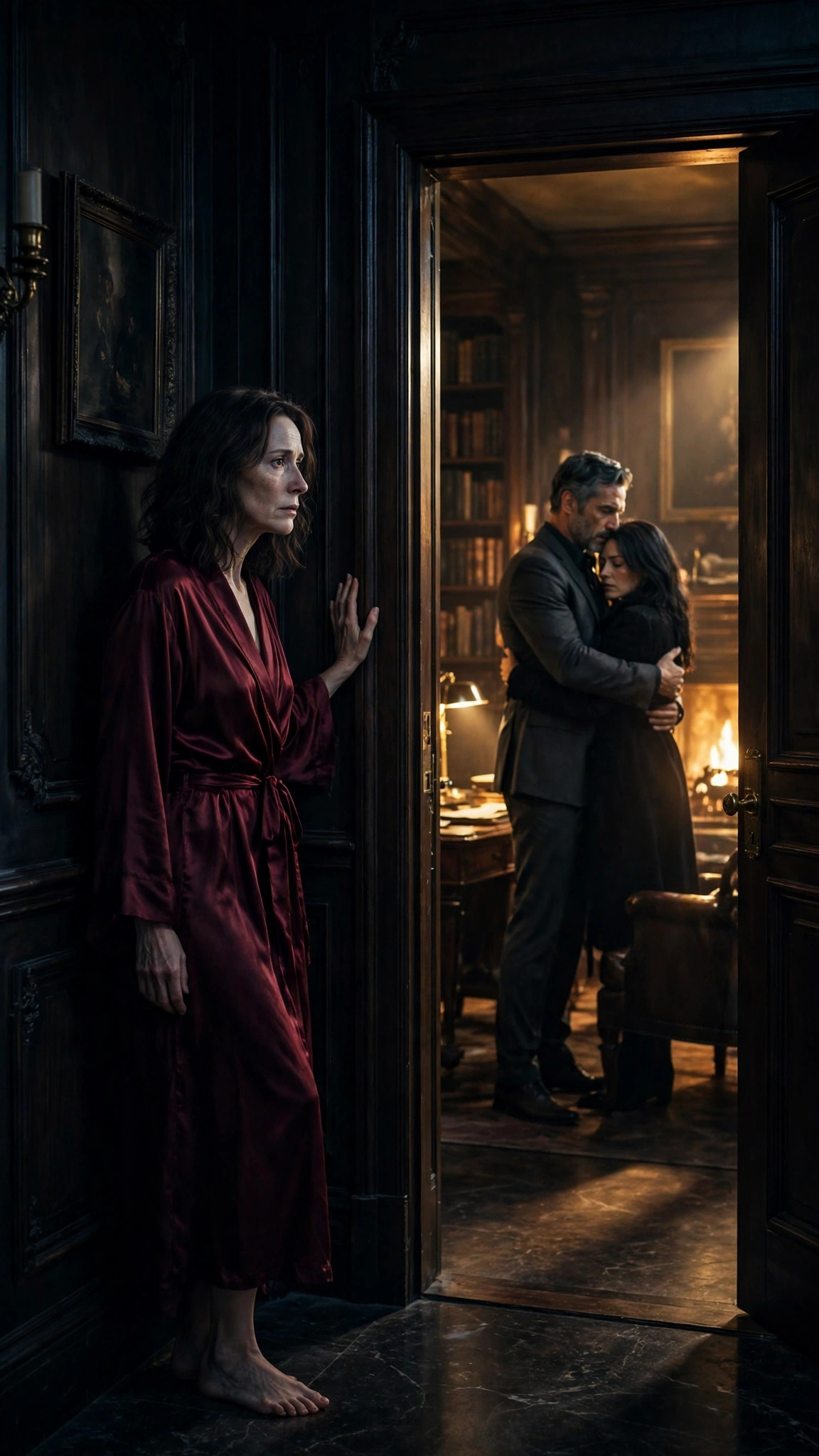
At midnight, I could not sleep. The bed was too warm. The room was too quiet. The robe felt too tight around my throat. I got up, barefoot, and I walked to the door, and I stood in the hallway, and I told myself I was only going to get a glass of water.
But my feet did not take me to the kitchen. My feet took me to the study, and the study door was half open, and the light was on, and I heard Elena's voice, soft and low, and then Adrian's voice, answering her, and I stopped outside the door with my hand pressed flat against the wall, and I looked in.
Elena's hand rested against his cheek. His arm circled her waist. Then she kissed him.
For one terrible second, Adrian kissed her back.
That second was enough.