The hospital room was white and quiet, and the only sound was the steady beeping of the monitor beside my bed, a small, regular rhythm that meant my baby's heart was still beating, that the tiny life inside me was still holding on, that there was still something left to fight for.
I lay in that bed for two days, staring at the ceiling, while the doctors came and went with their charts and their careful voices, telling me the baby had survived the impact but that I had suffered a partial placental abruption, telling me I needed strict bed rest, telling me I needed to stay calm, telling me that stress could make everything worse.
Stay calm. As if calm were something I could choose, as if I could simply decide not to feel the pain in my stomach and the pain in my heart, as if I could lie in a hospital bed and pretend my husband had not walked out of my mother's house with another woman while I was bleeding.
My mother never left my side. She slept in the chair beside my bed, her coat folded over her like a blanket, and she held my hand when the pain came, and she talked to me in the soft, steady voice she had used when I was a little girl and afraid of the dark.
"You are going to be all right, Claire," she said. "The baby is going to be all right. We have survived worse than this. We survived your father leaving. We survived being poor. We survived every hard thing this world threw at us, and we are going to survive this too."
"How?" I whispered. "How do I survive a husband who chose another woman over his wife and his baby?"
"You survive it the same way we survived everything else," she said. "One day at a time. One breath at a time. And you remember that you are not alone. You have me. You have this baby. And that is enough."
But it did not feel like enough. It felt like nothing. It felt like the whole world had gone quiet and empty, and I was lying in a white room with a monitor beeping beside me, and the man I loved most in the world had not even called to ask if I was alive.
Two days later, he called. Not to ask whether I was alive. Not to ask why I had been doubled over in pain. He only said, "There's an important Moretti family gathering. Be there on time, and don't embarrass me."
I said nothing. I let the silence sit between us on the phone line, and I thought about the little white box with the baby shoes, still sitting on my mother's kitchen table, and I thought about the dinner I had planned, and the surprise I had wanted to give him, and the baby he did not know existed, and I realized something with a clarity that was almost peaceful.
He did not deserve to know. Not like this. Not from a hospital bed, not from a phone call, not from a woman he had humiliated in front of his first love. If he was ever going to understand what he had done, he was going to have to understand it on his own, without me handing him the answer.
I ended the call. I put the phone down on the bedside table, and I looked at my mother, and I said, "Mom, I need you to take me home. Not to Alexander's apartment. To your house. I need to pack a bag, and I need to leave, and I need you to come with me."
She did not argue. She did not ask questions. She simply nodded, and she helped me sit up, and she helped me into my clothes, and she signed the discharge papers against the doctor's advice, promising we would go straight to another hospital if anything went wrong, and she drove me home in the dark, with one hand on the wheel and one hand holding mine.
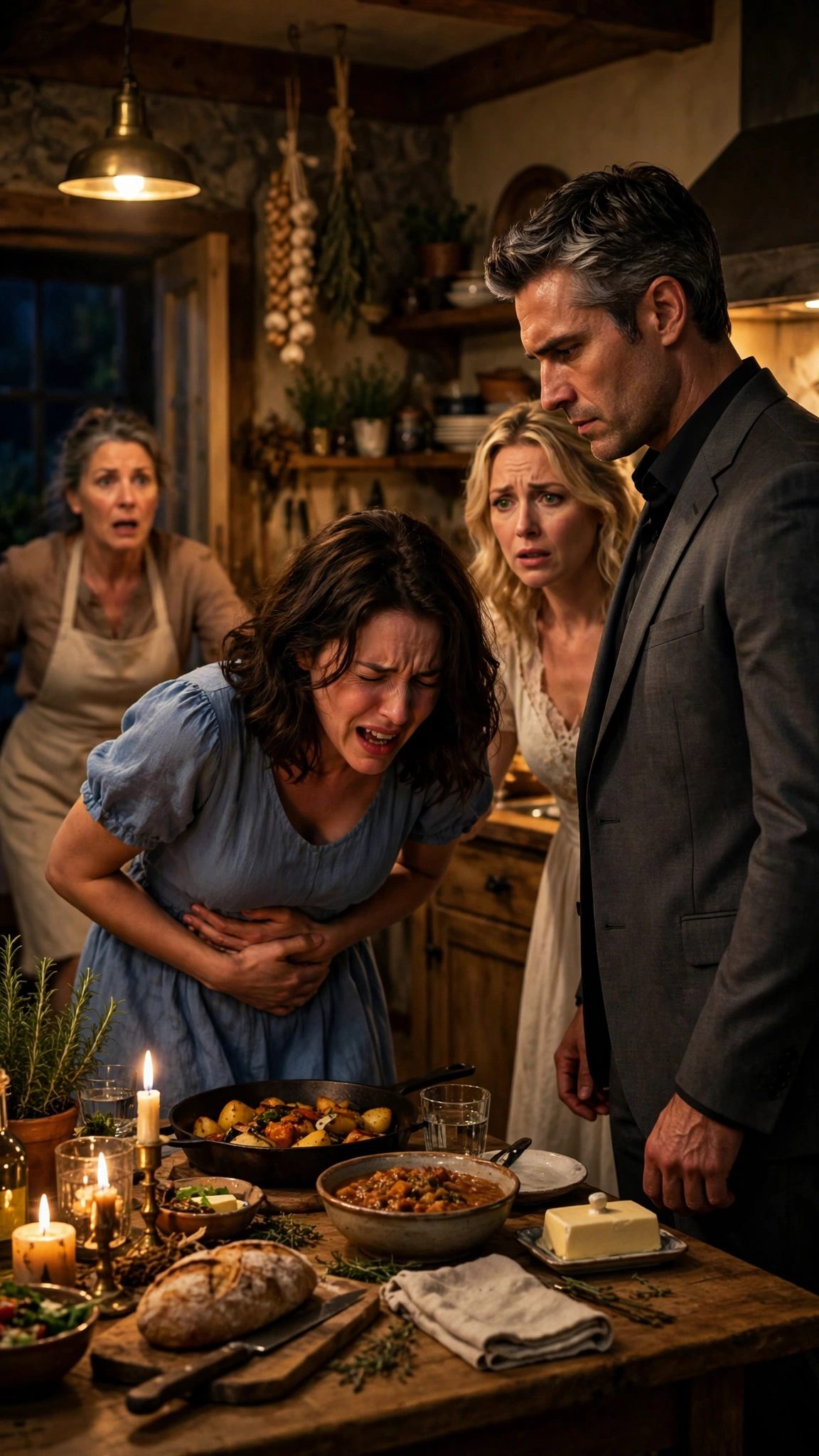
We went to her house first. The lights were off. The table was still set from the dinner that had ended in disaster, the plates still sitting where we had left them, my mother's good tablecloth still stained with the food Alexander had thrown away. The little white box with the baby shoes was still sitting on the counter where I had left it, waiting for a moment that would never come.
I picked it up. I held it in my hands for a long moment, and then I put it in my bag, because the baby shoes belonged to me and to my baby, not to Alexander, not to Sophia, not to anyone who had not earned the right to see them.
Then I took out a small recorder, the kind I used to use when I was in college to record lectures, and I sat down at my mother's table, and I pressed the record button, and I spoke to my husband for what I believed would be the last time.
"Alexander," I said, and my voice was steady, even though my hands were shaking. "By the time you hear this, I will be gone. I am not going to tell you where I am going, and I am not going to ask you to find me. I am going to tell you the truth, because you deserve to hear it, even if you do not deserve to hear it from me."
I told him about the pregnancy. I told him I had found out four days before the dinner, and that I had planned the dinner to surprise him, and that my mother had spent all day cooking, and that I had imagined his face when I told him we were going to be parents. I told him about the baby shoes, and the little white box, and the moment I had dreamed about for four days.
"I was eight weeks pregnant, Alexander," I said. "I was carrying our first child. And when Sophia shoved me into that table, I thought I was going to lose the baby. I thought I was going to lose everything. And you looked at her first. You asked her if she was okay. You walked out with her while your wife was bleeding on the floor."
I told him about the hospital. I told him about the doctors, and the monitor, and the words they had used, and the fear I had felt lying in that white room, wondering if my baby's heart would keep beating.
"The baby survived," I said. "The doctors say she might be all right, if I rest, if I stay calm, if I take care of myself. But I cannot take care of myself in a house where my husband chooses another woman over me. I cannot raise a child in a home where her father throws her grandmother's cooking into the trash. I cannot stay with a man who knows the deepest wound in my heart and uses it against me in front of the woman who has spent five years trying to destroy our marriage."
I paused. I took a breath. I looked at the recorder in my hands, at the small red light blinking in the dark kitchen, and I said the words I had been carrying inside me since I was ten years old.
"You saved my future once, Alexander. You paid my tuition. You bought my textbooks. You fixed my mother's roof. You gave me a life I could never have built on my own, and I will always be grateful for that. But gratitude is not the same as love, and a man can be good to you in a hundred ways and still fail you in the one way that matters most. You failed me. You failed our baby. And I cannot stay and wait for you to fail us again."
I told him I loved him. I told him I would always love the man he had been in college, the man who had carried my textbooks and brought me coffee at midnight and looked at my mother like she was someone worth respecting. But I told him that man was gone, and the man who had replaced him was someone I did not know, and someone I could not trust with my child.
"Goodbye, Alexander," I said. "This recorder is the last thing I am leaving you. I hope you listen to it. I hope you hear me. And I hope that one day, you understand what you lost."
I stopped the recording. I put the recorder on the table, in the center of the good tablecloth, where he would not be able to miss it. I attached a note to it, written in my careful handwriting, in the script my mother had taught me when I was a little girl.
For Alexander Moretti.
Then I packed a bag, and my mother packed a bag, and we left the house in the dark, and we drove to a small cottage on Lake Geneva that had belonged to my mother's late sister, a place where no one would think to look for us, a place where I could rest and heal and decide what came next.
When I didn't appear at the family gathering, Alexander sent his men to my mother's house. They found it empty. The lights were off. The table was still set. Then they discovered I had been hospitalized because of pregnancy complications.
"Pregnancy?" Alexander demanded, and his man hesitated before he answered, the way men hesitate before they tell a powerful man something he does not want to hear.
"Mrs. Moretti is pregnant, boss."
That was when everything came back to him. The shove. My hands over my stomach. My mother screaming. The dinner I had arranged. He finally understood why I had invited him there. I had been trying to tell him we were having our first child.
His men searched the empty house again. This time, they found the small recorder on the table. A note was attached.
For Alexander Moretti.
When he pressed play, my voice filled the room. And for the first time in five years, the man who believed he could control everything realized he might never hear me speak to him in person again.
He listened to the whole recording twice. His men told me later that he sat at my mother's table for a long time after it ended, with his head in his hands, not speaking, not moving, like a man who had just been told that the world he thought he lived in had never existed at all.
And then he stood up, and he walked out of the house, and he went to find Sophia Reynolds, and what he did next changed everything.
We drove north in the dark, my mother at the wheel, the highway empty except for the occasional truck, the headlights cutting through the night like two small lanterns. I lay in the back seat with a blanket over me, my hand on my stomach, feeling the baby move, or imagining that I felt her move, and I thought about the life I was leaving behind, and the life I was driving toward, and I did not know which one scared me more.
My mother talked as she drove, the way she always talked when she was afraid, telling me stories about her sister Anne, about the summers we had spent at the cottage when I was a little girl, about the garden Anne had planted, about the dock where we had sat with our feet in the water, watching the sun go down over the lake.
"Anne always said that cottage was the safest place in the world," my mother said. "She said that when the world got too loud, you went to the lake, and you sat on the porch, and you listened to the water, and you remembered who you were. I think she was right. I think that is exactly what we need right now."
We arrived just before dawn. The cottage was small and white, with blue shutters and a porch that faced the water, and a garden that had gone wild since Anne died, roses growing over the fence, lavender spilling onto the path. My mother unlocked the door, and we went inside, and the air smelled of dust and old wood and lake water, and I stood in the doorway, and I felt something in my chest loosen for the first time in days.
"This is where we are going to heal," my mother said, and she said it like a promise, like a vow, like a woman who had decided that nothing else mattered except keeping her daughter and her grandchild safe.
She made up the small bedroom at the back of the cottage, the one with the white curtains and the view of the lake, and she helped me into bed, and she tucked the blankets around me the way she had tucked them around me when I was a little girl, and she sat beside me until I fell asleep, holding my hand, humming the lullaby she had sung to me when I was a baby.
I slept for twelve hours. When I woke up, the sun was coming through the white curtains, and the lake was glittering outside the window, and my mother was in the kitchen making soup, and for a moment, just a moment, I felt peaceful.
The hospital called that afternoon to check on me. A nurse named Grace, the same nurse who had sat beside my bed, asked how I was feeling, and I told her the truth, that I was scared, that I was angry, that I did not know what came next.
"Rest," she said. "That is your only job right now. Rest, and eat, and let your mother take care of you. The baby is strong. You are strong. And whatever comes next, you will handle it, because that is what you do, Claire. You handle it."
I did rest. I lay in that small bedroom with the white curtains, and I watched the lake, and I felt the baby move, a real flutter this time, unmistakable, like a tiny fish swimming in my stomach, and I put my hand over the place where she was, and I whispered, "I'm here, little one. I'm here. Your grandmother is here. We are going to be all right."
My mother cooked for me, and she read to me, and she sat on the porch with me in the evenings, and she told me stories about her own mother, about the women in our family who had survived hard things, about the strength that ran in our blood like a river, quiet and deep and impossible to stop.
"Your grandmother survived the war," she told me one night, as we sat watching the sun go down over the lake. "She survived losing her husband young. She survived raising three children on her own. And she always said the same thing: a woman who knows her own worth can survive anything, because no one can take away what she knows about herself. Remember that, Claire. Remember who you are."
I remembered. I remembered the girl who had worked two jobs to stay in college. I remembered the woman who had married a man she loved and built a life with him. I remembered the mother who was carrying a baby she would protect with everything she had. And I knew, lying in that small bedroom with the white curtains, that whatever came next, I was going to be all right. Not because someone came to save me, but because I was going to save myself.